To avoid these ads, REGISTER NOW!

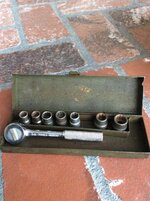
My Small But Growing 1/4" drive Socket Set Collection

To avoid these ads, REGISTER NOW!

d42jeep

Well-known member
Joined
Oct 22, 2014
Messages
16,532
Location
Northern California
I believe that I’m the person that posted the picture of the Plomb small crossbar with the groove. That picture was provided to me by another collector. Other than that picture, I would say that they don’t exist. My only original Plomb crossbar does NOT have the groove and none of my 1/4” drive Plomb handles have the balls, so I’m saying no on 1/4” drive Plomb. I can’t say for sure about conventionally numbered 9/32“ drive Plomb (non WF) handles. I don’t even know where the one I used to have went. My WF knowledge is nil.
-DonD8BAD4C7-57B9-44F6-9BAB-CDA7A6967FE3.jpeg0DDC3016-1EF9-42A8-9B64-A95BE351BB46.jpeg
 
Last edited:

Oldtuleguy

Well-known member
Joined
Nov 4, 2017
Messages
10,459
Wf yes, 4766 no. My early snap on 9/32 no, williams 9/32 yes, armstrong yes, herbrand no.

*note* snap on had 2 models, m10b and m10d, both available at same time. M10b had no detent in crossbar hole, m10d did.
 
Last edited:

Farmer J.

Well-known member
Joined
Sep 18, 2016
Messages
1,995
Location
UK, Cornwall/Hertfordshire.
Well, I knew this would be like herding cats, but I didn't think it would be like herding cats right out of the gate by two guys who are normally very good at following directions!! :)


Thanks, J, and cool set (I have a very similar Super Chrome ATHOL set made by Heath & Pond, see post #616) but it also has no hinge handle whatsoever, and if there is no hinge handle, it's outside the parameters of my interest.


And some crossbars also just have a little pinch in the bar on one end, which also creates a stop, preventing it from sliding out in that direction. But none of the crossbars in the interchangeable era are captive (two balls, two pinches) and crossbars with one detent ball or one pinch can fall out the other way.

However, I am not interested in an exhaustive list of 'Ways in which Mfgrs Kept Crossbars in a Crossdrilled Hinge Handle holes.'

I'm only interested in answering this question: Which Mfgrs put spring-loaded detent balls in the crossbar holes of their midget drive hinge handles? I suppose I could've just asked it like that, but open-ended question usually prompt vague results.

Thanks for your input. I edited the running list in post #1,469.

Beware, :evil: , this project brings this quote to mind.. ha ha.. :D

everything-that-can-be-counted-does-not-count.jpg
 

Private Lugnutz

Well-known member
Joined
Mar 30, 2012
Messages
30,554
Location
The Authentic Jersey Shore
Wf yes, 4766 no. My early snap on 9/32 no, williams 9/32 yes, armstrong yes, herbrand no
Thank you! That is VERY helpful.

How early do you think your Snap-on M-10 is without the detent ball? Prewar, right? Is it chromed? Is it date coded? That has very interesting ramifications on this survey and also especially my original observation and the original and continuing discussion on the Snap-on thread. THAT I would like to see a photo of, please, because it is different from my M-10 with a detent ball. Attached below.
I've never seen any Indestro brand breaker (2850) with any detent ball in the handle (and I have quite a few of them.)
Thanks.
 

Attachments

  • 20211114_070521.jpg
    20211114_070521.jpg
    265.8 KB · Views: 23
  • 20211114_071825.jpg
    20211114_071825.jpg
    145.5 KB · Views: 22
  • 20211114_070801.jpg
    20211114_070801.jpg
    127.3 KB · Views: 15
Last edited:

Private Lugnutz

Well-known member
Joined
Mar 30, 2012
Messages
30,554
Location
The Authentic Jersey Shore
Beware, :evil: , this project brings this quote to mind.. ha ha
Sorry, but I'm not following you on Einstein's caution, J, as it relates to empirical surveys, many of which I have conducted before, in general, or on my insistence on constraining this one to my focused purpose, which is just common best survey practices. EDIT: But if you want to start a broader one on other crossbar retention techniques, or on sets without hinge handles, I would support you! :)
 
Last edited:

Oldtuleguy

Well-known member
Joined
Nov 4, 2017
Messages
10,459
I have 3 m10-b breakers, all chrome, 40 to 42. Smaller pin hole, no detent ball.20211114_080720.jpg20211114_080541.jpg20211114_080703.jpg
 
Last edited:

Farmer J.

Well-known member
Joined
Sep 18, 2016
Messages
1,995
Location
UK, Cornwall/Hertfordshire.
Sorry, but I'm not following you on Einstein's caution, J, as it relates to empirical surveys, many of which I have conducted before, in general, or on my insistence on constraining this one to my focused purpose, which is just common best survey practices. EDIT: But if you want to start a broader one on other crossbar retention techniques, or on sets without hinge handles, I would support you! :)
I was just trying an attempt at a joke Lugz.. I often find the humour of Einstein amusing and somehow comforting.. :) I'm not good at constrained thought or focus..... It seemed that you may get a load of information of no use to you, (already some of that from me) and also not get some which you really require for your survey!
Always the greatest respect for your techniques and practices, which result in solid knowledge.
I normally only manage to form opinions and theories, which i have to constantly revise in the light of new information!
I did actually consider doing a thread on the wider issue of the varied methods of crossbar retention, but ran out of steam before starting.. After looking at my Ferret sliding bar which has a retention ball in the hole, a central groove in the bar and also a detent ball on both ends of it.... I get a short way along the train of thought then give up and just seek comfort in the thought 'one day years ago somebody made something and it got changed around.. whatever... some of it was good... '
 

d42jeep

Well-known member
Joined
Oct 22, 2014
Messages
16,532
Location
Northern California
Here is a repack Plomb 9/32” drive bar and crossbar. I assume that it is marked WF. It has the detent on the opposite side of the hole from snap-on and a smooth crossbar. The crossbar is the same diameter as the Snap-on crossbars.
-Don56F99FE5-810C-456B-AC0A-42BEEA5337FB.jpeg907B081E-036A-4E5E-A9A6-B72B22A8B3F8.jpeg
 

Private Lugnutz

Well-known member
Joined
Mar 30, 2012
Messages
30,554
Location
The Authentic Jersey Shore
It has the detent on the opposite side of the hole from snap-on...
Yes, as I noted in my list here...
Plomb WF-7 (9/32) - YES - bottom of hole
What Plomb did was forge it, mill it from the end above the crossdrilled hole, just like SO, but then mill below the crossdrilled hole and seat the spring and ball inside that. It remains open at the end, ostensibly to access the ball and spring, in case of repair or replacement, but practically, probably just because it was more economical.

Armstrong used the same technique. I'm guessing Williams, too.
 
Last edited:

Private Lugnutz

Well-known member
Joined
Mar 30, 2012
Messages
30,554
Location
The Authentic Jersey Shore
Would someone with a prewar and/or wartime Williams NM-42 (1/4-dr) and Blackhawk 24999 (1/4-dr) hinge handle please check to see if there is a detent ball. Thanks. Survey not exhaustive by any means but those are two major stragglers with serious ramifications. 1943 Blackhawk catalog indicates detent. 1943 Williams catalog does not include anything one way or another in the text.
 
Last edited:
To avoid these ads, REGISTER NOW!

Oldtuleguy

Well-known member
Joined
Nov 4, 2017
Messages
10,459
It is not odd, because they did not come in the sets! If they made one in the 40s I have not seen it
 

Private Lugnutz

Well-known member
Joined
Mar 30, 2012
Messages
30,554
Location
The Authentic Jersey Shore
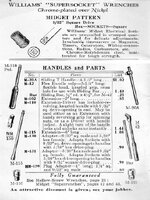
They switched from 9/32-drive to 1/4-drive in 1941. The 1939 catalog (see excerpt in Pic ), showing and describing a 9/32-drive M-42 hinge handle with a cross-drilled hole and a bar that goes with it, does not describe a detent ball, but we know empirically that it had one. The 1941 catalog (see excerpt in Pic 2) is the exact same approach, except that it's now an NM-42 hinge handle and bar, in 1/4-inch drive. The 1943 and 1945 catalogs were exactly the same as the 1941, except for the WPB L-216 notices. My inkling would be they included a detent ball just on precedence in 1941, but we don't have an example. And OTG is correct. Williams apparently never considered the hinge handle an essential standard tool. It is never included in any of the multiple midget sets they offered in 1939, 1941, 1943, or 1945 catalogs. You had to buy it extra.
 

Attachments

  • Williams 1939 cat excerpt 2.jpg
    Williams 1939 cat excerpt 2.jpg
    184.1 KB · Views: 21
  • Williams 1941 cat excerpt 2.jpg
    Williams 1941 cat excerpt 2.jpg
    134.8 KB · Views: 16
OP
F

four.cycle

Well-known member
Joined
Oct 19, 2015
Messages
28,793
Location
Tacoma, Washington
wait.....
"Previously 9/32" square drive --- now obsolete"
in 1941?
Were there not several other manufacturers of hand tools still making 9/32" well into the 1940s?

(I know that has nothing to do with what you're asking about, but it definitely causes me to raise an eyebrow.)
 
OP
F

four.cycle

Well-known member
Joined
Oct 19, 2015
Messages
28,793
Location
Tacoma, Washington
ahhh... okay... maybe it's just how I'm interpreting that line... as in "Williams is boss and we can unilaterally determine what is and what is not obsolete." ;)
 

d42jeep

Well-known member
Joined
Oct 22, 2014
Messages
16,532
Location
Northern California
Since I had them out, I checked some 1/4” drive Craftsman BE bars and a Circle H bar just to rule them out. No detents to be seen.
-Don5A81B3CA-B5C2-489D-8574-2BD639754BC9.jpeg99CA3199-3E37-48A8-97E4-7E1926B49D0E.jpeg
 
Last edited:

Oldtuleguy

Well-known member
Joined
Nov 4, 2017
Messages
10,459
These 40s blackhawk extensions and pin handle have them
20211115_210232.jpg
 

Attachments

  • 20211115_210201.jpg
    20211115_210201.jpg
    181.1 KB · Views: 12
  • 20211115_210157.jpg
    20211115_210157.jpg
    123.6 KB · Views: 9
  • 20211115_210101.jpg
    20211115_210101.jpg
    223.1 KB · Views: 11
  • 20211115_210022.jpg
    20211115_210022.jpg
    124.9 KB · Views: 11
  • 20211115_210019.jpg
    20211115_210019.jpg
    174.3 KB · Views: 13

LesserSon

Well-known member
Joined
Feb 7, 2016
Messages
5,058
Location
PA USA
Lugz, is this the Midget thread you mentioned moving the conversation to, from the Snappy thread?
I don’t think it’s possible to quote your post from that thread to this (I believe the underlying HTML code uses relative address versus absolute address), so my response here will appear non sequitur. Also, I do not intend to and am unable respond to the entirety of your post: the nature of the point I was making is limited to criticizing the use of “cost” (and implication of profit motivation) in the preceding conversation. This is not a criticism of your personal posts, but the use among the participants in the discussion.
Perhaps most importantly for understanding my point: I do not propose any pet theory - why/why not - of my own, only to suggest that attributing motivations to the catch-all of money precludes investigating specific causitive factors.
In short, cost/profit/laziness is a dependant variable, whereas available time, labor, equipment and material are independent variables, each of which may be the actual reason why the 1/4dr has no detent, OR why the 9/32dr does have a detent (as was pointed out, those are two different questions). Linear programing can be used to calculate a product mix of 1/4dr and 9/32dr hinge handles which optimizes for expediency, profit, cost-savings, etc, but I bet the contracts were bid and signed with a less cerebral approach. There may, in fact, be other reasons why, that have nothing to do with manufacturing concerns (as I think you are considering, ie customer specs).
As far as “the War demanded urgency,” I am making NO claim that urgency affected 1/4dr and 9/32dr handles separately. The limited nature of available resources dictates that production of BOTH products are affected. Reasonable assumptions about those resources seem to me to suggest that many more detent-less (1/4dr, as far as we know) tools could be produced by a given deadline, than detent-bearing (9/32dr) tools, but as long as BOTH products were manufatured in a given period, the total number produced of each was significantly reduced from the maximum possible separately. In my little exposure to such things, the surprising revelation to me was how MUCH each product line can be affected by the other.
 
Last edited:

d42jeep

Well-known member
Joined
Oct 22, 2014
Messages
16,532
Location
Northern California
These 40s blackhawk extensions and pin handle have them

20211115_210232.jpg
As I am unfamiliar with Blackhawk of that vintage, are those 1/4” drive? Did Blackhawk offer 9/32” drive at some point?
LS, you can just copy and paste a quote from one thread to another.
-Don
 
Last edited:

Private Lugnutz

Well-known member
Joined
Mar 30, 2012
Messages
30,554
Location
The Authentic Jersey Shore
Lugz, is this the Midget thread you mentioned moving the conversation to, from the Snappy thread?
Yes. Thanks.
In short, cost/profit/laziness is a dependant variable, whereas available time, labor, equipment and material are independent variables, each of which may be the actual reason why the 1/4dr has no detent, OR why the 9/32dr does have a detent (as was pointed out, those are two different questions). Linear programing can be used to calculate a product mix of 1/4dr and 9/32dr hinge handles which optimizes for expediency, profit, cost-savings, etc,
In a purely commercial context, in which the manufacturer has control over all variables and the product, as a purely mathematical cost-benefit exercise, of course I agree. And I appreciate your expertise in that. But the context - what started this whole expanded excursion over here on this thread from the Snappy thread, was the fact that Snap-on was making hinge handles with and without detent balls, at the same time, during WWII, for military customers. That's why all those factors are anything but irrelevant. Hence my reply.
There may, in fact, be other reasons why, that have nothing to do with manufacturing concerns (as I think you are considering, ie customer specs).
I am still looking into it, but the results of the survey (#1469, page 37) and the conclusions I had already drawn from it and summarized on the Snap-on thread, prior to your reply about manufacturing optimization and wartime urgency, already eliminate the idea that cost-savings and faster schedule had anything to do with this particular case.

What the survey has already helped show is that Snap-on was not even making midget hinge handles with a spring-loaded detent ball prior to WWII. Provisioning their long-standing product with a spring-loaded detent ball, therefore, was indeed very likely a customer (USAAF) spec. More importantly as it relates to your manufacturing optimization point, a point many others made in so many other words, provisioning their product with a spring-loaded detent ball would clearly have an additional cost in materials, resources (machines and labor), and time. In other words, it sure looks to me like the USAAF prioritized securing the crossbar over cost and time.

Plomb, who was also a major USAAF supplier, was also not making any hinge handles with a spring-loaded detent ball before WWII. They were not making 9/32-drive hinge handles at all, in fact, but I think it's reasonable to conclude that making them with a spring-loaded detent ball would be slightly more costly in time and materials than making their long-standing product - a 1/4-drive hinge handle without a detent ball. Again, within the context of WWII, that sure lends credence to the notion that the spring-loaded detent balls were a USAAF thing, and that they considered it more important than a slight cost increase and delay. Hence my reply about war urgency, certainly an undercurrent in everything, not being a monolithic policy.

The survey is showing that the vast majority of mfgrs were making hinge handles without spring-loaded detent balls. Hence my point about wartime 1/4-inch hinge handles without spring-loaded detent balls obviously not being the result of the War Machine demanding cost-savings and urgency out of its midget socket wrench suppliers.

In short, in most cases, there weren't many pesky (what was J's word? oh yes, fiddly) little spring-loaded detent balls for the WPB or the contracting agencies of the various technical services (Ordnance Dept, USAAF, etc) to ask manufacturers to get rid of!

The cases where there were a couple mfgrs (Blackhawk, potentially Williams) making 1/4-drive hinge handles with spring-loaded detent balls are even more damaging to the manufacturing cost and time savings theory. The US Army actually used one of them (Blackhawk) as a Specification source for one of its four midget sets. But more on that later.
As far as “the War demanded urgency,” I am making NO claim that urgency affected 1/4dr and 9/32dr handles separately. The limited nature of available resources dictates that production of BOTH products are affected. Reasonable assumptions about those resources seem to me to suggest that many more detent-less (1/4dr, as far as we know) tools could be produced by a given deadline, than detent-bearing (9/32dr) tools, but as long as BOTH products were manufatured in a given period, the total number produced of each was significantly reduced from the maximum possible separately.
See reply just above.
 

Private Lugnutz

Well-known member
Joined
Mar 30, 2012
Messages
30,554
Location
The Authentic Jersey Shore
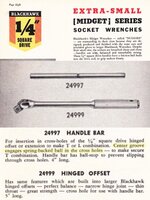
Here's an excerpt from the 1939 Blackhawk catalog. It's not clear that the figure to the right showing a spring-loaded detent ball in the upper part of the cross-drilled hole applies to ALL the hinge handles listed.


Blackhawk 1939 cat excerpt.jpg

But OTG's examples and this excerpt from the 1943 Blackhawk catalog makes it unmistakable. (You'll be especially interested in the highlight, Don.)

Blackhawk 1943 cat excerpt.jpg
 

d42jeep

Well-known member
Joined
Oct 22, 2014
Messages
16,532
Location
Northern California
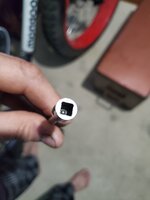
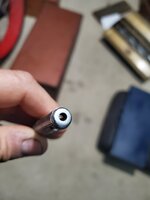
Has anyone checked a P&C handle? Likely the same as conventional Plomb. I would like to see inside the crossbar hole of this one that I finally found a picture of. I believe that it may currently reside in Texas.
-Don

2C1B83C2-45D3-4424-B3A4-97ED3C8115AF.jpeg
 

Private Lugnutz

Well-known member
Joined
Mar 30, 2012
Messages
30,554
Location
The Authentic Jersey Shore
As some of you know very well, I have an original paper copy of the 1945 issue of the Army Service Forces Catalog, Ordnance Supply Catalog, ORD 5. I have cited it and used excerpts from it before here on GJ, but it's been awhile, so I'll take a little time to set some context. In essence, it is the master catalog, covering every tool in the Ordnance Dept inventory. It doesn't care about - in fact, doesn't even include - the application (vehicle, depot, etc). It is split into many, many smaller catalogs, by functional group. The ORD 5 Standard Nomenclature List (SNL) J-4, for example, covers the tools you can see described in the title (and subtitle), including all socket wrenches.

20211116_064151.jpg

Here's a page for more context and to introduce the first of three (3) major 1/4-inch drive socket sets that the Ordnance Dept issued during WWII.

ORD 5 midget 1.jpg

The Stock No. in Column 2 (those are early Treasury Dept FSN's) and the Nomenclature in Column 5 are self-explanatory, but note that the FSN is the linkage to the applications (other TM's, etc) that the ORD 5 did not care about.

Let me draw your attention to the Specification column 4. The Ordnance Dept used many sources. Those funny-looking so-called "TAXI" numbers (because they all tend to have a lot of T's and X's) at the top are an Ordnance stock number system. Those B-numbers are Ordnance Dept drawing numbers, also used as stock numbers. The other numbers are Mfgrs Codes. IDS-1234, for example, is an Indestro set. It doesn't necessarily always equate to identifying their "sole source", but in many cases, it does.

That BKM-100W - and the first of the three (3) 1/4-inch drive socket sets I am going to show here, refers to the Blackhawk 100W Master Wrench Set and Box. The Ordnance Dept was specifying their largest (100-piece) socket wrench kit - 41-W-2613-500, based on the Blackhawk 100W. More on that and its application in the next post.
 

Private Lugnutz

Well-known member
Joined
Mar 30, 2012
Messages
30,554
Location
The Authentic Jersey Shore
The 41-W-2613-500 100-piece set occupies several pages which I am not going to post, but here is an excerpt including the hinged handles, including the 1/4-drive hinged handle. As you can see, the nomenclature column does not include anything about the detent ball, nor would I really expect it to, but that's what the specification source is for, and we know from the 1943 Blackhawk catalog and OTG's examples, that it included one.

ORD 5 midget 2.jpg

This is the Blackhawk box and set being specified - also specified in TM 9-767.

Blackhawk 100W.jpg

TM9-767 is the manual for the M25 40-Ton Tank Recovery vehicle - more affectionately known during WWII as the "Dragon Wagon." The truck (M26) was made by Pacific Car & Foundry. The semi-trailer (M15) was made by Fruehauf. And every single one of them was issued (1) Blackhawk 100W Master Mechanic Kit.

Dragon Wagon.jpg
 
To avoid these ads, REGISTER NOW!
Top Bottom