To avoid these ads, REGISTER NOW!

Garage Slab Replacment

tealetm

Well-known member
Joined
Jan 21, 2020
Messages
131
Location
NY
Hi all-

I have a 20x26 two bay detached garage that needs to have the slab broken out and replaced (its beyond leveling or floating). My question is, has anybody done this before on a building where the stem walls were placed on top of the slab?

Do you sawcut the slab a few inched away from the stem wall all the way aroud, hammer out the slab/fix subgrade and then pin the new slab to the existing slab perimeter under at the walls?

Seems like sawcutting would add quite a bit of work to the project, but I can't think of another way of doing it other than jacking the whole building up which isn't going to happen.
 
To avoid these ads, REGISTER NOW!

billconner

Well-known member
Joined
Jul 20, 2021
Messages
6,963
Location
Thousand Islands NYS
Not sure best removal except I think it would break away from stem wall unless they ran reinforcing continuous. How far does stem wall go down below grade?

I'm in camp that says isolate slab on on ground from stemwalls, so it's unrestrained.
 

Leaflessshadetree

Well-known member
Joined
Aug 1, 2013
Messages
7,151
Location
Don't ask.
If it is slab on grade I'd lift the building and replace the slab.
If it does have actual footings and the perimeter is OK (flat, unbroken etc) your idea may be possible.
 

ConCretin

Well-known member
Joined
Jan 20, 2011
Messages
3,378
Location
Central Maine
If you don't want to tackle lifting the building, I don't see another way to replace the slab other than the method you describe - Cut as close to the curb as possible and replace everything inside of the cut. One potential snag might be the depth of the concrete. It's not uncommon to thicken the edges of a monolithic slab, which might make for a deep cut. I'd dig some test holes on the outside and maybe drill a few on the inside to see how much concrete you'll be dealing with.

Normally I'd agree with billconnor about pinning slab around the perimeter but in this case, I think you might want to. If you don't, your curb wall is now the sole support for the structure with it's relatively narrow bearing area. I'd be more comfortable 'reconnecting' the curb wall to the slab. I'd probably even scratch out a little extra thickness around the edge of the new slab.

Don't forget to check the base under the slab and remediate as necessary to make sure that it wasn't the reason the first slab failed.
 

Skooterj

Well-known member
Joined
Mar 11, 2021
Messages
750
Location
Indiana
If it is a monolithic slab, have one or more of the thickened edges sunk? Is the building still level? If it was all poured at once, the slab can't sink without the building sinking, unless it maybe sunk in the middle? If it has a separate footer, I would rent a concrete saw and cut out the slab. Otherwise you are going to have a very jagged edge around the building where you jackhammered out the slab.
 

billconner

Well-known member
Joined
Jul 20, 2021
Messages
6,963
Location
Thousand Islands NYS
For my solution I should have said if there is a stem wall and footer under walls...

I guessed in NY, the wall foundation was probably not the problem and frost heave inside stem wall broke up the slab in ground. A picture would help and confirming or not this is not heated.

Definitely trying to understand that slab edge under walk would help.

How old? I don't think the thickened edge slab was popular in NYS till 60s...
 
OP
T

tealetm

Well-known member
Joined
Jan 21, 2020
Messages
131
Location
NY
There is a full foundation (i'd assume 48"+ with footing), the slab was poured over the foundation wall, an 8" CMU stem wall was laid on top of the slab, and then the 2x4 framing was framed on top of the 8" CMU. So yes, the foundation wall and thus framing is fine, its the slab which has failed (presumably from frost/poor subgrade).

Lifting the whole garage off the CMU and then replace the slab and the CMU but that would just be a larger project than time and money allows at the moment.

I'll see if I can get any photos tonight- thanks.
 

billconner

Well-known member
Joined
Jul 20, 2021
Messages
6,963
Location
Thousand Islands NYS
I'd cut as close to cmu as possible, chip way as much as possible. Prepare a really good base, put isolation around perimeter, and pour new as slab.

No experience but maybe look at concrete chain saw. I have to wonder if a good chisel and small sledge wouldn't get a fairly clean cut off. All bets off if reinforced.

I would try hard to avoid any connection between new and old. Frost can move it vertically and shrinkage horizontally without restraint.

Try a foot or two and see how it goes.

My 2 cents.
 

joes169

Well-known member
Joined
Sep 19, 2011
Messages
663
Location
WI
There is a full foundation (i'd assume 48"+ with footing), the slab was poured over the foundation wall, an 8" CMU stem wall was laid on top of the slab, and then the 2x4 framing was framed on top of the 8" CMU. So yes, the foundation wall and thus framing is fine, its the slab which has failed (presumably from frost/poor subgrade).

Lifting the whole garage off the CMU and then replace the slab and the CMU but that would just be a larger project than time and money allows at the moment.

I'll see if I can get any photos tonight- thanks.

If you're confident on the full foundation, I would do as others have said and saw as closely as possible to the block and remove the floor. Actually, I did exactly this in my own shop about 15 years ago. On my shop, they laid 5 courses of 8"block and then a 4" wide half-course on top. They poured the floor at this point, flush with the top of the half course, and after curing, laid another 13 courses of 8" block, half on the floor and half on the frost wall. Here's a couple pieces of advice I can offer:

- Expect to find huge voids under the floor, mine was generally 3-4" on average under the whole floor.
- I would dowel the new concrete to the existing floor where you sawed, probably #4 (1/2") every 3' or so.
- Rent a walk behind concrete saw with water hook-up, if you're doing this yourself. It will cut faster than you probably suspect.
- Don't bother with a concrete chainsaw, I've owned a few of them over the last 15 years, and only pull one out when there's no other option.
- Lastly, but most importantly, grab a shovel and make sure that there actually is a block frost wall that extends down into the ground before going forward.
 

Skooterj

Well-known member
Joined
Mar 11, 2021
Messages
750
Location
Indiana
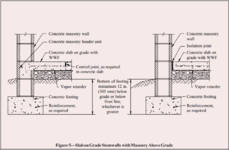
If they poured the slab on top of the below grade stem wall, then built another 1 block stem wall on top of the slab, then you will need to cut the slab before breaking it out. I have no idea why anyone would build like that though. Assuming the below grade stem wall was block, your block layer would have to come out twice, once after the footer set, then again after the slab set. Seems the most expensive option and I do not see any structural advantages.
Build the stem wall continuous from the footer to the desired height, then pour the slab inside the stem wall so it can float and flex independent of the foundation. I still want to see pictures, because if the one block is sitting on top of the slab, and the slab moved, how did the one block not move too?

I found this picture. Maybe someone can explain to me why anyone would build the one on the left?
 

Attachments

  • Slab.png
    Slab.png
    94.6 KB · Views: 55

Showkey

"MEMBER EMERITUS"
Joined
Aug 9, 2014
Messages
8,638
Location
Wausau WI
Wouldn’t a detached slab construction, with no deep frost footing, with no stem wall face the same issues ?

Lift the building or cut the slap at some point as only two viable solutions ?

E50732E2-7082-4CC3-ACB9-004FA4060712.png
 
To avoid these ads, REGISTER NOW!

Skooterj

Well-known member
Joined
Mar 11, 2021
Messages
750
Location
Indiana
Yes, any type of slab with the stem wall or the framed wall sitting on the slab where the slab heaved should throw the building out of level. Cutting through a monolithic pour would be even worse than the slab poured on top of separate footers, as the concrete could be over a foot thick at the base of the stem wall. I don't understand how if the slab heaved and the walls are sitting on the slab, the building did not heave too. Even if the slab sunk in the middle of the building, it would have pulled the walls towards the middle unless it cracked and wasn't reinforced. Cracks that separate would have little effect on the edges though.
 

billconner

Well-known member
Joined
Jul 20, 2021
Messages
6,963
Location
Thousand Islands NYS
Just on the frost heave, seems that below frost line footings and weight of building would limit destructive impact of frost, while the relatively light and thin slab could easily be broken up by heaving. For unheated buildings in freezing climate, basic reason I think the slab on ground should not be tied to or restrained by the walls. Let it shrink and float. Also easier to replace.

The diagrams with slab tied into block wall, probably fine in a climate without freezing. Not that I would do that.
 

Skooterj

Well-known member
Joined
Mar 11, 2021
Messages
750
Location
Indiana
The diagrams with slab tied into block wall, probably fine in a climate without freezing. Not that I would do that.
And your mason would either hate you because of the return trip, or love you because of his extra paycheck.
 

ConCretin

Well-known member
Joined
Jan 20, 2011
Messages
3,378
Location
Central Maine
Just a thought; are you sure the slab is poured all the way across the top of the frost wall? Can you see a construction joint between the top of the wall and the slab on the outside? The slab might just **** into the wall, which would make removal of the entire slab possible.
 

billconner

Well-known member
Joined
Jul 20, 2021
Messages
6,963
Location
Thousand Islands NYS
Well, were it me, the mason never left. DIY changes things a lot. Working solo also changes a lot. Block instead of poured stem walls. Rafters instead of trusses.

Around here the same contractor and workmen that pour concrete also lay block anyways.
 

Skooterj

Well-known member
Joined
Mar 11, 2021
Messages
750
Location
Indiana
Even if its the same crew, it has to be an extra trip. Can't put block on the slab until the slab has dried.
 

Swiftlegend

Active member
Joined
Mar 1, 2013
Messages
26
bumping this as I may be in the same situation. My slab is completely cracked and just junk. I need to put in a car hoist and I only have a 4in slab with cinder block stem wall. Normal 2 car garage.

So I have to jack the whole house and somehow pour a whole new slab??? I am in the midwest so alot of frost and snow. Next is finding a contractor worth his salt.
 

Zeke

Well-known member
Joined
Aug 13, 2009
Messages
17,176
Location
Long Beach CA, the sewer by the sea.
Even if its the same crew, it has to be an extra trip. Can't put block on the slab until the slab has dried.
Sure you can. Wet set the block. CMU fences are done that way every day. I'm not saying they did it one way or another.

I can't see the building in question but with one course block perimeter, I'd at least think about addressing the problem area and capping the whole thing with another slab with rebar set into the block.

But I'm in CA and no nothing about frost heave or why there would be a problem inside the garage.
 
Last edited:

LiketoFix

Well-known member
Joined
Dec 31, 2022
Messages
209
Location
OHIO
Hi all-

I have a 20x26 two bay detached garage that needs to have the slab broken out and replaced (its beyond leveling or floating). My question is, has anybody done this before on a building where the stem walls were placed on top of the slab?

Do you sawcut the slab a few inched away from the stem wall all the way aroud, hammer out the slab/fix subgrade and then pin the new slab to the existing slab perimeter under at the walls?

Seems like sawcutting would add quite a bit of work to the project, but I can't think of another way of doing it other than jacking the whole building up which isn't going to happen.
Done it more times in business than I care to try to remember.
Yes ! Saw cut around the perimeter a few inches away and we always made a second cut about 4-6 inches away from that so two parallel saw cuts depending on the condition of the job and work to be done as this would determine the need for the second cut. Make sure that you leave enough meat,(slab under the curb/wall), to support what your trying to save. Your saw cuts need to be completely through the slab. Diamond blade with water is the Best. We always used an Air compressor with a couple 90 lb. Jack Hammers, but years ago we also did it with 20 lb. Sledge Hammers when we we're a lot younger! Slow and easy and start away from the walls and remove what you break to relieve pressure on the next piece and don't pry against pieces that are gonna remain. Spud Bars help a lot. Did many very successful back in the Day.

LtF
 

bb29510

Well-known member
Joined
Dec 27, 2022
Messages
1,216
pour another slab beside the shop and then have mover, transfer it over, then demo the old slab
 
To avoid these ads, REGISTER NOW!
Top Bottom