Let's do this differently. Each post has this format so we know how many GW tools you have and whether you are a pro or home warrior. For example: John HW 10. John is a home warrior with 10 GW tools so far. Joe Pro 20. Joe is a professional with 20 GW tools. I am going to try to get to top 10 for HW class!


You are using an out of date browser. It may not display this or other websites correctly.
You should upgrade or use an alternative browser.
You should upgrade or use an alternative browser.
Show off your GearWrench tools!
- Thread starter qqzj
- Start date
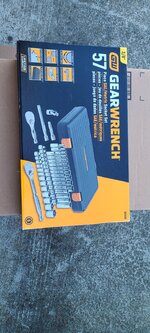


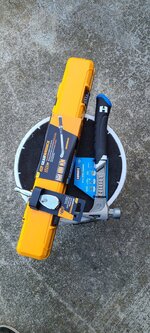
qqzj HW 6-10
That Husky serpentine belt is completely a GW tool. It is inferior to the GW serpentine belt tool because the ratchet head is not locking flexible. I measured the 'depth' of various alternatives for tools used in narrow, but long, spaces. Info here.
 www.garagejournal.com
We can see that the serpentine belt tool is only 2/3 of the depth of a low profile ratchet and socket combo (22.68mm vs. 33.69mm). And it is only 4mm thicker than a wrench with 'sleeves' on both sides (22.68mm vs 18.03mm). So it is actually can be used as a intermediate tool between ratchets and wrenches. Due to the design, it is A LOT beefier than any wrench.
I am not a fan of so called standard combination wrenches because they are 12 points. For any hex fastener, I start with 6 point sockets. If that doesn't work, I either go to low profile sockets/wrench or serpentine belt tool because they are all six points. If they still don't work, I go for tekton 6 point long double flex head wrenches, if that still don't work, I pick up my 6 point combination wrenches. A standard 12 point wrench is about the last thing I would touch. I would only use it when the space is so narrow that a serpentine belt tool won't fit, AND the space is so small that a six point ratchet wrench won't fit, AND the angel is so limited that I cannot position a 6 point combination wrench well. This is theoretically possible. However often does it happen? Never for me.
That Husky serpentine belt is completely a GW tool. It is inferior to the GW serpentine belt tool because the ratchet head is not locking flexible. I measured the 'depth' of various alternatives for tools used in narrow, but long, spaces. Info here.
Flex head wrenches vs low profile socket/wrench vs pass thru tools
All of them are useful in scenarios where the space is deep and wide but narrow. And the tool can flex a bit. I have been thinking about making a comparison for myself for a while. Today is the day! Hopefully others find these measurements useful. And if you have similar setups, please do share...
www.garagejournal.com
We can see that the serpentine belt tool is only 2/3 of the depth of a low profile ratchet and socket combo (22.68mm vs. 33.69mm). And it is only 4mm thicker than a wrench with 'sleeves' on both sides (22.68mm vs 18.03mm). So it is actually can be used as a intermediate tool between ratchets and wrenches. Due to the design, it is A LOT beefier than any wrench.
I am not a fan of so called standard combination wrenches because they are 12 points. For any hex fastener, I start with 6 point sockets. If that doesn't work, I either go to low profile sockets/wrench or serpentine belt tool because they are all six points. If they still don't work, I go for tekton 6 point long double flex head wrenches, if that still don't work, I pick up my 6 point combination wrenches. A standard 12 point wrench is about the last thing I would touch. I would only use it when the space is so narrow that a serpentine belt tool won't fit, AND the space is so small that a six point ratchet wrench won't fit, AND the angel is so limited that I cannot position a 6 point combination wrench well. This is theoretically possible. However often does it happen? Never for me.
Attachments


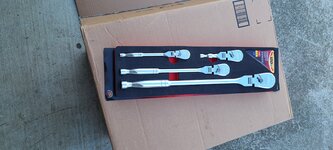
Last edited:
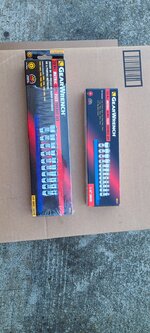


qqzj HW 16-20
1/2 shallow impact socket
1/2 12 pt shallow socket
Flex head flarenut wrenches
Precision screwdriver set
A fairly handy small set
1/2 shallow impact socket
1/2 12 pt shallow socket
Flex head flarenut wrenches
Precision screwdriver set
A fairly handy small set
Attachments

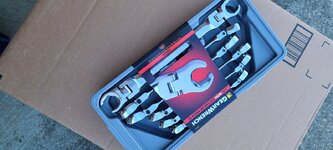


I'm a homer, I used to be a Gearwrench fan when most of it was made in Taiwan. I don't buy much from them anymore.
My favorite Gearwrench tools are my flex head ratcheting wrenches and an old microdriver set that I've used for more things than I could count. I also have a 3/8" stubby that I like to use. I have had all of them for a really long time; they were all made in Taiwan. I also have the serpentine belt tool, a tap and die set, an impact driver (all Taiwan made), two torque wrenches (USA made), and a badass pair of scissors.
My favorite Gearwrench tools are my flex head ratcheting wrenches and an old microdriver set that I've used for more things than I could count. I also have a 3/8" stubby that I like to use. I have had all of them for a really long time; they were all made in Taiwan. I also have the serpentine belt tool, a tap and die set, an impact driver (all Taiwan made), two torque wrenches (USA made), and a badass pair of scissors.
Attachments


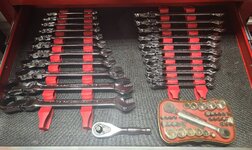
I used to be a fan of Gearwrench when it was mostly made in Taiwan and generally just for not often used tools. I prefer USA made tools for my most used and bought mostly Armstrong. Then Apex bought and shuttered Armstrong and now when you warranty armstrong stuff, it gets replaced by chinese (not taiwanese) made Gearwrench =(
Hold up - I've got piles of Gearwrench, and thought they were all Taiwan made? How can I tell which Gearwrench stuff is made in China?I used to be a fan of Gearwrench when it was mostly made in Taiwan and generally just for not often used tools. I prefer USA made tools for my most used and bought mostly Armstrong. Then Apex bought and shuttered Armstrong and now when you warranty armstrong stuff, it gets replaced by chinese (not taiwanese) made Gearwrench =(
vssjim
ALLIANCE MEMBER
I have too many to post but I have been pleased with everything I have bought from GearWrench older and newer. Most are Taiwan some are finished in china and some made in china but they All perform great, top notch. To answer some above posting many high dollars special tools from Bosch/ OTC and others are now made in china and not going to change soon for sure.
Same experience here. Out of all the tools I showed above, only the spark plug gauge and the hose pliers are made in USA. Most of them, about 60%, are made in Taiwan. The rest are MIC. I can clearly see that GW is shifting production to China now. I bet people complained a lot when production moved from USA to Taiwan as well. This is just how things work. Instead of fighting with economics, it is easier for me to enjoy the tools that work and in my price range. I also have a set of Astro Pneumatic suspension tools, all made in China but all work very well. Same for my Weber grill and my wife's Apple products. (I am cheap and I only use Android.)
I personally wouldn't let Apex/Gearwrench off that easy. They built the brand on good quality and then shifted to lower quality while keeping the same part numbers and prices. Can you guess which of these were made in Taiwan and which was made in China? The quality of the newer Chinese Gearwrench is less and you pay the same price. That's not cool.

That microdriver set is pretty popular... Curious what is in the impact driver box? Like the scissors too. But seems it's out of production now.I'm a homer, I used to be a Gearwrench fan when most of it was made in Taiwan. I don't buy much from them anymore.
My favorite Gearwrench tools are my flex head ratcheting wrenches and an old microdriver set that I've used for more things than I could count. I also have a 3/8" stubby that I like to use. I have had all of them for a really long time; they were all made in Taiwan. I also have the serpentine belt tool, a tap and die set, an impact driver (all Taiwan made), two torque wrenches (USA made), and a badass pair of scissors.
I guess the middle one is from China? I have a set of flex head wrenches coming. I can compare with you later. Maybe it takes a while for the quality to catch up?I personally wouldn't let Apex/Gearwrench off that easy. They built the brand on good quality and then shifted to lower quality while keeping the same part numbers and prices. Can you guess which of these were made in Taiwan and which was made in China? The quality of the newer Chinese Gearwrench is less and you pay the same price. That's not cool.
bsaint
Well-known member
I'm guessing the middle one alsoI guess the middle one is from China? I have a set of flex head wrenches coming. I can compare with you later. Maybe it takes a while for the quality to catch up?
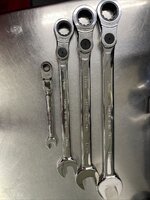
Heck, don't want to wait till my new tools. I don't have flex head GearWrench now. But I do have locking flexible head Craftsman and I believe they are made by GW in China. Take a look. What do you think? I also found a set made in USA from eBay. In the last picture, look at the smallest wrench. That is evidence that the Craftsman wrenches are made by GearWrench. My GW China-made Craftsman locking flex head wrenches have serial number L-AD. I bought them 10 years ago. Let me just call them qqzj HW 27.
Attachments


Last edited:
Fedwrench
ALLIANCE MEMBER
In the early days of Gearwrench mechanic's hand tools, the only thing that was US made were their micrometer torque wrenches. You have to remember that Gearwrench started out as an offshoot of KD tools many years ago only offering a line of ratcheting wrenches. There wasn't a move from made in the USA production to being made in Taiwan. Rather, one day you woke up to KD tools being killed off and replaced with an expanded line of Gearwrench mechanic's hand tools. This was followed shortly with the closing of Armstrong tools which at the time, was the source of many different US made brands including NAPA professional hand tools, Craftsman, Allen, Master Mechanic, KD, and others. It wasn't until after the demise of KD tools, that you saw a few specialty tools like feeler gauges that were US made but, now branded Gearwrench. I think the quality of Gearwrench tools has been hit or miss for a number of years but, it's not just Taiwan made versus PRC made Gearwrench. I've always thought it also depended on where you purchased it from. Several years ago during, Gearwrench's rapid expansion, the Big Box store market was flooded with lower priced sets of ratcheting wrenches around the holidays. Some of these sets were good and many weren't so good. Gearwrench has had some great product innovations over the years. They probably started the high tooth ratchets wars starting with 60 tooth models, moving to 84 teeth, and now 90 teeth as their standard. You would be hard pressed to find a thinner head, high tooth count ratchet on the market today. The deep band of knurling on their metric sockets' bases are probably one of the best on the market. Their serpentine belt tool set is one of the more versatile sets available at any price. Their ratcheting wrench offerings have gone from a few zero offset, flip over to reverse direction, ratcheting wrenches in stubby and standard lengths, to ratcheting wrenches in every shape, style, length, imaginable. Gearwrench is also widely available. If you like Gearwrench, use the hell out of them. That's the great thing about today's tool choices, there has never been a wider variety of tool choices available than you have today.Same experience here. Out of all the tools I showed above, only the spark plug gauge and the hose pliers are made in USA. Most of them, about 60%, are made in Taiwan. The rest are MIC. I can clearly see that GW is shifting production to China now. I bet people complained a lot when production moved from USA to Taiwan as well. This is just how things work. Instead of fighting with economics, it is easier for me to enjoy the tools that work and in my price range. I also have a set of Astro Pneumatic suspension tools, all made in China but all work very well. Same for my Weber grill and my wife's Apple products. (I am cheap and I only use Android.)

Cool. Without looking at the box or packaging, is there a way to tell whether a GW tool is made in Taiwan or China? I am always wondering about that.In the early days of Gearwrench mechanic's hand tools, the only thing that was US made were their micrometer torque wrenches. You have to remember that Gearwrench started out as an offshoot of KD tools many years ago only offering a line of ratcheting wrenches. There wasn't a move from made in the USA production to being made in Taiwan. Rather, one day you woke up to KD tools being killed off and replaced with an expanded line of Gearwrench mechanic's hand tools. This was followed shortly with the closing of Armstrong tools which at the time, was the source of many different US made brands including NAPA professional hand tools, Craftsman, Allen, Master Mechanic, KD, and others. It wasn't until after the demise of KD tools, that you saw a few specialty tools like feeler gauges that were US made but, now branded Gearwrench. I think the quality of Gearwrench tools has been hit or miss for a number of years but, it's not just Taiwan made versus PRC made Gearwrench. I've always thought it also depended on where you purchased it from. Several years ago during, Gearwrench's rapid expansion, the Big Box store market was flooded with lower priced sets of ratcheting wrenches around the holidays. Some of these sets were good and many weren't so good. Gearwrench has had some great product innovations over the years. They probably started the high tooth ratchets wars starting with 60 tooth models, moving to 84 teeth, and now 90 teeth as their standard. You would be hard pressed to find a thinner head, high tooth count ratchet on the market today. The deep band of knurling on their metric sockets' bases are probably one of the best on the market. Their serpentine belt tool set is one of the more versatile sets available at any price. Their ratcheting wrench offerings have gone from a few zero offset, flip over to reverse direction, ratcheting wrenches in stubby and standard lengths, to ratcheting wrenches in every shape, style, length, imaginable. Gearwrench is also widely available. If you like Gearwrench, use the hell out of them. That's the great thing about today's tool choices, there has never been a wider variety of tool choices available than you have today.
Also GW used to have combo deals. For example, I got the serpentine tool and the double x pliers set for $7x.** from an online GW dealer. Now the deals and the online dealers are all gone. Not so easy to find a good deal any more. What happened? All the good GW deals now are from Home Depot via Husky branded tools...
Fedwrench
ALLIANCE MEMBER
Nope. Gearwrench never stamped where a tool is made on the actual tool itself. The only clue to some of the bargain store sets was that the wrenches in the set didn't have individual part numbers on them. As for the buy one get one specials, I think covid killed those. It's hard to offer bargains if you're not making ends meet. However, Amazon has had some decent deals on SATA tools this holiday season.Cool. Without looking at the box or packaging, is there a way to tell whether a GW tool is made in Taiwan or China? I am always wondering about that.
Also GW used to have combo deals. For example, I got the serpentine tool and the double x pliers set for $7x.** from an online GW dealer. Now the deals and the online dealers are all gone. Not so easy to find a good deal any more. What happened? All the good GW deals now are from Home Depot via Husky branded tools...
Ton ton
Well-known member
I like the claw hammer.qqzj HW 1-5
The last picture has a 90T stubby 3/8 ratchet and a 120xp flex head torque wrench.

KnurledNut
Well-known member
Do i get bonus points for an overstamped error?
Last edited:
qqzj No 29 1/2 drive Pass Thru set
The metric sizes are 15mm-22mm, plus 24, 27, 30 and 32. GearWrench's pricing on 1/2 drive tools is artificially high and its normal square drive socket sets are very limited in size. So overall, they are not very competitive. I bought this set just because it completes my collection and I can think of a few places that they are actually going to help. Also, it actually has already been discontinued since 2019. Buying it later might be very hard.
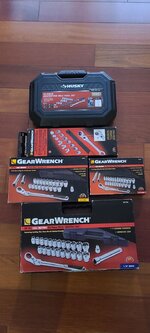

The metric sizes are 15mm-22mm, plus 24, 27, 30 and 32. GearWrench's pricing on 1/2 drive tools is artificially high and its normal square drive socket sets are very limited in size. So overall, they are not very competitive. I bought this set just because it completes my collection and I can think of a few places that they are actually going to help. Also, it actually has already been discontinued since 2019. Buying it later might be very hard.
MushCreek
Well-known member
I got tired of all of my old, mismatched beat-up sockets, so I bought two GW sets, a 1/4" drive and a 3/8". They are very smooth, and work well for my shade tree projects. BUT- The 3/8" ratchet falls apart! The snap ring just falls out, and the guts follow it. Is there a fix for this?
Warranty claim might be the cheapest way. Buying a better ratchet is probably the right way...I got tired of all of my old, mismatched beat-up sockets, so I bought two GW sets, a 1/4" drive and a 3/8". They are very smooth, and work well for my shade tree projects. BUT- The 3/8" ratchet falls apart! The snap ring just falls out, and the guts follow it. Is there a fix for this?
Mr Ratchet
Well-known member
He's what I have that are branded GW. I also have some KD tools and rebranded Kobalt.

What is the set of tools in the black box? I thought I have all the pass thru tools. Obviously I am missing this one.He's what I have that are branded GW. I also have some KD tools and rebranded Kobalt.
No 30: a new set of flex head wrenches GW sent me recently for review. I took a lot of time typing up the review. So may as well copy and paste it here. Ask me any questions.
**************************************************************************
The 16-piece GearWrench flex head metric wrench set is a significant addition to my arsenal. These wrenches feature 72 teeth, requiring only 5 degrees of swing angle. With the 180-degree flex heads, these are the ideal tools to attack fasteners in awkward locations.

In the first picture, I compare the length of my eight 17mm wrenches. The furthest left is the Craftsman raised panel. It is the shortest one at 215mm. Next are the GearWrench 6-point combo, 0-offset, flex head, and reversible ratcheting wrenches. All of them are about 225mm. The Craftsman locking flex head wrench is 250mm. The Craftsman and Carlyle long-pattern are both around 260mm, with the Carlyle being slightly longer.

For the open end, the 2nd picture shows that all three ratcheting GearWrench offerings have identical profile. The Craftsman long-pattern has a slightly fatter profile, and the Craftsman locking flex head is the fattest. The GearWrench 6-point, Craftsman raised panel and Carlyle has very similar outside profile. Thinner profile enables better access while fatter ones tend to be stouter. Typically, thinner profile is slightly preferred since ratchets and sockets are used to attack stubborn fasteners first. Among them the Carlyle has a very aggressive anti-slip design, the GW 6-point has a moderate anti-slip design while all others have smooth teeth. Anti-slip is preferred when dealing with nasty fasteners, while smooth teeth tend to protect the finish of fasteners. Both are desirable.

The above comparisons show that the GW flex head wrenches follow a conventional design overall with an emphasis on the flex head feature. These wrenches are surprisingly convenient in certain scenarios. I can remember that once I had to remove a bolt hidden between radiator support and front frame and a flex head wrench is the only tool that can remove it. They are designed to remove tricky fasteners hidden in difficult positions, rather than rusty/stubborn fasteners exposed to elements. The Carlyle seems to fit that bill the most.
One particular issue concerning flex head wrenches is that the heads become too floppy. It then becomes difficult to keep the heads in the proper position. Among all 16 wrenches, only the 9mm and the 17mm wrenches seem a bit too easy to flex. All other wrenches are perfect. Tightening the hex screws on the yokes can resolve the issue. But it would be nice if all the wrenches have the right amount of tension out of the factory. BTW, the hex screws are SAE instead of metric. A less obvious feature is that one side of the wrench beam has grooves so that it will be easy to know when I am turning clockwise or counterclockwise.

The overall package is stunning in appearance, but the rack I received was beaten up during shipping. The 8mm and the 22mm have trouble staying put in the rack. The rack still works very well when laying flat inside the drawer. But it would be a stretch to hang them up on the wall. Overall, the wrenches are very well designed and executed with some small imperfection. The 21 and 22mm wrenches obviously share the same blank. Same thing for 24 and 25mm. Consequently, the smaller wrenches, 21 and 24, appear stouter than their large siblings, which seems a bit strange. Other than that, these tools are perfect.
**************************************************************************
The 16-piece GearWrench flex head metric wrench set is a significant addition to my arsenal. These wrenches feature 72 teeth, requiring only 5 degrees of swing angle. With the 180-degree flex heads, these are the ideal tools to attack fasteners in awkward locations.
In the first picture, I compare the length of my eight 17mm wrenches. The furthest left is the Craftsman raised panel. It is the shortest one at 215mm. Next are the GearWrench 6-point combo, 0-offset, flex head, and reversible ratcheting wrenches. All of them are about 225mm. The Craftsman locking flex head wrench is 250mm. The Craftsman and Carlyle long-pattern are both around 260mm, with the Carlyle being slightly longer.
For the open end, the 2nd picture shows that all three ratcheting GearWrench offerings have identical profile. The Craftsman long-pattern has a slightly fatter profile, and the Craftsman locking flex head is the fattest. The GearWrench 6-point, Craftsman raised panel and Carlyle has very similar outside profile. Thinner profile enables better access while fatter ones tend to be stouter. Typically, thinner profile is slightly preferred since ratchets and sockets are used to attack stubborn fasteners first. Among them the Carlyle has a very aggressive anti-slip design, the GW 6-point has a moderate anti-slip design while all others have smooth teeth. Anti-slip is preferred when dealing with nasty fasteners, while smooth teeth tend to protect the finish of fasteners. Both are desirable.
The above comparisons show that the GW flex head wrenches follow a conventional design overall with an emphasis on the flex head feature. These wrenches are surprisingly convenient in certain scenarios. I can remember that once I had to remove a bolt hidden between radiator support and front frame and a flex head wrench is the only tool that can remove it. They are designed to remove tricky fasteners hidden in difficult positions, rather than rusty/stubborn fasteners exposed to elements. The Carlyle seems to fit that bill the most.
One particular issue concerning flex head wrenches is that the heads become too floppy. It then becomes difficult to keep the heads in the proper position. Among all 16 wrenches, only the 9mm and the 17mm wrenches seem a bit too easy to flex. All other wrenches are perfect. Tightening the hex screws on the yokes can resolve the issue. But it would be nice if all the wrenches have the right amount of tension out of the factory. BTW, the hex screws are SAE instead of metric. A less obvious feature is that one side of the wrench beam has grooves so that it will be easy to know when I am turning clockwise or counterclockwise.
The overall package is stunning in appearance, but the rack I received was beaten up during shipping. The 8mm and the 22mm have trouble staying put in the rack. The rack still works very well when laying flat inside the drawer. But it would be a stretch to hang them up on the wall. Overall, the wrenches are very well designed and executed with some small imperfection. The 21 and 22mm wrenches obviously share the same blank. Same thing for 24 and 25mm. Consequently, the smaller wrenches, 21 and 24, appear stouter than their large siblings, which seems a bit strange. Other than that, these tools are perfect.
Also after using the GW 120xp flex head torque wrench, I like it a lot now. The best thing about it is that
(1) 120xp, it does help a lot in tight corners, which seems a small possibility event until I finally came across it once recently.
(2) Flex head. That is great.
(3) Don't need to loosen and tighten the knob to lock into a certain torque. Once the collar is released, the torque setting is fixed. It won't go anywhere.
(4) In theory, it is not necessary to store it in the lowest torque setting. However, the wrench will only go into its box at around 20 ft lbs. That kind of forces me to set to it to that value, which is kind of good.
Here is my original review.
************************************

You cannot believe how happy I am!

Just when I am worried about torquing the spark plugs on my Subaru, I received this flex head torque wrench. Here is a picture showing how valuable it is to have a TW with a flex head. All my other TWs have fixed heads. This new addition definitely upped my game by a huge amount! All my other TWs just won’t work.
Using the GW 85188 TW is overall similar to using other TWs with some interesting differences. First there is not a nob at the end of the handle to enable or disable adjustment. Instead, there is a metal collar. Pulling down the collar will enable adjustment. Once the desired setting is reached, releasing the collar will lock. This is a bit awkward when I have to adjust the setting from the lowest 5 ft lbs to 75 ft lbs. Holding down the collar seems a bit of a hassle. However, at the same time, I do not have to worry about forgetting to lock down the torque setting by turning the nob at the end of the handle. Overall, I like this design because I like to have different kind of tools. When precision is the paramount goal, maybe it is reasonable to sacrifice a bit of convenience. The torque setting is accurate up to 0.5 ft lbs. It can be set to something like 25.5 ft lbs. But not 25.4 ft lbs. The collar will not lock outside of 0.5 ft lbs intervals. Another notable feature is that there are two lines in the center of the handle clearly marking the place where force should be applied. That is neat.

It is heavily promoted that the torque wrench is accurate within +/-3% of the torque setting. Once I read the instruction more carefully, this high accuracy only applies to the top 80% of the torque range. The full torque range is 5-75 ft lbs and that implies the TW is only super accurate in the 19-75 ft lbs range. Within the 5-19 ft lbs range, we are not sure about the accuracy. However, in the Certificate of Calibration, the TW is tested at three settings, i.e., 15/45/75 ft lbs. The results for the 15 ft lbs are really interesting and important because that cover most spark plugs. For my TW, the actual readings for the 15 ft lbs setting are 15.15, 15.15, 15.15, 15.2 and 15.2. That translates to torque errors of 1%, 1%, 1%, 1.3% and 1.3%. The average accuracy is about 1.1%. That is even closer than the 3% promoted for the top 80% of the range. (In case you are interested, the average accuracy readings for the 45/75 settings are 0.09% and 1.25%.) It seems that this TW might be a lot more accurate than advertised with the most accurate part being in the middle of the range. The accuracy at 45 ft lbs is a lot more than at both 15 ft lbs and 75 ft lbs. Another interesting observation is that among all the 15 tests, only 1 test shows that the actual torque is less than the intended torque spec. That makes a lot of sense because TYPICALLY slightly higher than spec is more desirable than slightly lower than spec. Therefore, when making these torque wrenches, GearWrench probably set the target torque slightly above the required torque spec. Otherwise, it would be difficult to explain that out of 15 tests, the actual torque is lower than spec only once.
There are a few other places where it is quite interesting
1 I looked over the instruction several times and I did not notice that the TW needs to be stored at its minimum torque setting, which is a common requirement for other TWs. That certainly makes life easier.
2 In the Certificate of Calibration, the stamp shows ‘SATA QC3’. This shows that most likely these TWs were made in the SATA factory. However, I have bought SATA tools in the past, and I consider them of lower quality than GearWrench. Coming out of the same factory does not imply the tools are of the same quality.
Possible improvements
1 I think it maybe a good idea to use a normal 90T ratchet head rather than the 120XP design with dual 60T paws. When access is an issue, a thinner head is more desirable than one additional degree of swing.
2 It would also be nice to add more flex positions. As of now, there are only three positions where the flexible head can stay with the help of a ball bearing. That seems a bit restrictive. Typically flex head ratchets with similar design have five such positions. In fact, it would be REALLY desirable if GearWrench can equip this TW with a locking flexible head. That would certainly add more flex positions and the locking feature is especially desirable on a torque wrench where you really want to make the ratchet steady while slowly applying torque.
3 Finally, I was a bit disappointed that there are a couple of typos in the instruction material. I can only read English. There is an obvious typo in the formula to adjust torque spec when used with an extension. There is another, less significant, typo in the example on how to operate the TW to adjust torque setting values. Finding typos in a manual is a big issue for me. It dampens my enthusiasm quite a bit.
(1) 120xp, it does help a lot in tight corners, which seems a small possibility event until I finally came across it once recently.
(2) Flex head. That is great.
(3) Don't need to loosen and tighten the knob to lock into a certain torque. Once the collar is released, the torque setting is fixed. It won't go anywhere.
(4) In theory, it is not necessary to store it in the lowest torque setting. However, the wrench will only go into its box at around 20 ft lbs. That kind of forces me to set to it to that value, which is kind of good.
Here is my original review.
************************************
You cannot believe how happy I am!
Just when I am worried about torquing the spark plugs on my Subaru, I received this flex head torque wrench. Here is a picture showing how valuable it is to have a TW with a flex head. All my other TWs have fixed heads. This new addition definitely upped my game by a huge amount! All my other TWs just won’t work.
Using the GW 85188 TW is overall similar to using other TWs with some interesting differences. First there is not a nob at the end of the handle to enable or disable adjustment. Instead, there is a metal collar. Pulling down the collar will enable adjustment. Once the desired setting is reached, releasing the collar will lock. This is a bit awkward when I have to adjust the setting from the lowest 5 ft lbs to 75 ft lbs. Holding down the collar seems a bit of a hassle. However, at the same time, I do not have to worry about forgetting to lock down the torque setting by turning the nob at the end of the handle. Overall, I like this design because I like to have different kind of tools. When precision is the paramount goal, maybe it is reasonable to sacrifice a bit of convenience. The torque setting is accurate up to 0.5 ft lbs. It can be set to something like 25.5 ft lbs. But not 25.4 ft lbs. The collar will not lock outside of 0.5 ft lbs intervals. Another notable feature is that there are two lines in the center of the handle clearly marking the place where force should be applied. That is neat.
It is heavily promoted that the torque wrench is accurate within +/-3% of the torque setting. Once I read the instruction more carefully, this high accuracy only applies to the top 80% of the torque range. The full torque range is 5-75 ft lbs and that implies the TW is only super accurate in the 19-75 ft lbs range. Within the 5-19 ft lbs range, we are not sure about the accuracy. However, in the Certificate of Calibration, the TW is tested at three settings, i.e., 15/45/75 ft lbs. The results for the 15 ft lbs are really interesting and important because that cover most spark plugs. For my TW, the actual readings for the 15 ft lbs setting are 15.15, 15.15, 15.15, 15.2 and 15.2. That translates to torque errors of 1%, 1%, 1%, 1.3% and 1.3%. The average accuracy is about 1.1%. That is even closer than the 3% promoted for the top 80% of the range. (In case you are interested, the average accuracy readings for the 45/75 settings are 0.09% and 1.25%.) It seems that this TW might be a lot more accurate than advertised with the most accurate part being in the middle of the range. The accuracy at 45 ft lbs is a lot more than at both 15 ft lbs and 75 ft lbs. Another interesting observation is that among all the 15 tests, only 1 test shows that the actual torque is less than the intended torque spec. That makes a lot of sense because TYPICALLY slightly higher than spec is more desirable than slightly lower than spec. Therefore, when making these torque wrenches, GearWrench probably set the target torque slightly above the required torque spec. Otherwise, it would be difficult to explain that out of 15 tests, the actual torque is lower than spec only once.
There are a few other places where it is quite interesting
1 I looked over the instruction several times and I did not notice that the TW needs to be stored at its minimum torque setting, which is a common requirement for other TWs. That certainly makes life easier.
2 In the Certificate of Calibration, the stamp shows ‘SATA QC3’. This shows that most likely these TWs were made in the SATA factory. However, I have bought SATA tools in the past, and I consider them of lower quality than GearWrench. Coming out of the same factory does not imply the tools are of the same quality.
Possible improvements
1 I think it maybe a good idea to use a normal 90T ratchet head rather than the 120XP design with dual 60T paws. When access is an issue, a thinner head is more desirable than one additional degree of swing.
2 It would also be nice to add more flex positions. As of now, there are only three positions where the flexible head can stay with the help of a ball bearing. That seems a bit restrictive. Typically flex head ratchets with similar design have five such positions. In fact, it would be REALLY desirable if GearWrench can equip this TW with a locking flexible head. That would certainly add more flex positions and the locking feature is especially desirable on a torque wrench where you really want to make the ratchet steady while slowly applying torque.
3 Finally, I was a bit disappointed that there are a couple of typos in the instruction material. I can only read English. There is an obvious typo in the formula to adjust torque spec when used with an extension. There is another, less significant, typo in the example on how to operate the TW to adjust torque setting values. Finding typos in a manual is a big issue for me. It dampens my enthusiasm quite a bit.
Ton ton
Well-known member
Is anyone a fan of the round head gearwrench ratchets? I bought a 1/2" drive gearwrench ratchet with a round head for $19. I have not used it yet. But I do like Roundhead ratchets.
The main advantage of roto head ratchets areIs anyone a fan of the round head gearwrench ratchets? I bought a 1/2" drive gearwrench ratchet with a round head for $19. I have not used it yet. But I do like Roundhead ratchets.
1 the pivotal point is right on top of fastener. So it won't move like non locking flex head ratchets when pressing on it.
2 you can use it like a screwdriver. Faster.
Both are valid for smaller ratchets like 1/4 and 3/8. Not super important for 1/2 drive size. That's why I bought 1/4 and 3/8 from harbor freight. (I like easy release, which is available on HF, not on GW.)
As for GW ones, some would say old ones are very good, new ones are not. I don't know about the details.
Ton ton
Well-known member
Thank you for the reply,Qqzj.
qqzj HW 31
The GearWrench magnetic spark plug socket!
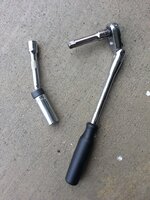
This is actually one of my early GW purchases and it is the first time I was truly amazed by the tool. (The 2nd time is using GW serpentine belt tool. Nothing else.) Back in the day, this kind of sockets was not that ubiquitous. I remember Craftsman had a set with a lot of duplicated items, probably made by GW. Then I found this one from Advanced Auto Parts. Back in 2016, shopping was great. AAP had a 40% off coupon, Denso had rebates for Spark Plugs and Amex has cash rebate for AAP. So I got a set of Denso plugs and this little tool basically free. And this free item totally shocked me. It completely eliminated the need to play with hoses, papers and plastic inserts falling out of traditional spark plug sockets, those kinds of hassles. It simply worked. And it worked perfectly for my two cars that use the 5/8 spark plugs. If you look closely inside, it even has space to accommodate the stem of spark plugs so that it is straight inside the socket.
Years later, I read some people complained certain feature was not perfect. I guess car makers continue to reduce the space inside of engine bay and making everything smaller. Therefore, this socket needs some updates/improvements. But as long as it physically fits your car, it is perfect. Back in 2016, it was new and very innovative.

The GearWrench magnetic spark plug socket!
This is actually one of my early GW purchases and it is the first time I was truly amazed by the tool. (The 2nd time is using GW serpentine belt tool. Nothing else.) Back in the day, this kind of sockets was not that ubiquitous. I remember Craftsman had a set with a lot of duplicated items, probably made by GW. Then I found this one from Advanced Auto Parts. Back in 2016, shopping was great. AAP had a 40% off coupon, Denso had rebates for Spark Plugs and Amex has cash rebate for AAP. So I got a set of Denso plugs and this little tool basically free. And this free item totally shocked me. It completely eliminated the need to play with hoses, papers and plastic inserts falling out of traditional spark plug sockets, those kinds of hassles. It simply worked. And it worked perfectly for my two cars that use the 5/8 spark plugs. If you look closely inside, it even has space to accommodate the stem of spark plugs so that it is straight inside the socket.
Years later, I read some people complained certain feature was not perfect. I guess car makers continue to reduce the space inside of engine bay and making everything smaller. Therefore, this socket needs some updates/improvements. But as long as it physically fits your car, it is perfect. Back in 2016, it was new and very innovative.
Mr Ratchet
Well-known member
It's a tap handle set. I added to hex key.What is the set of tools in the black box? I thought I have all the pass thru tools. Obviously I am missing this one.
Ton ton
Well-known member
As far as changing spark plugs, that seems to happen most often in weedeater and chainsaws. Plus other small engines.qqzj HW 31
The GearWrench magnetic spark plug socket!
This is actually one of my early GW purchases and it is the first time I was truly amazed by the tool. (The 2nd time is using GW serpentine belt tool. Nothing else.) Back in the day, this kind of sockets was not that ubiquitous. I remember Craftsman had a set with a lot of duplicated items, probably made by GW. Then I found this one from Advanced Auto Parts. Back in 2016, shopping was great. AAP had a 40% off coupon, Denso had rebates for Spark Plugs and Amex has cash rebate for AAP. So I got a set of Denso plugs and this little tool basically free. And this free item totally shocked me. It completely eliminated the need to play with hoses, papers and plastic inserts falling out of traditional spark plug sockets, those kinds of hassles. It simply worked. And it worked perfectly for my two cars that use the 5/8 spark plugs. If you look closely inside, it even has space to accommodate the stem of spark plugs so that it is straight inside the socket.
Years later, I read some people complained certain feature was not perfect. I guess car makers continue to reduce the space inside of engine bay and making everything smaller. Therefore, this socket needs some updates/improvements. But as long as it physically fits your car, it is perfect. Back in 2016, it was new and very innovative.
Several years ago Sears was selling this set of wrenches right around the holidays. As I recall, they were priced to sell, and they did. I must have bought about ten sets to give as Christmas gifts. I still have a couple NOS sets. I also did keep one of the sets for myself. The five metric wrenches went into my metric box and I added a few more to the SAE wrenches so I’d have a set running between 1/4” and 3/4”. That’s it for my Gear Wrench tools.
Jim C.
Jim C.
Attachments


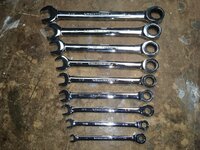
Brake pads thickness gauge! So that my brake inspection will turn professional. Also get it because I'd like to measure the gap first before removing stuff so that I can put things back exactly the same way, like pressing in bearings or installing CV axles. This should help.
Attachments

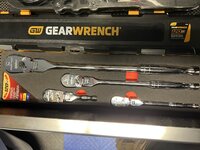
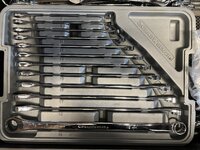
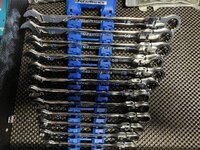
Got too many to post as I am Home Warrior GearWrench fan. Here some of my favorites centered around 120XP lines and the long double box ratcheting wrench. Work primarily on Japanese cars, hence like the compact design and short swings. This is probably 1/10 of GearWrench tools I have.
nicks78camaro
Well-known member
qqzj No 29 1/2 drive Pass Thru set
The metric sizes are 15mm-22mm, plus 24, 27, 30 and 32. GearWrench's pricing on 1/2 drive tools is artificially high and its normal square drive socket sets are very limited in size. So overall, they are not very competitive. I bought this set just because it completes my collection and I can think of a few places that they are actually going to help. Also, it actually has already been discontinued since 2019. Buying it later might be very hard.
Something else I never knew I needed!