To avoid these ads, REGISTER NOW!

The Lugzsonian - A Virtual Tour

JjKk40

Well-known member
Joined
Jan 10, 2021
Messages
616
Location
New York
I checked the #134, 139, the c-1 (1947?), and i didn't see it. Then I ran across the #41 and I found it! I'm not sure what year the #41 catalog refers to but it mentions 66 years of service in one of the pages. Heres a few pics...

20211230-013141.jpg
Screenshot-20211230-013056-Chrome.jpg
Screenshot-20211230-013019-Chrome.jpg
 
To avoid these ads, REGISTER NOW!
OP
P

Private Lugnutz

Well-known member
Joined
Mar 30, 2012
Messages
30,597
Location
The Authentic Jersey Shore
Cool! You beat me to it! That's the 1941 catalog. Which, if you were following me above about your PAT PEND marking (applied in '40, granted in '42), makes perfect sense for year of production and for it allowing us to fairly reasonably derive that it was indeed made by Stanley for Bonney under the Sowell patent.

The Curator is honored that we 'first broke this story' here collaboratively in the Lugzsonian - with a tool on virtual loan from the JjKk40 Collection!

EDIT: And just think, if you hadn't been scrolling around in the back pages looking through the Great Gerber Cadmium Evaporust Experiment, you wouldn't have seen the more modern (1949) iteration Stanley made for Sears as the Craftsman Add-a-Bit!

The Acquisitions Dept will be on the lookout for an example of the older, wooden handled version in the wild now!
 
Last edited:
OP
P

Private Lugnutz

Well-known member
Joined
Mar 30, 2012
Messages
30,597
Location
The Authentic Jersey Shore
Pressure. And, as long as you mention it, very akin to the little spring steel tongues that were pinned inside the female openings on handles of very early socket sets with male drive tangs. Like those tongues, that crimp in the shank creates a narrower opening. The tapered tang of the screwdriver bit, slightly larger than the crimped opening, is squeezed in place by the crimp. Also similar to early female drive systems with extensions having press-fit sockets. Those are meant to be permanent though. EDIT: The catalog calls it "taper shank engagement."

I can't speak for JjKk's Bonney and bits, but my later Craftsman bits are actually very difficult to get out. Going in was easier, but I had to use pliers to pull them out. That's how tightly the crimp holds them in place. On the Craftsman Long C thread I remarked that I was skeptical of the durability. I wondered, and still do, about the long-term effects of that action. How many bit insertions and removals before the crimping is worked loose? But I suppose it could just be re-crimped.
 

duddly

Well-known member
Joined
Aug 25, 2013
Messages
596
Location
Southern MD
Cool! You beat me to it! That's the 1941 catalog. Which, if you were following me above about your PAT PEND marking (applied in '40, granted in '42), makes perfect sense for year of production and for it allowing us to fairly reasonably derive that it was indeed made by Stanley for Bonney under the Sowell patent.

The Curator is honored that we 'first broke this story' here collaboratively in the Lugzsonian - with a tool on virtual loan from the JjKk40 Collection!

EDIT: And just think, if you hadn't been scrolling around in the back pages looking through the Great Gerber Cadmium Evaporust Experiment, you wouldn't have seen the more modern (1949) iteration Stanley made for Sears as the Craftsman Add-a-Bit!

The Acquisitions Dept will be on the lookout for an example of the older, wooden handled version in the wild now!

Great work and great finds!
As we use the modern multi-bit sets of today we have so many of the OG toolmakers to thank for pressing forward with innovation. And the stories and pics were amazing. Thanks JjKk40 and Lugz!
 

duddly

Well-known member
Joined
Aug 25, 2013
Messages
596
Location
Southern MD
Indeed, but what is OG? Old Guard?

I will hasten to add Mark Stansbury to the backslapping, and any and all who have generously contributed their catalogs for scanning into IA/ITCL.

I went with the Merriam-Webster (slang) definition... Well it is really the modern "Original Gangster" but they include:

Definition of OG

https://www.merriam-webster.com/dictionary/OG (Entry 1 of 2)
slang
: someone or something that is an original or originator and especially one that is highly respected or regarded

but the engineers of the past were really amazing and truly deserve the modern title of OG/Original Gangsters!
And apologies on the omissions.. GJ is TRULY a community of knowledge.
 

Nick Danger

Well-known member
Joined
May 7, 2013
Messages
4,249
Location
Albuquerque
For the curious, that is the cover of the February 1991 issue of the Smithsonian magazine he has appropriated. As for the caption at the bottom, 'Dear Editor, please tell us something we don’t already know!' :)
I read that article when it came out. What I best remember from it is that it was impossible for the widow of a collector to assess the value of a high-end tool collection. Rare tools were different from rare coins or stamps. That's because the only people who could judge the value of the tools were other tool collectors, and they undervalued the tools that they wanted to buy. Coins and stamps had a large body of collectors, price guides, and independent evaluators. But there were only a few big collectors in the country who were experts in rare tools.

Thank goodness for the internet, huh? I know next to nothing about vintage tools, but I can go online and learn what I want from experts in a day.

So I appreciate that you all are sharing your knowledge with duffers like me.
 

JjKk40

Well-known member
Joined
Jan 10, 2021
Messages
616
Location
New York
Yes the 1 bit i have is extremely difficult to get out and even install. I have to tap it in with a nylon face hammer and use a chisel to take it out. That is all after lubing it and hitting it with a file to smooth it out a little.

Lugz if that catalog #41 is year 1941 catalog then why is the #134 , 137, 139 years 1934, 1937, 1939 respectively? What happen to the the 1st digit being a "1"? Very confusing. And my C-2 , supposedly 1947 catalog, have circle CV deep sockets?
 
OP
P

Private Lugnutz

Well-known member
Joined
Mar 30, 2012
Messages
30,597
Location
The Authentic Jersey Shore
Lugz if that catalog #41 is year 1941 catalog then why is the #134 , 137, 139 years 1934, 1937, 1939 respectively? What happen to the the 1st digit being a "1"? Very confusing.
They were never very consistent. The 1914 is No. 18, the 1919 is No. 21, the 1925 is No. 26, and the 1933 is No. 33. Moving postwar, the No. 46-J, a very abbreviated catalog, is thought to be 1946. The 1951 is No. M-2. And the 1957 is No. 57-S. Trust me though, that is the 1941 catalog. I use it all the time.

I would defer to Mark and 4.c on this, but in my experience with the catalogs I spend the most time with, not very many mfgrs were very consistent with their publication numbering schemes.
And my C-2 , supposedly 1947 catalog, have circle CV deep sockets?
Hmm. I don't have this one on my hard drive. I usually consult the 1946 for immediate postwar reference. Did you pull it from IA/ITCL? Or do you have a paper copy?

As for the Circle-CV, and this goes for most mfgrs, most graphics, they re-use them regardless of markings without giving as much thought as we do to that as collectors 70+ years later.
 
OP
P

Private Lugnutz

Well-known member
Joined
Mar 30, 2012
Messages
30,597
Location
The Authentic Jersey Shore
What I best remember from it is that it was impossible for the widow of a collector to assess the value of a high-end tool collection.
Your recollection is good. It bemusedly delved into the old collectors' adage about widows selling them for what they were told their husbands paid for them (a lie), and therefore getting back pennies on the dollar. :) The majority of the article did a respectful job of describing the tools as the objects of art (and historical, artifactual significance) that many of us in the hobby treat them as. On this site, where a lot of guys of the strict utilitarian persuasion tend to sneer at those of us who put them under lights and glass, it's nice to see a magazine of that caliber for an institution of that caliber give antique and vintage tools - including automotive mechanics hand tools (that is a Mack Trucks bulldog on the cover with the wrenches!) the credit they deserve as collectibles.
 
Last edited:

four.cycle

Well-known member
Joined
Oct 19, 2015
Messages
28,953
Location
Tacoma, Washington
Private Lugnutz said:
I would defer to Mark and 4.c on this, but in my experience with the catalogs I spend the most time with, not very many mfgrs were very consistent with their publication numbering schemes.

I know nothing about Bonney, but I would tend to agree with that overall - across the board among all U.S. manufacturers.
 

JjKk40

Well-known member
Joined
Jan 10, 2021
Messages
616
Location
New York
Guys I'm gonna post the catalog 134, 136, 139, and c-1 in the Bonney thread! The numbering system confuses me.
 
OP
P

Private Lugnutz

Well-known member
Joined
Mar 30, 2012
Messages
30,597
Location
The Authentic Jersey Shore
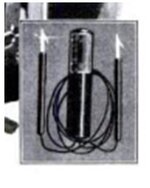
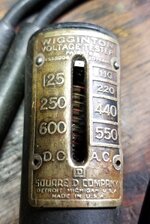
The Acquisitions Department picked up this antique version of a crude, inexpensive, apparently dangerous, but simply effective (is it hot or not?) near-legendary solenoid type voltage tester at the flea market this morning.

20220101_133043.jpg
20220101_133108.jpg

Ostensibly* invented in 1918 by prolific inventor George P. Wigginton (who also invented the first loose-leaf binder mechanism) and manufactured for many years by his Kalamazoo, Mich.-based company, it became so commonly known among electricians by its whimsical nickname, the “Wiggy,” that the Detroit company Square D, who somehow* ended up with the rights to it, actually trademarked that name for it in 1973.

Wiggy TM 1973.jpg
1970's vintage Wiggy.jpg

The Lugzsonian's example is quite a bit older than that. In fact, it’s the oldest Square D “Wigginton” type voltage tester we have ever seen, and after several hours of searching on-line, we can’t find one with a brass plate.

For the unfamiliar, it has a spring-loaded solenoid core with a simple pointer attached to it. The pointer is pulled up the tube and AC/DC scale on each side of the tester when the probes, which are sharp to dig into insulation, touch voltage. (In more modern versions, the top of the tester has a small permanent magnet rotor that clicks on DC and vibrates on AC. We’re not sure this one has that feature and we don’t plan to find out.) The cap and tube are made of fiber resin.

20220101_133142.jpg

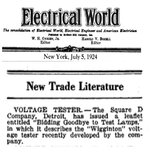
*The history on these is easily one of the most frustrating the Curator has ever researched. Multiple sites, from radio museums to electricians' forums to Wiki, say that George P. Wigginton patented the first one in 1918. But they don’t cite the patent number and the actual patent has eluded us. We found several patents related to voltage testers assigned to the Wigginton Company, but none in 1918, all in the 20's, and Square D was taking credit for this one - despite calling out Wigginton on the product itself, at least as early as 1924.

We believe we have a 1920's first generation "Wiggy" here.

Wigginton Electrical World 1924.jpgWigginton The Dotted Line 1924.jpgWigginton The Dotted Line 1924 zoom.jpg1942 american electricians handbook.jpg
 
Last edited:

four.cycle

Well-known member
Joined
Oct 19, 2015
Messages
28,953
Location
Tacoma, Washington
^ very cool.
Any possibility that the inventor's name, and the later colloquially used term for the device was the source of the expression "wiggy"?
I am finding nothing but ambiguity online searching for etymology on that one. (My big hard-copy dictionaries don't even contain "wiggy".)

You sure you don't want to plug something in and make us a demonstration video on YouTube? ;)
 

four.cycle

Well-known member
Joined
Oct 19, 2015
Messages
28,953
Location
Tacoma, Washington
exactly. I just ran searches on "wiggy" and not ONE site offers a credible explanation on etymology.
I went and dug out my TWO 1969 American Heritage dictionaries, and "wiggy" isn't in them.
 
Last edited:
To avoid these ads, REGISTER NOW!
OP
P

Private Lugnutz

Well-known member
Joined
Mar 30, 2012
Messages
30,597
Location
The Authentic Jersey Shore
As much as the Curator likes the idea and the potential logic of the theory that the slang word "wiggy" (erratic, wildly uninhibited, etc) may have come from an electrician's device that goes a little crazy with clicking and vibrating when in contact with voltage, we think this from Merriam-Webster makes sense:

wigged-out​

adjective WIGD-OUT


What It Means​

: mentally or emotionally discomposed : upset, crazy

The wig in wigged-out is the one you don to change or enhance your appearance. Wig has been in use since the late 17th century, when it was adopted as a clipped form of periwig, itself denoting a manufactured covering of natural or synthetic hair for the head. The source of periwig is Middle French perruque (source also of the synonym peruque). In the American slang of the mid-20th century, the word wig was moving into new territory: wig became a word for the mind, and to "wig out" was to lose one's composure or reason. The idiom "flip one's wig" also came into use (sharing the "to become crazy or very angry" meaning of the very similar "flip one's lid"), and the adjective wigged-out found a home in the language too, describing anyone who was mentally or emotionally discomposed.
 
OP
P

Private Lugnutz

Well-known member
Joined
Mar 30, 2012
Messages
30,597
Location
The Authentic Jersey Shore
After a full day of stinky (red herrings), eye-burning (have you ever looked through dozens of USPTO Gazettes and Annual Commissioner Reports?), frustrating (grumblings were heard from upstairs), but ultimately successful research, the Curator boldly announces that he officially thinks that Wikipedia, linked here, and excerpted here...

"Wiggy is the registered trademark for a common solenoid voltmeter used in North America derived from a device patented in 1918 by George P. Wigginton."[2]
2. David E. Shapiro "Your Old Wiring", McGraw-Hill Professional, 2001 ISBN 0-07-135701-7 page 22

...a popular electrician/blogger, David Herres, linked here, and excerpted here...

"Way back in 1918, George P. Wigginton invented the solenoid voltmeter."

...and basically all the guys on this antique radio forum, who just seem to be repeating half-bits of information found on the internet, linked here...

...ARE QUITE PROBABLY WRONG!
 
Last edited:
OP
P

Private Lugnutz

Well-known member
Joined
Mar 30, 2012
Messages
30,597
Location
The Authentic Jersey Shore
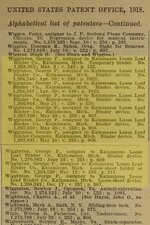
In 1918, George P. Wigginton was indeed granted a patent. In fact, he was granted a whopping nine (9) patents. Unfortunately, all of them were related to a few different loose-leaf binder mechanisms.

Wiggington patents 1918 USPTO.jpg

George P. Wigginton was the superintendent, general manager, and later President of a company called the Kalamazoo Loose-Leaf Binder Company. In fact, George P. Wigginton was the Thomas Alva Edison of loose leaf binders, with dozens of patents to his name, all related to loose-leaf binder mechanisms, all granted between 1909 and 1933.

Wigginton Portrait ad 1921.jpg

But there is no evidence of him knowing anything about electricity, and he was most certainly not granted a patent, in 1918 or in any other year, for a voltage tester.

The Curator has also found no relationship whatsoever between George P. Wigginton and The Wigginton Company of Kalamazoo, Michigan. It is possible. He seems to have been involved in a number of different companies in that area at the same time. For example, according to the 1924 Poors Index, linked here, he was also the President of the Roamer Motor Car Company, the last vestiges of the company known as Streator and then Barley Motor Car Company that had made the Roamer and the Pennant before going insolvent.

There is ample evidence of the Wigginton Company, whether it was one of George P.'s enterprise's or not, manufacturing electrical testing devices and apparatuses. An interesting excerpt about the voltage testers that they apparently made for Gibson, the famous guitar manufacturing company, can be read here. Much later, they had patents for an improved voltage tester (Simkins, 2,469,703, granted May 10, 1949) and an improved case for a voltage tester (Hopkins, D167,403, granted Aug 5, 1952), which I believe was the upgraded Square D tester.

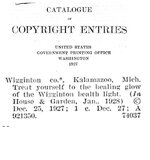
In 1928 the Wigginton Company was also making something they called a Health Light.

Wigginton Copyright 1928.jpg

They also had their own CAGE code, which meant they were supplying things to the federal government.

In fact, in 1945, the Wigginton Company made $52,000 worth of what I have good reason to conclude was their Wigginton Voltage Tester for the Navy during the later stages of WWII.


Wigginton WWII comtracts.jpg

Then again, so did Square D, in 1943, for the US Army QMC, and we feel pretty confident those were also probably manufactured by Wigginton for Square D.

Square D WWII comtracts.jpg
 
Last edited:
OP
P

Private Lugnutz

Well-known member
Joined
Mar 30, 2012
Messages
30,597
Location
The Authentic Jersey Shore
All sources.

Basically, the entire websphere, from Wiki to electricians' blogs (there is more than one, believe it or not!) to electrician's forums, all attribute the patent to George P. Wigginton in 1918. But none provide a patent number. And, as I said, he has no patents for a voltage tester, not in 1918, and not in any year I checked between 1909 and 1933. I don't know where it started, but I can imagine how. The guy was a prolific inventor and his surname is on the dang device! Why 1918? I don't know. But think it's a massive case of everyone quoting and citing each other but nobody identifying the actual patent number.
 
OP
P

Private Lugnutz

Well-known member
Joined
Mar 30, 2012
Messages
30,597
Location
The Authentic Jersey Shore
And here is my piece de resistance (pun definitely intended).

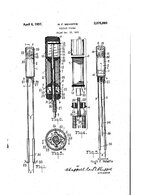
I found this patent, not in 1918, but filed in 1920, granted in 1925, to Richard Parisian, and assigned to the Wigginton Company. Note that this was only a few months after Square D first introduced and started advertising the heck out of the Wigginton tester, which they described as new and revolutionary. I believe that THIS is the "Wigginton" Voltage Tester patent. Not assigned to the person Mr. George P. Wigginton, which everyone else except your humble Curator seems to have just assumed, but to the company of that name which may or may not be his.

Parisian Wiggington patent 1925.jpg
 
Last edited:
OP
P

Private Lugnutz

Well-known member
Joined
Mar 30, 2012
Messages
30,597
Location
The Authentic Jersey Shore
I am going to find a copy of Mr. Shapiro's book on home wiring, which Wiki cites as its source, just to see if he provides a source for crediting good ol' loose-leaf binder king George P. Wigginton, rather than Mr. Parisian in the employment of the Wigginton Company. If not, I am going to contact Wiki, send them the Parisian patent, and tell them to correct their page.
 

RTM

Well-known member
Joined
May 13, 2019
Messages
13,190
Location
SF Bay Area
And here is my piece de resistance (pun definitely intended).

I found this patent, not in 1918, but filed in 1920, granted in 1925, to Richard Parisian, and assigned to the Wigginton Company. Note that this was only a few months after Square D first introduced and started advertising the heck out of the Wigginton tester, which they described as new and revolutionary. I believe that THIS is the "Wigginton" Voltage Tester patent. Not assigned to Mr. George P. Wigginton, but to the company which may or may not be his.
Well done sir, as always. Nice to boil away the BS and get to the truth.

You gonna join a few fora and drop some fact bombs, disrupt their cozy little world?
 

RTM

Well-known member
Joined
May 13, 2019
Messages
13,190
Location
SF Bay Area
I am going to find a copy of Mr. Shapiro's book on home wiring, which Wiki cites as its source, just to see if he provides a source for crediting good ol' loose-leaf binder king George P. Wigginton, rather than Mr. Parisian in the employment of the Wigginton Company. If not, I am going to contact Wiki, send them the Parisian patent, and tell them to correct their page.

You can correct the page yourself if you are a member. My membership is still alive. Wigginton as Patentee was added 17 august 2011, and credited to Shapiro a month later.
 
Last edited:
OP
P

Private Lugnutz

Well-known member
Joined
Mar 30, 2012
Messages
30,597
Location
The Authentic Jersey Shore
I haven't donated in years, so feel free to make the change if you'd like.

To keep things in perspective, the principle Parisian used - metered electromagnetic movement, had been around since d'Arsonval, but putting solenoids in a small resin device was a pretty cool idea that I'm thinking Parisian's family wouldn't mind being corrected to the right guy! :)

Note that I do plan to get a copy of Shapiro's book to see if he provides a source for his claim, just for final due diligence. If you want to wait until then. Stranger things have happened.
 

RTM

Well-known member
Joined
May 13, 2019
Messages
13,190
Location
SF Bay Area
Not many libraries in NJ with a copy, but abebooks has it for $33.o_O

Rowan University in Glassboro is only one I see. Poking WorldCat for where your travels take you might help.

Will wait for your follow on. I checked Archive.org, nada, and Google Books only has snippet view, searching Wiggy shows "Wiggy is the trade name for a tester invented by a Mr Wigginton. Colloquially........."
 

Outlawmws

Well-known member
Joined
Aug 9, 2011
Messages
39,263
Location
The Badlands
Lugz, I don't think you need to donate to be a "contributing member" and make edits. I've made a couple of edits way back, and no issues.
 
  • Like
Reactions: RTM

humber2

Well-known member
Joined
Feb 13, 2011
Messages
1,768
Location
Downunder
Can you post the 2nd patent # and details please?

Looks to me that the 1st patent has ridged fixed probes and the SqD version has the flexible wander leads.
 

Mintgrun

Well-known member
Joined
Oct 7, 2015
Messages
2,133
Location
Kingston, Wa.
I have one of those testers as well, but it does not have the cool brass plate (and it is missing the screw-in cap). Here is a closeup photo showing the two patent numbers.

1641572020941.jpeg

1641572250674.jpeg

When I searched for the second patent number, I found that it was granted in 1937 and they showed an image with the flexible leads, but the site would not let me copy it; so here is a link.


(I did get up the guts to stick the probes into an outlet and got a 120 volt reading, but did not try plugging it into a 240 outlet).

Thank you for the research, Lugz.

Tom
 
To avoid these ads, REGISTER NOW!
Top Bottom