I checked the #134, 139, the c-1 (1947?), and i didn't see it. Then I ran across the #41 and I found it! I'm not sure what year the #41 catalog refers to but it mentions 66 years of service in one of the pages. Heres a few pics...


Cool! You beat me to it! That's the 1941 catalog. Which, if you were following me above about your PAT PEND marking (applied in '40, granted in '42), makes perfect sense for year of production and for it allowing us to fairly reasonably derive that it was indeed made by Stanley for Bonney under the Sowell patent.
The Curator is honored that we 'first broke this story' here collaboratively in the Lugzsonian - with a tool on virtual loan from the JjKk40 Collection!
EDIT: And just think, if you hadn't been scrolling around in the back pages looking through the Great Gerber Cadmium Evaporust Experiment, you wouldn't have seen the more modern (1949) iteration Stanley made for Sears as the Craftsman Add-a-Bit!
The Acquisitions Dept will be on the lookout for an example of the older, wooden handled version in the wild now!
Indeed, but what is OG? Old Guard?so many of the OG toolmakers to thank
Indeed, but what is OG? Old Guard?
I will hasten to add Mark Stansbury to the backslapping, and any and all who have generously contributed their catalogs for scanning into IA/ITCL.
I read that article when it came out. What I best remember from it is that it was impossible for the widow of a collector to assess the value of a high-end tool collection. Rare tools were different from rare coins or stamps. That's because the only people who could judge the value of the tools were other tool collectors, and they undervalued the tools that they wanted to buy. Coins and stamps had a large body of collectors, price guides, and independent evaluators. But there were only a few big collectors in the country who were experts in rare tools.For the curious, that is the cover of the February 1991 issue of the Smithsonian magazine he has appropriated. As for the caption at the bottom, 'Dear Editor, please tell us something we don’t already know!'
Private Lugnutz said:"...my later Craftsman bits are actually very difficult to get out..."
They were never very consistent. The 1914 is No. 18, the 1919 is No. 21, the 1925 is No. 26, and the 1933 is No. 33. Moving postwar, the No. 46-J, a very abbreviated catalog, is thought to be 1946. The 1951 is No. M-2. And the 1957 is No. 57-S. Trust me though, that is the 1941 catalog. I use it all the time.Lugz if that catalog #41 is year 1941 catalog then why is the #134 , 137, 139 years 1934, 1937, 1939 respectively? What happen to the the 1st digit being a "1"? Very confusing.
Hmm. I don't have this one on my hard drive. I usually consult the 1946 for immediate postwar reference. Did you pull it from IA/ITCL? Or do you have a paper copy?And my C-2 , supposedly 1947 catalog, have circle CV deep sockets?
Your recollection is good. It bemusedly delved into the old collectors' adage about widows selling them for what they were told their husbands paid for them (a lie), and therefore getting back pennies on the dollar.What I best remember from it is that it was impossible for the widow of a collector to assess the value of a high-end tool collection.
The majority of the article did a respectful job of describing the tools as the objects of art (and historical, artifactual significance) that many of us in the hobby treat them as. On this site, where a lot of guys of the strict utilitarian persuasion tend to sneer at those of us who put them under lights and glass, it's nice to see a magazine of that caliber for an institution of that caliber give antique and vintage tools - including automotive mechanics hand tools (that is a Mack Trucks bulldog on the cover with the wrenches!) the credit they deserve as collectibles.Private Lugnutz said:I would defer to Mark and 4.c on this, but in my experience with the catalogs I spend the most time with, not very many mfgrs were very consistent with their publication numbering schemes.

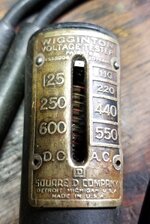



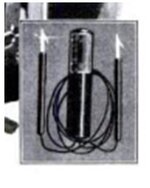

If you mean weirdly erratic, i.e., "wigged out", I hadn't thought of that! It sorta fits in a 'stick a fork in an old light socket and see what happens' kinda way, doesn't it?Any possibility that the inventor's name, and the later colloquially used term for the device was the source of the expression "wiggy"?
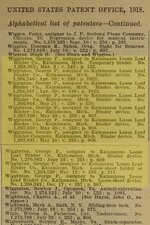

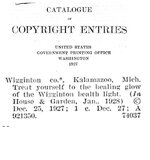


Well done sir, as always. Nice to boil away the BS and get to the truth.And here is my piece de resistance (pun definitely intended).
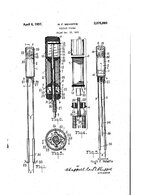
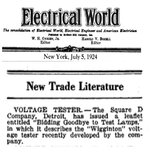
I found this patent, not in 1918, but filed in 1920, granted in 1925, to Richard Parisian, and assigned to the Wigginton Company. Note that this was only a few months after Square D first introduced and started advertising the heck out of the Wigginton tester, which they described as new and revolutionary. I believe that THIS is the "Wigginton" Voltage Tester patent. Not assigned to Mr. George P. Wigginton, but to the company which may or may not be his.
Nah. Not my style. I will correct Wiki though.You gonna join a few fora and drop some fact bombs, disrupt their cozy little world?
I am going to find a copy of Mr. Shapiro's book on home wiring, which Wiki cites as its source, just to see if he provides a source for crediting good ol' loose-leaf binder king George P. Wigginton, rather than Mr. Parisian in the employment of the Wigginton Company. If not, I am going to contact Wiki, send them the Parisian patent, and tell them to correct their page.


 pdfpiw.uspto.gov