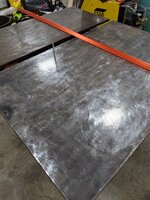
Been planning a fab table for some time now. Not one piece of new material, but stuff I have collected here and there.
Some 4"x8" and 4"x4" 1/4" wall tubing for the base and legs.
My buddy closed up his welding shop and I helped him clear it out and pack him up for his move. He gifted me a couple pieces of 3/4" plate.
I wanted about a 4'x4' table. One plate was L shaped, so I cut the small leg off and ended up with 36"x48". The other plate was 16"x 48".
I pondered for a while about butting the plates together and maybe welding them, but settled on the idea of leaving a 2" gap between the plates, like a slat style welding table.
I can picture the slat being handy in welding certain projects, or for peculiar clamping, or even using the gap for pressing something out in the gap.
Ended up with a 54" x 48" table.
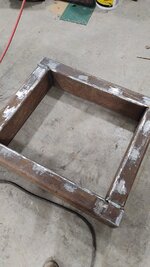
Carefully putting together the 4"x8" box base for the table. Tacked two 90 degree sections at a time using 3 points of contact on some angle iron. This keeps the base in the same plane and level. I then squared and levelled the two 90's before tacking and welding them out.

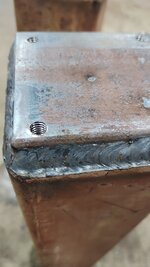
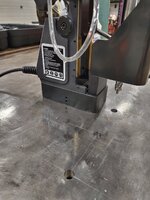
Got the 4"x4" legs cut to length and welded some 1/2" caps on the bottom that I tapped for castors.
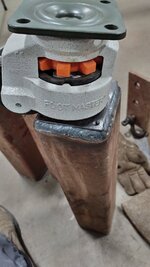
Picked up some heavy duty Foot Master self-levelling swivel casters for the legs. The wheels retract and the foot height is adjustable to account for variations in the floor. They roll very nicely and its easy to move the table around.


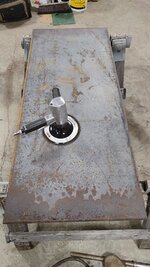
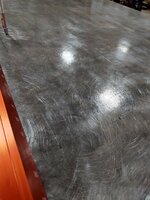
Both plates had some spots of rust. This one above was the worst. Went at them with acid and heavy surface sanding. This took a ton of time, but in the end I got to a surface condition I was happy with. There are spots of pitting, but this is a welding table and I'm not building aerospace components.
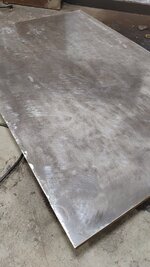
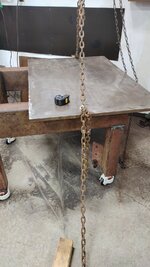
Putting the big plate on the base.

Got the plates into position and clamped them together on the base with a piece of 1"x2" solid bar.
Some 4"x8" and 4"x4" 1/4" wall tubing for the base and legs.
My buddy closed up his welding shop and I helped him clear it out and pack him up for his move. He gifted me a couple pieces of 3/4" plate.
I wanted about a 4'x4' table. One plate was L shaped, so I cut the small leg off and ended up with 36"x48". The other plate was 16"x 48".
I pondered for a while about butting the plates together and maybe welding them, but settled on the idea of leaving a 2" gap between the plates, like a slat style welding table.
I can picture the slat being handy in welding certain projects, or for peculiar clamping, or even using the gap for pressing something out in the gap.
Ended up with a 54" x 48" table.
Carefully putting together the 4"x8" box base for the table. Tacked two 90 degree sections at a time using 3 points of contact on some angle iron. This keeps the base in the same plane and level. I then squared and levelled the two 90's before tacking and welding them out.
Got the 4"x4" legs cut to length and welded some 1/2" caps on the bottom that I tapped for castors.
Picked up some heavy duty Foot Master self-levelling swivel casters for the legs. The wheels retract and the foot height is adjustable to account for variations in the floor. They roll very nicely and its easy to move the table around.
Both plates had some spots of rust. This one above was the worst. Went at them with acid and heavy surface sanding. This took a ton of time, but in the end I got to a surface condition I was happy with. There are spots of pitting, but this is a welding table and I'm not building aerospace components.
Putting the big plate on the base.
Got the plates into position and clamped them together on the base with a piece of 1"x2" solid bar.
Last edited: