
You are using an out of date browser. It may not display this or other websites correctly.
You should upgrade or use an alternative browser.
You should upgrade or use an alternative browser.
craftsman commercial crown top
- Thread starter Mark914
- Start date


d42jeep
Well-known member
Here is mine that I found December 2016. It was an El Cerrito, CA garage sale find and looked unused. According to Brian Riley they were made in the early 70s
-Don
-Don
Last edited:
Sears catalogs cannot be fully relied on to provide accurate dating and product images, but here's what I know from the research into the RHFT type study:
Sometime in the late 1960s--circa 1968--Sears began to use the words CRAFTSMAN COMMERCIAL as an actual grade designation for its high-end tools and equipment. Instead of just in the item description, they would use the word in the title of the item. Elsewhere in the large main catalogs, they were using a graphic of SEARS BEST in a white oval to tag their premium items in categories like clothing, electronics and appliances. The 1970 specialty tool catalog was the first time the oval graphic was used to tag a tool, the RHFT ratchet. Starting in 1972, they began applying the oval to more items in the tool catalog. The overall impression is that they decided to phase out the COMMERCIAL designation, perhaps because they found rank-and-file consumers would shy away from a "commercial" product apparently meant for contracters or pro shops. By the 1976 tool catalog, the COMMERCIAL designation had been eliminated. So based on the catalogs, the OP's toolbox should be 1968-1975. However, I also found in my research that the catalogs of the time can be as much as two years behind the actual product introduction in the physical stores, which at the time were the largest retail tool distribution network in the world, and so didn't need the catalog to begin selling the products in their stores. In this case, the CRAFTSMAN COMMERCIAL case badge on the physical item could have been introduced as early as 1966 and discontinued as early as 1973.
Sometime in the late 1960s--circa 1968--Sears began to use the words CRAFTSMAN COMMERCIAL as an actual grade designation for its high-end tools and equipment. Instead of just in the item description, they would use the word in the title of the item. Elsewhere in the large main catalogs, they were using a graphic of SEARS BEST in a white oval to tag their premium items in categories like clothing, electronics and appliances. The 1970 specialty tool catalog was the first time the oval graphic was used to tag a tool, the RHFT ratchet. Starting in 1972, they began applying the oval to more items in the tool catalog. The overall impression is that they decided to phase out the COMMERCIAL designation, perhaps because they found rank-and-file consumers would shy away from a "commercial" product apparently meant for contracters or pro shops. By the 1976 tool catalog, the COMMERCIAL designation had been eliminated. So based on the catalogs, the OP's toolbox should be 1968-1975. However, I also found in my research that the catalogs of the time can be as much as two years behind the actual product introduction in the physical stores, which at the time were the largest retail tool distribution network in the world, and so didn't need the catalog to begin selling the products in their stores. In this case, the CRAFTSMAN COMMERCIAL case badge on the physical item could have been introduced as early as 1966 and discontinued as early as 1973.
yatg
Well-known member
JoCoSawdust
Well-known member
Overall agree with Dads Tools on the catalogs not being a perfect way to pinpoint the production date(s) of something. I do think the "Super Duty" boxes shown in the 67 and 68 catalogs (both as carry boxes and stacks) helps to narrow down the "start date" for the Commercials. The Commercials make their first appearance in the 69 catalog. I'd say that's pretty close, they probably came out sometime in 68. The Sears Best oval flitted around on different items both before the Super Duties and after the Commercials. Let's not forget "Master Craftsman" of the late 30s and "Craftsman Professional" of the....whenever that was. 90s? Early 2000s?
Either way....OP: You've got an incredibly solid (and heavy) box there. Congrats and enjoy it.
Either way....OP: You've got an incredibly solid (and heavy) box there. Congrats and enjoy it.
Last edited:
d42jeep
Well-known member
Here is a catalog page showing the toolbox and a couple more pictures of mine.
-Don


-Don
tombell572
Well-known member
On d42jeep's catalog page shot, am I missing something obvious? The dimensions given for the add-on chest (last one) show 3 9/12 for what should be the height. Appears not possible--a typo?
Tom B.
Tom B.
Beautiful box! Do you have the year of the catalog containing this page?Here is a catalog page showing the toolbox and a couple more pictures of mine.
-Don
d42jeep
Well-known member
I don’t remember where I captured that particular image but the boxes are shown in ‘69, ‘70 and ‘71.
-Don!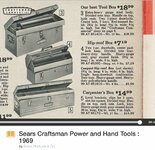


-Don!
RubiconJK
Well-known member
I see the carry versions of these Craftsman Commercial boxes occasionally however the stacks are much harder to find. Don's is one of the nicer examples that I've seen, but here is a link to a post I made a few years ago with some pics of mine.
 www.garagejournal.com
The VINTAGE toolboxes of Garage Journal!
If you guys are referring to the decals (one on the top box, one on the roller) for the Staten Island dealership this stack came out of, I agree. Those made it very tempting. But the roller and the top box needed a lot of work, I'm not really looking for a stack, I'm not a Huot nut, and he...
www.garagejournal.com