To avoid these ads, REGISTER NOW!

Some black oxide pics

mmouse

Well-known member
Joined
Sep 4, 2010
Messages
92
With respect, I've gotten the same finish using Brownells Oxpho-Blue gun bluing solution. I have the cream version.

Thanks for the tip. I have sporadically used the Caswell black oxide solution over the last 2 years. For the most part, it works as advertised. Last week, I used some on a table that I made. Since a table is too big to submerse, I had to keep it wet for a few minutes by using a foam brush. The cream would certainly solve the issues I had.

I started using the caswell solution on some engine accessory bolts on my daily driver Honda too see how well it holds up over time. Initially it looked really good, but has faded quite a bit after one year. I used caswell's cheaper penetrating sealer, but wiped off as much as I could because I didn't want oily bolts. Maybe this is why it faded quite a bit.

As far as tap water goes, I used it last week because I didn't have distilled water on hand. It turned the steel orange-blue. I'm assuming that was from the minerals in my hard tap water. The good news is that for the most part, the orange tone wiped off with wax and grease remover. After that, I applied satin clear coat.
 
To avoid these ads, REGISTER NOW!

mmouse

Well-known member
Joined
Sep 4, 2010
Messages
92
Picture of table. Caswell black oxide solution mixed with tap water. Wiped down with wax & grease remover (acetone and alcohol mixture). Then, cleared with two coats of diamond clear from Eastwood. Under bright light, it still has a slight orange tone.
 

daparrothead

Well-known member
Joined
Dec 21, 2013
Messages
200
Well I was kind of skeptical if this wood work as good as it seemed to. It was killing me to try it so out to the shop I went. Found the oldest beat up, rustiest Snap On impact socket I could find. Started off with a little filling and sand paper, bead blasted it then soaked it in acetone for about 2 minutes. Warmed the socket up with my heat gun and dunked it in the Brownell's Oxpho blue. Left it in for two minutes and rinsed it off, looked pretty good but not quite as dark as I wanted. So I warmed it up again and did another two minute soak in the Oxpho blue, rinsed with water, warmed it up again and soaked it in ATF. It turned out so good I had to do another one, OK one more, and another and another! lol Ended up doing 6 sockets & a 3/8 to 1/2 adapter and they all look better than new. :)

I'm going to have a drawer full of new impact sockets in the next couple days. :)


20140111_225959.jpg
 
Last edited:

SVibs

Well-known member
Joined
Nov 14, 2021
Messages
103
Location
MA. no, VA, no wait; what day is it?
I realize that this is a very old thread but that actually might be to my advantage. I'm currently restoring a 90s vintage 6" Delta jointer that was in pretty tough shape and I made the mistake of soaking parts in a 2:1 water to Simple Green mix for a day and it stripped much of the BO from the parts and they need to be re-coated. The jointer will live in my non-climate controlled garage in (humid!) Virginia. For those of you who have used the Caswell Black Oxide concentrate, how has the coating held up over time?
 

Steve_P

Well-known member
Joined
Sep 15, 2010
Messages
5,185
Ancient thread, and I just scanned it, but if you are blackening something below a 212F bath temperature, it is not black oxide- it's a phosphate treatment. BO is done above 250F which makes it dangerous; because it's dangerous to add additional water to the bath- you can get steam explosions unless you are adding the water from the bottom, which you can't do at home with a pan on a hot plate.
 
To avoid these ads, REGISTER NOW!

Renegade1LI

Well-known member
Joined
Mar 11, 2018
Messages
4,978
Location
long island ny
I realize that this is a very old thread but that actually might be to my advantage. I'm currently restoring a 90s vintage 6" Delta jointer that was in pretty tough shape and I made the mistake of soaking parts in a 2:1 water to Simple Green mix for a day and it stripped much of the BO from the parts and they need to be re-coated. The jointer will live in my non-climate controlled garage in (humid!) Virginia. For those of you who have used the Caswell Black Oxide concentrate, how has the coating held up over time?
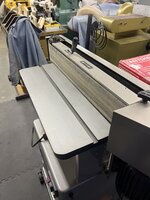
I have found you’re better off to paint the machine and clear coat the polished steel surfaces. I did a pm66 and delta edge sander, what a pleasure not to deal within the tops rusting. As the clear coat wears, just lightly sand and recoat, no more rust.
 

Attachments

  • image.jpg
    image.jpg
    305.8 KB · Views: 14
  • image.jpg
    image.jpg
    364.3 KB · Views: 14

SVibs

Well-known member
Joined
Nov 14, 2021
Messages
103
Location
MA. no, VA, no wait; what day is it?
Ancient thread, and I just scanned it, but if you are blackening something below a 212F bath temperature, it is not black oxide- it's a phosphate treatment. BO is done above 250F which makes it dangerous; because it's dangerous to add additional water to the bath- you can get steam explosions unless you are adding the water from the bottom, which you can't do at home with a pan on a hot plate.
I don't know much about the chemistry, process, or differences between the 2 coatings so can't comment. I'm mainly after whether or not the corrosion protection with the Caswell process is similar to the factory BO coating.
 

SVibs

Well-known member
Joined
Nov 14, 2021
Messages
103
Location
MA. no, VA, no wait; what day is it?
I have found you’re better off to paint the machine and clear coat the polished steel surfaces. I did a pm66 and delta edge sander, what a pleasure not to deal within the tops rusting. As the clear coat wears, just lightly sand and recoat, no more rust.
For large cast iron surfaces I agree. I generally, repaint the non-machined cast iron surfaces and wax the machined flat cast iron surfaces and/or coated them with Boeshield. But there's a ton of BO coated shafts, collars, pins, hardware, etc. that can't be painted because of film thickness issues with paint.--that's the stuff I need to BO recoat.
 

Steve_P

Well-known member
Joined
Sep 15, 2010
Messages
5,185
I don't know much about the chemistry, process, or differences between the 2 coatings so can't comment. I'm mainly after whether or not the corrosion protection with the Caswell process is similar to the factory BO coating.

Impact sockets are typically phosphate coated. This is actually superior to BO as it gives a coarser finish that holds the oil- which is the primary corrosion inhibitor. BO is prettier though, IMO.
 
To avoid these ads, REGISTER NOW!
Top Bottom