To avoid these ads, REGISTER NOW!

Digital vs Mechanical TW

infinite97

Well-known member
Joined
Aug 15, 2009
Messages
229
Location
Vancouver, WA
I have a tekton 1/2” clicker. I’ve exploded the head / gears twice.

I have a snap on techangle in 3/8” that I love.

In the market for a 1/2” tech angle in 1/2” but not willing to pay the new price.
 
To avoid these ads, REGISTER NOW!

WWheeler

Well-known member
Joined
Jun 23, 2015
Messages
4,105
Location
Middleofnowhere USA
The breaker bar handle direction is all I've ever needed to use for TTY fasteners. 45° turns are easy to repeat until you need a fraction thereof to meet spec.
 

qqzj

Well-known member
Joined
Nov 28, 2017
Messages
3,747
I have a tekton 1/2” clicker. I’ve exploded the head / gears twice.

I have a snap on techangle in 3/8” that I love.

In the market for a 1/2” tech angle in 1/2” but not willing to pay the new price.
Did tekton warranty the tw?
 

IndyGarage

Well-known member
Joined
Apr 29, 2010
Messages
9,685
Location
Indy
Not really unless you have transparent aluminum sockets (Yes, I'm a Trekkie). Yes, you know where the stopping point is since that's visible but you can't see where the mark on the point of the bolt is unless you've marked the outside of the socket at the same location. You have to continuously check to see where you are so that you don't go over.
I'm still not understanding what the problem is. Turn until you get resistance, note the location of the bar, then turn the required distance - 1/8 turn for 45 degrees, 1/6 turn for 60 degrees, 1/4 turn for 90 degrees, etc. .

It's not rocket science.
 

Odd-job

Well-known member
Joined
Aug 13, 2017
Messages
2,272
Location
SF Bay Area
I'm still not understanding what the problem is. Turn until you get resistance, note the location of the bar, then turn the required distance - 1/8 turn for 45 degrees, 1/6 turn for 60 degrees, 1/4 turn for 90 degrees, etc. .

It's not rocket science.
With great access this probably gets to close enough. Trying to get to some torque to yield bolt deep in an engine bay where you have to ratchet is a slightly different matter.
 

VolvoRyan

Well-known member
Joined
Dec 29, 2019
Messages
1,339
Location
Kentuckiana, USA
With great access this probably gets to close enough. Trying to get to some torque to yield bolt deep in an engine bay where you have to ratchet is a slightly different matter.


The whole point of TTY is to get close enough. Lots of workarounds if you get creative with the math. That said, if I could get a Snap-On Tech Angle, I'd be all over that.

-Ryan
 

javyLSU

Well-known member
Joined
Jan 2, 2019
Messages
1,542
Location
New Haven, CT
Clicker pros (for me):
  • No batteries to fuss with
  • Cheaper
Clicker cons:
  • Less accurate
  • Having to turn them down to the lowest setting after use drives me nuts
Digital pros:
  • Higher accuracy. Also, the lights let you know how close you get to target value, so you can go slower as you get closer for even more accuracy.
  • Ability to save preset torque values - no forearm workouts to set torque. Much faster when dealing with different fasteners with different torque specs
  • No unit conversions needed, tool does the math
  • Easier to do torque-plus-angle
  • Calibration date and cycle counts stored in tool
  • Tool compensates for added length of crowfoot wrench/torque adapter if in-line use is needed
  • Display much easier to read than engravings on clickers
Digital cons:
  • Batteries - I don't leave the batteries in the tool for fear of leaking batteries.
  • Expensive
In my book, the pros of the digital far outweigh those of the clickers. I switched over all my torque wrenches to Snap-on TechAngle torque wrenches a few years ago, and they are simply the finest torque wrenches I've ever used. They weren't cheap, but every single time I use them they make my work quicker and easier.
 

Odd-job

Well-known member
Joined
Aug 13, 2017
Messages
2,272
Location
SF Bay Area
Clicker pros (for me):
  • No batteries to fuss with
  • Cheaper
Clicker cons:
  • Less accurate
  • Having to turn them down to the lowest setting after use drives me nuts
Digital pros:
  • Higher accuracy. Also, the lights let you know how close you get to target value, so you can go slower as you get closer for even more accuracy.
  • Ability to save preset torque values - no forearm workouts to set torque. Much faster when dealing with different fasteners with different torque specs
  • No unit conversions needed, tool does the math
  • Easier to do torque-plus-angle
  • Calibration date and cycle counts stored in tool
  • Tool compensates for added length of crowfoot wrench/torque adapter if in-line use is needed
  • Display much easier to read than engravings on clickers
Digital cons:
  • Batteries - I don't leave the batteries in the tool for fear of leaking batteries.
  • Expensive
In my book, the pros of the digital far outweigh those of the clickers. I switched over all my torque wrenches to Snap-on TechAngle torque wrenches a few years ago, and they are simply the finest torque wrenches I've ever used. They weren't cheap, but every single time I use them they make my work quicker and easier.
good input. You are reminding me that I need swap out the alkaline batteries to those Energizer lithiums in all my digital torque wrenches.
 

corn chip

Well-known member
Joined
Jul 15, 2021
Messages
672
Clicker pros (for me):
  • No batteries to fuss with
  • Cheaper
Clicker cons:
  • Less accurate
  • Having to turn them down to the lowest setting after use drives me nuts
Digital pros:
  • Higher accuracy. Also, the lights let you know how close you get to target value, so you can go slower as you get closer for even more accuracy.
  • Ability to save preset torque values - no forearm workouts to set torque. Much faster when dealing with different fasteners with different torque specs
  • No unit conversions needed, tool does the math
  • Easier to do torque-plus-angle
  • Calibration date and cycle counts stored in tool
  • Tool compensates for added length of crowfoot wrench/torque adapter if in-line use is needed
  • Display much easier to read than engravings on clickers
Digital cons:
  • Batteries - I don't leave the batteries in the tool for fear of leaking batteries.
  • Expensive
In my book, the pros of the digital far outweigh those of the clickers. I switched over all my torque wrenches to Snap-on TechAngle torque wrenches a few years ago, and they are simply the finest torque wrenches I've ever used. They weren't cheap, but every single time I use them they make my work quicker and easier.

you made one or two good points but let me mention a few things you forgot.

not all mechanical clicker style use a stone age era dial handle with impossible to read numbers ,that must be dialed back to zero each time.
converting measuring systems could be a problem if the wrench scale only reads in one measuring system. but many wrenches have dual scale however and any good service manual lists each fastener torq value in multiple systems. so i think converting would very rarely be a problem , atleast in my experience.
easier to read display ?, again , not all mechanical clickers have crappy hard to read dial handles. some have easy to read sliding scales.
torq+angle: this is a valid point for a full time mechanic dealing with angles on a regular basis. weekend warriors very rarely run into tty fasteners and in the rare event they do , a simple work around ( like marking bolt head ) can be used.
accuracy: i see this as a moot point if the wrench in question is of high qaulity. ill attach the cert from one of my stahlwille. you can see its accuracy and deviation is plenty good enough for all but the rocket scientist building a spaceship.
dont get me wrong , im sure digital torq wrenches are badass and likely many of us would have them if we were in the mechanical field but at $600-$2500 ,us poor peasants simply cant afford it just to tighten lug nuts twice a year

20211215_215152.jpg
 

javyLSU

Well-known member
Joined
Jan 2, 2019
Messages
1,542
Location
New Haven, CT
you made one or two good points but let me mention a few things you forgot.

not all mechanical clicker style use a stone age era dial handle with impossible to read numbers ,that must be dialed back to zero each time.
converting measuring systems could be a problem if the wrench scale only reads in one measuring system. but many wrenches have dual scale however and any good service manual lists each fastener torq value in multiple systems. so i think converting would very rarely be a problem , atleast in my experience.
easier to read display ?, again , not all mechanical clickers have crappy hard to read dial handles. some have easy to read sliding scales.
torq+angle: this is a valid point for a full time mechanic dealing with angles on a regular basis. weekend warriors very rarely run into tty fasteners and in the rare event they do , a simple work around ( like marking bolt head ) can be used.
accuracy: i see this as a moot point if the wrench in question is of high qaulity. ill attach the cert from one of my stahlwille. you can see its accuracy and deviation is plenty good enough for all but the rocket scientist building a spaceship.
dont get me wrong , im sure digital torq wrenches are badass and likely many of us would have them if we were in the mechanical field but at $600-$2500 ,us poor peasants simply cant afford it just to tighten lug nuts twice a year

20211215_215152.jpg
Completely agree with you. If you’re tightening lug nuts once or twice a year, you have no business owning a digital torque wrench.
 

WWheeler

Well-known member
Joined
Jun 23, 2015
Messages
4,105
Location
Middleofnowhere USA
[...] Clicker cons:
  • Less accurate
  • Having to turn them down to the lowest setting after use drives me nuts [...]
Your pros/cons only compared dial clickers with digitals. There's no need to turn back to zero a split beam clicker and they are very accurate for LONG periods of heavy/professional use. Same goes for beam style. Digitals haven't been around long enough to realistically compare to the proven reliability of split beam and beam torque wrenches.

We use 90s era PI-made Snap-on split beams all day every day at work in a 24/7 automotive manufacturing setting that have to get a new calibration every month from our quality dept. Every month they come out to each machine and take it and ~15 minutes later they'll bring it back with a new sticker. They just work and keep on working and don't have a spring to wear out that necessitates turning it back to zero every time.
 
Last edited:
  • Like
Reactions: T45

Mgdoug3

Well-known member
Joined
Mar 2, 2018
Messages
1,391
Location
KY
I have 5 different kinds of TW, clicker, split beam, beam, torqometer and digital. I use Techangle mostly when rebuilding engines. It's really handy for TTY bolts and longer my other 1/2" TW so it takes less effort. If I'm just torqing tires I grab my clicker because that's close enough.

If you need a torque wrench for TTY, digital is the way to go. If you're just using it for wheels and/or no TTY bolts go with a clicker or split beam. A torque wrench with a flex head is handy in tight spots. If money isn't an issue get a split beam and a digital.
 

javyLSU

Well-known member
Joined
Jan 2, 2019
Messages
1,542
Location
New Haven, CT
Your pros/cons only compared dial clickers with digitals. There's no need to turn back to zero a split beam clicker and they are very accurate for LONG periods of heavy/professional use. Same goes for beam style. Digitals haven't been around long enough to realistically compare to the proven reliability of split beam and beam torque wrenches.

We use 90s era PI-made Snap-on split beams all day every day at work in a 24/7 automotive manufacturing setting that have to get a new calibration every month from our quality dept. Every month they come out to each machine and take it and ~15 minutes later they'll bring it back with a new sticker. They just work and keep on working and don't have a spring to wear out that necessitates turning it back to zero every time.
I considered split beams before I made my decision on the TechAngles, and I like them a lot. If I still owned a clicker, it would definitely be a split beam. The only thing I didn’t like about them is that they only work in clockwise rotation, and I do occasionally come across reverse threaded fasteners. Again, this is just my use case, and everyone’s is different.
 

RickyPetite

Well-known member
Joined
Oct 12, 2019
Messages
173
Location
Buck's County, PA
I started out with 2 Tekton clickers (1/4 in, 1/2 in). I subsequently got a great deal on a 3/8 CDI digital (non-angle) to fill the gap between the Tektons. Given that most auto work falls in the sub-100 ft-lb range, I use the CDI the vast majority of the time. Pro's of the digital is that you can clearly see when you have over-torqued the fastener and by how much. With the clicker, if you give a little extra just as it clicks, you over-torque but may not realize it. The downside of the digital is the batteries. If the tool is going to be unused for a length of time, I take the batteries out which is surprisingly annoying. Regarding the Tekton's, I recently tried to calibrate the 1/2" and it turned out miserably. The unit was out of spec by quite a lot and the usual screw-turn calibration resulted in a non-clicking state. I disassembled it/regreased/reassembled it without luck. It's the second one that ended up that way. I contacted Tekton and they replaced it. Unfortunately, I have now lost faith in the Tekton units and am shopping for something better. Probably a CDI clicker 1/4" and PI beam 1/2" in my future.
 

roofdweller49

Well-known member
Joined
Jan 22, 2023
Messages
182
One thing I do like about digital torque wrenches is that I'm a metric kind of guy and I think in N-m not ft-lb. I've got Japanese and German cars and all of the specs are in N-m and converting these to ft-lb is a pain in my ***. Here's an easy way to remember how to go from N-m to ft-lb. WHAT IS THE MOST POPULAR COMMERCIAL AIRPLANE IN THE WORLD? The 737. 0.737 is the conversion factor between N-M and ft-lbs. If you have 20 ft-lb divide that by 0.737 to determine the number of N-m. In this case 20/0.737 = 27 N-m. if you have N-m multiply by 0.737 to convert to ft-lb, 40 N-m = 40 X 0.737 = 29.5 ft-lb.
I want an one of those Norbar style etorks, but I wish they came in metric.

I guess I can just buy a Norbar. You'd think with so many cars with metric torque specs that we'd see more Nm primary scaled wrenches.
 

F-22

Well-known member
Joined
Jan 23, 2022
Messages
1,830
accuracy: i see this as a moot point if the wrench in question is of high qaulity. ill attach the cert from one of my stahlwille. you can see its accuracy and deviation is plenty good enough for all but the rocket scientist building a spaceship.

There are more things at play here. The mechanical torque wrenches themselves can be as accurate BUT with a competent operator. I guarantee you the majority of mechanics are not as accurate as their torque wrench allows them to be. Just the other day I was at someone swapping my tires, first he didn't want to use a torque wrench at all but I had mine in the trunk and said to just put the nuts on and that I'll tighten the wheels. He felt insulted and continued to take his own torque wrench out of the closet. It was a Unior, so quite a decent one (I think they're ~400€ new). He turned it till it clicked, then continue to click it 10 more times on every wheel. I cringed at every click. It's only accurate the first time, everything more is idiocity.

Even then when it clicks, if two people operate it to the same torque the actual measured force is quite different. As it was said, the digital torque wrench warns you when you're getting close and is a lot more repeatable.
 

cannuck

Well-known member
Joined
Nov 30, 2021
Messages
4,624
Location
Rural SK
When I was building an engine or two every day I found by far the highest quality and most practical 3/8 torque wrench was a Repco spit beam. Visible, audible and tactile signal. Still my 90% of use torque tool. Still in production as Warren & Brown 320500. I have a 1/2 drive adapter for TTY angle fasteners and have been thinking of getting a pair of Stahlwille electronics for those reasons, but when you get to big diesel engines that means 3/4" (= $$$$!!!!!).
 

dnschmidt

Well-known member
Joined
Oct 3, 2014
Messages
7,276
Location
Phoenix, AZ
I want an one of those Norbar style etorks, but I wish they came in metric.

I guess I can just buy a Norbar. You'd think with so many cars with metric torque specs that we'd see more Nm primary scaled wrenches.
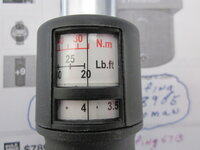
Look at the scale. The metric (N-m) scale is in red with the SAE in black. There is no such thing as a metric style Norbar torque wrench as they are unisex. Both scales are just as easily read.
 
To avoid these ads, REGISTER NOW!

roofdweller49

Well-known member
Joined
Jan 22, 2023
Messages
182
Look at the scale. The metric (N-m) scale is in red with the SAE in black. There is no such thing as a metric style Norbar torque wrench as they are unisex. Both scales are just as easily read.
But the single digit dial on the very bottom is for ft lb, no? I'd still have to convert if I wanted, say 113 Nm Amazon-Handle2.jpg
 

Samuel D

Well-known member
Joined
Apr 9, 2019
Messages
638
The mechanical torque wrenches themselves can be as accurate BUT with a competent operator. I guarantee you the majority of mechanics are not as accurate as their torque wrench allows them to be. Just the other day I was at someone swapping my tires, first he didn't want to use a torque wrench at all but I had mine in the trunk and said to just put the nuts on and that I'll tighten the wheels. He felt insulted and continued to take his own torque wrench out of the closet. It was a Unior, so quite a decent one (I think they're ~400€ new). He turned it till it clicked, then continue to click it 10 more times on every wheel. I cringed at every click. It's only accurate the first time, everything more is idiocity.
Exactly.

I damaged my car in Germany not long ago, hundreds of kilometres from my home in another country, and had to go looking for a local mechanic with no knowledge of the landscape. The first guy I found was tightening lug nuts in that style: four clicks per nut (screw, really). Swing, click, click-click-click.

That’s at best useless and worst harmful. You should stop at the first click. And you should be swinging the wrench smoothly and slowly at the point of the click: about 20 degrees a second.

What’s more, that final swing should be large: ideally a quarter of a turn. So it should take about four seconds. Studies have shown a lot of mechanics swing too fast and overshoot the free movement beyond the click, slamming the momentum of the wrench handle into the fastener after it falls over the centre of the click.

You might bump into the click unexpectedly toward the beginning of the final swing. In that case, back off (with another tool) and adopt a wrench position and body position that allow you to approach the target torque slowly over a quarter-turn with a good grip on the centre of the handle, applying force purely tangentially to the arc of the swing at the moment of the click.

And if you encounter stick-slip (creaking, etc.), abort the attempt and clean and lubricate the threads or replace the fastener. Accurate torque measurement is not possible in the presence of stick-slip.

Another couple of points too often ignored in the haste of a busy professional environment:

First, unlike beam-type or electronic torque wrenches, click-type wrenches should be exercised (clicked) a few times before the first use of the day. This is ideally done at max torque, but target torque for your application gives most of the benefit. This breaks up corrosion and replenishes lubricant at the sliding surfaces of the mechanism, returning the wrench as closely as possible to its calibrated state.

Second, screw in the target torque from below. That’s how the wrench was calibrated. Hysteresis will harm accuracy if you approach target torque from above.

Third, it follows from the above that you can’t check the torque of a fastener without turning it. Sticking friction (stiction) may prevent a bolt from turning at its target torque even if its tension is much lower than it should be (i.e. it has backed out). To check the torque, start again. Break the fastener loose and then set the torque again with the long, slow, smooth final swing. (If you need to check whether a fastener has worked loose, give it a witness mark and compare before and after re-torquing it.)

As is often the case, the tool matters less than how it’s used. Of course nice tools are nice to use.
 

dnschmidt

Well-known member
Joined
Oct 3, 2014
Messages
7,276
Location
Phoenix, AZ
But the single digit dial on the very bottom is for ft lb, no? I'd still have to convert if I wanted, say 113 Nm Amazon-Handle2.jpg
NO. I took a picture of my actual eTorq wrench below. The Newton Meter scale in is Red and the ft-lb scale is in Black. The scale at the very bottom in the first picture is a ft-lb vernier. On the second picture I've set the wrench to 50 N-m which corresponds to about 37 ft-lb.
 

Attachments

  • IMG_3380.JPG
    IMG_3380.JPG
    523.5 KB · Views: 13
  • IMG_3381.JPG
    IMG_3381.JPG
    555.4 KB · Views: 14

roofdweller49

Well-known member
Joined
Jan 22, 2023
Messages
182
NO. I took a picture of my actual eTorq wrench below. The Newton Meter scale in is Red and the ft-lb scale is in Black. The scale at the very bottom in the first picture is a ft-lb vernier. On the second picture I've set the wrench to 50 N-m which corresponds to about 37 ft-lb.
No I understand, but if I wanted 51Nm, I can't just dial it in. Just like how you have it set at ~36.9ft lbs. Granted, 5Nm resolution should be enough, and it's a much more useful scale than your typical micrometer torque wrench.


This Norbar, you can dial in 11.5 Nm no problems
 
Last edited:

ronkz650

Well-known member
Joined
Oct 29, 2022
Messages
220
Location
Denver, CO
If you wanted 51nm, just set the dial by eye a little higher than 50nm. If you wanted 52nm, just set the dial not quite 1/2 way between 50nm and 55nm. It's easy and fairly close, that's how I do my split beams. Being as the accuracy is only 4% on the wrench, to me going by eye on the dial between the numbers is plenty close.
 

2ndGearRubber

Well-known member
Joined
Mar 24, 2014
Messages
14,185
Location
Pittsburgh
I don't torque everything, but I do use torque wrenches daily. Mostly drain plugs, caliper bracket bolts, engine stuff.

If you're using it daily, get a techangle and move on with your life having the ultimate solution. I also have standard micrometer style, and a beam or two. Mostly my preference is for digital simply because I can change ranges faster and do not have reset them to "zero". So I can grab a techangle 1/2 out of the box, it's set at 200ft/lb by the time I walk over, torque, walk it back and it turns off automatically. Same deal if you have a fastener range from 75 to 20. I can adjust digital faster.

For less than constant use, mechanical "clicker" is probably the best bet. That's what I keep in my cart, mostly for drain plugs and critical hardware in the engine bay.
 

Farmall450

Well-known member
Joined
Dec 23, 2011
Messages
13,367
Location
Marengo, Illinois
The GJ consensus is always to eventually buy both, but this is going to be highly opinionated. Went on a similar journey as a DIYer a while back and eventually ended up with a selection of digitals.

Mechanicals are definitely nice and low fuss with no batteries and can be dropped in coolant without too much worry. While I like my CDIs the lower ratchet tooth count drives me nuts in tight places. Think of the old notorious Craftsman 36 tooth ratchets.

Digitals are nice especially if you don't like math. Things requiring angle. Also nice not having to convert for newton meters if you deal a lot with Euro/global stuff, etc. My digitals don't vibrate, but I could see them being annoying if you can't see the lights or hear the beep.

One last thing, if you are lazy like me... for some reason unwinding the click types (so they don't lose calibration) I find really annoying. I just leave my Quinn/Eclatorq 1/2 digital set to 100 ft/lbs when I want to tighten lug nuts on the family fleet which is probably 90% of the use of my 1/2 inchers. Maybe split beam, dial or beam types would be a nice alternatives or compliments to digitals.
It's annoying, but not several hundred dollars annoying, for me.

But I would understand if you regularly dealt with angle - the old **** I work on is all torque.
 

dnschmidt

Well-known member
Joined
Oct 3, 2014
Messages
7,276
Location
Phoenix, AZ
No I understand, but if I wanted 51Nm, I can't just dial it in. Just like how you have it set at ~36.9ft lbs. Granted, 5Nm resolution should be enough, and it's a much more useful scale than your typical micrometer torque wrench.


This Norbar, you can dial in 11.5 Nm no problems
You’re getting ridiculous. The lower value e-Torq wrenches have finer scales as well. The one I took pictures of is 20-100 ft-lb model. They make lower max value wrenches in both 1/4" and 3/8" drive. I've tried to help you but now I'm done with you. If you can't figure something this simple out nothing I can tell you is going to help you understand it.
 

roofdweller49

Well-known member
Joined
Jan 22, 2023
Messages
182
You’re getting ridiculous. The lower value e-Torq wrenches have finer scales as well. The one I took pictures of is 20-100 ft-lb model. They make lower max value wrenches in both 1/4" and 3/8" drive. I've tried to help you but now I'm done with you. If you can't figure something this simple out nothing I can tell you is going to help you understand it.
I guess I'll grab a 3/8" one - for the price I see no better alternatives and you've recommended them for a while
 

F-22

Well-known member
Joined
Jan 23, 2022
Messages
1,830
The first guy I found was tightening lug nuts in that style: four clicks per nut (screw, really). Swing, click, click-click-click.
Yes, wanted to mention - my old Focus has in total 16 lug nuts. By clicking it 10 times on every lug nut, instead of using it 16 times he used it 160 times. If he has... 15 cars per day, and most new ones have 5 lug nuts, he'd need to use it 300 times if he clicked once, but he uses it 3000 times instead. If I go on, he'd need to use it 6000 times per month but he does that in two days and clicks it 60000 times per month.

Basically, in a month (even when excluding weekends), he uses it as many times as he could use it in a year AND he is less accurate.

I know lug nuts don't need high precision. Even cylinder head studs. But it just makes me cringe every time I see it. Only thing worse is when they use a torque wrench as a breaker bar - and we all know some idiots certainly do that as well.

It's like using a micrometer as a C clamp.
 

dchawk81

Well-known member
Joined
Jul 31, 2014
Messages
14,366
Yes, wanted to mention - my old Focus has in total 16 lug nuts. By clicking it 10 times on every lug nut, instead of using it 16 times he used it 160 times. If he has... 15 cars per day, and most new ones have 5 lug nuts, he'd need to use it 300 times if he clicked once, but he uses it 3000 times instead. If I go on, he'd need to use it 6000 times per month but he does that in two days and clicks it 60000 times per month.

Basically, in a month (even when excluding weekends), he uses it as many times as he could use it in a year AND he is less accurate.

I know lug nuts don't need high precision. Even cylinder head studs. But it just makes me cringe every time I see it. Only thing worse is when they use a torque wrench as a breaker bar - and we all know some idiots certainly do that as well.

It's like using a micrometer as a C clamp.
You'd explode if you saw me do my semi truck. 10 lug nuts per wheel, I do the star once then go around twice just to make sure I didn't miss any.
 

F-22

Well-known member
Joined
Jan 23, 2022
Messages
1,830
You'd explode if you saw me do my semi truck. 10 lug nuts per wheel, I do the star once then go around twice just to make sure I didn't miss any.
Ah that wouldn't bother me, it's understandable and has a reasoning to check your work. The way that particular mechanic did it was to tighten until it clicked, then he just juggled it on that same nut. Like some people shift manual cars, and they keep viciously shaking the shift lever while in neutral. He didn't re-check in the end if he tightened all of them.
 

2ndGearRubber

Well-known member
Joined
Mar 24, 2014
Messages
14,185
Location
Pittsburgh
Ah that wouldn't bother me, it's understandable and has a reasoning to check your work. The way that particular mechanic did it was to tighten until it clicked, then he just juggled it on that same nut. Like some people shift manual cars, and they keep viciously shaking the shift lever while in neutral. He didn't re-check in the end if he tightened all of them.

I've seen a lot of guys do that, it's a "compulsion" sort of thing like you said about people jerking off the shift lever in neutral. Seems to spread through a shop, it's fairly satisfying to do.
 

dnschmidt

Well-known member
Joined
Oct 3, 2014
Messages
7,276
Location
Phoenix, AZ
Yes, wanted to mention - my old Focus has in total 16 lug nuts. By clicking it 10 times on every lug nut, instead of using it 16 times he used it 160 times. If he has... 15 cars per day, and most new ones have 5 lug nuts, he'd need to use it 300 times if he clicked once, but he uses it 3000 times instead. If I go on, he'd need to use it 6000 times per month but he does that in two days and clicks it 60000 times per month.

Basically, in a month (even when excluding weekends), he uses it as many times as he could use it in a year AND he is less accurate.

I know lug nuts don't need high precision. Even cylinder head studs. But it just makes me cringe every time I see it. Only thing worse is when they use a torque wrench as a breaker bar - and we all know some idiots certainly do that as well.

It's like using a micrometer as a C clamp.
Many, especially TOPTUL's torque wrenches, made in Asia or in Europe are uni-directional. They only work on right handed fasteners so using them as a breaker bar to remove things is completely acceptable as nothing inside of the wrench is moving. I use the one I've got that's about 30 inches long for this purpose when I do head bolts and it doesn't bother it at all. I asked TOPTUL why their torque wrenches only work in one direction and they said so that you can take things off in the other direction.
 

2ndGearRubber

Well-known member
Joined
Mar 24, 2014
Messages
14,185
Location
Pittsburgh
Many, especially TOPTUL's torque wrenches, made in Asia or in Europe are uni-directional. They only work on right handed fasteners so using them as a breaker bar to remove things is completely acceptable as nothing inside of the wrench is moving. I use the one I've got that's about 30 inches long for this purpose when I do head bolts and it doesn't bother it at all. I asked TOPTUL why their torque wrenches only work in one direction and they said so that you can take things off in the other direction.

That's a huge downside. So you can't torque reverse thread hardware, or use crowfeet/torque adapters from the "back side" of a fastener?
 

Samuel D

Well-known member
Joined
Apr 9, 2019
Messages
638
That's a huge downside. So you can't torque reverse thread hardware, or use crowfeet/torque adapters from the "back side" of a fastener?
On the other hand, reverse-threaded hardware shouldn’t exist. It’s proof of bad engineering. The correct way to stop a screw from backing out by precession is not to reverse the thread so it frets anyway but tends to self-tighten. It’s to stop it moving, i.e. eliminate radial loads on the screw.
 

F-22

Well-known member
Joined
Jan 23, 2022
Messages
1,830
On the other hand, reverse-threaded hardware shouldn’t exist. It’s proof of bad engineering. The correct way to stop a screw from backing out by precession is not to reverse the thread so it frets anyway but tends to self-tighten. It’s to stop it moving, i.e. eliminate radial loads on the screw.
It's not bad engineering, sometimes you have space constraints or budget constraints that require you to make the most out of what you have, and if by using left handed threads you manage to cheaply solve your issue without problems, it's brilliant engineering.

Specifically I remember some old Italian mopeds that had the generator rotor (flywheel) mounted with a reverse threaded nut. Yes, you can use locking tabs or some kind of a high tension fastener... But you need to ask youself what the market for it was, and what kind of mechanics worked on mopeds in the 60's and 70's when it was new (often just kids thinkering). If they used such solutions, the tabs wouldn't be bent the first time they'd swap the points, and other solutions would require different designs etc... The left hand thread worked, even if you'd forget to tighten it, it would generally be fine.
 

Samuel D

Well-known member
Joined
Apr 9, 2019
Messages
638
Loctite, nyloc nuts, safety wire, reverse threads … I don’t like any of them.

They’re proof the designer knew that radial movement (within the necessary thread clearance) would cause problems. But instead of redesigning the joint to eliminate that movement, they used one of these hacks.

Until about the end of World War II, cars had left-handed lug nuts on their left wheels. The wheels sometimes fell off anyway.

Eventually someone designed the modern lug nut or screw, which has a deep conical seat that absorbs radial loads with minimal movement, relieving the threads of a duty for which they weren’t designed. Car wheels no longer fall off.

I don’t know the Italian moped flywheel situation but feel sure there could have been a better solution than threading them the wrong way.
 
To avoid these ads, REGISTER NOW!
Top Bottom