To avoid these ads, REGISTER NOW!

Anti-seize on Lug Studs?

PCustoms

Well-known member
Joined
Jul 23, 2011
Messages
22,803
Location
VT
Paging TorqueTestChannel to the Antisieze thread...TorqueTestChannel to the Antisieze thread... :)
Why, so they can verify well established engineering principles?

Lubed threads have a k factor, as long as the torque is reduced correctly there's no issue.

What will really blow your mind is if I tell you that liquid thread lockers also should be used with a reduced torque....
 
Last edited:
To avoid these ads, REGISTER NOW!

Mooky

Well-known member
Joined
Jul 6, 2014
Messages
257
Location
PA
From one the countless, rambling debates on anti seize, the engineering calculations are:


Torque number with Anti-seize:
The torque required for a bolted joint design comes from a long string of calculations, but boils down to a simple linear equation.

T = Wp x K x dn
Where T=torque; Wp=fastener preload; K=torque coeff; dn=diameter

The factor that changes with dry vs lubricated fasteners is the "torque coefficient" and is published for a variety of cases. These are taken from a DuPont Engineering Specification (10 pages of calcs). Examples:

- Dry steel fasteners: K=0.20
- Lightly oiled steel: K=0.15
- Cad Plated: K=0.14
- Anti Seize on steel: K=0.13 (as published by Bostik for their Never Seez products)
Graphite & mineral oil: K=0.10

Fastener preload is the value held constant. Solving for the reduced torque reduces to the ratio of the lubricated fastener’s k value to that of the unlubricated, 0.13 / 0.20 = 0.65.

Never Seize versus dry uncoated steel, multiply the specified torque by 0.65.
 

2ndGearRubber

Well-known member
Joined
Mar 24, 2014
Messages
14,185
Location
Pittsburgh
Luckily lug nuts are not remotely torque sensitive, and function at a wildly large range of torque values.

I don't think anyone is disagreeing that liquid/grease on threads reduces torque. The argument is that it doesn't matter from a functional standpoint. On lubricated threads, the torque should be reduced, if ones goal is the identical clamping force as a dry lug. What people like myself are saying, is that the torque involved in a lug nut installation is not critical whatsoever. A large range of values will produce a functional clamping force that does not damage the threaded surfaces, and secures the wheel.


It don't matter. LOL It's a lug nut. Install it using an IQ above room temperature, and you'll be fine.
 

bubinga

Well-known member
Joined
Jul 26, 2014
Messages
12,744
Location
Bridgeport Ohio. (Across River From Wheeling WV)
The stretch of the stud is what is providing the clamping force to hold the wheel on. You get that stretch by tightening the lug nut (obviously). However, the friction between the lug nut cone and the wheel is maintaining the torque (and resultant clamp force). If there was no friction in the cone/seat then nothing would keep the nut from backing off (in a frictionless world bolted joints won't work).
Sure, it has to torque down or tighten to something.
 

bubinga

Well-known member
Joined
Jul 26, 2014
Messages
12,744
Location
Bridgeport Ohio. (Across River From Wheeling WV)
NO

Will I use it on the centering ring of the hub when putting a brake disc or wheel on ...YES

Even a Little where I know the wheel meets the face of the rotor... yes

But lug torque is a value given for a dry stud.

Lubricate that stud and the torque value goes out the window

It is one of the few fasteners that are intended to be assembled dry in order to get the right torque value ( which is just a numerical value to get the proper bolt stretch.

Even if you read a Machinery's Handbook and get a torque spec out of it for a a geeric bolt of any grade, it says the value is with the threads lightly oiled, but again wheel fastening hardware is an exception to that rule.
I know when I worked at the equipment garage for the highway department I put a little bit on something
(EDIT; put anti seize on a truck wheel stud)
one day in the format came out and told me not to he said the dot said not to use it for what it's worth. I would have to say tight is tight whether you have a lubricant an anti-seize oil as long as you didn't over stretch the thread as someone else stated I can't see the lubricant properties of the anti-seize making it loosen up. But they said not to use it so I didn't use it.
 
Last edited:

bubinga

Well-known member
Joined
Jul 26, 2014
Messages
12,744
Location
Bridgeport Ohio. (Across River From Wheeling WV)
You have to between the rotor and the hub here or you'll need a torch to get them off.
I have used it between the rotor and have myself but I think it was one of the other groups they said no anti-seize is for threads only. I'm sure it works though, between the hub and the rotor to help it not stick.
As you stated just a very light coating because you don't want a possible hydraulic action taking place preventing the rotor from sitting home.
 

bubinga

Well-known member
Joined
Jul 26, 2014
Messages
12,744
Location
Bridgeport Ohio. (Across River From Wheeling WV)
Aren’t wet torque values only for the threads being lubricated? The nut face or bolt head being lubed would have little effect on the stretch of the threads where they contact each other.
I imagine it would result in slightly less friction, (lubrication under the bolt head or cone seat that is) therefore allowing slightly more stretch or torque to be applied to the threads just slightly now.
 

bubinga

Well-known member
Joined
Jul 26, 2014
Messages
12,744
Location
Bridgeport Ohio. (Across River From Wheeling WV)
interesting, I am not in the mechanics field so i do not get to see that many. However the 4 i have owned "all Subaru STI all different years" have never had that issue. But the 4 i have owned is nothing compared to the ones that must come through your place
Right but you and I are careful when we work on our cars, Blake The car Guy and other professional mechanics second gear rubber etc we are all experienced and careful but we also know there's a lot of yoyos out there.
We had a guy at the equipment garage good mechanic and everything but, if he would cross a bolt, out came the impact and he"d say real mean like, "A stripped in bolt is better than no bolt........"
Yeah it's in there and it's providing some clamping force, but I wouldn't want to be the guy to have to take it out.
 

bubinga

Well-known member
Joined
Jul 26, 2014
Messages
12,744
Location
Bridgeport Ohio. (Across River From Wheeling WV)
From one the countless, rambling debates on anti seize, the engineering calculations are:


Torque number with Anti-seize:
The torque required for a bolted joint design comes from a long string of calculations, but boils down to a simple linear equation.

T = Wp x K x dn
Where T=torque; Wp=fastener preload; K=torque coeff; dn=diameter

The factor that changes with dry vs lubricated fasteners is the "torque coefficient" and is published for a variety of cases. These are taken from a DuPont Engineering Specification (10 pages of calcs). Examples:

- Dry steel fasteners: K=0.20
- Lightly oiled steel: K=0.15
- Cad Plated: K=0.14
- Anti Seize on steel: K=0.13 (as published by Bostik for their Never Seez products)
Graphite & mineral oil: K=0.10

Fastener preload is the value held constant. Solving for the reduced torque reduces to the ratio of the lubricated fastener’s k value to that of the unlubricated, 0.13 / 0.20 = 0.65.

Never Seize versus dry uncoated steel, multiply the specified torque by 0.65.
So if it calls for a hundred foot pounds and I use anti-seize torque it to 65 ft pounds.
 
Last edited:

kelpaso1

MEMBER EMERITUS
Joined
Sep 28, 2009
Messages
3,962
Location
New Brunswick
Not joking, that's my method. stick a lug in the socket. Zip it down, next one, zip it down. I never start them by hand. Unless one is starting it 2-3 threads it can still go on messed up, especially if the leading threads are messed up from a hammer hit or something.

A couple times a year when I start one a little off, I simply remove the fastener, run a chaser on the lug and stud,and it's just fine. So long as one uses little to no down pressure starting the nut, it isnt an issue. The threads want to line up, just like a tap wants to cut straight. You just need to let them.
Wow I would never hire someone that worked like this.
 

2ndGearRubber

Well-known member
Joined
Mar 24, 2014
Messages
14,185
Location
Pittsburgh
Wow I would never hire someone that worked like this.

Start a nissan maxima 18" wheel by hand. You'll find you cant, its recessed 2+ inches. That's where the method came from.

It's also nice because the lug is on, or off. No goobers spinning them on, and walking away, and the wheel falling off. And yes, a finger tight lug will make a torque wrench click, with the wheel sitting 15 degrees crooked and not touching the hub.
 

ptabatcher

Well-known member
Joined
Jun 26, 2021
Messages
182
Location
NE Ohio
Luckily lug nuts are not remotely torque sensitive, and function at a wildly large range of torque values.

With past cars, the owners manual would always specify a single value. On the new Mazda we bought last summer, I noticed they give a range. They recommend between 80 and 108 ft-lb.

I’ve been applying caliper grease between the wheel and the hub for 20 years. Ever since I needed to use a mallet to remove a wheel that had rusted to a hub. I’ve also lubed the bolts and studs on my cars. For those, I tend to give them a spritz of Corrosion-X before installing.
 

WWheeler

Well-known member
Joined
Jun 23, 2015
Messages
4,105
Location
Middleofnowhere USA
Start a nissan maxima 18" wheel by hand. You'll find you cant, its recessed 2+ inches. That's where the method came from.
I start by hand using the socket and extension, same way I do anything recessed like spark plugs. Only after it's started threading will I put a ratchet or power tool on ANY fastener. That's like shop class 101.
 

corn chip

Well-known member
Joined
Jul 15, 2021
Messages
672
There is NO difference between a wheel stud/bolt and any other bolt or nut. I never knew that some anti-seize mfgs didn't recommend it for wheel bolts/studs. Why? It's obviously a liability prevention. Because if someone put it on their wheel studs, didn't properly tighten them, and the wheel fell off, they'd find a ***** lawyer that'd file a lawsuit. So they say "don't use on wheel studs". Lawsuit prevention done.
But again, there is no difference between a wheel stud/bolt or any other bolt. It is 100% the same thing- it's a threaded fastener. I've driven 500K+ miles with anti-seez on wheel studs. And every car that I take the wheels off has it on it- so at least another 1 million miles on all of them. No wheel losses. And I use it on brake disc/drums where they contact the axle flange.

wait a minute. are you saying a lug and wheel stud act just the same as any other fastener ? how can that be lol
you may not gain any popularity among the members but thanks for setting the record straight
 

PelicanPines

ALLIANCE MEMBER
Joined
Apr 30, 2014
Messages
38,112
Location
New Jersey, USA, Earth, My own reality
Pines SR used to dab of grease on each lug. We lived our lives in beach country and never had an issue over either of our lives with a rusted stuck lugnut. Granted I use a breaker bar to loosen mine and a torque wrench to put them back on. Over my fathers 8 decades... a lug nut NEVER "went slack" or got loose on it's own. Neither one of us has ever snapped a lug either. My uncle who refused to do this practice snapped several that I witnessed.

For reference... for the last 2 decades... I have only owned Subarus.

Insert flame war below about torque values and grease and temperature and such...
 

2ndGearRubber

Well-known member
Joined
Mar 24, 2014
Messages
14,185
Location
Pittsburgh
I start by hand using the socket and extension, same way I do anything recessed like spark plugs. Only after it's started threading will I put a ratchet or power tool on ANY fastener. That's like shop class 101

In the 102 course you learn how to spin it on with the gun.

Not that I'd start a spark plug like that BTW.
 
To avoid these ads, REGISTER NOW!

lund

Well-known member
Joined
Nov 2, 2019
Messages
768
Location
Michigan
Sorry, but a lot in this thread is really off. You guys realize that this bs on no anti-seize on wheel studs is driven by USA lawsuit mania when someone does something wrong? You torque bolts on a flange primarily to be uniform tightness to prevent tilting and distortion. There is a HUGE range that is ok. Factor of 2x almost to failure. Degrade specs if you want to account for lubrication, but it *DOES NOT MATTER*. Corrosion will screw up torque. If you live in an area with rust, you are way worse not using anti-seize. Plus if you have to get the damn thing off without impact on a flat etc, you may have real fun in a bad situation. It is also important to coat the mating surfaces with anti-seize in rust prone areas also.

Listen to engineers who study the problem if you do not believe me (and I am a physical scientist). What is really annoying is tire places pushing this lawyer driven madness. My sent my wife to get new tires and they told her to have the car towed home due to anti-seize on the studs. I was royally po'd and had fun talking the manager (who essentially admitted it was stupid and driven by company lawyers).

What is also funny is people arguing this for wheel studs seems ok with anti-seize on much smaller nuts and bolt -- even in AL blocks. There the extra torque on a small diameter **might** catch up with you if you do not degrade (should usually be enough margin though).
 

Tools4Me

Well-known member
Joined
Jun 22, 2021
Messages
546
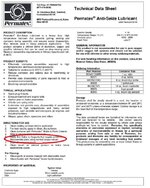
Permatex anti seize states in there technical data sheet to torque to normal values after applying. :dunno:
Permatex Technical Data sheet link

permatex anti seize 2.jpg
Yes they do, and I think they are being very lazy and disingenuous by doing so. They also no longer post the K-values of their products on their website to help customers with calculating torque reduction factors. Permatex must know they are lying to the customer, because they contradict their "use normal torque values" statement on their own website. Look at the following FAQ question posted on their site.

Source- https://www.permatex.com/faqs/

Does Permatex® suggest applying anti-seize to lubricate lug nuts when installing or tightening the nuts?
Permatex® does not recommend the use of any anti-seize product on wheel studs. Many people have used anti-seize for this applications, however, there is the potential for over-torquing and therefore, higher clamp loads and potentially dangerous bolt stretch. Because of the lubricity of anti-seize, there is a tendency to over-tighten because of the ease with which the nut will bear down on the lug. For this reason, even if you try to torque the nuts to factory specs, the clamp load may become too high depending on the type of bolt, size and manufacturer.

The answer they give demonstrates clearly that you can overstretch bolts if you don't reduce your final torque value to account for the lubricity of anti-seize. They can't have it both ways. If there's a chance of overstretching a lug bolt if the final torque isn't reduced to compensate for anti-seize, there's a chance of overstretching other bolts that aren't similarly reduced (using techniques like K-value torque reduction equations or actual clamping load testing). That's common sense, there's nothing magical about lug bolts compared to regular bolts/nuts.

I think Permatex is doing a tremendous disservice to it's customers by having the "use normal torque values" statement on their products, especially for products that have fairly high torque reduction factors, like their Nickel anti-seize, which requires a 35% reduction in torque to achieve clamping forces equal to a dry bolt.

Now go to the Loctite anti-seize website or pretty much any other anti-seize maker's website and you will see torque reduction K values listed for their anti-seize products. I attached the Loctite "K-value" chart to this post so you can see what I mean. Torque reduction when using anti-seize is a thing, and it is important. Anyone trying to tell you otherwise is not being truthful for some reason.
 

Attachments

  • loctite anti seize chart which shows k values for each of their products.png
    loctite anti seize chart which shows k values for each of their products.png
    511.2 KB · Views: 12
Last edited:

JeepYJ

Well-known member
Joined
Dec 25, 2015
Messages
8,966
In the 102 course you learn how to spin it on with the gun.

Not that I'd start a spark plug like that BTW.
Good chance once you run that spark plug in that’s the last time they’ll need to be changed. Wheels should be coming off at least once per year.
Of course fixing a cross threaded lug is easier than a spark plug hole!
Ive always started them a couple turns by hand. IMO only a NASCAR put crew should be gunning lug nuts on (now they don’t even do that)
 

laser3kw

Well-known member
Joined
Nov 17, 2012
Messages
7,276
Location
northen IL
I think Permatex is doing a tremendous disservice to it's customers by having the "use normal torque values" statement on their products,
That is the most accurate statement yet. I happen to notice the other statement on their technical data sheet someone else posted. Makes you scratch your head. The same argument starts with Loc-tite (thread locking products) and whether you should treat it as a lubricant and torque accordingly.
 

Terra Nova

Well-known member
Joined
Feb 26, 2012
Messages
4,198
Location
Michigan
Sorry, but a lot in this thread is really off. You guys realize that this bs on no anti-seize on wheel studs is driven by USA lawsuit mania when someone does something wrong? You torque bolts on a flange primarily to be uniform tightness to prevent tilting and distortion. There is a HUGE range that is ok. Factor of 2x almost to failure. Degrade specs if you want to account for lubrication, but it *DOES NOT MATTER*. Corrosion will screw up torque. If you live in an area with rust, you are way worse not using anti-seize. Plus if you have to get the damn thing off without impact on a flat etc, you may have real fun in a bad situation. It is also important to coat the mating surfaces with anti-seize in rust prone areas also.

Listen to engineers who study the problem if you do not believe me (and I am a physical scientist). What is really annoying is tire places pushing this lawyer driven madness. My sent my wife to get new tires and they told her to have the car towed home due to anti-seize on the studs. I was royally po'd and had fun talking the manager (who essentially admitted it was stupid and driven by company lawyers).

What is also funny is people arguing this for wheel studs seems ok with anti-seize on much smaller nuts and bolt -- even in AL blocks. There the extra torque on a small diameter **might** catch up with you if you do not degrade (should usually be enough margin though).

Most people really misunderstand factor of safety. Just because something is designed with X times factor of safety doesn't mean you won't damage or compromise the part by loading it beyond the design spec. Factor of safety just means you won't have a single cycle catastrophic failure when loaded to X times its design load. Doesn't mean you haven't permanently deformed or otherwise compromised the part by overloading it.

Generally fasteners are not sized with 2 times factor of safety. Bolted joints are sized to provide the needed clamp load at 60-70% of yield strength. That means when you torque a fastener to spec the bolt/wheel stud is stretched to within 60-70% of it's yield strength. Maybe not a big deal on larger fasteners but smaller ones can easily be overloaded with small increases in torque. Factor in the standard deviation on bolted joints, which can be high since you're relying on dry friction and some parts of the population will fail early. That is the one benefit of lubricating bolts that hasn't been discussed is it tends to tighten up the population and you'll have a more uniform torque/clamp load across multiple fasteners.
 
Last edited:

2ndGearRubber

Well-known member
Joined
Mar 24, 2014
Messages
14,185
Location
Pittsburgh
Good chance once you run that spark plug in that’s the last time they’ll need to be changed. Wheels should be coming off at least once per year.
Of course fixing a cross threaded lug is easier than a spark plug hole!
Ive always started them a couple turns by hand. IMO only a NASCAR put crew should be gunning lug nuts on (now they don’t even do that)

That's my theory. Take basically nothing to fix nicked up lug threads. Transmission case? Oil pan bolts? Timing chain guides? Yeah, that's probably getting a 1/4 torque wrench for that. Although feel would be fine, I just prefer to be double careful. A trashed lug nut and stud cost $10 in parts and 10min of time. Just touch them up with a chaser, that's the fix 99% of the time. Doing a helicoil on a timing chain guide is a WAY bigger deal, as far as time and access.
 

corn chip

Well-known member
Joined
Jul 15, 2021
Messages
672

while its nice he puts a visual representation to whats already been said ( for the members that needed visual aid ) ,he also says something thats irrelevant. perhaps he hasnt any real world knowledge of the subject.
at the video end he seems to put a bit of emphasis on the increased clamp force but that doesnt matter in this situation. the hub face wont care . the wheel face wont care. now if it were gasketed components like oil pan ,waterpump , valve cover , etc then ya the additional clamp force would likely be a big deal.
 

KnurledNut

Well-known member
Joined
Jan 28, 2011
Messages
8,130
Location
n/a
while its nice he puts a visual representation to whats already been said ( for the members that needed visual aid ) ,he also says something thats irrelevant. perhaps he hasnt any real world knowledge of the subject.
at the video end he seems to put a bit of emphasis on the increased clamp force but that doesnt matter in this situation. the hub face wont care . the wheel face wont care. now if it were gasketed components like oil pan ,waterpump , valve cover , etc then ya the additional clamp force would likely be a big deal.
Over-tightening can distort the rotor and sometimes even the hub flange, so it kinda does matter.
 

4 FN 27

ALLIANCE MEMBER
Joined
Oct 19, 2015
Messages
4,635
Location
Minnesnowta
I’ll get things really fired up!!

I use Anti Seize on Lug Studs.

I don’t use Pex for Air Lines.

Steak: Rare.

Bacon: Extra crispy.

Chocolate Chip cookies: No Nuts.

Hot Dog: Ketchup only.

Toilet Paper: Over the top towards the front.

Parking: Always back in.

Driveway: Concrete.

Coffee: Like my Woman, cold and bitter.
 

corn chip

Well-known member
Joined
Jul 15, 2021
Messages
672
Over-tightening can distort the rotor and sometimes even the hub flange, so it kinda does matter.

sorry but no. your tightening one face into another. if the lugs are tightened equally and cross pattern it cant warp anything. go look at a wheel and a rotor/drumflange of any kind and tell me how its going to warp from a increased clamp force
 

joel63

Well-known member
Joined
Oct 9, 2012
Messages
1,909
Location
Central FL
I’ll get things really fired up!!

I use Anti Seize on Lug Studs.

I don’t use Pex for Air Lines.

Steak: Rare.

Bacon: Extra crispy.

Chocolate Chip cookies: No Nuts.

Hot Dog: Ketchup only.

Toilet Paper: Over the top towards the front.

Parking: Always back in.

Driveway: Concrete.

Coffee: Like my Woman, cold and bitter.
I go with 5 out of 10. :lol:
 

KnurledNut

Well-known member
Joined
Jan 28, 2011
Messages
8,130
Location
n/a
sorry but no. your tightening one face into another. if the lugs are tightened equally and cross pattern it cant warp anything. go look at a wheel and a rotor/drumflange of any kind and tell me how its going to warp from a increased clamp force
 
Last edited:

2ndGearRubber

Well-known member
Joined
Mar 24, 2014
Messages
14,185
Location
Pittsburgh
I’ll get things really fired up!!

I use Anti Seize on Lug Studs.

I don’t use Pex for Air Lines.

Steak: Rare.

Bacon: Extra crispy.

Chocolate Chip cookies: No Nuts.

Hot Dog: Ketchup only.

Toilet Paper: Over the top towards the front.

Parking: Always back in.

Driveway: Concrete.

Coffee: Like my Woman, cold and bitter.

Dry, maybe light oil.

No Pex.

Medium for a steak. Hard to screw that up.

Bacon, slight bending, not crispy.

CC cookies inherently have NO NUTS

Hot dog - plain

Parking, usually pull in.

Concrete > blacktop = gravel

No coffee for me.
 

msharley

Well-known member
Joined
Sep 20, 2021
Messages
14,070
Location
Central Pennsylvania
I’ll get things really fired up!!

I use Anti Seize on Lug Studs.

I don’t use Pex for Air Lines.

Steak: Rare.

Bacon: Extra crispy.

Chocolate Chip cookies: No Nuts.

Hot Dog: Ketchup only.

Toilet Paper: Over the top towards the front.

Parking: Always back in.

Driveway: Concrete.

Coffee: Like my Woman, cold and bitter.
I'm with ya on everything except hot dog.

Hot dogs are either kraut & dark mustard

or

Ketchup, dark mustard & onion.
 
To avoid these ads, REGISTER NOW!
Top Bottom