To avoid these ads, REGISTER NOW!

Ethernet Patch Cable Confuson

Mr onetwo

Well-known member
Joined
Apr 6, 2011
Messages
2,010
Location
Coastal Maine
Good morning all,
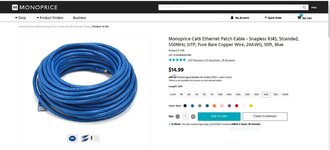
I have read thru several discussions about networking a house with Ethernet patch cords...does anyone have any current recommendations on the best quality cables to use.I have found Monoprice, but their offerings are a bit confusing.They have cables in 23,24,28 30 and 36 AWG. What AWG is appropriate for runs under 100ft? All wires will be buried inwall with brush type cover plates...no keystones. I have a Zoom docsis 3.0 modem on Spectrum !00Mbps right now and it is fine for my needs.Also what is a good quality 8 port un managed switch to use. I have no interest in buying bulk cable and building my own.
 

Attachments

  • monoprice.JPG
    monoprice.JPG
    127.9 KB · Views: 52
To avoid these ads, REGISTER NOW!

theoldwizard1

Well-known member
Joined
Feb 22, 2011
Messages
43,243
Location
SE MI
You are over thinking this ! Any Cat 5e patch cable from a reputable supplier is him. I use Amazon Basic. Buy in quantities of 5 for a discount.

The one advantage that Cat 6 has is they do use heavier gauge wire. Less likely to break when being abused like pulling through holes in wood.
 

couch67

Well-known member
Joined
Mar 18, 2016
Messages
1,408
Location
Ontario Canada
24 gauge is going to be most common for longer runs, I wouldn't go smaller. I buy from Amazon and Monoprice, and I like both their cables. CAT6 as wizard says would be best, more for future proofing (if you ever get faster speeds than what you currently have) but CAT5e is about half the price for finished cables (at least in my end of the world).

Edit: forgot to mention that a lot of patch cables are not rated for in-wall use. FYI to be code compliant you would need to source cables that have a CM rating I believe. You may have already come across this as you mention you have been reading up on other forums.
 
Last edited:

wyliesdiesels

Well-known member
Joined
Aug 14, 2012
Messages
20,067
Location
Modesto, CA
Good morning all,
I have read thru several discussions about networking a house with Ethernet patch cords...does anyone have any current recommendations on the best quality cables to use.I have found Monoprice, but their offerings are a bit confusing. They have cables in 23,24,28 30 and 36 AWG. What AWG is appropriate for runs under 100ft? All wires will be buried in-wall with brush type cover plates...no keystones. I have a Zoom docsis 3.0 modem on Spectrum !00Mbps right now and it is fine for my needs. Also what is a good quality 8 port un managed switch to use. I have no interest in buying bulk cable and building my own.
umm stranded wire patch cords are not designed for nor rated for in-wall use. you should be using solid copper core riser rated cable and if you dont want to use keystone jacks, terminate RJ45s on the ends.

patch cords are use in the rack to patch from the patch panel to the switch.


24awg is typically only used for CAT5e, CAT6 is almost always 23awg, 28/30/36 is used for very short "slim" patch cables in the rack to keep things tidy.

CAT5e riser is good for gigabit but if you want to future proof you could go with CAT6 riser 23awg.... just stay away from patch cords....
 

nadogail

Well-known member
Joined
Jan 23, 2009
Messages
32,032
Location
Coronado, CA
When in doubt, I build for stout. Heavier gauge conductors generally give better electrical performance and are more resistant to damage.
 

wyliesdiesels

Well-known member
Joined
Aug 14, 2012
Messages
20,067
Location
Modesto, CA
why all the different AWG's?
the thicker 23awg can run higher power for POE
Different AWGs are needed if you are running POE or are running longer runs.

24 gauge is going to be most common for longer runs, I wouldn't go smaller. I buy from Amazon and Monoprice, and I like both their cables. CAT6 as wizard says would be best, more for future proofing (if you ever get faster speeds than what you currently have) but CAT5e is about half the price for finished cables (at least in my end of the world).
huh? why would you use smaller wire for longer runs especially for POE?
 

wyliesdiesels

Well-known member
Joined
Aug 14, 2012
Messages
20,067
Location
Modesto, CA
I guess if someone didn't know what they were doing? :) Agreed on the 23 awg for POE.
Except you said it was most common to use smaller gauge wire for longer runs. That is actually not the case.

cabling jobs are spec’d out for one type of cable for the whole job (CAT5e, CAT6, etc). they’re not spec’d out based on the length of run.

In other words The same cable is used for the entire job, not mixed and matched based on run length.
 

dogdog

Well-known member
Joined
Nov 15, 2011
Messages
12,711
Never knew they have smaller than 23AWG cables, but standard spool I see are just 23/24 and 21/22 AWG I think...

But, there are different type conductor of cables apparently as in copper, or that CCA ( Copper Coated Aluminum) That **** is stiff and pokes you easily... bad for your teeth too (LOL).

There are different jackets or PVC coatings

and there are solid wires vs stranded.. Patch cable are usually stranded and more flexible.
 
  • Like
Reactions: Git
OP
M

Mr onetwo

Well-known member
Joined
Apr 6, 2011
Messages
2,010
Location
Coastal Maine
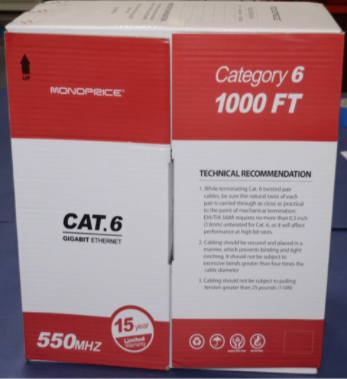
ok...cat6 cable and pass thru ends it is. This stuff is 23ga and riser rated
 

Attachments

  • cat6.JPG
    cat6.JPG
    93.7 KB · Views: 44

DHCrocks

Well-known member
Joined
May 2, 2008
Messages
1,349
Location
Hawaii
its a little more expensive but I would recommend plenum not riser. Plenum cables are fire retardant and would be a safer alternative.
 

wyliesdiesels

Well-known member
Joined
Aug 14, 2012
Messages
20,067
Location
Modesto, CA
Never knew they have smaller than 23AWG cables, but standard spool I see are just 23/24 and 21/22 AWG I think...

But, there are different type conductor of cables apparently as in copper, or that CCA ( Copper Coated Aluminum) That **** is stiff and pokes you easily... bad for your teeth too (LOL).

There are different jackets or PVC coatings

and there are solid wires vs stranded.. Patch cable are usually stranded and more flexible.
stay away from CCA. not only is it not listed by an NRTL nor code permitted but its a fire hazard if you use it for POE powered hosts
its a little more expensive but I would recommend plenum not riser. Plenum cables are fire retardant and would be a safer alternative.
waste of money. only needed if cable is ran through a PLENUM air handling space
 
Last edited:

jblnut

ALLIANCE MEMBER
Joined
Jan 17, 2015
Messages
7,127
Location
In the Middle of MN
GenSPEED 6000 user here ..... both riser and Plenum depending on application. 23GA, wire colors are easy to distinguish from each other, fits well into a Cat6 EzRJ45 plug (202010J Platinum tools part number) and is available from most wholesalers (I use Anixter for most things). It is not the least expensive product that meets it's specs but it has been the most consistent one that is still mildly affordable. I've used lots of nicer quality cable products and this one is a decent one for the $$$$$$$

Like wyliesdiesel said, AVOID CCA like the plague.

Have fun and learn a new skill while terminating cables. Buy some faceplates and keystone jacks along with a punch down tool and learn more and have more fun. It'll look nice when it's done !!!
 

couch67

Well-known member
Joined
Mar 18, 2016
Messages
1,408
Location
Ontario Canada
Except you said it was most common to use smaller gauge wire for longer runs. That is actually not the case.

cabling jobs are spec’d out for one type of cable for the whole job (CAT5e, CAT6, etc). they’re not spec’d out based on the length of run.

In other words The same cable is used for the entire job, not mixed and matched based on run length.
That's not what I said. Maybe my original post wasn't clear. I said 24 ga was common for longer runs,in reference to the OP's original question about the different gauges that ranged up to 36 awg.
 

wyliesdiesels

Well-known member
Joined
Aug 14, 2012
Messages
20,067
Location
Modesto, CA
That's not what I said. Maybe my original post wasn't clear. I said 24 ga was common for longer runs,in reference to the OP's original question about the different gauges that ranged up to 36 awg.
The gauges above 24 are not uswd for horizontal cable runs.

Theyre used for patch cords to save on space in the rack
 
To avoid these ads, REGISTER NOW!

dcg9381

Well-known member
Joined
Jun 20, 2018
Messages
11,883
Location
Austin, TX
Not sure why OP doesn't want keystone jacks. It makes a cleaner install.
Because he's buying already cut-to length "patch" cables. Probably doesn't want to be in the business of terminating and testing runs (which I'd agree is a little painful).
 

wyliesdiesels

Well-known member
Joined
Aug 14, 2012
Messages
20,067
Location
Modesto, CA
ok...cat6 cable and pass thru ends it is. This stuff is 23ga and riser rated
be careful with monoprice cable...personally i wouldnt buy it. I'd stick to reputable brands

Because he's buying already cut-to length "patch" cables. Probably doesn't want to be in the business of terminating and testing runs (which I'd agree is a little painful).
no he isnt using patch cables. read #13.
 

u3b3rg33k

Well-known member
Joined
Dec 18, 2017
Messages
4,048
Because he's buying already cut-to length "patch" cables. Probably doesn't want to be in the business of terminating and testing runs (which I'd agree is a little painful).
you can get keystone couplers. If you can pull a patch cable, why terminate?
 

wyliesdiesels

Well-known member
Joined
Aug 14, 2012
Messages
20,067
Location
Modesto, CA
why not? who cares? you can literally buy that as a product from Belden. I see zero downsides, and plenty of upsides.
You obviously dont understand code and cable insulation ratings

It was already explained further up in the thread

Furthermore, the stranded conductors in patch cords is easily susceptible to breaking especially when pulling through attics and around framing.
 

u3b3rg33k

Well-known member
Joined
Dec 18, 2017
Messages
4,048
You obviously dont understand code and cable insulation ratings

It was already explained further up in the thread

Furthermore, the stranded conductors in patch cords is easily susceptible to breaking especially when pulling through attics and around framing.
so buy riser rated patch cords then. not like it's a specialty item. if you're installing after the fact, they'll be fine. if you can fish it, it'll work.
 

wyliesdiesels

Well-known member
Joined
Aug 14, 2012
Messages
20,067
Location
Modesto, CA
so buy riser rated patch cords then. not like it's a specialty item. if you're installing after the fact, they'll be fine. if you can fish it, it'll work.
Patch cords are far more expensive than bulk cable.

A person who uses patch cords because they dont want to learn how to terminate bulk cable is pennywise-pound foolish and lazy.
 

haveissues

Well-known member
Joined
Feb 9, 2011
Messages
379
Location
Hudson Valley NY
Agreed on using bulk cable for doing a whole house just for cutting the cable to length and not having a bunch of **** balled up alone. Plus it is cheaper, even after buying a couple of basic tools. If you do end up terminating to wall plates and a patch panel, and you should, stay away from monoprice jacks. 1 in 10 defective in my experience. Also if you poke around ebay you can often find deals on new boxes of Belden, Berk-Tek, Commscope etc. I have used cheaper brands of cable that certified fine but it kinked coming out of the box and was a pain in the *** to pull. Wherever you need a cable run 2. NO CCA!!!!
 

u3b3rg33k

Well-known member
Joined
Dec 18, 2017
Messages
4,048
Patch cords are far more expensive than bulk cable.

A person who uses patch cords because they dont want to learn how to terminate bulk cable is pennywise-pound foolish and lazy.
bulk cable is only cheaper if you need the whole box. overpaying for 1kft of bulk cable when you need 100'-200' total isn't economy. if you've never done terminations, and aren't going to do this over and over, the likelihood you'll do something wrong is very high. It can work at line speed and still be technically wrong. hard to hide those mistakes from a Fluke.

it's REALLY hard to screw up plugging in a patch cord. I've seen it done, but it's much harder than screwing up a termination - even if it works, if you do it wrong, you might not end up with a "cat 6" installation, but have "cat 5" bandwidth.

I mean you can literally buy pre-term cords to made to length from Belden. for professional installation.

I terminated copper and fiber professionally for years. there's no shame in doing something that installs quickly if it works and complies with standards.
 
OP
M

Mr onetwo

Well-known member
Joined
Apr 6, 2011
Messages
2,010
Location
Coastal Maine
The reason I was going to stay away from keystones and short patch cords is because I thought it would be better to have the cable come out of the wall and connect directly to the device on one end and into the switch on the other.I just don't feel it makes much sense to invest in tools and materials that I will never use again. Is this flawed thinking?The longest run is actually only around 75 ft. there will be 2 around 30 ft and 2 more around 50 ft. Where can I get pricing on the Belden riser rated made up cables. Also thanks for the tip on Monoprice....I thought there must be a reason that 250 ft coil was so cheap.Still looking for a reliable 8 position un managed switch.If keystones are the way to go is the parts and tools from Truecable any good... https://www.truecable.com/collections/keystone-jacks/style_cat6#
 
Last edited:
OP
M

Mr onetwo

Well-known member
Joined
Apr 6, 2011
Messages
2,010
Location
Coastal Maine
There will be 3 TV locations, 1 for camera system and 1 PC in the house and one line over to my unattached shop underground.It is in sch40 pvc with pressure fittings not conduit, so it is not subject to water infiltration.
 
Last edited:

dscheidt

Well-known member
Joined
Apr 26, 2017
Messages
2,909
The reason I was going to stay away from keystones and short patch cords is because I thought it would be better to have the cable come out of the wall and connect directly to the device on one end and into the switch on the other.I just don't feel it makes much sense to invest in tools and materials that I will never use again. Is this flawed thinking?The longest run is actually only around 75 ft. there will be 2 around 30 ft and 2 more around 50 ft. Where can I get pricing on the Belden riser rated made up cables. Also thanks for the tip on Monoprice....I thought there must be a reason that 250 ft coil was so cheap.Still looking for a reliable 8 position un managed switch.If keystones are the way to go is the parts and tools from Truecable any good... https://www.truecable.com/collections/keystone-jacks/style_cat6#
No, it's not better to have cords going through the wall to the device. Terminating in a keystone jack lets you easily change what's hooked up, and where it's located. If you get rid of a tv, you just have jack in the wall. It's also much easier to properly punch down into a keystone or patch panel than it is to terminate a male plug. Much better to let the robots do that.

There's nothing wrong with monoprices cable or cords. they're exactly what they claim to be. I've had 1000s of feet of cable and hundreds of patch cables, with zero problem. monoprice operate on high volume, low margin business.
 
OP
M

Mr onetwo

Well-known member
Joined
Apr 6, 2011
Messages
2,010
Location
Coastal Maine
Monoprice does not have riser rated solid conductor terminated patch cables on their website. I do not want to become a network tech, I just want the right stuff in the walls so I can finish things up. I do not see why it is better to have a keystone jack with a wall plate connected to a patch cord which is then attached to the device.Why not have a couple of ft of cord that can be tucked up inside the wall cavity directly connected on both ends? You can get the Belden cables referenced above pretty inexpensively.
 

Attachments

  • Capture.JPG
    Capture.JPG
    43.6 KB · Views: 10

dscheidt

Well-known member
Joined
Apr 26, 2017
Messages
2,909
Monoprice does not have riser rated solid conductor terminated patch cables on their website. I do not want to become a network tech, I just want the right stuff in the walls so I can finish things up. I do not see why it is better to have a keystone jack with a wall plate connected to a patch cord which is then attached to the device.Why not have a couple of ft of cord that can be tucked up inside the wall cavity directly connected on both ends? You can get the Belden cables referenced above pretty inexpensively.
Riser rated patch cables are not a thing. No one runs path cables from floor to floor. that's what structured cable is for.

It's better to have keystone jacks for the same reason you don't plug your tv into the breaker box.
 

u3b3rg33k

Well-known member
Joined
Dec 18, 2017
Messages
4,048
Monoprice does not have riser rated solid conductor terminated patch cables on their website. I do not want to become a network tech, I just want the right stuff in the walls so I can finish things up. I do not see why it is better to have a keystone jack with a wall plate connected to a patch cord which is then attached to the device.Why not have a couple of ft of cord that can be tucked up inside the wall cavity directly connected on both ends? You can get the Belden cables referenced above pretty inexpensively.
CMR = PVC jacket.
CMP = plenum rated for use in air duct spaces (plenums)

both ratings are related to breathing the smoke while the cable is on fire. if your walls are on fire in a home, one patch cord in it isn't going to matter. if you're evac-ing an office building that's got a fire in a plenum space where 40,000CFM of air are being pumped through, maybe you care about the 500 cables running through the same space.

FYI: non plenum patch cords: also PVC jacket.
 
To avoid these ads, REGISTER NOW!
Top Bottom