To avoid these ads, REGISTER NOW!

Would this dust collector modification work?

MikeK

Well-known member
Joined
Oct 6, 2020
Messages
414
Location
Germany
I started my basement woodshop with a setup similar to the Jet DC-1200, but determined a 2HP blower would not meet my requirements, so I upgraded to the 3HP version by Bernardo. The only component of the system I used was the blower and built this around the Oneida 5-inch Steel Super Dust Deputy, a pair of Wynn Environmental 35B222NANO filters with catch pans for clean out, and a 35-gallon plastic trash can.

23608697328_f262e5ac97_c.jpg

The trash can collapsed while I was in the middle of a large project and I didn't realize it until the filters filled with dust and chips. I had to disassemble the system to clean out everything, including the impeller blades in the blower. If the seal between the trash can and lid isn't completely sealed, a lot of what is sucked up by the blower will pass through to the filters. As soon as the can buckled, the seal between the rim and lid was broken. I used some plywood offcuts to build an internal brace for the trash can and haven't had a problem with it since.

The blower and cyclone need to be matched, as well as the ducting size and routing. The Oneida Super Dust Deputy XL is made for 3-5HP blowers and will likely not be a good match for your blower. The 5-inch Steel Super Dust Deputy is made for 0.5 to 3HP blowers and is better suited for your 2HP Jet blower.

I recommend you wade through the Bill Pentz website before you go too far down the DC rabbit hole. The information is overwhelming, but Bill lays out everything you need to make an informed decision on your DC design. I made some mistakes in my DC system. Although I used 120mm (5-inch) steel ducting for my system, I foolishly put two 90-degree bends immediately at the input to the cyclone, which I later learned is a big no-no because this reduced the airflow considerably. The system still works well, but I know it can be better with more attention to proper design practices.

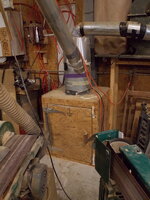
When I fix my errors, I will also change the 5-inch cyclone with the 6-inch Oneida Super Dust Deputy XL. My 3HP blower is at the transition point between the two cyclones, and I want the larger cyclone in case I find a good deal on a 5HP blower. The 6-inch cyclone is taller than the 5-inch cyclone and since I can't raise the blower, I had to reduce the size of the collection can. I built a plywood box that will fit under the new cyclone and still have about the same 35-gallon capacity.
 
To avoid these ads, REGISTER NOW!

brianh

Well-known member
Joined
Apr 6, 2010
Messages
1,299
Location
grahamsville NY
Here is my ugly but convenient setup I get very little in the bags at all as long as I remember to check the garbage can before it is overfull.

DSCN4325.jpg

DSCN4322.jpg

DSCN1805.jpg
 
OP
E

Enigma

Well-known member
Joined
Sep 2, 2010
Messages
861
Location
Florida
thank you Mike for the detailed reply. i would like to see some photos of your plywood dust bin for inspiration. also ive learned that the motor ratings by hp are completely subjective. they should go by measured cfm or amps. some 120v 12amp motors are called 2hp and other 120v 30amp also called 2hp. so it would be nice if a dust collection company would not use hp as a criteria and instead should use actual flow numbers.
 

MikeK

Well-known member
Joined
Oct 6, 2020
Messages
414
Location
Germany
When I start the upgrade, I'll post some photos. For now, the box is in the corner of one of my basement rooms gathering dust. I'll also replace the plenum box that holds the filters so I can eliminate the double bend in the blower output duct.

We are fortunate in Germany in that all residential wiring is 3-phase 230/400V. This allows me to source 3-phase equipment, such as blower motors and shop equipment.

As I stated in your other thread, and as you have learned, take the manufacturer's claims with a huge pinch of salt. I installed current transformers and meters in my shop electrical distribution, but didn't see a huge difference in my DC system with the blast gates open and closed. As expected, the power consumption was slightly reduced with the blast gates closed since the blower had less resistance. One test I have not done yet is to completely block the filters and see if there are any changes in power consumption.

This is a photo of the power panel with the blast gates open. The current on phases 1 to 3 is 3.3A, 3.1A, and 3.3A respectively.

42528033815_c4e6bebbf5_c.jpg

This is a photo of the power panel with the blast gates closed. The current on phases 1 to 3 is 3.3A, 3.1A, and 3.2A respectively. I think blocking the filters will produce similar results, so using current load as an indicator of filter blockage will not work for me.

43384473822_8f37e0915e_c.jpg
 
OP
E

Enigma

Well-known member
Joined
Sep 2, 2010
Messages
861
Location
Florida
it will be interesting to see what effect if any sealing shut the outlet has on the amps. if it has no significant effect how can you explain that? bill pentz hinself has reported blower motors burning up without restrictions and using very small fractions of their amp ratings when air is restricted on the input side. what is your explanation for the negligible differences between gates open and closed?
thank you!
 

MikeK

Well-known member
Joined
Oct 6, 2020
Messages
414
Location
Germany
The reason the motor uses less current when the blast gates are closed is because the impeller blades are not moving any air. This does not affect the motor unless the motor requires airflow through the impeller housing for cooling. All of the blower motors I have seen have a separate internal fan on the end of the motor to blow air across the housing.

I can't explain why the differences are so small, but it could be a combination of the airflow restrictions I created with my double 90-degree bends and the accuracy of the budget current transformers I installed.

I suspect blocking off the filters will create sufficient head pressure in the system to effectively stop the airflow, assuming I don't have any surprise leaks in the collection bin lid. When I wrapped the filters in plastic to test the Oneida filter efficiency gauge, I didn't have the current transformers installed. I did see an increase in the pressure before the plastic blew off of the filters.

Unfortunately, I wasn't paying attention to the gauge when the trash can collapsed. Had I noticed the gauge, I would have been able to stop in time to minimize the cleanup. Now I keep an eye on the gauge when I'm using the DC and regularly check the level of stuff in the trash can so I can empty it before it fills to the point where the dust and chips again make their way to the filters.
 

Firebrick43

Well-known member
Joined
May 12, 2015
Messages
14,185
Location
West central Indiana
The reason the motor uses less current when the blast gates are closed is because the impeller blades are not moving any air. This does not affect the motor unless the motor requires airflow through the impeller housing for cooling. All of the blower motors I have seen have a separate internal fan on the end of the motor to blow air across the housing.

I can't explain why the differences are so small, but it could be a combination of the airflow restrictions I created with my double 90-degree bends and the accuracy of the budget current transformers I installed.

I suspect blocking off the filters will create sufficient head pressure in the system to effectively stop the airflow, assuming I don't have any surprise leaks in the collection bin lid. When I wrapped the filters in plastic to test the Oneida filter efficiency gauge, I didn't have the current transformers installed. I did see an increase in the pressure before the plastic blew off of the filters.

Unfortunately, I wasn't paying attention to the gauge when the trash can collapsed. Had I noticed the gauge, I would have been able to stop in time to minimize the cleanup. Now I keep an eye on the gauge when I'm using the DC and regularly check the level of stuff in the trash can so I can empty it before it fills to the point where the dust and chips again make their way to the filters.
To "unload" the impeller, closing the blast gate does nothing. The impeller is still taking in air and trying to pump it. You must cover the inlet some to unload the impeller. If air cant get to the impeller, the impeller can't pump it.
 

niget2002

Well-known member
Joined
Oct 2, 2012
Messages
11,224
Location
Josephine, TX
To "unload" the impeller, closing the blast gate does nothing. The impeller is still taking in air and trying to pump it. You must cover the inlet some to unload the impeller. If air cant get to the impeller, the impeller can't pump it.
That doesn't cause cavitation?
 

Firstram

Well-known member
Joined
May 16, 2017
Messages
1,392
It does cavitate, but it doesn't do any harm. The motor is cooled by it's own fan and cavitating air doesn't erode the impeller.
 
OP
E

Enigma

Well-known member
Joined
Sep 2, 2010
Messages
861
Location
Florida
does it overload the motor if you totally block the outlet? my clip on ammeter will be here in a few days im going to see for myself what if anything happens to the amps with and without various restrictions.
 

MikeK

Well-known member
Joined
Oct 6, 2020
Messages
414
Location
Germany
To "unload" the impeller, closing the blast gate does nothing. The impeller is still taking in air and trying to pump it. You must cover the inlet some to unload the impeller. If air cant get to the impeller, the impeller can't pump it.
I don't know how your DC system is configured, but when I close all of the blast gates in my system, the impeller unloads almost immediately because the source of air has been removed. I can hear the difference in the motor and see the very slight difference in the power consumption on the three phases. I am confident that my system is functioning exactly as I described.
 

Firebrick43

Well-known member
Joined
May 12, 2015
Messages
14,185
Location
West central Indiana
Maybe I should clarify my previous statement. In a large system, if you close the blast gates there is still a significant volume of air in the pipe from the gates to the impeller. Its still trying to pump this volume. Air doesn't cavitate, water/liquids do, and when it does it actually can create air/steam bubbles (water boils at a lower temp in a vacuum) and these collapsing bubbles causes the impeller errosion. This doesn't happen with air.

If you close the intake of the impeller house directly you unload the motor and you see a significant drop in amperage on the motor as well as a climb in rpm.

Many ventilation and furnace(as in blacksmithing/casting) have the blowers controlled simply by a rotating plate that closes off the impeller/squirrel cage intake.

MikeK, I am not sure on the specifics of your system, but if its pulling 3.3 amps per leg your only outputting 1.5 hp which is really small for a dust collection system.
 

MikeK

Well-known member
Joined
Oct 6, 2020
Messages
414
Location
Germany
MikeK, I am not sure on the specifics of your system, but if its pulling 3.3 amps per leg your only outputting 1.5 hp which is really small for a dust collection system.

My residential power distribution is 230/400VAC 50Hz. It appears you might have used 120/208VAC 60Hz for your calculation. :)

The blower in my system is the Bernardo RV 350 and the motor is rated at 2.2kW (3HP). Using my observed voltage and current readings, and assuming a power factor of 0.85, this gives an estimated apparent power of 2.29kVA and an estimated active power of 1.94kW (2.6HP).

Point taken on the cavitation.
 
OP
E

Enigma

Well-known member
Joined
Sep 2, 2010
Messages
861
Location
Florida
If I measure my amps on my DC motor and the meter reads 15 amps at 230, how many hp is it making?
 
Last edited:

Firebrick43

Well-known member
Joined
May 12, 2015
Messages
14,185
Location
West central Indiana
My residential power distribution is 230/400VAC 50Hz. It appears you might have used 120/208VAC 60Hz for your calculation. :)

The blower in my system is the Bernardo RV 350 and the motor is rated at 2.2kW (3HP). Using my observed voltage and current readings, and assuming a power factor of 0.85, this gives an estimated apparent power of 2.29kVA and an estimated active power of 1.94kW (2.6HP).

Point taken on the cavitation.
No, Actually I was rounding up to 240 instead of 230 and I was using .90 power factor instead of .85 which when I do it lowers the numbers slightly from the 1.5hp to 1.35/1.4 hp. I checked it in three different calculators as well. :dunno:
 

Firebrick43

Well-known member
Joined
May 12, 2015
Messages
14,185
Location
West central Indiana
If I measure my amps on my DC motor and the meter reads 15 amps at 240, how many hp is it making?
Is that what your actually seeing on an amp meter? I would take the 15 amps on that sticker with a grain of salt as it doesn't match up at all to the 2hp or 12 amps stated in Jets instruction manual. That motor doesn't have a standardized name plate.

Also realize full load amps is different than running amps/hp that MikeK and I are discussing. FLA should only be seen for a short period of time during start up.
 
To avoid these ads, REGISTER NOW!
OP
E

Enigma

Well-known member
Joined
Sep 2, 2010
Messages
861
Location
Florida
Is that what your actually seeing on an amp meter? I would take the 15 amps on that sticker with a grain of salt as it doesn't match up at all to the 2hp or 12 amps stated in Jets instruction manual. That motor doesn't have a standardized name plate.

Also realize full load amps is different than running amps/hp that MikeK and I are discussing. FLA should only be seen for a short period of time during start up.
its an older model from 1995. i havent measured it but my meter is arriving this week and i am anticipating the measuring of actual amps and hp.
 

Attachments

  • 20220421_183708.jpg
    20220421_183708.jpg
    382.6 KB · Views: 10
OP
E

Enigma

Well-known member
Joined
Sep 2, 2010
Messages
861
Location
Florida
talking about horsepower to drive the fan to create air flow not start up. Is the rating on the motor 15 amps for start up? or is that running? I plan to measure the amps with no restrictions, with input blocked, with output blocked and with both blocked. Then I plan to experiement with impellers. I have a 12" now and theres 3 inches room all the way around for up to an 18" impeller from what I can see. I would like to try different size and shaped impellers and see the effect on amps , rpms and air flow.
 

Attachments

  • 20220423_154334.jpg
    20220423_154334.jpg
    413.7 KB · Views: 9
OP
E

Enigma

Well-known member
Joined
Sep 2, 2010
Messages
861
Location
Florida
According to this calculator

If my meter reads 15 amps and 230v and my efficiency is only 80%, the motor will be making 3.7hp! But that cant be. Why not?

Volts = 230
Amps = 15
Watts = Volts * Amps = 3450
Power Factor = Watts / Volts * Amps 3450 / 3450 = 1
Efficiency = not sure how to measure this since I have no way to actually dyno the output shaft of the motor so Im using 80%
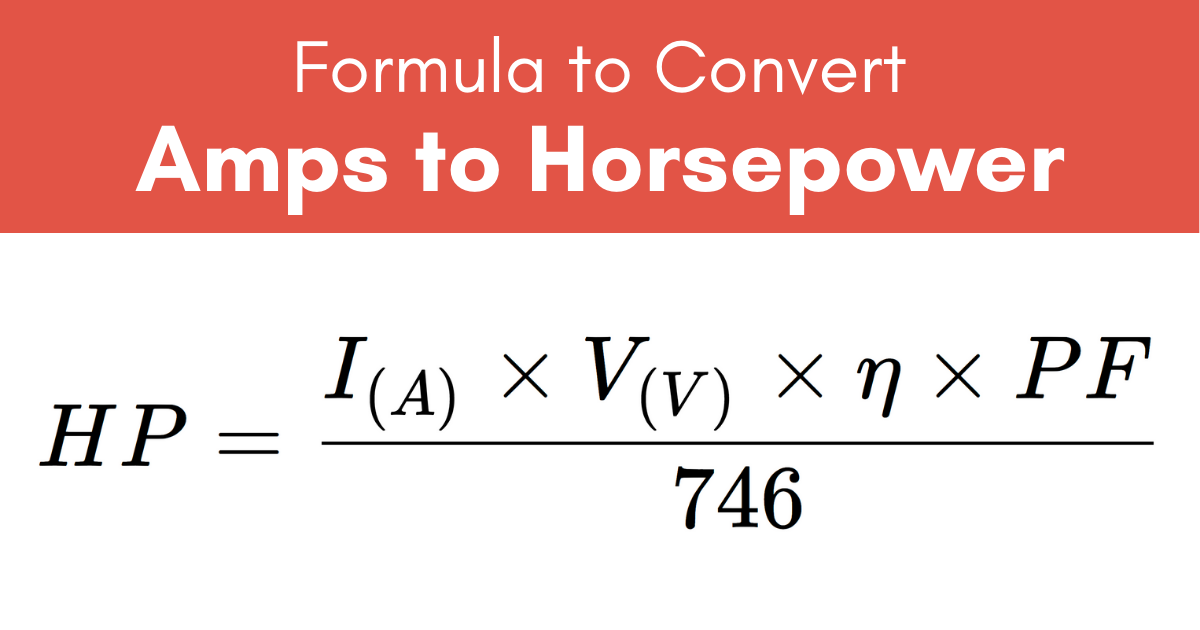
HP = volts * amps * power factor * efficiency / 746 ( i dont know why 746)

HP = 230 * 15 * 1 * 80% / 746
HP = 3.69 hp
 
Last edited:

MikeK

Well-known member
Joined
Oct 6, 2020
Messages
414
Location
Germany
No, Actually I was rounding up to 240 instead of 230 and I was using .90 power factor instead of .85 which when I do it lowers the numbers slightly from the 1.5hp to 1.35/1.4 hp. I checked it in three different calculators as well. :dunno:
When calculating the power in 3-phase systems, the phase to phase voltage is used, not the phase to neutral. In Europe, the residential phase to phase voltage is 400V.

The formula to calculate power (in Watts) uses the square root of 3, which is about 1.732, the phase to phase voltage, the current on each phase, and the power factor. I use a power factor of 0.85 for motors unless the manufacturer is kind enough to include it on the data plate.

(1.732 * 400V * 3.3A * 0.85)/1000= 1.943W, or 2.6HP
 

PoorUB

Well-known member
Joined
Mar 29, 2021
Messages
11,704
Location
Fargo, ND
According to this calculator

If my meter reads 15 amps and 230v and my efficiency is only 80%, the motor will be making 3.7hp! But that cant be. Why not?

To really know you will need to measure the actual voltage and amps. Just because it says 15 amps doesn't mean it will draw 15 amps! Also that is a Chinese built motor, the efficiency might not be 80%, it might be worse.

On the other hand I generally figure 5 amps per HP on 220 volt. So maybe for some weird reason the motor it under rated, which I find weird as one would think the manufacturer would want to brag up the HP if they could! At a guess I would assume that motor is slightly above 2 HP. Not sure how you came up with 3.7!
 
OP
E

Enigma

Well-known member
Joined
Sep 2, 2010
Messages
861
Location
Florida
I used a calculator on this website

and then I also did it manually using these formulas.
Volts = 230
Amps = 15
Watts = Volts * Amps = 3450
Power Factor = Watts / Volts * Amps 3450 / 3450 = 1
Efficiency = not sure how to measure this since I have no way to actually dyno the output shaft of the motor so Im using 80%
HP = volts * amps * power factor * efficiency / 746 ( i dont know why 746)

HP = 230 * 15 * 1 * 80% / 746
HP = 3.69 hp

Maybe they under rate the motor because they want to sell the 3hp motors, we shall see when my meter arrives and I can test the actual current and volts. Is there a way to calculate HP by CFM at the inlet with no filters? Surely by this late date in human history we must know how many horsepower it takes to move 1 cubic foot of air per minute.
 
Last edited:

Firebrick43

Well-known member
Joined
May 12, 2015
Messages
14,185
Location
West central Indiana
My residential power distribution is 230/400VAC 50Hz. It appears you might have used 120/208VAC 60Hz for your calculation. :)

The blower in my system is the Bernardo RV 350 and the motor is rated at 2.2kW (3HP). Using my observed voltage and current readings, and assuming a power factor of 0.85, this gives an estimated apparent power of 2.29kVA and an estimated active power of 1.94kW (2.6HP).

Point taken on the cavitation.
(y)My bad, I assumed that in the pics that the volt meters were set up to show phase to phase voltage. Were I work they have been installing a schieder electric volt/amp meters on all the enclosures that shows phase to phase and also sends it over the ethernet link to a factory automation web page for troubleshooting and energy savings.
 

jar944

Well-known member
Joined
Jul 26, 2010
Messages
5,955
Location
Northern VA
talking about horsepower to drive the fan to create air flow not start up. Is the rating on the motor 15 amps for start up? or is that running? I plan to measure the amps with no restrictions, with input blocked, with output blocked and with both blocked. Then I plan to experiement with impellers. I have a 12" now and theres 3 inches room all the way around for up to an 18" impeller from what I can see. I would like to try different size and shaped impellers and see the effect on amps , rpms and air flow.

What is your goal here, where is the current setup lacking or are you just Tinkering?

Nothing wrong with either but just using the dust collector might work better that thinking about using it, and any or all problems it might have. That's assuming your goal is to collect sawdust, and not build a dust collector.
 
OP
E

Enigma

Well-known member
Joined
Sep 2, 2010
Messages
861
Location
Florida
What is your goal here, where is the current setup lacking or are you just Tinkering?

Nothing wrong with either but just using the dust collector might work better that thinking about using it, and any or all problems it might have. That's assuming your goal is to collect sawdust, and not build a dust collector.
Thank you Jar. My goal is to maximize and optimize the Jet 1200 for maximum performance exhausting the fine dangerous wood dust from the shop and away from my body while taking up the least amount of floor space and look good for the least money. Now that im looking at all these customize and modified collectors on you tube Im kinda wanting to do the whole pinewood derby thing too so you are right, there is some of that going on. Yes I want useful performance but I like the idea of hot rodding my dust collector and making it look cool like one would fix up a musclecar and make it cooler and high performance.
 

Monza Harry

Well-known member
Joined
Dec 29, 2018
Messages
1,433
Location
Windsor ON
Enigma a perfect electric Horse Power is 746 watts. As Poor UB points out 5 amps at 220 volts is a realistic power need for 1HP. My Baldor 5 HP compressor motor is tagged at 26.4A. Harry
 

MikeK

Well-known member
Joined
Oct 6, 2020
Messages
414
Location
Germany
Thank you Jar. My goal is to maximize and optimize the Jet 1200 for maximum performance exhausting the fine dangerous wood dust from the shop and away from my body while taking up the least amount of floor space and look good for the least money. Now that im looking at all these customize and modified collectors on you tube Im kinda wanting to do the whole pinewood derby thing too so you are right, there is some of that going on. Yes I want useful performance but I like the idea of hot rodding my dust collector and making it look cool like one would fix up a musclecar and make it cooler and high performance.

As long as you use the bags for dust and chip collection, I doubt you will ever get rid of the fine dangerous wood dust, regardless of how cool the DC looks. I don't worry about the chips I can see, it's the stuff floating around that I can't see that scares me. Since my shop is in a fully enclosed basement, any dust that escapes could make it to the rest of the house. That is why I built my shop around the DC system and added the machines later. I use a Dylos DC1700 air quality meter (AQM) to monitor the fine dust in my shop, but there are less expensive AQMs available that will do the same thing. When the particle count increases to about 500 units above the ambient reading, I turn on the Record Power AC400 and let it run for 10 to 20 minutes, or until the Dylos reading drops to at least the ambient reading. Sometimes, I turn on the AC400 as soon as I start working.

If you search the Internet, you will find lots of people who have converted the Harbor Freight DC into an effective two-stage system by adding a cyclone and pleated filter. If you don't want to add a cyclone, Wynn Environmental makes a MERV-15 filter that fits the Harbor Freight housing and is a great improvement over the cloth bag.
 

MikeK

Well-known member
Joined
Oct 6, 2020
Messages
414
Location
Germany
(y)My bad, I assumed that in the pics that the volt meters were set up to show phase to phase voltage. Were I work they have been installing a schieder electric volt/amp meters on all the enclosures that shows phase to phase and also sends it over the ethernet link to a factory automation web page for troubleshooting and energy savings.

I wanted an all-in-one module like you described, but couldn't justify the €400 price. I installed dozens of these in the power panels at work that monitored instant and average voltage, current, and power for phase to phase and phase to neutral, but the current transformers were large.
 
OP
E

Enigma

Well-known member
Joined
Sep 2, 2010
Messages
861
Location
Florida
As long as you use the bags for dust and chip collection, I doubt you will ever get rid of the fine dangerous wood dust, regardless of how cool the DC looks. I don't worry about the chips I can see, it's the stuff floating around that I can't see that scares me. Since my shop is in a fully enclosed basement, any dust that escapes could make it to the rest of the house. That is why I built my shop around the DC system and added the machines later. I use a Dylos DC1700 air quality meter (AQM) to monitor the fine dust in my shop, but there are less expensive AQMs available that will do the same thing. When the particle count increases to about 500 units above the ambient reading, I turn on the Record Power AC400 and let it run for 10 to 20 minutes, or until the Dylos reading drops to at least the ambient reading. Sometimes, I turn on the AC400 as soon as I start working.

If you search the Internet, you will find lots of people who have converted the Harbor Freight DC into an effective two-stage system by adding a cyclone and pleated filter. If you don't want to add a cyclone, Wynn Environmental makes a MERV-15 filter that fits the Harbor Freight housing and is a great improvement over the cloth bag.
thank you for the insights on air quality. I realized since i started researching dust collectors that for maximum air quality i would need to 1. have maximum cfm to collect the fines in the first place and then 2. exhaust said fines to the great outdoors.

rightnow i have the singlestage parked outside the shop when in use. the fines are collected, pass through the 30 micron bags and float away on the breeze. i wouldnt ever consider running that dc in the garage with those 30 micron bags.

originally i thought about just exhausting the raw unseparated sawdust and chips outside into a lined garbage can. the fines would escape on the way into the can. when full just pull the bag out, tie a knot and put on the curb with the weekly garbage. without separation or filters i would get maximum cfm and collection of fines

then i learned about separators. i saw a lot of homemade and modded cyclones and thien baffles on youtube and thought i could make one from the middle piece on the single stage. some guys were getting 99% separation with just a home depot bucket and a couple pieces of pvc. i thought how hard can it be?

i found the jet 1200 for $150 which i thought was a good deal since it had a 15amp / 230v motor which if true should be at least 2 maybe even 3hp. i was on the waiting list for a penn state 2hp but it made much less amps and was $450. so i was happy to find the Jet 1200.

with the jet blower and home made separator i could separate the dust and exhaust the fines straight outside through a vent in the wall. no mess no sawdust no conceens from neighbors or passers by. just empty the bin when full. plus i dont have to worry about the safety of the impeller in the event a hard object inadvertently gets sucked into the airstream.

i also considered a oneida cyclone or grizzly with a matching factory dust bin for $$$$ and i still am.

im going to get an air quality meter and do like you do. i like the idea of running the dc to clean the air in the shop.

i have considered the Merv filters you mentioned, then i can run it in the shop and dont need a long flexhose robbing precious cfms but i wonder how much cfm you lose on the merv compared to the 30 micron bags?

of course looks is the least consideration but all other things being equal i want it to look cool and do a flame job custom paint, chrome with leather tuck and roll upholstery.
 
OP
E

Enigma

Well-known member
Joined
Sep 2, 2010
Messages
861
Location
Florida
Enigma a perfect electric Horse Power is 746 watts. As Poor UB points out 5 amps at 220 volts is a realistic power need for 1HP. My Baldor 5 HP compressor motor is tagged at 26.4A. Harry
ok thanks for the info! i will be testing the motor soon to measure actual amps drawn!
 

firebirdparts

Well-known member
Joined
Jun 8, 2016
Messages
10,666
Location
Kingsport, TN
Cyclone performance is all about two things, basically:
1. Diameter. You get more G force as you go smaller, and you also don't give the dust as much room to get out of the air flow. So there's an optimum for a given flow rate.
2. The center tube needs to reach down below the inlet.

Luckily for us, there is a set of "standard" cyclone dimensions that we can compare to.

So if you put in the drum, use a 35 gallon drum (or whatever you have around with better dimensions). Let the inlet be tangential if you decide to just get rid of the original spiral thing. Put an air outlet in the middle of the lid which extends down below the inlet by an inch or two, or let's say to the bottom of the spiral. Discharge outside. 55 gallon drum will be pretty useful if that's all you have. The use of an outlet dip tube with spirals is a bit of a oddball case, but I'd still do it if I was building this.

In a sense, if you discharge outside, this has to work perfectly as far as you're concerned. If you see dust outside, then you can come back and try harder (mostly just for the fun of it at that point).
 
Last edited:
OP
E

Enigma

Well-known member
Joined
Sep 2, 2010
Messages
861
Location
Florida
ok. got my cfm meter today. my first test almost pulled the meter into the impeller!! after a few samples i got the following results.

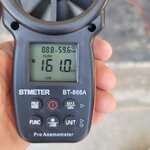
at inlet with both bags 1610cfm
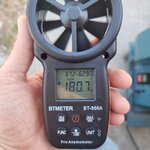
at inlet with no bags 1807cfm
at the oulet i got 1900.
i have no standardized way of holding the meter to ensure consistent results. i may use a tripod or bracket to hold it exactly the same way each time so i can tune this system to maximum cfm.
 

Attachments

  • 20220427_113211.jpg
    20220427_113211.jpg
    856.6 KB · Views: 4
  • 20220427_112834.jpg
    20220427_112834.jpg
    324.4 KB · Views: 4
  • 20220427_111522.jpg
    20220427_111522.jpg
    302.5 KB · Views: 4
  • 20220427_111745.jpg
    20220427_111745.jpg
    345.7 KB · Views: 6

jar944

Well-known member
Joined
Jul 26, 2010
Messages
5,955
Location
Northern VA
ok. got my cfm meter today. my first test almost pulled the meter into the impeller!! after a few samples i got the following results.

at inlet with both bags 1610cfm
at inlet with no bags 1807cfm
at the oulet i got 1900.
i have no standardized way of holding the meter to ensure consistent results. i may use a tripod or bracket to hold it exactly the same way each time so i can tune this system to maximum cfm.

You need to test at the tool with the ductwork/restrictions in place to get a valid reading for the actual dust collection.
 
OP
E

Enigma

Well-known member
Joined
Sep 2, 2010
Messages
861
Location
Florida
That doesnt tell what just the motor is doing though. That introduces more variables.

What im thinking is that first I want to see what cfm's the motor is making without restrictions to see what im starting with.

Next i want to check the amps and see what it draws fully loaded at wide open. If its below 15 its will only go lower once I add restrictions, leaving precious cfm's on the table since its not working at its full potential.

If this is the case I will put on a bigger impeller and check the amps again wide open until its overloaded. Then add restrictions until its pulling 15amps at the tool. If my calculations are correct, that should make maximum cfms.
 
Last edited:
OP
E

Enigma

Well-known member
Joined
Sep 2, 2010
Messages
861
Location
Florida
also i checked my 1.25hp shop vac with 1" hose and it pulls 125cfm at the end of the hose, clean filter, empty can. 165 with hose removed. does that sound right? i used .0054 sq ft as the area of the hose.
 

Attachments

  • 20220427_120629.jpg
    20220427_120629.jpg
    302.8 KB · Views: 6
Last edited:

MikeK

Well-known member
Joined
Oct 6, 2020
Messages
414
Location
Germany
i have considered the Merv filters you mentioned, then i can run it in the shop and dont need a long flexhose robbing precious cfms but i wonder how much cfm you lose on the merv compared to the 30 micron bags?

Each of the main pleated filters in my system has the equivalent of 222 square feet of surface, and each of the filter catch pans on the bottom adds another 18 square feet of surface. This gives me about 480 square feet of filter area. Imagine a square that is 22 feet on each side, and that is the equivalent size of my filters.

By contrast, the flat 30-micron bag on the Jet DC1200 (20-inch diameter and 32 inches tall) has an equivalent surface area of about 12.2 square feet. As the bag "seasons", it will pass less material, but everything 30 microns and smaller will be passing through the bag. This is not much of a filter, and if you plan on venting the DC to the outside, you are better off moving the entire system outside.

If I had the option, I would vent to the outside and not bother with the filters. However, winters here can be cold and it wouldn't take much time before the heat in my house would be outside. I would still use the cyclone to keep everything from passing through the impeller blades.
 
To avoid these ads, REGISTER NOW!
Top Bottom