To avoid these ads, REGISTER NOW!

What makes Wilton bullet vises so desirable?

jmarkwolf

Well-known member
Joined
Jan 15, 2013
Messages
1,824
Location
Southeast Michigan
I'm considering replacing a Craftsman 5in vise with a bullet vise, but am concerned about making Swiss cheese out of the corner of my work bench with the mounting holes, where the vise will go.

I'm under no allusion that the mounting hole pattern will line up.
 
To avoid these ads, REGISTER NOW!

GeoBruin

Well-known member
Joined
May 5, 2018
Messages
3,750
I'm considering replacing a Craftsman 5in vise with a bullet vise, but am concerned about making Swiss cheese out of the corner of my work bench with the mounting holes, where the vise will go.

I'm under no allusion that the mounting hole pattern will line up.
If the Craftsman works and has been working, there's probably no real reason to "upgrade". If a Wilton falls in your lap, and you think you would benefit from wider jaws, greater clamping force, pipe jaws, or just more mass, go for it. But all that depends on how you use it. I wouldn't feel the need to upgrade just for the mystyque.

I had a big Rock Island I bought on Craigslist and had for years. I had no problems with it but I had an uncle die and I inherited a Wilton C2 in flawless condition. It came with a swivel base which I didn't have before and it had pipe jaws which seemed useful so I swapped and sold the RI. All that said, I may not have paid to replace it, even for used prices.

Now the last thing I'll say is that we are a community of people who try to justify "upgrading" everything all the time, and there's nothing wrong with that. Tools are a hobby for me, not how I make my living, so upgrading because I simply want to is not uncommon either.

You do you!
 

seber

Well-known member
Joined
May 31, 2016
Messages
4,206
Location
Deep East Tx.
If the Craftsman works and has been working, there's probably no real reason to "upgrade". If a Wilton falls in your lap, and you think you would benefit from wider jaws, greater clamping force, pipe jaws, or just more mass, go for it. But all that depends on how you use it. I wouldn't feel the need to upgrade just for the mystyque.
The reason I gave up on the five inch machinist vise was lack of clamping force. Almost any vise will give more force. Everything else about the vise was superior, but I couldn't keep things clamped when really stressing it. the Yost ductile iron cost less than I got for the Wilton and serves my use far better.
 

exmaxima1

Well-known member
Joined
Jun 25, 2011
Messages
6,343
Location
Midwest
The reason I gave up on the five inch machinist vise was lack of clamping force. Almost any vise will give more force. Everything else about the vise was superior, but I couldn't keep things clamped when really stressing it. the Yost ductile iron cost less than I got for the Wilton and serves my use far better.
Seriously? My Wilton 400S holds everything tight with practically finger pressure. Are you using it to bend metal or are you using it to hold things while you cut/file/sand/drill? Was your Wilton a BULLET Machinist vise?
 

Mr. Wonderful

Well-known member
Joined
Jan 15, 2018
Messages
1,781
Location
Pacific Northwest
If you're worried about the holes in the bench you can always glue in a piece of dowel in the hole and sand it flush. I have a pretty nice workbench top and that's the route I'm going. I have a nice Craftsman 5197 there now and I was really cranking on it to hold a piece of rod that I was threading. The collar on the main screw slipped some. It didn't damage the vise but I thought it did. I'm replacing the Craftsman with something a little more stout with a little less collector value. Probably my Wilton 600s, which like @exmaxima1 said has quite a bit more holding strength.
 

joshmodelskidoo

Well-known member
Joined
Apr 18, 2012
Messages
872
Location
mid western michigan
The quality is much nicer than anything else i have used.tighter tolerances for smoother action, higher tinsel strength. I had a big Chinese vice and broke it. A friend broke my dads big Chinese vice when i was a kid. So I skipped buying one I figured I would break and went with a used wilton bullet. If the one you have work’s just keep using it. The new hf doyal look pretty decent and im sure night and day difference from there old blue ones
 

Davefr

Well-known member
Joined
Jan 7, 2010
Messages
11,848
Location
OR
I always mount a steel plate to the workbench and then mount the vise to the plate. It's a better mount and you can change vises without making swiss cheese to the corner of your bench. Wilton's are excellent but I think part of the allure is simply the shape. There are plenty of other great vises that are equal or better in strength. (ex: Ridgid forged steel vises from Germany). I see a lot of Wilton's where the cast iron ledge under the jaws is broken off. Wilton's are pretty unforgiving when beaten on.
P1030112.JPG
 

Mgdoug3

Well-known member
Joined
Mar 2, 2018
Messages
1,391
Location
KY
I have a 400HD with a swivel and it's been an amazing vise. It's smooth as silk and the jaws aren't too aggressive and doesn't mark up parts. I have a Morgan Chicago 45 with more aggressive teeth if I need it but I use my Wilton 95% of the time. I gave $50 for it and gave it a face lift.

I wouldn't mind having a 5 or 6" Wilton but I hardly ever see one for sell around here. People either never sell them or so beat up they're not worth buying.
 

slowtwitch73

Well-known member
Joined
Apr 18, 2019
Messages
5,876
Location
Hellgate
They are a good vise, but there are other good vises out there. Irrational exuberance. The word 'bullet', the word 'machinist' etc etc.

I have had a few and didn't like them any better than other vises I have so it made sense to get the money out of them.
 

isb cornbinder

Well-known member
Joined
Nov 3, 2010
Messages
7,073
Location
Pacific South West, BC, Canada
WILTON VISES are among the best ever made. What has made them so expensive was You Tube contributors like Adam Booth, Keith Rucker, and Keith Fenner. When these guys and the other YT makers bought Wilton, there was a rush on to buy these vises. The Wilton Bullet was the star attraction.
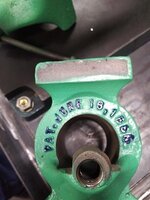
I have a few vises. All of my vises were made in North America. My favorite Craigslist vise is a BURKE. I like the green vise. The date on it make it over 100 years old.
 

Attachments

  • BURKE VICE 1.jpg
    BURKE VICE 1.jpg
    46.3 KB · Views: 46
  • BURKE VICE 2.jpg
    BURKE VICE 2.jpg
    42.6 KB · Views: 42
  • BURKE VICE 3.jpg
    BURKE VICE 3.jpg
    44.3 KB · Views: 41
  • BURKE VICE4.jpg
    BURKE VICE4.jpg
    41.3 KB · Views: 63
  • VICE VINTAGE.jpg
    VICE VINTAGE.jpg
    42.4 KB · Views: 68
  • OLD VISE 4.jpg
    OLD VISE 4.jpg
    43.3 KB · Views: 59
Last edited:

seber

Well-known member
Joined
May 31, 2016
Messages
4,206
Location
Deep East Tx.
Seriously? My Wilton 400S holds everything tight with practically finger pressure. Are you using it to bend metal or are you using it to hold things while you cut/file/sand/drill? Was your Wilton a BULLET Machinist vise?
You have only to look at the screw thread to understand the problem. I seem to recall that the Wilton was 8 tpi. The Yost is 14 tpi. That translates to 75% more clamping force.
 

Mgdoug3

Well-known member
Joined
Mar 2, 2018
Messages
1,391
Location
KY
There's much more than thread pitch that determines clamping force. You can't say that a vise with more threads per inch has a higher clamping force. I watched a Fireball Tools YouTube video and increasing thread diameter took more effort to move the vise.

A smaller diameter thread with a lower TPI could have the same clamping force as a larger diameter thread with higher TPI. There's too many variables to just say the higher TPI has more clamping force.
 

PierceA

Well-known member
Joined
Aug 6, 2020
Messages
471
Location
SE Michigan
The friction from the mainscrew hub against the dynamic jaw consumes a LOT of clamping force.. Just adding a hardened thin shim/washer with good lubricant will greatly reduce the friction at that location, then the next friction areas are the sliding surfaces of the dynamic against the static, then the friction of the threads themselves..
Usually with all else being equal, a greater number of threads per inch will increase clamping force with the same pressure applied to the handle..

The wiltons are an 'OK' vise. but they are more of a fad or popular vise to collect, rather than in any way a better vise.
As mentioned above, the wiltons are very prone to having the jaw insert shelf broken off, the iron appears to be a bit brittle in that area.
The hub against the dynamic jaw surface is prone to wear just like any other vise, but on some Wilton's the area is difficult to adequately lubricate, so they get a LOT of wear.
The round, dynamic jaw's slide appears to be better at keeping the screw cleaner, but the round, lubricated slide attracts dirt and grime more than the typical rectangular enclosed screw dynamic slide.. and it's much easier to clean and lubricate a vise screw in a typical dynamic.
The round slide is NOT one-piece with the dynamic jaw. it is a two piece assembly and they DO get loose, and the pressures on the round static bore can and do crack from over tightening and a big hammer.

The Wiltons are neat looking, and especially the C-series are good looking vises. BUT the C3 does not have any 'edge' or special features or better design than a Reed 4C, a Yost 34C, a Parker 436 , Holland 56, or the many other big and effective combination vises..

The above comments may sound like I don't like Wiltons, I only dislike the rather outrageous prices that they often sell for.
Example: I watched a nearly mint USA made Yost 34C sit on Ebay for about $300 for several weeks, I couldn't figure out the logistics to get it in my possession. Once I figured that out, I purchased it for $250.
But I have not seen a Wilton C3 for sale for under $1200 for a year or more.. And the swivel bases are very weak on these vises.

The wiltons are nice vises, but are not in my opinion, and experience using many different vises, any better or poorer than the equivalent Reed, Howard, Parker, Athol, Prentiss, Morgan etc etc..

PierceA.
 

Steve_P

Well-known member
Joined
Sep 15, 2010
Messages
5,186
Wiltons have the name and history- as one of the largest US producers of vises over the last 50 years. And one of the last few vintage US names in vises that still exist- but Wilton is mostly offshore now; or all? The fully enclosed screw makes them ideal for the rear bumper on a service truck. But for home use, this offers no real advantage for inside use. Yes, in theory it's an advantage, but no one at home has ever worn out a screw on a vise on their indoor workbench because it was open at the bottom. So, buy what you want and don't get hung up on the Wilton name. The new Yost ADI vises are super nice for the $ and ready to go with no restoration or running around dealing with idiots required.
 

justtools

Well-known member
Joined
Aug 16, 2008
Messages
416
The car dealership i work at was built in 1965. it has Metal benches with 400 wilton bullet vises attached. A few have broke. Overtightening etc. But there is still 8 to 10 left still working to this day almost 60 years later. I have a bullet vise on my bench and happy for it. if a guy leaves or retires the dealership the first thing that gets claimed is the vise in the empty stall he was working in.
 

justtools

Well-known member
Joined
Aug 16, 2008
Messages
416
About the clamping force. Had to remove the front knuckle of a saturn to get the wheel bearing out. Clamped the knuckle in the vise where it attaches to the strut. Started pounding the wheel bearing with a 3 lb hammer, took 20 plus strikes to remove the bearing but the knuckle never moved. I would say it clamped very well for a 60 year old vise with 0 maintenance, this was only a 4 inch bullet.
 

shawhite

Well-known member
Joined
May 28, 2014
Messages
1,519
There is obviously something desirable about the Wilton’s because I have never been in a machine shop that has not had at least one on a bench. Also they are the most common vise on the rear bumper of service trucks in my area.
 
To avoid these ads, REGISTER NOW!

Mgdoug3

Well-known member
Joined
Mar 2, 2018
Messages
1,391
Location
KY
My older Wilton is a one piece dynamic jaw. Some time during the 70s Wilton went to a two piece jaw which is suppose to be stronger. I used my Wilton to hold my stuck Morgan vise in a last ditch effort to free it up with a 10 lb sledge hammer and punch. The Wilton held it fine and the Morgan is now on my bench as a usable vise.

When I restored my Morgan I added a thrust bearing to make it smoother. It takes less effort to get adequate clamping force now. My Wilton is still smoother and feels like it has more clamping force but I never have tried to scientifically prove it. My Morgan has much more aggressive teeth. I like having two vises on the bench with checkered jaws (Wilton) and aggressive jaws.

Wilton vises are great vises and many have stood the test of time. I can't say they are the best vises ever made but I see why they have a higher resale value. Reed vises seem to bring a decent price too. If I was looking for a budget vintage USA machinist vise I would probably go with a Colombian.
 

seber

Well-known member
Joined
May 31, 2016
Messages
4,206
Location
Deep East Tx.
There's much more than thread pitch that determines clamping force. You can't say that a vise with more threads per inch has a higher clamping force. I watched a Fireball Tools YouTube video and increasing thread diameter took more effort to move the vise.

A smaller diameter thread with a lower TPI could have the same clamping force as a larger diameter thread with higher TPI. There's too many variables to just say the higher TPI has more clamping force.
While you watched the Fireball video, did you notice that he came up with the same conclusion I did? The Wilton fails on clamping force.
 

Mgdoug3

Well-known member
Joined
Mar 2, 2018
Messages
1,391
Location
KY
While you watched the Fireball video, did you notice that he came up with the same conclusion I did? The Wilton fails on clamping force.
8 tpi vs 14 tpi does not translate to 75% more clamping force so my point still stands. You inaccurately believe Yost has 75% more clamping solely because of the difference of TPI.

Edit: I watched the strongest vise video again. Fireball did not test a Machinist Bullet vise. There were two Tradesman vises and two economy lines of Wilton.
 
Last edited:

seber

Well-known member
Joined
May 31, 2016
Messages
4,206
Location
Deep East Tx.
OK. let me explain. A ten inch handle moving through a full circle is 31.14159 inches of travel to move the jaw .0714 inches. That is a mechanical advantage of 440 to one. That would be the Yost. The same handle working on a n 8 tpi is moving the jaw .125 inches for a mechanical advantage of 251 to one for the Wilton. That is a 75% difference in mechanical advantage. Other factors pale in comparison.
 

LOW1

Well-known member
Joined
Jul 20, 2018
Messages
2,652
Location
ontario
Wiltons are the purebred dogs of the vice world. They cost a lot of money and look nice. But vices that happen to be mutts do the same thing for less money.
 

Mgdoug3

Well-known member
Joined
Mar 2, 2018
Messages
1,391
Location
KY
8 tpi vs 14 tpi does not translate to 75% more clamping force so my point still stands. You inaccurately believe Yost has 75% more clamping solely because of the difference of TPI.

OK. let me explain. A ten inch handle moving through a full circle is 31.14159 inches of travel to move the jaw .0714 inches. That is a mechanical advantage of 440 to one. That would be the Yost. The same handle working on a n 8 tpi is moving the jaw .125 inches for a mechanical advantage of 251 to one for the Wilton. That is a 75% difference in mechanical advantage. Other factors pale in comparison.
And yet that has nothing to do with clamping force so I don't know what point you're trying to make. Perhaps the thread diameter is smaller and the dynamic jaw moves smoother. That would make the clamping force of two different size threads more similar.

Higher pitch does have more of a mechanical advantage. It's like using a 15" breaker bar vs 24". My entire point is that a screw with 75% more threads does not equal 75% more clamping force. Explain it any way you want but there's too many factors to in determining CLAMPING FORCE.

The high dollar, arguably toughest and strongest clamping force vise on the market today (Fireball) uses I believe 8 tpi.
 

seber

Well-known member
Joined
May 31, 2016
Messages
4,206
Location
Deep East Tx.
And yet that has nothing to do with clamping force so I don't know what point you're trying to make. Perhaps the thread diameter is smaller and the dynamic jaw moves smoother. That would make the clamping force of two different size threads more similar.

Higher pitch does have more of a mechanical advantage. It's like using a 15" breaker bar vs 24". My entire point is that a screw with 75% more threads does not equal 75% more clamping force. Explain it any way you want but there's too many factors to in determining CLAMPING FORCE.

The high dollar, arguably toughest and strongest clamping force vise on the market today (Fireball) uses I believe 8 tpi.
440 to one times a push from you of 150 pounds equals 66,000 pounds clamping force minus friction. In this case friction should be almost negligible. 251 to one times 150 pounds equals 37,650 pounds of clamping force. I don't know how to put it any more clearly.
 

CallumRD1

Well-known member
Joined
Jul 7, 2017
Messages
339
Location
Colorado
440 to one times a push from you of 150 pounds equals 66,000 pounds clamping force minus friction. In this case friction should be almost negligible. 251 to one times 150 pounds equals 37,650 pounds of clamping force. I don't know how to put it any more clearly.
You cannot treat friction as negligible at all. When there are thousands of pounds of clamping pressure there are also thousands of pounds of pressure at the screw-nut interface and (likely more importantly) at the screw-dynamic jaw interface. This is why putting a thrust bearing under the main screw makes such a huge improvement in the amount of clamping force you get for a given torque on the handle.
 

Mgdoug3

Well-known member
Joined
Mar 2, 2018
Messages
1,391
Location
KY
440 to one times a push from you of 150 pounds equals 66,000 pounds clamping force minus friction. In this case friction should be almost negligible. 251 to one times 150 pounds equals 37,650 pounds of clamping force. I don't know how to put it any more clearly.
I'm done arguing. You're wrong. Tpi does not equal clamping force. Here's an example to show what I mean. Take two vises that have identical TPI. One vise has a very *********** like a C2 the other one has a shorter throat like a 500. The 500 will have a higher clamping because the ram is bigger (less flex) and because the jaws are closer to being in line with the spindle. The thread pitch is the same but they don't have identical clamping force because TPI does not equal clamping force.
 

seber

Well-known member
Joined
May 31, 2016
Messages
4,206
Location
Deep East Tx.
You need to take a physics course. Preferably one that includes vector dynamics. Maybe I should mention that I am a mechanical engineer. If I am wrong, I must have screwed up a lifetime of machine designs.
 

Mgdoug3

Well-known member
Joined
Mar 2, 2018
Messages
1,391
Location
KY
You need to take a physics course. Preferably one that includes vector dynamics. Maybe I should mention that I am a mechanical engineer. If I am wrong, I must have screwed up a lifetime of machine designs.
You should try to get a refund.
 

rdenney

Well-known member
Joined
Mar 30, 2022
Messages
142
The fireball test considered resistance to destruction, and maximum clamping force. Neither of those dimensions is all that important to me—I’ve never managed to break a vise even using it as a bending brake for steel flat bar.

But here’s what I do notice: vises that spin when I’m really torquing on the workpiece, vises that require me to use my left hand to keep the jaws aligned on the workpiece while I tighten with my right hand, and vises that have so much backlash that I’m spinning the handle full turns back and forth to get the workpiece lined up how I want it.

Back in my pro mechanicking days (the 70’s), Wilton vises had the same status as Snap-On tools. That’s good and bad. Both companies made pro-grade tools much better than consumer stuff. But there were other pro-tool makers that were preferred in industrial settings, and didn’t have the fetish-object pricing. Like the old IBM joke, nobody was ever fired for buying a Wilton vise.

Time passes. Wilton bought Columbian, and I have a Wilton-branded Columbian that I bought for cheap in the 90’s. It’s craptastic. I have to hammer the swivel locks to keep it from spinning, and the moveable jaw rocks back and forth 3/16” while being tightened. I can’t break it so it has become the abuse vise.

I recently came upon a Wilton mechanic’s vise—their budget pro-use vise even when it was made in the USA. Gray iron, etc. But the swivel locks positively engage when tightened and can’t slip, and the dynamic jaw only wiggles 1/32”. The enclosed screw was pretty clean 52 years after it was made. Backlash is 1/8 turn.

I also bought a 5” Doyle at Harbor Freight. Ductile iron, enclosed screw, tight tolerances, and very little backlash. It’s a good vise and vastly cheaper than a Wilton. So, like Snap-On tools, the fetish-object pricing makes Wilton appealing more to collectors than users. Users have other options.

Rick “whose Wilton was a freebie bolted to a well-priced rolling tool cabinet” Denney
 
Last edited:

matt_i

Well-known member
Joined
Mar 14, 2008
Messages
10,744
Location
SE Michigan
I think Wilton's design advantage is the relatively close fit between the round slider and the bored thru-hole of the fixed jaw. The vises I have with rectangular slides are comparatively much looser.

The fine thread/coarse thread debate is ultimately limited by the design of the thread and the strength of materials. In a fine thread system its much easier to pull out the threads unless you have tensile strength in the base material to match. In the design of the thread the larger pitch diameter is going to win every time with all else being equal...no doubt a 3/4-10 can deliver more clampload than a 1/4-20.
 

rdenney

Well-known member
Joined
Mar 30, 2022
Messages
142
I think Wilton's design advantage is the relatively close fit between the round slider and the bored thru-hole of the fixed jaw. The vises I have with rectangular slides are comparatively much looser.

The fine thread/coarse thread debate is ultimately limited by the design of the thread and the strength of materials. In a fine thread system its much easier to pull out the threads unless you have tensile strength in the base material to match. In the design of the thread the larger pitch diameter is going to win every time with all else being equal...no doubt a 3/4-10 can deliver more clampload than a 1/4-20.
Yes if there is a difference in diameter, but fine threads are stronger than coarse threads simply because there is more sheer area and a larger root diameter for a given nominal size and alloy.

I think people are mistaking ultimate clamp load and clamping efficiency--which is the clamping force on the workpiece that results from a given force applied at the handle. The thread pitch (literally--the angle of the thread) matters for clamping efficiency. A shallower pitch resulting from more threads per inch will provide a higher clamp load for a given force at the handle just due to its greater leverage. And it might also be stronger ultimately because of the fine thread, assuming good thread engagement.

But I doubt many people really explore the limits of ultimate clamping force if they use the vise as intended. And that means not using cheater pipes, not using the jaws as a bending brake or otherwise as a pry point after it is tightened.

Wilton advertised the ability of the 74x series "Mechanic's Vise" to provide an 8000-pound clamping force, and showed pictures of using a cheater pipe to conduct the test. But they warned that they were intentionally breaking the rules to see what it would take to break the vise. The destruction tests on the YouTube used cheaters and were specifically trying to find the failure strength. They are a violation of proper and intended use, and are fun to watch but not really instructive. Vises that provide extremely high ultimate strength may not be very good vises for other reasons, including insufficient clamping depth, poor handle efficiency, high untightened friction, too much backlash, or whatever. Let's face it--8000 pounds of clamping force on smaller jaws will likely damage the workpiece. I don't care a whit whether a sub-6" vise will deliver an 8000-pound clamping force versus 16,000 pounds, if 2000 pounds is what it takes to keep it from moving during my operation.

Whether the dynamic jaw's beam is round or square or rectangular is a design issue, not an execution issue. The deep rectangular designs, such as were common on vises like those by Reed and similar for machinists vises, are stronger than square beams of the same width but lesser depth, and square beams are stronger than round beams of the same width and height. For a given weight, a round beam is less efficient in delivering strength than the others. But round beams sure to make a vise pretty. The yielding of the (usually steel rather than cast iron) beam was the usual failure mode for the better vises when tested to destruction in that YouTube video.

I have a vise that I will crank on with a cheater if necessary--a cheapie Wilton-branded Columbian from the late 90's that is supposedly made in the USA but that isn't a very good vise. It's quite sloppy and the swivel locks are really ineffective. If I break it, who cares?

I completely agree that Wilton's better vises do what makes a vise fun to use--there is a tight tolerance between the beam and the stationary jaw, a design that will fail in bending before fracturing or rupturing (which can be dangerous), and good jaw alignment that stays good as one tightens the vise, so that the workpiece stays aligned without having to use one's third hand to keep the jaws aligned while bring it to snug, and and stays clean where it counts in a dirty shop. They are not the only ones to do so.

Rick "who has a 20-ton shop press that will out-squeeze any vise" Denney
 

ATC

Well-known member
Joined
May 12, 2012
Messages
8,341
Location
VA
I don’t know, but I just bought one tonight… :D
 

yardiron

Well-known member
Joined
Oct 9, 2014
Messages
209
Location
NJ
I won't argue that the Wilton Bullet Vises are some of the nicest made but a past experience has always made me leery of them.
As a kid, at maybe 8 or so years old my pop had a Wilton vise on his work bench in the basement. Although he wouldn't have likely ever spent the kind of money they cost on a vise, my grandfather got it for him as a Christmas gift sometime in the mid to late 60's. As a kid I was always a tinkerer, working on bicycles, motorcycles, small engines, and such and I even had my own welder at that age. My grandfather was a machinist for a big oil company in a department that built and repaired pumps and had been at the same company for decades so I had a basement full of tools at hand.

The vise was mounted to an all oak work bench my pop and grandpop had built in the basement The vise sat atop the left corner of the bench mounted to a welded 1/4 " steel corner cap on that side of the bench.
I was trying to removed a pulley off a broken jack shaft on a homemade go cart. The shaft was 1" in diameter and the inner end had two lock nuts holding a pulley on a stepped part of the shaft. The shaft had snapped about 1" from the backside of the pulley, which i needed to reuse. Keep in mind i was around 8 at the time and maybe 70lbs at best.
I got the outer nut loose and with some effort, it came off fine. The second nut wouldn't budge. I was trying to lock the broken stub of the shaft in the vise and with a large wrench, knock the nut loose by hammering on the wrench with a lead hammer.
The thing kept rolling out of the vise, so I got a buddy who was there to help me get the vise tighter, I put about a two foot long piece of water pipe on the vise handle and cranked it down, but it still wouldn't grip the end of the shaft, so we tried again, this time making it tighter yet. On that attempt the one vise jaw broke loose, shearing both screws off and the jaw slid out to the left.
Knowing I was already in deep **** for breaking the vise, I wanted to get done even faster.
Luckily neither of the broken screws were hard to get out of the jaw, they both spun right out. Wanting to to at least finish what I started I stole one of the screws from the rear jaw to hold the front jaw in place. I knew enough not to use the thing without a jaw, knowing that pop would completely loose it if I buggered up the main vise doing something stupid.

So, with each jaw held in place with one screw, I went back to trying to get the broken shaft and pulley held tight enough where I could brake the rusted on nut loose on the end of the shaft. My next attempt is where I really screwed up. I realized that the vise couldn't hold onto the round shaft tight enough to prevent it from turning and another attempt would likely only break off the remaining two jaw screws. I got the idea of flipping it over, clamping the nut in the vise, and using a huge pipe wrench to loosen the shaft. The nut was recessed just enough where it was out of reach using the top of the jaws, (about 4 1/2" wide), I then used the left end of the vise jaws to grab the nut. My thought was that it wouldn't put as much side stress on the two remaining jaw screws, and it let me get a grip over the full width of the nut flats.
On the first try, the nut rounded a bit and slipped out of the vise. I rotated the thing to an undamaged pair of flats and this time we both used our weight to tighten the vise. Two kids, both 75-80 lbs each, a couple foot long pipe and all our strength to tighten the vise wasn't enough and it slipped out again.
This was round two, strike two. Seeing that we were destroying what remained of the rusty axle nut I knew if we rounded off the nut it was going to take some heat to loosen. I didn't have access to torches, which was probably a good thing. There also was no air compressor or air tools, only my father's old Snap On tool box and basic hand tools, he kept the power tools locked up. On try number three we got a longer pipe, which we slid over the first pipe. Now with about 5ft of leverage, and the now well rounded nut clamped in the end of vise jaws we were tightening it with all we had. On the first try with the pipe wrench it started to move in the vise, so we went back to make it tighter. This time I was hammering on the short pipe with a 5lb maul while my buddy, who as a few years older than me, was hanging on the end of the pipe like an ape off the end of the bench. It was then it gave way, in a loud pop, followed by a few choice words from my buddy who hit the floor suddenly, the entire front jaw of the vise gave way. The pulley was on the floor, and the vise jaw was now angled back about 1/2" or so. The iron had cracked down low near the screw after bending first. The jaw was bent, and leaning back with a crack across the narrowest part of the casting. Not mention the handle was bent like an S as well.

The funny thing was I wasn't worried about breaking the vise, I was more worried about toppling the bench or pulling the bolts out of the floor that held it in place.

Like any 8 year old would do, I knew then we weren't getting it apart so I tossed it in the basket of my newspaper route bike and went down to the corner gas station. After showing it to the guy there he grabbed an impact gun and socket, and while holding the thing in one hand, a few cracks of the gun and the nut spun right off.

We both went back to my house, hurriedly put the new shaft on the go cart, and took off to try the thing out. Partly because I knew pop was going to blow his stack when he saw the busted up vise.
In the end I fixed the go cart, but I wasn't allowed to use it or the tools in the basement for a year.
The next Christmas though, I got my own vise and Grandpop built me my own work bench down there with my own tools. Pop kept his locked up after that. I did find him a new vise, but not a Wilton, an older super sized vise without a swivel or removable jaws. An old farmer on my paper route gave it to me for free. It was so big I could barely get it home by myself. I bent up the basket on my bike trying to carry it home that way.
Years later I did buy pop a new Craftsman's Best' vise after I got tired of him complaining that the used vise didn't have a swivel. My pop is long gone, but that Craftsman vise is still on his bench downstairs. I'm not sure what ever happened to the broken Wilton but I know the wouldn't warranty it with the bent handle.

Having broken that one vise back then made me stay away from Wilton over the years. Even though I know better, breaking that one tainted my impression of the brand and i never owned one as my own vise. I've bought and flipped a few here and there but i never kept one. My go to vise now is an 6" jaw Columbian and a massive no name, probably Chinese vise with 8" jaws which I use when I'm doing something that's likely to damage the vise. I've never broken another vise though.
 
To avoid these ads, REGISTER NOW!
Top Bottom