
You are using an out of date browser. It may not display this or other websites correctly.
You should upgrade or use an alternative browser.
You should upgrade or use an alternative browser.
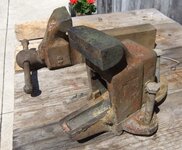
Do I send this rusty vise to the electrolysis tank?
- Thread starter exmaxima1
- Start date


toolmiser
Well-known member
I'm sure others will follow, but electrolysis is the easy way to attack this. I would do a few rounds of that cleaning up whatever you can, then I would start soaking with a penetrating solution if the threads won't turn. I would disassemble as much as possible before starting.
ZRX61
Well-known member
I hear good things about Rust911, you dilute it unlike Evaporust. More spendy up front, but you can then dunk the entire vice in a barrel of the mix.
Try PB Blaster. Soak a towel and give it a good coat, wait 5 minutes, then hit it with a brass brush. Usually takes off the surface rust pretty easily but the penetrating rust needs a bit more effort. Might be worth using PB then electrolysis so it works more directly against the stronger rust.
Desertskyy
Well-known member
I agreeI'm sure others will follow, but electrolysis is the easy way to attack this. I would do a few rounds of that cleaning up whatever you can, then I would start soaking with a penetrating solution if the threads won't turn. I would disassemble as much as possible before starting.
I have a pretty good electrolysis set up for anytime I come across anything real rusty
If you do not already have something in place then Evaporust maybe the ticket for you
Boilerhouse
Well-known member
I would dismantle everything, and go at the parts with a wire wheel to get the worst of it, then drop into Evaporust for the final de-rusting.
If you have the power supply 12vdc or a battery on a charger will do. And a box of laundry detergent enchancer like borax or super laundary powder or baking soda baked in oven for 1 hour. Electrolysis is a way to g. Then follow by a garden hose wash and tsp wash before paint or oil
Works wonders for iron rust.
Electrolysis works well on flat or exposed surfaces but you might have to clean holes and crevasse manually or move the scrafical electro to be near the hole
Works wonders for iron rust.
Electrolysis works well on flat or exposed surfaces but you might have to clean holes and crevasse manually or move the scrafical electro to be near the hole
I use a 44 gallon trash can for my E tank. An ounce or so of pool clarifier added to the mix really brings the rust to the top with the scum. Makes it easy to skim off and the tank stays much cleaner.
paulsomlo
Well-known member
Don't even waste your time with other methods - with something that big and that rusty, as said before, electrolysis IS the easy way. And the cheapest.
Jswain
Well-known member
If you don't have the battery charger then citric acid would likely be cheaper.
Mix around 250ml citric acid powder per 10-20litres of water, hot if possible, collect your part in 12-36 hrs 100% rust free. If it fits in a bucket put a lid on it and save it for next time. Soak in a solution of water with some baking soda when you remove it then rinse off & oil immediately.
Citric acid is very safe, don't need any crazy PPE, and very fast
Mix around 250ml citric acid powder per 10-20litres of water, hot if possible, collect your part in 12-36 hrs 100% rust free. If it fits in a bucket put a lid on it and save it for next time. Soak in a solution of water with some baking soda when you remove it then rinse off & oil immediately.
Citric acid is very safe, don't need any crazy PPE, and very fast
Shiftless
Well-known member
Electrolysis would be the right approach for something like that.
I like Evaporust for smaller parts. One trick for using Evaporust for larger pasts is to put your rusty part in a heavy duty plastic bag, fill the bag with Evaporust, seal the bag and then lower the bag into a bucket of water. That way you don’t need 5 gallons of Evaporust.
The chemical reaction needs to be above 60 degrees F. Warmer temps makes it go faster. If you have a heated ultrasonic cleaner (I don’t) it will work GREAT!
I like Evaporust for smaller parts. One trick for using Evaporust for larger pasts is to put your rusty part in a heavy duty plastic bag, fill the bag with Evaporust, seal the bag and then lower the bag into a bucket of water. That way you don’t need 5 gallons of Evaporust.
The chemical reaction needs to be above 60 degrees F. Warmer temps makes it go faster. If you have a heated ultrasonic cleaner (I don’t) it will work GREAT!
I wouldn't argue with anyone suggesting electrolysis. That said, is it free? Or, is it bound up? Do you have a wire wheel on a bench grinder? If it is free, I would use some kind of penetrating fluid and after a bit of soaking just take the thing apart. Wire wheeling shafts and even Acme threads is easy enough. If it is bound up, soaking it in some rust removal product (I use Evaporust) or electrolysis would be a fine place to start.
perfect candidate for electrolysis IMO
catalytic
Well-known member
If you are going to repaint anyways, and the paint is already loose/easy to strip, then strip the paint *before* electrolysis.
Even if you de-rust now with electrolysis, you will get rust when stripping paint and need to de-rust all over again before painting/refinishing.
If the paint is hard to strip, then electrolysis can help loosen it, though you will need to re-electrolysis (probably) after taking it out and fully stripping the paint, as that always makes surface rust.
Nice vise---my dad has had the quick release version (maybe yours is?) on his main bench since I was born. We have used the hell out of it and it still works like new.
Even if you de-rust now with electrolysis, you will get rust when stripping paint and need to de-rust all over again before painting/refinishing.
If the paint is hard to strip, then electrolysis can help loosen it, though you will need to re-electrolysis (probably) after taking it out and fully stripping the paint, as that always makes surface rust.
Nice vise---my dad has had the quick release version (maybe yours is?) on his main bench since I was born. We have used the hell out of it and it still works like new.
Thanks for all the advise and suggestions. I do have an electrolysis setup but hate the scummy mess. I'll try that Pool Clarifier solution to minimize the cleanup. Sure beats a wire wheel and rusty dust all over my garage.
And yes, the vise does have a quick release---doubtful I would even have bought it if it didn't.
And yes, the vise does have a quick release---doubtful I would even have bought it if it didn't.
I put it in the tank an hour ago and it's already getting pretty scummy. When do I add the clarifier? About how much for a small tank like this?I use a 44 gallon trash can for my E tank. An ounce or so of pool clarifier added to the mix really brings the rust to the top with the scum. Makes it easy to skim off and the tank stays much cleaner.
Attachments

I add it after I dissolve the washing powder, it doesn't take very much. I just pour a dash or a smidge I guess. Same thing with the powder, I start with some then add more while mixing with a drill mounted mixer until the amp meter is reading 5 amps at 12v. I don't know if the clarifier eventually reduces the concentration but it really keeps things cleaner.I put it in the tank an hour ago and it's already getting pretty scummy. When do I add the clarifier? About how much for a small tank like this?
Don't add any thing just change water and the super washing powder, they are cheap enough. More chemical =/= better and it is more nasty to remove than just sodium tricarbonate / carbonate and rust/dust/paint at the end. Just drain water scope up the solids to a bag, clean electrode, refill and repeat. and you can clean the electrode in between with a wire brush and rinse it.
hailwood1965
Well-known member
- Joined
- Nov 28, 2014
- Messages
- 162
Really nice vice. Envy!
Preventing flash rusting right after coming out of the e-tank can be largely prevented by blowing it dry with an air hose. I start by blowing out any holes, then the larger flat areas. Not perfect, but it really helps a lot. Depending on what's going to be done to it next, a mist of WD40 will keep it rust free for a long time. If it's going to be painted, you can still use WD40, but you'll have to give it a lacquer thinner rubdown before painting or the paint will not adhere.If you are going to repaint anyways, and the paint is already loose/easy to strip, then strip the paint *before* electrolysis.
Even if you de-rust now with electrolysis, you will get rust when stripping paint and need to de-rust all over again before painting/refinishing.
If the paint is hard to strip, then electrolysis can help loosen it, though you will need to re-electrolysis (probably) after taking it out and fully stripping the paint, as that always makes surface rust.
Nice vise---my dad has had the quick release version (maybe yours is?) on his main bench since I was born. We have used the hell out of it and it still works like new.
Very nice vise - I have one essentially identical, but Columbian branded-used it a ton for over 30 years. Very much worth the effort to restore!Got this rusty vise from a wet basement and not sure how to proceed with the restoration. Do I go directly to electrolysis or is there an easy way to attack this?
paulsomlo
Well-known member
I've got the 10" Columbian version on my bench - cost me $10, unfortunately had to buy the whole bench it was attached to. Auction company wouldn't help me carry it up the stairs, so I had to dismantle the bench in place and carry out the pieces. Ended up with a good vise and a pile of dimensional lumber and plywood.
catalytic
Well-known member
Good advice---if you have an air hose this is definitely the way to go, but be warned---if any parts are not totally dry when you start oiling, then the rust will show up underneath after a week or two. Also, my personal experience is don't oil it if you ever want to paint it---it's very difficult to get the last of the oil out of cast iron, and anything that is not totally de-oiled will not adhere to paint.Preventing flash rusting right after coming out of the e-tank can be largely prevented by blowing it dry with an air hose. I start by blowing out any holes, then the larger flat areas. Not perfect, but it really helps a lot. Depending on what's going to be done to it next, a mist of WD40 will keep it rust free for a long time. If it's going to be painted, you can still use WD40, but you'll have to give it a lacquer thinner rubdown before painting or the paint will not adhere.

Much has been written about Evaporust pro and con. I tried it with a small amount- a quart, I think, and was pleased with the results, though I didn't think it lived up to its press. Pretty darn expensive, too. But, a project (aka "fool's errand") arose that I thought Evap would be the best choice for. I searched around and found that some dramatically less-per-gallon deals can be had on the 3.5 gallon bucket with dip tray. That has proved to be very useful for doing large batches of small things - sockets for instance.
I still favor electrolysis for most things, but Evaporust has its place in my arsenal in the War On Rust.
I still favor electrolysis for most things, but Evaporust has its place in my arsenal in the War On Rust.
Shiftless
Well-known member
Much has been written about Evaporust pro and con. I tried it with a small amount- a quart, I think, and was pleased with the results, though I didn't think it lived up to its press. Pretty darn expensive, too. But, a project (aka "fool's errand") arose that I thought Evap would be the best choice for. I searched around and found that some dramatically less-per-gallon deals can be had on the 3.5 gallon bucket with dip tray. That has proved to be very useful for doing large batches of small things - sockets for instance.
I still favor electrolysis for most things, but Evaporust has its place in my arsenal in the War On Rust.
That‘s the best attitude… maintain an ARSENAL of rust removal tools, chemicals, and techniques. Different situations dictate different approaches. I’m a big fan of Evaporust but it’s not always the best way to go.
I just finished part of a VERY rusty vise restoration project where the handle was rusted solid in the front end of the main screw. It wouldn’t slide back and forth at all. Penetrating oil, propane torch, hammering… still stuck. Soak in Evaporust for 24 hours, more oil and hammering..still stuck.
But 4 hours in a specially designed electrolysis tank,where the 4 anodes were only an inch from the stuck part, was enough to loosen the rust’s grip.
These are the problems you often run into when working on neglected tools that are 100 years old.
Here is a pic. The handle was stuck all the way to one end. You can see the rusty end where it was stuck. I had removed the rust on the rest of the handle with sandpaper and a 3M abrasive wheel before the electrolysis. (Lots of pitting.) Electrolysis didn't remove all the rust but enough of it to let me hammer the handle loose.

Last edited:
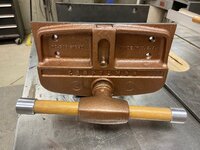
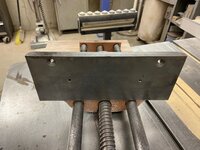
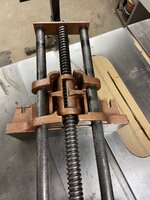
I thought I should bring some closure to this thread. There's been a break in the hot weather so I spent a few hours with various wire wheels, degreasing, and painting. I'm happy with the results.
Attachments
gleman
Well-known member
Nicely done! I like the color, what is it?
looks great !
Rustoleum Hammered CopperNicely done! I like the color, what is it?