To avoid these ads, REGISTER NOW!

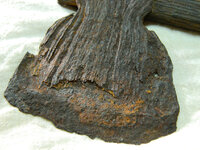
Very early claw face hammer, hatchet / shingle hammer

I'mMattman

Member
Joined
May 29, 2022
Messages
14
I've had this for quite some time now, picked it up at an estate sale. After some research and forensics, I can date this tool to sometime between 1720-1800. This puts it in the second colonial dominion era. The earliest known example of this design if from around 1750, and this one likely predates that. In those days there were no steel factories in what was to become America, so the carbon steel was most likely salvaged from ships. They did have naturally formed Bog Iron deposits here, this is where the iron for the body likely came from.

It has definitely seen better days. However, the natural erosion of the metals gives it an x-ray of how it was actually forged. The claw face and cutting edge of the ax are carbon steel, while the body is forged layers of Iron. The handle is the original hickory, but one of the coolest things about it are the form fitted steel shims are still in place. Whoever created this, was a master blacksmith for sure.
 

Attachments

  • DSCN3490-s.jpg
    DSCN3490-s.jpg
    842.7 KB · Views: 57
  • DSCN3491-s.jpg
    DSCN3491-s.jpg
    1,001.8 KB · Views: 55
  • DSCN3492-s.jpg
    DSCN3492-s.jpg
    795.9 KB · Views: 47
  • DSCN3495-s.jpg
    DSCN3495-s.jpg
    1 MB · Views: 47
  • DSCN3498s.jpg
    DSCN3498s.jpg
    1.1 MB · Views: 48
  • DSCN3499s.jpg
    DSCN3499s.jpg
    1.1 MB · Views: 47
  • DSCN3501s.jpg
    DSCN3501s.jpg
    1.3 MB · Views: 45
  • DSCN3500s.jpg
    DSCN3500s.jpg
    920 KB · Views: 56
To avoid these ads, REGISTER NOW!

Farmer J.

Well-known member
Joined
Sep 18, 2016
Messages
1,995
Location
UK, Cornwall/Hertfordshire.
That's a lovely old relic, and very interesting. I love the way the wrought iron partially delaminates and shows the grain and direction of forgeing on things of that era.
The date range you give seems right to me. I wonder if it may have been originally part of a ships carpenter's on board tool kit and arrived in America , or if it was indeed forged right there in the new colony and is one of the early items actually made there. I don't know much about that but suppose blacksmith shop would be something set up pretty quickly in the new settlements.
Thanks for posting it, and it's a nice change from factory made mass produced items. I am going to look around and see if I can find any others from that period of similar design.
 
OP
I

I'mMattman

Member
Joined
May 29, 2022
Messages
14
Naw, I've got to keep the patina. I have been tempted to soda blast it and put a coat of oil on it to stop the deterioration, but for some reason I always stop myself.
 

mike93lx

ALLIANCE MEMBER
Joined
Dec 9, 2013
Messages
37,678
Location
Richmond, VA
Naw, I've got to keep the patina. I have been tempted to soda blast it and put a coat of oil on it to stop the deterioration, but for some reason I always stop myself.
Shiny metal is pretty metal! Just joking.

I'd leave it be, maybe a little oil. I'd never use any kind of abrasive on it
 
OP
I

I'mMattman

Member
Joined
May 29, 2022
Messages
14
Shiny metal is pretty metal! Just joking.

I'd leave it be, maybe a little oil. I'd never use any kind of abrasive on it
Any recommendation on oil? I was thinking just mineral/butcher block oil, so it won't discolor the wood.
 
To avoid these ads, REGISTER NOW!

Private Lugnutz

Well-known member
Joined
Mar 30, 2012
Messages
30,623
Location
The Authentic Jersey Shore
Cool piece. Love your instincts. I might be tempted to clean the handle and restore some oils with something gentle like Murphy's or BLO and also use something to retard further deterioration of the head, but I'd probably want to talk to an expert first. How fragile is it? Does it crumble or flake off if you touch it? Have you thought about consulting the Smithsonian's Museum Conservation Institute? It's like a backdoor to the museum, or their education function. The how to the what. Or contacting their staff? They're very approachable.


Jacobs976

Well-known member
Joined
Sep 11, 2020
Messages
830
Location
Indiana
I'd recommend a light coat of 3 in 1 oil for rust prevention. I've used it on my conflict sword from 1812 and my hewing axe from the mid 1850s that still has a nearly perfectly intact handle. Also use it on 1900-1920s handles without issue. On wood it acts like any wood oil so a little bit won't hurt it as long as the wood isn't deteriorated too much.

Would also recommend being gentle with the metal, delaminated iron is a bit tricky sometimes. Pulled a pickaxe out of a creek that was probably from around 1910 and it had delaminated the top layers completely so it flaked apart when working on it. Ended up with the core of the pick which was interesting on its own but it wasn't in any way significant age or historically so it wasn't an issue.
 

Farmer J.

Well-known member
Joined
Sep 18, 2016
Messages
1,995
Location
UK, Cornwall/Hertfordshire.
This one very similar on Worthpoint.

For those unfamiliar with the process of making this and forge welding the carbon steel cutting edge within the wrought iron here's a link describing how it was done to recreate some axes using the same method although a different design of axe and a bit older than this one.. My Blacksmith son can do it, a neat trick! As part of his qualification he did a bit about preserving old iron like that, and comments: "Once it's started to delaminate and rust there's not much you can do except stabilise it and keep it dry".
 
Last edited:
OP
I

I'mMattman

Member
Joined
May 29, 2022
Messages
14
Cool piece. Love your instincts. I might be tempted to clean the handle and restore some oils with something gentle like Murphy's or BLO and also use something to retard further deterioration of the head, but I'd probably want to talk to an expert first. How fragile is it? Does it crumble or flake off if you touch it? Have you thought about consulting the Smithsonian's Museum Conservation Institute? It's like a backdoor to the museum, or their education function. The how to the what. Or contacting their staff? They're very approachable.

Info much appreciated! It's actually very solid, not fragile at all. The handle is loose, however it won't come out of the head. Shims are still tight as well.
 
OP
I

I'mMattman

Member
Joined
May 29, 2022
Messages
14
I'd recommend a light coat of 3 in 1 oil for rust prevention. I've used it on my conflict sword from 1812 and my hewing axe from the mid 1850s that still has a nearly perfectly intact handle. Also use it on 1900-1920s handles without issue. On wood it acts like any wood oil so a little bit won't hurt it as long as the wood isn't deteriorated too much.

Would also recommend being gentle with the metal, delaminated iron is a bit tricky sometimes. Pulled a pickaxe out of a creek that was probably from around 1910 and it had delaminated the top layers completely so it flaked apart when working on it. Ended up with the core of the pick which was interesting on its own but it wasn't in any way significant age or historically so it wasn't an issue.
Good info thanks!

Haha, I have the same pickaxe, found it in a bedrock hole on the Feather River. It was looking great until the fire in Paradise, after digging it out of the ashes, I have an extremely delaminating core that crumbles when you look at it... Might snap some pics and post.
 
To avoid these ads, REGISTER NOW!
Top Bottom