To avoid these ads, REGISTER NOW!

How much should new bandsaw vibrate?

WilsonLR

Well-known member
Joined
Sep 5, 2021
Messages
82
Location
FL
I've only ever had a cheap 9" Ryobi bandsaw (since early 90's). I recently upgraded to a new proper cast-iron table and wheels 14" Grizzly G0555LX. I expected little to no vibration but it's got terrible vibration. It's bad enough to make it hard to follow a line. I have an incident open with Grizzly Tech support but after replacing the upper wheel/tire, it only improved a little.

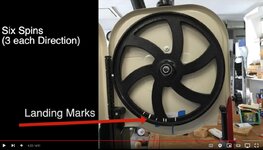
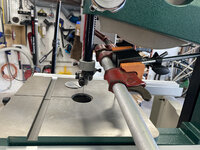
So I picked up a .0005 Tayline dial indicator and spent a day measuring it in various ways making sure to re-tension the tires when I put them back on. Attached is a photo of my test rig. I'm new to dial indicators and not sure I'm reading it right. Here's the video of the results.

These are the measurements I made:
  1. Lateral movement of blade guard with replacement upper wheel: .010 variation
  2. Vertical movement of table with factory wheels/tires/blade: .004 variation
  3. Vertical movement of table with replacement wheel/tire: .003 variation
  4. Vertical movement of table without blade: under .001 variation
  5. Runout of upper wheel with tire removed (hand spun): Roughly .004 variation
  6. Runout of lower wheel with tire removed (hand spun): Roughly .004 variation
  7. Runout of lower wheel with tire removed (motor spun): Roughly .005 variation
  8. Spin test of each wheel: Both settle in roughly the same place
Is this a legit methodology? What would you do differently to make the case to Grizzly Tech support for what to do next?


IMG_8957 WEB.jpg
 

Attachments

  • IMG_8958 WEB.jpg
    IMG_8958 WEB.jpg
    1.6 MB · Views: 20
To avoid these ads, REGISTER NOW!

Sinatra

Well-known member
Joined
Apr 22, 2013
Messages
117
A few suggestions. Make sure all four feet have contact with solid ground. Check that the saw is level. Check all the bolts on the saw, especially the motor. There are three basic moving parts. The motor and the two wheels. Discounting guide bearings for now. Your vibration is most likely based on one of those. I would take off the belt and run the motor and see if you have the vibration. If not, Remove the guide bearings and add the belt back and run it again.
 
OP
W

WilsonLR

Well-known member
Joined
Sep 5, 2021
Messages
82
Location
FL
I would take off the belt and run the motor and see if you have the vibration. If not, Remove the guide bearings and add the belt back and run it again.
Great idea @Sinatra . I'll add the motor only test. I have the guide bearings adjusted so they don't turn so I'm not sure what removing them would do? The unit sits directly on a Grizzly Bear Crawl mobile base and no wobble. However the garage floor has variations and the table is about a 1/4 bubble out of level in each direction.
 

RTM

Well-known member
Joined
May 13, 2019
Messages
13,176
Location
SF Bay Area
I can't tell how your pipe clamp is mounted, but is that solid enough that it isn't adding to the vibration measurement?

Your measurements are telling you how bad it is, not the source of the vibration.

I would look at your wheels both ways, radially where the tire mounts, and along the edge, looking for wobble.

You might also look at the weld on your blade, make sure it's not contributing. Should be a lower oscillation though.

Measure your belt pulleys the same as I noted above on your wheels, both on motor and on wheel.

If you are getting good low reading when spinning by hand on all of the above, try to observe them under power, but not with your dial indicator. Maybe hold a popsicle stick pointing downstream against the edges, and see if it feels as smooth as the dial indicator suggested. Might be wobbling at speed.

Measuring with your indicator base against the frame should be good, but at speed check the base against the ground to see if it's wobbling.

It will be an iterative approach to tracking it down.

Good luck
 
Last edited:
OP
W

WilsonLR

Well-known member
Joined
Sep 5, 2021
Messages
82
Location
FL
@2Fast agreed. Mine fails. Trying to figure out why. @RTM I switched to a cast iron pipe to minimize contribution of pipe clamp to movement. It's held in an end vise and quite solid. Is my measurement of the wheel without tire a valid method? They vary roughly .004. I plan to add some weights to try and balance the wheels but I wanted a good way to measure improvements. My thinking was that as the farthest point and the least supported point, the blade guard would be the spot on the unit that vibrates the most.
 

seber

Well-known member
Joined
May 31, 2016
Messages
4,196
Location
Deep East Tx.
I'm with the wheel wobble. That is the one thing most likely to causes vibration. Same as grinders.
 

BFBOB

Well-known member
Joined
Sep 20, 2011
Messages
5,073
You should be checking for weight distribution too, not just dimensions. Run it without the blade, see if it vibrates. if so, the lower wheel is out of balance. Add a stick-on auto wheel-weight to the wheel (bend it into a V so it will stay put and be centered) Run it - Vibration better or worse? Check, move, check, move on and on. Tedious, but effective.
You may also be able to find the heavy spot by taking off blade and belt, give it a spin by hand and see if it settles at or near the same place. Your brand-new bearings may be too tight for this to work, but it's worth a try.

My 60 year-old Sprunger 14" took all of this to get it to settle down.

...I just saw that weights have already been mentioned. I second the motion!
 
OP
W

WilsonLR

Well-known member
Joined
Sep 5, 2021
Messages
82
Location
FL
It should not vibrate AT ALL.
Yah, I bought new so I wouldn't have to do all this. Where would you recommend measuring it? Table? Guard? What?

@BFBOB At the end of the video in my original post, I show the results of "spin testing" each wheel. Both settle in the same place. I would expect a properly balanced wheel to spin and stop. But these wheels spin, stop, back up, stop, backup ... several times before finally stopping. So much for Grizzly's "Computer balanced cast iron wheels". Even though the NOBLADE test in the video shows reduced vibration, I'm thinking I'm better off balancing it.
Screen Shot 2022-07-11 at 7.39.38 AM.jpg
 

Attachments

  • Screen Shot 2022-07-11 at 7.39.51 AM.jpg
    Screen Shot 2022-07-11 at 7.39.51 AM.jpg
    206.8 KB · Views: 14
OP
W

WilsonLR

Well-known member
Joined
Sep 5, 2021
Messages
82
Location
FL
I balanced the wheels using earth magnets and re-did the spin tests to confirm balance. That removed alot of vibration but it still failed nickel test. So I tested the left-right and front-back movement of the table. "There's your problem" see 4:00 for table tests with balanced wheels. I have no idea what to do next. What a pain. Waiting to hear back from Grizzly.

EDIT: UPDATE VIDEO LINK TO TODAY'S TESTS

 
Last edited:

PCustoms

Well-known member
Joined
Jul 23, 2011
Messages
22,922
Location
VT
What problem are you chasing?

0.004" runout on the wheel (can't tell if you are on wheel, tire or blade) does not seem excessive.
 
OP
W

WilsonLR

Well-known member
Joined
Sep 5, 2021
Messages
82
Location
FL
@PCustoms - Chasing front-back table vibration of .016" as shown at 4:44 in this video.

The runout tests were done with tires removed. Balancing the wheels brought down the vibration to acceptable measurements on blade guides, up-down table movement and left-right table movement. But it still fails the nickel test and keeping a board steady during cutting is difficult. When I measured the front-back table movement, the dial indicator read wildly with total movement of .016".

Motor v-belt is smooth and properly tensioned. There is no vibration at all when running just the motor and no v-belt. I am puzzled what could be causing such movement on a factory unit. I am beginning to think the design can't handle the extra weight of cast iron wheels.
 
Last edited:

PCustoms

Well-known member
Joined
Jul 23, 2011
Messages
22,922
Location
VT
@PCustoms - Chasing front-back table vibration of .016" as shown at 4:44 in this video.

The runout tests were done with tires removed. Balancing the wheels brought down the vibration to acceptable measurements on blade guides, up-down table movement and left-right table movement. But it still fails the nickel test and keeping a board steady during cutting is difficult. When I measured the front-back table movement, the dial indicator read wildly with total movement of .016".

Motor v-belt is smooth and properly tensioned. There is no vibration at all when running just the motor and no v-belt. I am puzzled what could be causing such movement on a factory unit. I am beginning to think the design can't handle the extra weight of cast iron wheels.
Got it.

Watched your vid @4 min mark and didn't see anything, closed before I got to that section.

Have to aligned the belt and pulley?
 
To avoid these ads, REGISTER NOW!

tester19

Well-known member
Joined
Apr 25, 2021
Messages
225
Location
chigago
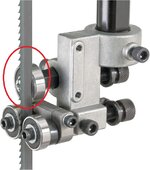
Sorry no help but I had a question on the design of the blade bearings?
They seem to be 90 degree's out from where they should be?

Saw Blade Bearing.jpg

Why is the bearing set like that? It does no good and should be rotated so the bearing surface is pushing on the back of the blade to support it.

Why not like this one instead?

Saw Blade Bearing-Correct.jpg

For the cost of the machine I would expect better? Maybe this is a possible source of your problems? That blade is just dragging across the bearing?

I mean my cheap *** Harbor Freight band saw is even built correctly in this area?
.
.
.
 

RTM

Well-known member
Joined
May 13, 2019
Messages
13,176
Location
SF Bay Area
Saw Blade Bearing.jpg

Why is the bearing set like that? It does no good and should be rotated so the bearing surface is pushing on the back of the blade to support it.
.
.
This is the correct orientation on many bandsaws I’ve seen over the last 20 years.

Maybe ask the designers at the manufacturer. Or read the Carters page to see if they tell. But it’s not wrong for that saw.
 

CallumRD1

Well-known member
Joined
Jul 7, 2017
Messages
339
Location
Colorado
It's not wrong for that saw but it is an inferior design. The better guides run the spine of the blade against the outside race so that it's a true single-point contact with no lateral forces from the rotation of the bearing. As an aside, the second picture shows a blade being run with it's teeth set inside the lateral guide bearings. This is absolutely not how to set up the saw! Doing so will result in the bearings removing the set from the teeth resulting in it not being able to cut straight ever again.
 
OP
W

WilsonLR

Well-known member
Joined
Sep 5, 2021
Messages
82
Location
FL
All my testing is done with the bearings pulled away. No bearing touches the blade so they are eliminated as a possible source of a problem. I did more testing and discovered that the shaking is cyclical. It takes about 4 minutes to run through the cycle from minimal .001" variation to .016" at the worst. Even the other axis of movement I measured are affected but don't vary as much. They vary from .001 to .006 or so.
 

turner66

Well-known member
Joined
Jan 29, 2016
Messages
122
Location
Texas
Regarding: "Why is the bearing set like that? It does no good and should be rotated so the bearing surface is pushing on the back of the blade to support it."

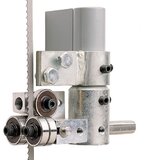
Actually an inaccurate statement when all is done correctly. This orientation is more common on the European industrial and commercial saws. Here is an example of the guide system on my Centauro (Italian). The same is found on many other larger saws from Wadkins, SCM, Agazzani, and the like... Some folks like them, some folks don't. And, it's a design that seems to have found it's way to the smaller saws in some cases. Sorry I'm no historian on the origins of this design, I just use it to great success ;)

The assembly below has been in use and on my saw since 2004. Never replaced, and no signs of wear as you can clearly see on the face of that thrust bearing. Your concerns of wear or heat may be legitimate on a standard ball bearing oriented as as shown in your picture and installed on a smaller saw (notorious for not being able to properly tension blades), but totally unfounded here. This thrust bearing spins as free and smooth as the day this saw was delivered.

Why does tension matter you ask? The blade on this saw right now is a 1 1/2" Lenox Tri-Master 2/3 vari-tooth carbide. Notice in the 3rd pic the gap behind the blade spine to the thrust bearing, they never touch unless feed pressure is high enough and it can flex the blade. In this case, it's not particularly easy to flex this resaw blade when it's tensioned properly which this saw is certainly capable of doing. The blade itself can handle up to 30,000 psi. In reality, that thrust bearing should never see much action unless something isn't quite "right"...

Finally, although it's difficult to see in the first pic, there is actually a narrow gap about the thickness of a piece of paper on each side between the blade and the side guides (which are not bearings). Same principle and never any wear... This setup will resaw veneer with very little blade tooth marks, which are easily cleaned up on a pass through the wide belt or drum sander.
Hope that helps the understanding on this guide design.

IMG_1163.jpg
IMG_1164.jpg

IMG_1165.jpg
 
Last edited:

RTM

Well-known member
Joined
May 13, 2019
Messages
13,176
Location
SF Bay Area
The blade on this saw right now is a 1 1/2" Lenox Tri-Master 2/3 vari-tooth carbide. Notice in the 3rd pic the gap behind the blade spine to the thrust bearing, they never touch unless feed pressure is high enough and it can flex the blade. In this case, it's not particularly easy to flex this resaw blade when it's tensioned properly which this saw is certainly capable of doing. The blade itself can handle up to 30,000 psi.
Damn, that’s nice. My Italian made Laguna won’t go that high, I think 3/4” is the biggest I ever ran. I’ve not gotten around the getting a pic of mine for this thread.
 
OP
W

WilsonLR

Well-known member
Joined
Sep 5, 2021
Messages
82
Location
FL
Any updates?
Thanks for asking, this topic kinda got diverted.

I think I have a lemon. The brand new G0555LX had wheels that settled at one spot. Ditto a replacement wheel. After I manually balanced the wheels, it brought the up-down and left-right vibration down to .001". However, the front to back movement is awful. After re-tensioning both tires, v-belt and triple checking blade tension with multiple blades, the front-back movement is .010" (originally .020"). HOWEVER, the front-back vibration goes in a cycle from bad (.010") to OK (.001") and back to bad over the course of 4 minutes. A nickel will stand when it's under .005".

I documented everything to Grizzly Friday and it's been added to the incident report and is under a 2 day review. BTW, I didn;t know this, but if they can't fix it over the phone, you have to send it to Washington state where they will swap parts. They don't have any repair capability or wheel balancing equipment. That is only in Taiwan

IF ANYONE WANTS TO HELP:

Take a measurement on your BS at the right front railing with a solidly mounted dial indicator. It would help to know what other saw are doing in this regard. Below is my setup.
Screen Shot 2022-07-15 at 6.54.08 PM.jpg
 
OP
W

WilsonLR

Well-known member
Joined
Sep 5, 2021
Messages
82
Location
FL
This is the BAD to GOOD and on the way back to BAD cycle I am seeing:
 

tarbellb

Well-known member
Joined
Apr 17, 2011
Messages
5,756
Location
Oregon
Well documented, this should be a helpful thread for anyone that finds themselves in a similar situation.

Glad you got it sorted out, project time!
 

Rabid Badger

Well-known member
Joined
Apr 2, 2018
Messages
1,338
It's not wrong for that saw but it is an inferior design. The better guides run the spine of the blade against the outside race so that it's a true single-point contact with no lateral forces from the rotation of the bearing.

Running against the edge of the bearing is quieter. The reason cheaper saws do it the other way is so they don't have to use a more expensive thrust bearing.
 

Milton Shaw

Well-known member
Joined
Feb 11, 2011
Messages
4,838
I put urethane tires on mine also and they are smooth, don't create the problem again by not releasing the tension on the blade each time you have used the saw. Carter I think makes a lever action easy tension release for some saws that make it easier to release and then re-tension the blade, I don't use my bandsaw much so I haven't invested in one. If left under tension the belts will flat spot where the blade is squeezing the tire. I like the urethane belts as they didn't require glue like the old rubber style did.
 

DadsTools

Well-known member
Joined
Jul 27, 2017
Messages
1,852
Just an interesting note to add...I have a 1950s Atlas 912 I recently tuned with new blade, guide blocks, urethane tires and thrust bearings. My arrangement is the type where the rear blade edge rides on the side face or 'shoulder' of the outer race. I was experiencing problems with the blade riding so close to the shoulder edge that it could slip off the bearing with a little excess pressure on the blade. The original thrust bearings had a wider shoulder of around an additional 1mm. In studying the old and new bearings, I discovered that not only the inner diameter between the shoulder edges is larger on the new than the old, but the bevel at the outside edge where it meets the outer face is more pronounced. Come to find out that no one makes a 6202 shielded or sealed bearing anymore like the old ones with the wide shoulder. I lucked out finding a single NOS bearing on eBay with the thicker shoulder, and for the other I pried the metal seal off and cleaned-relubed inside.

So, why was the blade riding so close to the outer edge of the bearing? I also noticed that the guide blocks had a similar issue with the blade coming much closer to the right hand block holder than the left.

After scratching my head for awhile, I finally figured it out. The original tires were thin rubber. The one time the tires had been changed (got the original receipts with the saw) was also of a thin rubber. I had replaced the tires with new urethane. The urethane tires are significantly thicker than the old rubber. That's what was pushing the blade out to the right.

Who'd of thought?

So if you run into an blade alignment thrust bearing/block issue with an old vintage band saw, you might give some thought to the tires.

BTW, that old Atlas runs smooth as glass.
 
  • Like
Reactions: RTM
To avoid these ads, REGISTER NOW!
Top Bottom