To avoid these ads, REGISTER NOW!

Reconnecting Solar after Main Panel Upgrade

frankd

Well-known member
Joined
Aug 5, 2014
Messages
677
Location
Long Island, NY
I'm in the process of upgrading my main service panel to 200amps and looking for some help/advice.
We have solar panels (which we own) but am still tied to the grid. No batteries. The outside part of the service was updated when the panels were installed 4 years ago but the main service panel wasn't. My electrician quoted me $1,800 to install a new panel but he doesn't do solar and he suggested that I reach out to the solar installer regarding interconnecting the solar once the main panel was changed. There are just 3 wires coming from the inverter that appear to be connected to the hot and neutral wires coming into the panel with some sort of lugs (not sure of the correct term). My electrician said that he doesn't have a problem reconnecting those 3 wires but since he doesn't get involved with solar he just wanted to be sure that I didn't have any issues, which is why he suggested contacting the solar installer.
So I called the solar installer and was told that if they strongly suggest that They reconnect the solar to the main panel once my electrician is done. If my electrical does it, it would potentially void any warranties that I have on the system. And of course, they want $650 just to reconnect those 3 wires.... as long as my electrician saves the lugs. If they need to use new lugs it would be more.

I'm a bit annoyed that they want to charge me $650 for something that will take less than 30 minutes but they kind of have me by the balls. Do you think its ok to have my electrician just re-attach them? I can also see if I can find another electrician that has experience with solar panels but potentially could have the same issue if I have them reconnect the wires. any other suggestions?
 
To avoid these ads, REGISTER NOW!

nadogail

Well-known member
Joined
Jan 23, 2009
Messages
31,959
Location
Coronado, CA
Sounds like your electrician is one of those who have to dip their socks in kerosene to keep the ants from climbing up his legs and biting him on his candy flavored body.
 
OP
F

frankd

Well-known member
Joined
Aug 5, 2014
Messages
677
Location
Long Island, NY
Sounds like your electrician is one of those who have to dip their socks in kerosene to keep the ants from climbing up his legs and biting him on his candy flavored body.
Haha...maybe. he said he didn't have a problem reconnecting it but didn't want me to have issues with my solar warranty
 

jlv03

Well-known member
Joined
Jan 19, 2020
Messages
346
Location
SE IA
Lugs? Is the solar tapped into the incoming wires before the main breaker?

Depending on setup and size, sometimes the solar is brought into a breaker (or set of breakers) at the end opposite the main.
 
OP
F

frankd

Well-known member
Joined
Aug 5, 2014
Messages
677
Location
Long Island, NY
Lugs? Is the solar tapped into the incoming wires before the main breaker?

Depending on setup and size, sometimes the solar is brought into a breaker (or set of breakers) at the end opposite the main.
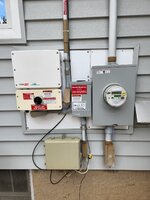
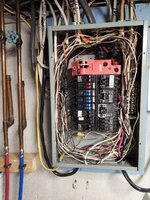
Yes, it looks like the solar is tapped into the incoming power lines before the main breaker. If you look closely at the photo you'll see two of the lugs above the main breaker. I think there's a third wire that is just connected straight to the ground bar
 

Attachments

  • 20220823_105850.jpg
    20220823_105850.jpg
    502.1 KB · Views: 110

jlv03

Well-known member
Joined
Jan 19, 2020
Messages
346
Location
SE IA
I assume there is some sort of outside disconnect?

My setup is slightly similar, only my solar is tapped (via Polaris connectors) ahead of the main on the outside of the house, all done in a separate outdoor enclosure.

What I don't know if your setup is done that way by code or utility requirement, or if it was simply a matter of not enough breaker space left in the panel.

At any rate, that type of tap looks questionable for long term usage. I'd kindly ask the solar company if something else could be done.
 
OP
F

frankd

Well-known member
Joined
Aug 5, 2014
Messages
677
Location
Long Island, NY
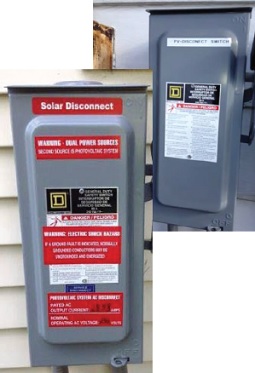
Youre probably right as my panel was jam packed (as you can see). There is a breaker outside as well as a large on/off switch below the inverter that Im assuming disconnecta the system.
 

Attachments

  • 20220823_110858.jpg
    20220823_110858.jpg
    312 KB · Views: 107

walta

Well-known member
Joined
Jan 13, 2017
Messages
2,311
Location
Dutzow Missouri
The first question is do you have a signed net metering agreement with your electric service provider?

Does your install meet all the requirements of your service provider and fire departments?

Walta
 
OP
F

frankd

Well-known member
Joined
Aug 5, 2014
Messages
677
Location
Long Island, NY
Wow that install would definitely not fly in California.
What's wrong with the installation? Maybe something I can have fixed with the panel upgrade? Everything was done with all the appropriate permits and sign off from the town and the installation was done by a large local (and supposedly reputable) installer.

Do you think I should reach out to another solar installer and get a quote from them? I'm a little concerned that my installer wanted to reuse those clamps or charge me $100 for new ones
 
Last edited:
OP
F

frankd

Well-known member
Joined
Aug 5, 2014
Messages
677
Location
Long Island, NY
The first question is do you have a signed net metering agreement with your electric service provider?

Does your install meet all the requirements of your service provider and fire departments?

Walta
Yes the install met all the requirements...or should have. I have all the permits and sign offs from the town. Not sure if I actually signed a net metering agreement but I do have net metering with the local utility company and am generally overproducing electricity which goes into my energy "bank" on my utility bill
 

walta

Well-known member
Joined
Jan 13, 2017
Messages
2,311
Location
Dutzow Missouri
From what I understand many utilities are not pleased with net metering deal and may not make it easy to get connected.

Note operating your solar so it back feeds the meter without an agreement would violate your terms of service! They could get nasty and pull the meter.

My guess is some of what that $650 is making sure you have an agreement in place and all the I are dotted and the Ts are crossed.


Walta
 

Meursault74

Well-known member
Joined
Apr 1, 2019
Messages
21,976
Location
Southern California
Our inverter stopped working a couple of years ago (few months out of 10 year warranty). The solar company charged $250 to remove and replace the inverter, the inverter was also reasonably priced from them. This also kept the warranty intact in the future. Sounded like a reasonable price. I was going to DIY it, but the warranty was too important for me to skimp. $650 seems like a lot to connect a couple of wires, but it should still be charged for a service call. Maybe try some other solar company.
 

reader2580

Well-known member
Joined
Dec 31, 2014
Messages
14,537
Location
Minneapolis, MN
The NEC is pretty specific on how solar is to be connected. Your panel upgrade may mean the connection method should be changed. I would pay an electrician who is familiar with solar unless you are very familiar with solar electrical.

For my solar I did a lot of research and also verified my plans with my local electrical inspector and my utility as I did a tap inside my meter socket.
 
To avoid these ads, REGISTER NOW!
OP
F

frankd

Well-known member
Joined
Aug 5, 2014
Messages
677
Location
Long Island, NY
From what I understand many utilities are not pleased with net metering deal and may not make it easy to get connected.

Note operating your solar so it back feeds the meter without an agreement would violate your terms of service! They could get nasty and pull the meter.

My guess is some of what that $650 is making sure you have an agreement in place and all the I are dotted and the Ts are crossed.


Walta

There definitely has to be some sort of agreement with the utility company. My monthly bill has an "energy bank" that keeps track of the excess electricity that I'm generating. Also, they had to install a new digital meter when the system was installed. And I had to go through the whole permitting process. I asked and the $650 is just to reconnect the wires and "properly" power up the system....I found a video from the inverter mfg (solaredge) and properly turning the system on essentially requires flipping 3 switches.
Thinking I'll just have my electrician reconnect and I'll follow the proper procedure for powering down and powering back up
 

mm08822

Well-known member
Joined
Jan 13, 2012
Messages
5,929
Location
NJ
There definitely has to be some sort of agreement with the utility company. My monthly bill has an "energy bank" that keeps track of the excess electricity that I'm generating. Also, they had to install a new digital meter when the system was installed. And I had to go through the whole permitting process. I asked and the $650 is just to reconnect the wires and "properly" power up the system....I found a video from the inverter mfg (solaredge) and properly turning the system on essentially requires flipping 3 switches.
Thinking I'll just have my electrician reconnect and I'll follow the proper procedure for powering down and powering back up
The green sticker on your meter indicates net metering and meter is labeled from LIPA so the inter-connect topic brought up by walta is a non-issue.

The cleaner way to connect the solar input is to bring it into the panel.
With a new 200amp service and panel buss rated for the same, you're permitted up to 20% of that (40amps) for inter-connecting the solar input into the main panel buss. So a 40amp 2 pole cb installed at the bottom of the panel is permitted. POCO feed with 200amp cb assumed at top of panel. You may only have 30 amp feed now. Check the exterior disconnect to determine what is present.

Since there are 32 ckts in that panel now, add two more for solar and you are at 34. You really want a 40 space/60 circuit panel and not a 40/40 or 30/40. Upgrading to only 40 ckt max is a minimal benefit.
If you get a new Siemens panel, the existing Siemens cb's could be re-used.

The Solar installer is bs'ing you for a quick $$$ house call. Re-using those taps is poor judgement and installing a cb is the better way to go.
Furthermore, once the inverter loses power (you open the exterior disconnect) it shuts down b/c of ac signal loss. No different than POCO power outage. Once the connections from that disconnect are made into the new cb at bottom of panel, the inverter will resume operation once the main disconnect cb, exterior disconnect and new cb are closed. (No different than if a power outage ceased.)

Tell your sparky to read NEC 705.12 (2) (3) (B). Also need a warning label next to the cb as required by same section.
 
OP
F

frankd

Well-known member
Joined
Aug 5, 2014
Messages
677
Location
Long Island, NY
The green sticker on your meter indicates net metering and meter is labeled from LIPA so the inter-connect topic brought up by walta is a non-issue.

The cleaner way to connect the solar input is to bring it into the panel.
With a new 200amp service and panel buss rated for the same, you're permitted up to 20% of that (40amps) for inter-connecting the solar input into the main panel buss. So a 40amp 2 pole cb installed at the bottom of the panel is permitted. POCO feed with 200amp cb assumed at top of panel. You may only have 30 amp feed now. Check the exterior disconnect to determine what is present.

Since there are 32 ckts in that panel now, add two more for solar and you are at 34. You really want a 40 space/60 circuit panel and not a 40/40 or 30/40. Upgrading to only 40 ckt max is a minimal benefit.
If you get a new Siemens panel, the existing Siemens cb's could be re-used.

The Solar installer is bs'ing you for a quick $$$ house call. Re-using those taps is poor judgement and installing a cb is the better way to go.
Furthermore, once the inverter loses power (you open the exterior disconnect) it shuts down b/c of ac signal loss. No different than POCO power outage. Once the connections from that disconnect are made into the new cb at bottom of panel, the inverter will resume operation once the main disconnect cb, exterior disconnect and new cb are closed. (No different than if a power outage ceased.)

Tell your sparky to read NEC 705.12 (2) (3) (B). Also need a warning label next to the cb as required by same section.
This is great info. Thank you SO much!
 

dcg9381

Well-known member
Joined
Jun 20, 2018
Messages
11,764
Location
Austin, TX
Around here electricians won't touch solar with a 10 foot pole. They've got enough business that they don't want to learn something new.
I don't like those taps either - what's more appropriate is breaker for solar in the panel. If you're ever going to do a generator interlock, where the solar breaker lives is important.

Note, these inverters, depending on how they are configured can be 2-wire, 3-wire. 120V or 240V. I would not assume by wire color. I see the taps, but I'm not 100% certain without sticking my nose in there that it's 240v.

I can't quite read what's on your outdoor install. Those numbers may shed some light.

I can tell that it has rapid shutdown, which means per NEC the DC side does not need a physical disconnect, but if here, my utility doesn't care what NEC says and wants a DC disconnect anyway. You appear to have both AC and DC disconnects if I am making it out right.
 

jeepxj

Well-known member
Joined
Mar 2, 2008
Messages
17,856
arnt those taps used when the panel isnt rated enough for the additional solar potential? keeps it off the bus?
 

walrus

Well-known member
Joined
Nov 12, 2008
Messages
11,679
Location
Maine
arnt those taps used when the panel isnt rated enough for the additional solar potential? keeps it off the bus?
Yes, its a line side tap. I doubt its code to back feed a breaker in most instances.
 

pistolpete1313

Well-known member
Joined
Sep 17, 2013
Messages
182
Location
Fort Collins, CO
Yes, its a line side tap. I doubt its code to back feed a breaker in most instances.

NEC 690 is pretty straightforward, as long as the breaker is listed for backfeed, you can do it (with some other stipulations also being met.)
 

pistolpete1313

Well-known member
Joined
Sep 17, 2013
Messages
182
Location
Fort Collins, CO
I can't see the inverter size but I'm betting it is a 7600 or smaller. You have 2, code correct options:

1) Leave everythng as is with the taps. Keep the knife blade exterior disconnect off when working with the wires and simply turn it on when complete. Nothing else is needed and it will work as before. That exterior disconect is fuesed and already provided the overcurrent protection required

2) Move the point of connection to a backfeed breaker on the opposite end of the feed (bottom of the busbar if you have a top-fed panel). Breaker would be a 20a for a 3800, 40a for a 7600, etc. It needs to be able to protect the output wires and the next avliable size up from the output. So if you have a 5000 -> 5000W/240A * 1.25 = 26A so you would use a 30A breaker and at least #10 wire. As stated before, you will need a sticker for the breaker stating that it is backfed and cannot be moved.

Honestly, #1 is fine and will be the easiest. I don't like fused disconnects as they can nusance blow and isn't as simple as flippng a breaker but it's what you have and has been working fine.
 

walrus

Well-known member
Joined
Nov 12, 2008
Messages
11,679
Location
Maine

NEC 690 is pretty straightforward, as long as the breaker is listed for backfeed, you can do it (with some other stipulations also being met.)
I don't think the breaker is the issue, its 705.12 thats the issue
 

pistolpete1313

Well-known member
Joined
Sep 17, 2013
Messages
182
Location
Fort Collins, CO
I don't think the breaker is the issue, its 705.12 thats the issue
If it's the 120% rule, I know these SolarEdge systems well, i'll bet that it is a 7.6kW w/ a corrected output of 40A, and the old 150A panel wouldn't pass the rule but will now. They make larger ones but they are much less common. It looks like he has ~8.5KWDC of solar, which would again point to a 7.6kWDC inverter. All guessing until he sends the inverter but still, the tap is fine to leave as-is.
 

gpiggaz

Well-known member
Joined
Mar 14, 2010
Messages
2,554
Location
Tucson, AZ & Edmonds, WA
I'm not a licensed Electrician, so take this advice with a grain of salt.

If you zoom in on the SolarEdge picture you can see it's a 30 Amp system based upon the label. So that means its most likely a SolarEdge HD7600 inverter. So back feeding a 40 Amp breaker in the bottom of the new panel should meet all the NEC Codes- It did with my installation in 2021. He should be ok with his new 200Amp panel to do that- and get rid of the line side tap - and certainly not reuse the insulation piercing connectors that currently feed the solar to his panel. I would bet the solar company would prefer to do it that way now anyway- But like others have said, his electrician should be able to do this for him. Just make sure to label the solar breaker properly per the NEC.
 

HamAndEggs

Well-known member
Joined
Nov 16, 2020
Messages
932
Location
Houston, TX
arnt those taps used when the panel isnt rated enough for the additional solar potential? keeps it off the bus?

Its also handy to keep it on the grid side of a generator ATS and not having to rely on the rapid shutdown of the inverter(s)

They wanted to do a breaker install for my 17kw install, but I pushed them to do a line side tap in the ATS. Now I can test the generator while still making power. Sure would **** to test the generator in the middle of the day and lose an hour of production!

Half the reason is that if I ever got a market rate sellback plan, you could possibly make $$$$ feeding back when the price spikes, like in the Texas window storm we had. I know someone that made $300 in a few days feeding back solar, since they happened to still have power. I could run off generator power (Currently just 12c/kwh calculated) and sell back the solar at a higher rate
 

reader2580

Well-known member
Joined
Dec 31, 2014
Messages
14,537
Location
Minneapolis, MN
Half the reason is that if I ever got a market rate sellback plan, you could possibly make $$$$ feeding back when the price spikes, like in the Texas window storm we had. I know someone that made $300 in a few days feeding back solar, since they happened to still have power. I could run off generator power (Currently just 12c/kwh calculated) and sell back the solar at a higher rate
Don't most solar inverters say not to use a generator to power the inverter? You must get paid based on the current wholesale rate of power if you make more when wholesale rates are higher.
 

HamAndEggs

Well-known member
Joined
Nov 16, 2020
Messages
932
Location
Houston, TX
Don't most solar inverters say not to use a generator to power the inverter? You must get paid based on the current wholesale rate of power if you make more when wholesale rates are higher.

Solar inverters are completely incompatible with generator output, and will not power on as they won't sync with the output. But, if they somehow did, it would be catastrophic for the generator.

Because I have a line side tap, it means I can run the generator and the solar at the same time, because they are physically separated. Here is a high quality technical diagram. The three dots represent the ATS switch where it can switch between generator power and Grid power

In this situation, the yellow rod being the switch position shows we are on gen power

1665499667735.png

AS you can see there, my home is completely disconnected from the grid when on generator power, but the solar IS still connected to the grid. So the grid can sync up with the solar even when I'm on generator power
 

reader2580

Well-known member
Joined
Dec 31, 2014
Messages
14,537
Location
Minneapolis, MN
AS you can see there, my home is completely disconnected from the grid when on generator power, but the solar IS still connected to the grid. So the grid can sync up with the solar even when I'm on generator power
Does your utility pay you enough to make it worthwhile running your generator and sending all solar to the grid?
 

HamAndEggs

Well-known member
Joined
Nov 16, 2020
Messages
932
Location
Houston, TX
Does your utility pay you enough to make it worthwhile running your generator and sending all solar to the grid?

Right now just based on the cost of NG, yes. But I'd never do it. But if I ever end up on a market rate sellback plan, I would possibly do it

But it is nice to be able to run on generator while still sending solar back. If I switch to generator right now at 4PM I'd be giving up a constant 7kw~, panels would be off. With the current setup I would be exporting it
 
To avoid these ads, REGISTER NOW!
Top Bottom