
You are using an out of date browser. It may not display this or other websites correctly.
You should upgrade or use an alternative browser.
You should upgrade or use an alternative browser.
Between 485 & 705 SQ/FT Mid-Century Moto Mecca Makeover
- Thread starter sakurama
- Start date
Workspaces between 485 and 705 squarefeet.
Gregor, how much riding experience do you expect people to have for one of these trips? Fair disclosure: I wouldn't able to do one any time in the near future.
Maybe we can convince Gregor organize an 'adventure riding basics' trip someday. While I've got a good amount of pavement riding experience under my belt, I've been researching adventure bikes a lot lately and have convinced myself that I need to get one sometime soon.
Gregor, how much riding experience do you expect people to have for one of these trips? Fair disclosure: I wouldn't able to do one any time in the near future.
For the normal trip I'd say beginner to intermediate. We don't do anything too hairy and John (Roderick) had never had any off road experience and by the end of the week on the second trip was doing great.

This trip I'd say would require more intermediate skills as we're going to do some exploring of double track, four wheel drive trails and cow trail if we come across it.
Maybe we can convince Gregor organize an 'adventure riding basics' trip someday. While I've got a good amount of pavement riding experience under my belt, I've been researching adventure bikes a lot lately and have convinced myself that I need to get one sometime soon.
The course I'm teaching with MotoCorsa is certainly geared to beginning off road riders who either got their first adventure bike or are beginning to explore off road riding. That said Scott and I share tips whenever there's a question or we're getting into something different that might be tricky.
Gregor
Angus Lemon
New member
Reached the end of the thread....took me a couple of weeks.
What a ride...you are an inspiration Gregor.
Appreciate you continuing this.
What a ride...you are an inspiration Gregor.
Appreciate you continuing this.
tjpavlov
Well-known member
Pizza Question--
What do you do for dough when you are on the road? The recipes I've tried have all needed lots of time to rise and then be periodically kneaded. They don't seem well suited for your tours. I ask because I've been looking for a simplified way to get decent dough going.
What do you do for dough when you are on the road? The recipes I've tried have all needed lots of time to rise and then be periodically kneaded. They don't seem well suited for your tours. I ask because I've been looking for a simplified way to get decent dough going.
elvee
Well-known member
While I’m not Gregor I do make a lot of pizza and have been working to refine my dough. Building the dough isn’t too labor intensive. You can shorten the initial fermentation and proof and then shape into balls. Once they are balled up you can throw them in the refrigerator for tw/o tomorrow three days to continue fermenting. Just give them one or two hours out of refrigeration before you go to shape them.Pizza Question--
What do you do for dough when you are on the road? The recipes I've tried have all needed lots of time to rise and then be periodically kneaded. They don't seem well suited for your tours. I ask because I've been looking for a simplified way to get decent dough going.
Depending on what foundation I am working from, I can have a lead time on dough from same day to four or five days in advance. It just depends on what I am starting with and what style crust I want.
Pizza Question--
What do you do for dough when you are on the road? The recipes I've tried have all needed lots of time to rise and then be periodically kneaded. They don't seem well suited for your tours. I ask because I've been looking for a simplified way to get decent dough going.
While I’m not Gregor I do make a lot of pizza and have been working to refine my dough. Building the dough isn’t too labor intensive. You can shorten the initial fermentation and proof and then shape into balls. Once they are balled up you can throw them in the refrigerator for tw/o tomorrow three days to continue fermenting. Just give them one or two hours out of refrigeration before you go to shape them.
Depending on what foundation I am working from, I can have a lead time on dough from same day to four or five days in advance. It just depends on what I am starting with and what style crust I want.
On the moto trips, as Ben mentions, I would make the pizza in the hotel kitchen the day before so I had 24 hours which I sort of consider the minimum for the dough to develop. When we go camping I make the dough the night before and then place the dough (formed into balls) in the proofing containers I use then put those into a cooler with ice.
The thing to remember is that the dough will proof based on two things: how much yeast you use (if you're using yeast) and what the temperature is. You can control proofing based on those two things. If you want to travel and have a few days before you will be able to make the pizza's you can use less yeast which will slow the proof. Same with keeping it cool - that slows the proof too.
So if you want to extend the time use less yeast/starter and keep the dough refrigerator cold - 38-45F and you can stretch this out for days. It has the added benefit that the flavors will become more complex and interesting and textures will develop as well. Doughs that develop for 2-4 days tend to be more delicate, have a more crunchy crust and a better flavor.
If you want to learn more and take the dive down the pizza or bread rabbit hole I can't recommend the books by Ken Forkish enough: Flour, Water, Salt, Yeast or The Elements of Pizza. Both of these are fantastic books that teach you the basics and allow you to learn as you go and do a great job demystifying the baking process.
Since we're talking about baking this might be a good time to introduce a new tool!

This is the Famag IM-8S commercial spiral mixer. I've been doing a lot of experimenting on the mixer front in the last 6 months but this mixer was something I'd been considering for well over two years and thinking about for probably 5 years when I read that Ken Forkish considered it the best mixer you can buy.
It's price - $1800 - was the reason that I took so long to make the decision. I can spend $100 on kitchen stuff 18 times but $1800 on one specialty tool took a long time to get to. I spent over a year looking for used ones, looking for sales and looking at options. The lead time on these was about 4 months too.

I ended up deciding to sell the Ankarsrum as it really just didn't do bread dough like I wanted - which is like a boss. I also broke down and bought a refurb commercial KitchenAid. Anyway, way back when I had a lot of money saved up, before I was going to buy the house and after I made pizza dough (by hand) for 25 people when I taught my first ADV class, I finally pulled the trigger.
The shot above is to give you an idea of the scale of the thing. It's 90lbs and absolutely dwarfs my espresso machine and dominated the coffee counter where I thought it might live. It's not something you pick up an move and I wasn't about to lift it in and out of a closet each time I wanted to mix dough. Also, it trips the GFCI breakers in the kitchen. It's a bit of a beast and that's how it ended up on it's own kitchen cart which has worked out perfectly.

But we'll first talk about why do you need a 90lbs spiral mixer.
You don't.
You absolutely don't knead (!) this mixer. Unless you're a commercial bakery making dough every day you do not need this. Also, you don't need a Bridgeport. Or 11 motorcycles. But you guys don't come here for common sense advice.
But if you make a lot of dough and in larger batches this takes a lot of the work out of the process and it does a pretty amazing job at developing gluten. It's called a spiral mixer because it has two actions; the bowl spins on the base and the dough hook also spins and you can see above that there's a "breaker bar" in the middle that serves as a way to force the dough to come around to the hook. Nothing comes close to what this thing does.
When I made pizza for 25 people it was a chore to mix that much dough. This thing doesn't break a sweat. It's overkill for what I do - just like the Bridgeport. And just like the Bridgeport I get so much satisfaction every time I see it and use it that it makes me really happy. Some day my children will resent that they inherit it and have no space for it but it will absolutely outlast me and probably them.

Because I've been very enamored by my new mixer I've been diving a bit deeper into baking this summer than usual. I wanted invite friends over for pizza and just keep exploring the baking thing. When J moved out I was able to take this pantry that was filled with crackers and ramen and turn it into my baking pantry. I invested in 22L. commercial Cambro bins (these things are the bomb) and bought about 100lbs of specialty flours from Central Milling - bread flour, three types of pizza flour, all purpose flour and of course I've been exploring different tomatoes.

You can make great dough without a mixer - arguably it's not needed at all. It just takes more time and effort and dough really needs time. As the gluten develops it will reach a point where it needs to rest before it can be stretched or kneaded again. In fact, with great power comes great responsibility and two days ago I discovered that the Famag can actually mix dough to death and break all those great gluten connections. Yesterday I made the worst pizza ever and it was because I wanted to see what would happen if I mixed on high for a long time and the result was dough beaten to death - flat, no stretch and tasted like cardboard.
As Nadia is fond of saying when that happens, "Sometimes the pizza master has a pizza disaster!"

But with all these flours and the mixer I've been trying things I don't normally bake like these Bon Mi rolls for sandwiches. The kids have discovered the joys of making your own sandwiches and we've been going on picnics to get out of the house and having fresh rolls has been a fun part of this.

The commercial mixer means I am making much larger batches of dough and then letting them sit in the refrigerator for days, sometimes up to a week. If I use very little yeast or starter I can slow the proofing process down and gain a lot of flexibility. It allows me to keep dough around and then bake it when we want bread or pizza. There's been a lot of pizza for breakfast this summer.

The other thing we tried was croissants. Judiaann had been suggesting that I try them for a while as she had the confidence that my baking skills were up to the task. I wasn't so sure. But Lucas loves chocolate croissants and so we decided to follow the NYTimes recipe of Claire Saffitz and it was actually not that hard and they turned out great.

Certainly better than any bakery we've found.
So, while I'm up to my eyeballs in Oprah product and retouching and shooting I'm still taking time to do some baking and that is a similar way for me to relax and continue to learn while I wait for the chance to get back into the shop.
Gregor
Last edited:
Andrew S
Well-known member
Ahhh, another Gregor post containing an entire college semester worth of knowledge...  I'm glad you are feeling better and sharing in-depth about topics I know nothing about.
If anybody is on the fence about signing up for the Saku Moto trip, do yourself a favor and DO IT! Last year was nothing short of epic, this year has the potential to be even more so.
Andrew
I'm glad you are feeling better and sharing in-depth about topics I know nothing about. If anybody is on the fence about signing up for the Saku Moto trip, do yourself a favor and DO IT! Last year was nothing short of epic, this year has the potential to be even more so.
Andrew
How is the local pizza out there in Portland? I have lived my life near Philly and, well, I’m used to good pizza. They say it’s in the water in NYC and it’s in the wooder out here as well. Just had pizza this weekend from Angelo’s in South Philly. Upside Down pie comes recommended.
Picture was tragically taken a day later while preparing leftovers.
Picture was tragically taken a day later while preparing leftovers.
Attachments

Hi everyone,
Sorry for the lack of updates. A few of you have reached out worried that my silence here is a bad sign so I just want to assure you that I'm doing great but that work has just kicked my *** since back before the Ducati Desert X job early this summer. Every year I am very lucky to have Oprah return with her "Favorite Things" and I've worked with the magazine since it started in 2000 - perhaps my longest running client. This year was different because I chose to shoot in the house - both to save money and because I have the kids every other week we shot the whole holiday issue in the dining room and living room. It was crowded but worked. That one job has lasted over two months.
I have had very little time for anything else this summer and because of buying the house and the increase of expenses I've just said "yes" to any and all work this summer. Which means that I've had no time for anything else. I rode my motorcycle exactly once this summer - to go on a date in June.
Now, with Oprah finally wrapping up and my other jobs that have been on hold getting finished I'm starting to see the light at the end of the tunnel. The last big project that I have coming up is a shoot with REV'IT! in a few weeks. Scouting locations for that was the second time I got to ride my motorcycle this summer/fall.


I have been working pretty much every day and getting the chance to finally get out and ride again was a relief. Even if it was just for one day. Also, apologies for the iPhone images. This was a scouting trip and I don't like scouting photos to look "too good" so that the client is disappointed when they finally see the real thing.
I have a long list of projects that I really want to get back to and sadly with the weather starting to turn the house (exterior) won't be one of them but I've been building back my savings with all this work so that's good. After the REV'IT! shoot at the end of this month I should hopefully have a break and be able to get back to some projects that I've been dying to do. I miss being in the shop.
So, sorry for the long absence, I'm almost out of the weeds. I'm doing well and so are the kids.
Gregor
Sorry for the lack of updates. A few of you have reached out worried that my silence here is a bad sign so I just want to assure you that I'm doing great but that work has just kicked my *** since back before the Ducati Desert X job early this summer. Every year I am very lucky to have Oprah return with her "Favorite Things" and I've worked with the magazine since it started in 2000 - perhaps my longest running client. This year was different because I chose to shoot in the house - both to save money and because I have the kids every other week we shot the whole holiday issue in the dining room and living room. It was crowded but worked. That one job has lasted over two months.
I have had very little time for anything else this summer and because of buying the house and the increase of expenses I've just said "yes" to any and all work this summer. Which means that I've had no time for anything else. I rode my motorcycle exactly once this summer - to go on a date in June.
Now, with Oprah finally wrapping up and my other jobs that have been on hold getting finished I'm starting to see the light at the end of the tunnel. The last big project that I have coming up is a shoot with REV'IT! in a few weeks. Scouting locations for that was the second time I got to ride my motorcycle this summer/fall.
I have been working pretty much every day and getting the chance to finally get out and ride again was a relief. Even if it was just for one day. Also, apologies for the iPhone images. This was a scouting trip and I don't like scouting photos to look "too good" so that the client is disappointed when they finally see the real thing.
I have a long list of projects that I really want to get back to and sadly with the weather starting to turn the house (exterior) won't be one of them but I've been building back my savings with all this work so that's good. After the REV'IT! shoot at the end of this month I should hopefully have a break and be able to get back to some projects that I've been dying to do. I miss being in the shop.
So, sorry for the long absence, I'm almost out of the weeds. I'm doing well and so are the kids.
Gregor
Seagoon
Well-known member
Don't worry Gregor. I for one didn't expect to see so many posts from you after the divorce. It was obvious you wouldn't have so much time.
Just keep on letting us know when you get to do something interesting.
Just keep on letting us know when you get to do something interesting.
GeddyT
Well-known member
That last job is the kind of work I'd be extra motivated to get started on!
hardtop5000
Well-known member
The single men of GJ would like to know: how was the date?I rode my motorcycle exactly once this summer - to go on a date in June.
Ipassgas
Well-known member
Well, considering it was date in the singular . . .The single men of GJ would like to know: how was the date?
I'm going to guess not amazing.
kaymccampbell
Well-known member
Depends on the date. Sometimes the best dates are total failures that leave you riding by yourself.Well, considering it was date in the singular . . .
I'm going to guess not amazing.
fartymarty
Well-known member
Hey let's not assume, all of my 4-6 month fantastic relationships started with singular dates.Well, considering it was date in the singular . . .
I'm going to guess not amazing.
It was that one time when it wasn't even really a date (can my sister get a ride with you?) that hooked me "'til death do us part".
so repeating....
The single men of GJ would like to know: how was the date?
Ha, you guys are funny.
The date was fun but didn't really have chemistry - which was a shame as she was cute, rode motorcycles and was funny and smart. That was the beginning of a short series of dates (some good and some bad) that culminated with a date in August that made me decide to quit for a while.
When I dated in NYC it was mostly fun with a soupçon of desperation depending on the age of the date. Early 30's - fun, late 30's - job interview. The exception was divorced women - they were maybe the most fun because they didn't seem to give a damn and knew what they wanted.
I think as you get older the fear of missing out on a family is replaced with the fear of being alone - or that's what it feels like. And regardless I think finding someone who is content in their own skin is always hard to find. For now I am content, busy and have put dating on hold - as far as looking for someone actively. If I meet someone that's fine too. There's more to this but we'll get into that later.
So, to catch up...

Nadia and I went on a very short overnight backpacking trip. I feel like I have so much going on that I never have time for things and sadly the things that I never seem to have time for are the important things - doing stuff with the kids or things for myself. I'm trying to carve out that time and this last minute trip was making good on a promise to Nadia who wanted to go camping, "the kind where you walk somewhere and stay in a tent and you have to carry everything yourself."
Bless her heart. She's 12 and never gone backpacking. At 12 I'd climbed several peaks in Colorado and hiked the grand canyon. I have large shoes to fill as a father but I'm working on it.
While I didn't take many photos we spent our time making camp, hiking, drawing and looking at things. It was a perfect two days.
Next was the REV'IT! shoot. We were working with a whole new team from Holland and we'd been given a new directive for style. Something that I love about REV'IT! is that they know and understand that we can change our approach. My skill is adaptability and creativity. I can't show you any of the shots yet - they're under embargo for a while - but the shoot was epic.

For the past several years I've been leaning into prime lenses - specifically super fast primes. I own most of the Sony G-Master (not, ironically, named after me) in 24, 35, 50 and 135 and for this job rented the 14 and the 85. Our approach was to have three photographers (myself, Scott and Regina) shooting in different styles to capture a wide gamut of images over four days but all with a cohesive tie in of a cinematic approach and low depth of field.

Sorry for the lousy quality - it's a screen grab from a video when we were shooting on Mt. Hood in a blizzard. The client was hoping we'd have some weather to show the all-weather gear and Oregon came through in spades. Rain, snow, hail, fog and glorious sun.

From left: Me, Regina (photographer), Matt (video) Jordy and Wes (REV'IT!) and Scott (photographer).
After the shoot ended the Dutch team wanted to go for a ride and so we wrangled some extra bikes and spent the day (a week ago Saturday) riding the muddy fire roads of southern Washington together. It was a great way to wrap up a crazy shoot with the best team I've ever worked with.
And the next part of the story isn't as great but I'll get into that tomorrow or later today...
Gregor
The date was fun but didn't really have chemistry - which was a shame as she was cute, rode motorcycles and was funny and smart. That was the beginning of a short series of dates (some good and some bad) that culminated with a date in August that made me decide to quit for a while.
When I dated in NYC it was mostly fun with a soupçon of desperation depending on the age of the date. Early 30's - fun, late 30's - job interview. The exception was divorced women - they were maybe the most fun because they didn't seem to give a damn and knew what they wanted.
I think as you get older the fear of missing out on a family is replaced with the fear of being alone - or that's what it feels like. And regardless I think finding someone who is content in their own skin is always hard to find. For now I am content, busy and have put dating on hold - as far as looking for someone actively. If I meet someone that's fine too. There's more to this but we'll get into that later.
So, to catch up...
Nadia and I went on a very short overnight backpacking trip. I feel like I have so much going on that I never have time for things and sadly the things that I never seem to have time for are the important things - doing stuff with the kids or things for myself. I'm trying to carve out that time and this last minute trip was making good on a promise to Nadia who wanted to go camping, "the kind where you walk somewhere and stay in a tent and you have to carry everything yourself."
Bless her heart. She's 12 and never gone backpacking. At 12 I'd climbed several peaks in Colorado and hiked the grand canyon. I have large shoes to fill as a father but I'm working on it.
While I didn't take many photos we spent our time making camp, hiking, drawing and looking at things. It was a perfect two days.
________________________________________
Next was the REV'IT! shoot. We were working with a whole new team from Holland and we'd been given a new directive for style. Something that I love about REV'IT! is that they know and understand that we can change our approach. My skill is adaptability and creativity. I can't show you any of the shots yet - they're under embargo for a while - but the shoot was epic.
For the past several years I've been leaning into prime lenses - specifically super fast primes. I own most of the Sony G-Master (not, ironically, named after me) in 24, 35, 50 and 135 and for this job rented the 14 and the 85. Our approach was to have three photographers (myself, Scott and Regina) shooting in different styles to capture a wide gamut of images over four days but all with a cohesive tie in of a cinematic approach and low depth of field.
Sorry for the lousy quality - it's a screen grab from a video when we were shooting on Mt. Hood in a blizzard. The client was hoping we'd have some weather to show the all-weather gear and Oregon came through in spades. Rain, snow, hail, fog and glorious sun.
From left: Me, Regina (photographer), Matt (video) Jordy and Wes (REV'IT!) and Scott (photographer).
After the shoot ended the Dutch team wanted to go for a ride and so we wrangled some extra bikes and spent the day (a week ago Saturday) riding the muddy fire roads of southern Washington together. It was a great way to wrap up a crazy shoot with the best team I've ever worked with.
And the next part of the story isn't as great but I'll get into that tomorrow or later today...
Gregor
So the REV'IT! job wrapped and we spent the day playing in the rain on bikes and I came home to finally relax. It was raining and a bit windy but it didn't seem too crazy. There was a few branches in the yard but they were small. The rains of the past week had soaked into the dry, rock hard soil and things were becoming moist again.
Around 11pm I heard a roar, the whole house shook and this incredibly loud sound, like a freight train, just grew louder and louder. I was nearly certain that a bomb had gone off downtown as the sound kept going for what seemed like seconds.
Then it was silent.
We still had power but somehow it seemed darker. The area at the top of the stairs was dark where normally the street light was visible. I turned on my phone flashlight to look out the window and all I could see were leaves. A tree had fallen and hit the house but I didn't see any obvious damage inside but the tree had crushed the mast for the power lines. Not knowing if the tree had broken the insulation on the power lines and electrified the tree, the ground or the trailer I decided to stay in the house and not investigate until the morning. I called the power company for a shut off.

The big leaf maple behind the house had crashed and somehow found the gap between the house and the trailer. And missed the canoe.

Well, not exactly between. It sort of managed to hit the house, the trailer and the garage. The trailer was lifted about 3' off the ground and the door was wedged shut by the frame twist. Ben came out to help me evaluate if it might be something I could dismantle on my own and it quickly became apparent that it was extremely precarious, heavy and likely to do more damage to me, the house or trailer if I tried to take it apart.
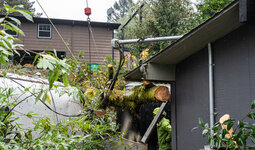
Ben got me the name of a friend who is a tree surgeon and Kevin came out immediately to evaluate the situation. The next day (Monday) they brought a crew to dismantle the tree. Because it had lodged in the gap it required a 5 ton crane but the crane could only lift it after the most of the tree had been limbed and cut back. I wasn't sure if replacing the mast was in my wheelhouse but Ben assured me that it was easy and that he'd done his. He called me in a permit.

The insurance company sent over a crew to tarp the roof. The tree probably hit the house and then rolled over into the gap and hit the trailer on its way to rest on the English Laurel by the top of the stairs.

The rear road side corner of the trailer and the vents and skylight were all broken, crushed or torn open. The corner is beyond saving. I put a call in to Cayo and talked to Chuck, the grandson of the founders of Avion, and he has corners still in the warehouse but he's not too sure about shipping them. Still, it looks like it may be savable.
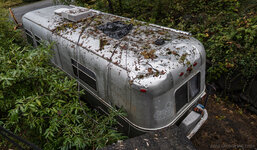

Talking to Chuck it seems the center section is just flat sheet that is bent and riveted to the frame struts and the only thing about that that makes it special is the anodizing. He'll send me that panel too. Hopefully I'll be able to bend out the frame and blind rivet in the new sections if I can get him to send them. Ironically the inside area is filled with a panel that is hollow and so the corner inside shows no damage.

With no power it was really pretty simple to get the parts and put in a new mast.
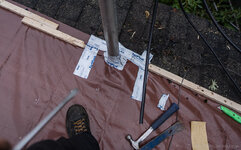
It's an exterior hole in the roof but I taped it inside the flashing, then over the flashing and then over the tarp. Belt, suspenders and coveralls.
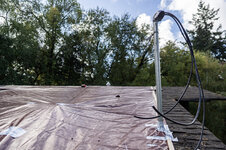
The new top cap for the mast was cast aluminum and yes, I did consider polishing it but I had no power...

I can't tell you how many times I went into the shop for tools and expected the lights to come on.
With the mast in I called for an inspection and was told it would take about a week. Ben gave me a number to reach a real person and soon I was able to leave a message for the head electrical inspector. 10 minutes later he calls me back and, knowing I was without power (I had the Honda generator powering the fridge and charging my phone) he had an inspector at the house in 15 minutes. Amazing.

The inspector told me to call for a PG&E emergency hookup and within an hour the same tech who cut my power was back to hook it up again.

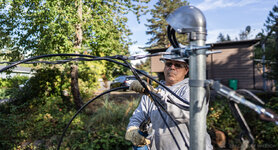
The service from the city of Portland and PG&E was stellar. Plus I got to check out the super cool tools they use to cut and crimp the lines. The connectors are waterproof and they use four crimps per side.


I don't know why I'd never ripped out the old land lines but this spring when I bought the house I got fiber optic internet (all the lines to the house were destroyed) and so I ripped out the cable, phone and whatever else was there. I wish I could say that Century Link was as great as PG&E but they were awful - each phone call to them was an hour on hold and they canceled on me three times. I'm only posting now, a week after, because it's taken 10 days to get internet back.

If there's a silver lining it's that I now have a lot of great hardwood maple firewood...

The crane was able to lift the main trunk out and the crew left me that intact so that I might have it milled. It's 9' long and 17" at the narrow side so hopefully enough for a table. The stump is 24" in diameter at the cut and has some really beautiful spalting which is probably why it ended up falling. The tree guys said maples just don't live that long so it wasn't surprising to them. If I can find a mill I'd like to section the stump for a coffee table and the long one cut into boards for a dining table. Not sure if maple is a wise choice given the weight but when life gives you maples you should make something from it.
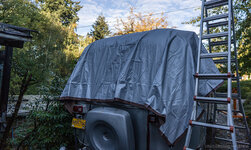
As for now, insurance says they'll pay for a new roof but I don't know yet what that will mean. Certainly not the roof I want to put on but if it offsets the cost of an insulated roof then perhaps it will be a blessing in disguise. The trailer looked like a loss at first but now seems like it should be savable.
No one was hurt, the house was stronger than I expected and I now get more morning light and the chance to build a large dinging table. So all in all it could have been worse.
Gregor
Around 11pm I heard a roar, the whole house shook and this incredibly loud sound, like a freight train, just grew louder and louder. I was nearly certain that a bomb had gone off downtown as the sound kept going for what seemed like seconds.
Then it was silent.
We still had power but somehow it seemed darker. The area at the top of the stairs was dark where normally the street light was visible. I turned on my phone flashlight to look out the window and all I could see were leaves. A tree had fallen and hit the house but I didn't see any obvious damage inside but the tree had crushed the mast for the power lines. Not knowing if the tree had broken the insulation on the power lines and electrified the tree, the ground or the trailer I decided to stay in the house and not investigate until the morning. I called the power company for a shut off.
The big leaf maple behind the house had crashed and somehow found the gap between the house and the trailer. And missed the canoe.
Well, not exactly between. It sort of managed to hit the house, the trailer and the garage. The trailer was lifted about 3' off the ground and the door was wedged shut by the frame twist. Ben came out to help me evaluate if it might be something I could dismantle on my own and it quickly became apparent that it was extremely precarious, heavy and likely to do more damage to me, the house or trailer if I tried to take it apart.
Ben got me the name of a friend who is a tree surgeon and Kevin came out immediately to evaluate the situation. The next day (Monday) they brought a crew to dismantle the tree. Because it had lodged in the gap it required a 5 ton crane but the crane could only lift it after the most of the tree had been limbed and cut back. I wasn't sure if replacing the mast was in my wheelhouse but Ben assured me that it was easy and that he'd done his. He called me in a permit.
The insurance company sent over a crew to tarp the roof. The tree probably hit the house and then rolled over into the gap and hit the trailer on its way to rest on the English Laurel by the top of the stairs.
The rear road side corner of the trailer and the vents and skylight were all broken, crushed or torn open. The corner is beyond saving. I put a call in to Cayo and talked to Chuck, the grandson of the founders of Avion, and he has corners still in the warehouse but he's not too sure about shipping them. Still, it looks like it may be savable.
Talking to Chuck it seems the center section is just flat sheet that is bent and riveted to the frame struts and the only thing about that that makes it special is the anodizing. He'll send me that panel too. Hopefully I'll be able to bend out the frame and blind rivet in the new sections if I can get him to send them. Ironically the inside area is filled with a panel that is hollow and so the corner inside shows no damage.
With no power it was really pretty simple to get the parts and put in a new mast.
It's an exterior hole in the roof but I taped it inside the flashing, then over the flashing and then over the tarp. Belt, suspenders and coveralls.
The new top cap for the mast was cast aluminum and yes, I did consider polishing it but I had no power...
I can't tell you how many times I went into the shop for tools and expected the lights to come on.
With the mast in I called for an inspection and was told it would take about a week. Ben gave me a number to reach a real person and soon I was able to leave a message for the head electrical inspector. 10 minutes later he calls me back and, knowing I was without power (I had the Honda generator powering the fridge and charging my phone) he had an inspector at the house in 15 minutes. Amazing.
The inspector told me to call for a PG&E emergency hookup and within an hour the same tech who cut my power was back to hook it up again.
The service from the city of Portland and PG&E was stellar. Plus I got to check out the super cool tools they use to cut and crimp the lines. The connectors are waterproof and they use four crimps per side.
I don't know why I'd never ripped out the old land lines but this spring when I bought the house I got fiber optic internet (all the lines to the house were destroyed) and so I ripped out the cable, phone and whatever else was there. I wish I could say that Century Link was as great as PG&E but they were awful - each phone call to them was an hour on hold and they canceled on me three times. I'm only posting now, a week after, because it's taken 10 days to get internet back.
If there's a silver lining it's that I now have a lot of great hardwood maple firewood...
The crane was able to lift the main trunk out and the crew left me that intact so that I might have it milled. It's 9' long and 17" at the narrow side so hopefully enough for a table. The stump is 24" in diameter at the cut and has some really beautiful spalting which is probably why it ended up falling. The tree guys said maples just don't live that long so it wasn't surprising to them. If I can find a mill I'd like to section the stump for a coffee table and the long one cut into boards for a dining table. Not sure if maple is a wise choice given the weight but when life gives you maples you should make something from it.
As for now, insurance says they'll pay for a new roof but I don't know yet what that will mean. Certainly not the roof I want to put on but if it offsets the cost of an insulated roof then perhaps it will be a blessing in disguise. The trailer looked like a loss at first but now seems like it should be savable.
No one was hurt, the house was stronger than I expected and I now get more morning light and the chance to build a large dinging table. So all in all it could have been worse.
Gregor
stsmytherie
Well-known member
Glad you're all safe. Looks bad on the surface, but other than 10 day's hassle and a busted trailer, I bet this turns out to be a blessing in disguise. You'll probably even enjoy the challenge of the trailer repairs. Be well G. Cheers
Big leaf maple is ideal for a dining room table. Much lighter weight than white oak, for example, and oak tables are super common. Unless you are planning on a 2" slab, but that would be heavy for any wood suitable for a table (not cottonwood, for example).
Glad the camper and house came out relatively ok!!
Glad the camper and house came out relatively ok!!
Trapps
ALLIANCE MEMBER
Glad no one was hurt!
Love, love, love the trailer. I somehow missed it previously.
Here's a spalted maple in my front yard:

And the desk I made from a section of it:
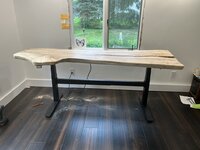

I cut mine in my driveway with a chainsaw and a couple of boards screwed to the side of the trunk as a straight edge/guide. Might be an option for the coffee table. Obviously not perfectly flat, but flat enough.
If shipping the trailer parts are an issue, Watervliet isn't that far from me, I have some friends I see regularly near there. Happy to help if needed.
Love, love, love the trailer. I somehow missed it previously.
Here's a spalted maple in my front yard:
And the desk I made from a section of it:
I cut mine in my driveway with a chainsaw and a couple of boards screwed to the side of the trunk as a straight edge/guide. Might be an option for the coffee table. Obviously not perfectly flat, but flat enough.
If shipping the trailer parts are an issue, Watervliet isn't that far from me, I have some friends I see regularly near there. Happy to help if needed.
Gregor - Glad everything turned out well for you. I'm sure you will manage to get it taken care of with your usual attention to detail.
On the maple, since you are in Portland you might want to give Goby Walnut a call. Not sure if they do custom work but they have all the facilities to mill and kiln dry your log. If they aren't able to help, I would imagine that they would be able to refer you to someone who can.
Even though it says walnut in the name, they mill up a bunch of big leaf maple as well.
Here is their website:

 gobywalnut.com
their contact info:
5315 NW St. Helens Rd.
Portland, OR 97210
Ph. 503.477.6744
Fax: 503.477.6747
[email protected]
Ron
On the maple, since you are in Portland you might want to give Goby Walnut a call. Not sure if they do custom work but they have all the facilities to mill and kiln dry your log. If they aren't able to help, I would imagine that they would be able to refer you to someone who can.
Even though it says walnut in the name, they mill up a bunch of big leaf maple as well.
Here is their website:
Goby Walnut - Located in the NW
We Carry A Beautiful Selection of Live Edge Wood Slabs, Tonewoods, Gunstocks, Figured Shorts, Flooring and More! Learn More.
gobywalnut.com
their contact info:
5315 NW St. Helens Rd.
Portland, OR 97210
Ph. 503.477.6744
Fax: 503.477.6747
[email protected]
Ron
Gregor - Glad everything turned out well for you. I'm sure you will manage to get it taken care of with your usual attention to detail.
On the maple, since you are in Portland you might want to give Goby Walnut a call. Not sure if they do custom work but they have all the facilities to mill and kiln dry your log. If they aren't able to help, I would imagine that they would be able to refer you to someone who can.
I've been there and it's a magical place with some stunning slabs of wood. I'll reach out to them and see what they can do.
Gregor
jon72vega
Well-known member
@sakurama ,If shipping the trailer parts are an issue, Watervliet isn't that far from me, I have some friends I see regularly near there. Happy to help if needed.
If the trailer parts are in Watervliet Michigan, I live about 30 miles from there.
PM me if I can be of help to you.
APEowner
Well-known member
Gregor - I just had a chance to catch up on this thread. I'm glad things are going well with you and that your home seems happy (at least when trees aren't falling on it). As I was reading the post comparing the satisfaction of using the commercial KitchenAid mixer with the satisfaction of using the Bridgeport I started to wonder about just putting a bread hook on the Bridgeport...
Last edited:
fartymarty
Well-known member
There are some that would throw gasoline on a fire...I'm thinking Steve might just be one of those peeps.Gregor - ........ the satisfaction of using the commercial KitchenAid mixer with the satisfaction of using the Bridgeport I started to wonder about just putting a bread hook on the Bridgeport...
.....Wait was that Gregor I saw looking at broken cement mixers on Craig's List with a big mixing bowl in mind?
Last edited:
hardtop5000
Well-known member
Thanks for the updates, Gregor. Stuff keeps coming at you and you keep coping, always learning.
Hi guys,
I'm doing well and taking today to just recover from Thanksgiving (which is also, this year, my birthday) and this was the first year I've ever made Thanksgiving dinner. It was simple and relaxed and Scott and Kira came over as well as Judiaann - so our first post separation family gathering. It was really nice. Please ignore Nadia's expression - she's still figuring out what face she wants to make when she doesn't want to take a photo.

We started the day with the long held tradition of "cleaning-the-house" which I've come to realize is basically the same as cleaning the shop before a big project - a form of resetting.

One of the big benefits of the tree falling was that we have a lot of firewood so I spent the morning before the kids got up (they sleep in now) splitting a lot of the new wood so it could be stacked to dry on the bottom and after breakfast the kids helped stack wood...

...and then do some clean up. I hated leaf blowers when they came out - they seemed like a metaphor for society; a loud, wasteful device that made your problem someone else's. I've come around and recognize that while they aren't the end all be all they serve a useful purpose: that is tricking children into doing yard work they wouldn't otherwise want to.

That rack in front is a caribou from Alaska. While on a shoot I noticed it and the owner didn't have a place for it and offered to me. European mounts are, to me, one of the most beautiful things and I didn't hesitate saying I'd take it.
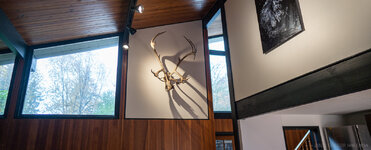
I wasn't familiar with the term but "European mount" is when the skull is bare - to me much more classy than a traditional mount. I thought it would look great over the fireplace but when I got home and held it up it was so large (almost 5' tall) that it hit the ceiling and wouldn't fit. It sat outside for a month and I knew if I didn't hang it it would be reclaimed by moss over the winter so the kids helped me position it and we mounted that on that one white panel on this wall. It's probably the only place in the house it would work but it feels like the right spot.
I'm going to do another post later but this weekend my gift to myself is a full weekend in the shop with no distractions.
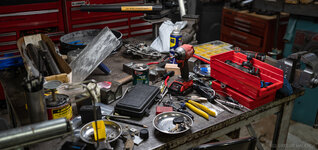
It has been forever since I've been able to have that time - pretty much all summer in fact - and so the first thing to do is some cleaning. The bench became a catchall for every rushed project (trailer, GPS mount, lamp rewire, carb cleaning) and I just want to do a reset and work on some non-house related personal projects.
Stay tuned! This will be another rabbit hole.
Gregor
I'm doing well and taking today to just recover from Thanksgiving (which is also, this year, my birthday) and this was the first year I've ever made Thanksgiving dinner. It was simple and relaxed and Scott and Kira came over as well as Judiaann - so our first post separation family gathering. It was really nice. Please ignore Nadia's expression - she's still figuring out what face she wants to make when she doesn't want to take a photo.
We started the day with the long held tradition of "cleaning-the-house" which I've come to realize is basically the same as cleaning the shop before a big project - a form of resetting.
One of the big benefits of the tree falling was that we have a lot of firewood so I spent the morning before the kids got up (they sleep in now) splitting a lot of the new wood so it could be stacked to dry on the bottom and after breakfast the kids helped stack wood...
...and then do some clean up. I hated leaf blowers when they came out - they seemed like a metaphor for society; a loud, wasteful device that made your problem someone else's. I've come around and recognize that while they aren't the end all be all they serve a useful purpose: that is tricking children into doing yard work they wouldn't otherwise want to.
That rack in front is a caribou from Alaska. While on a shoot I noticed it and the owner didn't have a place for it and offered to me. European mounts are, to me, one of the most beautiful things and I didn't hesitate saying I'd take it.
I wasn't familiar with the term but "European mount" is when the skull is bare - to me much more classy than a traditional mount. I thought it would look great over the fireplace but when I got home and held it up it was so large (almost 5' tall) that it hit the ceiling and wouldn't fit. It sat outside for a month and I knew if I didn't hang it it would be reclaimed by moss over the winter so the kids helped me position it and we mounted that on that one white panel on this wall. It's probably the only place in the house it would work but it feels like the right spot.
I'm going to do another post later but this weekend my gift to myself is a full weekend in the shop with no distractions.
It has been forever since I've been able to have that time - pretty much all summer in fact - and so the first thing to do is some cleaning. The bench became a catchall for every rushed project (trailer, GPS mount, lamp rewire, carb cleaning) and I just want to do a reset and work on some non-house related personal projects.
Stay tuned! This will be another rabbit hole.
Gregor
With a few days to dedicate to shop time the first thing to do was clean. After that I wanted to knock out a quick and simple project that I started in July, right after closing on the house and before I got busy.
A simple clock.
We had one over the fireplace and it was a central and essential part of the kitchen/dining room - the clock we checked to know when to leave for school or when bed time was. Judiaann took that clock and when I started to look for a replacement I couldn't find anything new that I liked. I searched Amazon and then ebay and discovered that there were a couple of people, mostly in England, that refurbished old factory or school clocks with simple battery movements.
They were also $2-500 and me being me I thought, "Hey, that would be a simple project!"
Old factory clocks are really large as they needed to be seen from the floor of a large factory but they also ran on a steady supply of 120v which we don't have over the fireplace.
After finding a mid-century era clock for a pittance due to the shell having been painted over with house paint I immediately took it apart and measured the shafts thinking it would be a dead simple thing to find a battery movement with similar size shafts.
It wasn't.
The project stalled and the clock sat on the bench for the whole summer and fall mocking me just waiting to brake the curved glass rendering it useless. Last week I gave up and just ordered a movement with similar sized hands hoping to just get it off the bench.
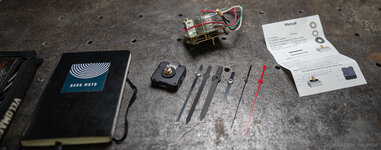
The original hands are the two larger, thicker ones and the red second hand. Now, a clever man would put the new hands onto his clock, because he would know that only a great fool would try to retrofit the original hands. I am not a great fool, so I can clearly not choose the wine in front of you...
Er, I am a great fool and I decided to try to make the hands fit. But first...

...I slathered on some paint stripper after trying to get the house paint off with no luck.

This "paint and primer in one" from Rustoleum has been pretty reliable so gave it a very light base coat...

...then, to mimic the textured finish that was popular in the 50's and 60's I gave it a light coat of bed liner and then another coat of satin to even it out.

To take up the space in the opening I made a top hat in brass to mimic the second hands button.
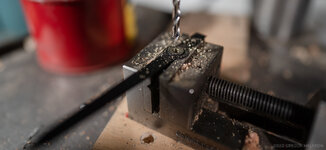
I drilled out the original hands and made small brass inserts that I green loctited into place.

The second hand had such a tiny button that I decided to make my life easier by just sacrificing the new second hand and fitting the button to the original red second hand.

Despite being careful with measurements the movement spun because of the spacers - not much, but enough that I was going to be bothered so I made a quick cut of some scrap L channel and glued that in place to index the new motor.

Then carefully pressed the hands onto the different shafts and bent them slightly to clearance each other. While you can spin the hands by setting the clock the motor doesn't have that sort of power so it's a good idea to check that the clock hands clear by letting it run.

After the clock made a few turns and nothing hung up it was time to recase it.
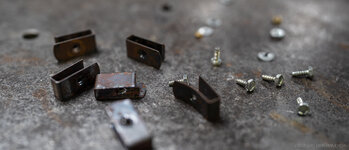
I reused the original clips and didn't bother to clean them up or paint them - they're hidden and this had already taken most of my day.
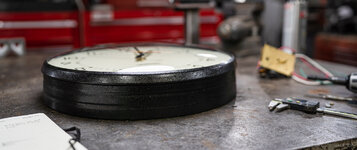

It was a lot more work than I expected - which has never happened before - but the stark simplicity, retro typeface and curved glass front all make for a very nice, simple clock. Fitting the era but also comically large in a fun way.

It's not a big project but it was a fun project and it forced me to clean up the shop and focus my hands for a bit and that felt great.
Next up is music.
Gregor
A simple clock.
We had one over the fireplace and it was a central and essential part of the kitchen/dining room - the clock we checked to know when to leave for school or when bed time was. Judiaann took that clock and when I started to look for a replacement I couldn't find anything new that I liked. I searched Amazon and then ebay and discovered that there were a couple of people, mostly in England, that refurbished old factory or school clocks with simple battery movements.
They were also $2-500 and me being me I thought, "Hey, that would be a simple project!"
Old factory clocks are really large as they needed to be seen from the floor of a large factory but they also ran on a steady supply of 120v which we don't have over the fireplace.
After finding a mid-century era clock for a pittance due to the shell having been painted over with house paint I immediately took it apart and measured the shafts thinking it would be a dead simple thing to find a battery movement with similar size shafts.
It wasn't.
The project stalled and the clock sat on the bench for the whole summer and fall mocking me just waiting to brake the curved glass rendering it useless. Last week I gave up and just ordered a movement with similar sized hands hoping to just get it off the bench.
The original hands are the two larger, thicker ones and the red second hand. Now, a clever man would put the new hands onto his clock, because he would know that only a great fool would try to retrofit the original hands. I am not a great fool, so I can clearly not choose the wine in front of you...
Er, I am a great fool and I decided to try to make the hands fit. But first...
...I slathered on some paint stripper after trying to get the house paint off with no luck.
This "paint and primer in one" from Rustoleum has been pretty reliable so gave it a very light base coat...
...then, to mimic the textured finish that was popular in the 50's and 60's I gave it a light coat of bed liner and then another coat of satin to even it out.
To take up the space in the opening I made a top hat in brass to mimic the second hands button.
I drilled out the original hands and made small brass inserts that I green loctited into place.
The second hand had such a tiny button that I decided to make my life easier by just sacrificing the new second hand and fitting the button to the original red second hand.
Despite being careful with measurements the movement spun because of the spacers - not much, but enough that I was going to be bothered so I made a quick cut of some scrap L channel and glued that in place to index the new motor.
Then carefully pressed the hands onto the different shafts and bent them slightly to clearance each other. While you can spin the hands by setting the clock the motor doesn't have that sort of power so it's a good idea to check that the clock hands clear by letting it run.
After the clock made a few turns and nothing hung up it was time to recase it.
I reused the original clips and didn't bother to clean them up or paint them - they're hidden and this had already taken most of my day.
It was a lot more work than I expected - which has never happened before - but the stark simplicity, retro typeface and curved glass front all make for a very nice, simple clock. Fitting the era but also comically large in a fun way.
It's not a big project but it was a fun project and it forced me to clean up the shop and focus my hands for a bit and that felt great.
Next up is music.
Gregor
hewey
Well-known member
So good to see another Gregor workshop project! That clock looks awesome. And also just great to see you settling in to your 'new normal' and really finding your groove.
octane_matty
Well-known member
When you mentioned finding an MCM era clock i was struggling to picture exactly what it would look like. Then seeing the face immediately thought that is the perfect clock! nice work gregor
zmotorsports
ALLIANCE MEMBER
Clock turned out great Gregor, but let's see some pics of the cleaned shop now.
Clock turned out great Gregor, but let's see some pics of the cleaned shop now.
I've come to accept that with a shop this small (and there are smaller for sure) and with this much stuff it's just never going to be that clean.

I would love to have more space but this shop is filled with all the tools and I'm very happy every time I'm working in it. The mini tracker finally got the chance to run the week before Thanksgiving and once it did there were problems to resolve. My goal for the year was to win one race during this years indoor flat track season - I won my first race (on my other bike) and took third in my other. So I need new goals.
We'll revisit this bike in a week or two - I have a short punch list for it but out of the gate it's phenomenal. The race I got third in I had my clock cleaned by two kids on 85's who just walked away from me on my other XR100. When I finally took the mini tracker out in open practice the tables turned.
But there's a lot more to catch up on before this bike comes up in the project cue.
Gregor
chrismenke
Well-known member
That is a Handy Air Lift (I blew up the photo and read the logo). I've forgotten the lift capacity but full dresser Harley requires their beefier model, IIRC. I dislike the jerky motion. I've used those, as well as the Snap On EELR series as motorcycle lifts. The Snap On has arms to lift cars too. Mine is a 6500lb lift.@sakurama Gegor - who makes your lift table? Are you happy with it? Is airover hydraulic, electric...?
Looking for something to raise and lower my assembly table which doubles as a table saw outfeed. Just can't take the bending over any more
Thanks
Ron
If you are just looking for a table lift mech for a workbench type install, I find hydraulic tables lifts with electric lifter heads on CL often enough in the 2-400 dollar range. They range between 1000-2000lbs.