To avoid these ads, REGISTER NOW!

Vehicle lift post spacing

Hobby_Man22

Well-known member
Joined
Nov 16, 2020
Messages
3,581
Location
tx
I can't find anything that shows how far apart you set the posts on a lift. The contractor is going to pour me two 3ftx3ft pads 12ft apart to install a lift at some point. Is that a good amount of space? Some lifts have the bar across the top and some dont though. Im going for a symmetrical lift and going to have 12ft in front of the lift.
 
To avoid these ads, REGISTER NOW!

SmackinHondas

Well-known member
Joined
Nov 12, 2021
Messages
73
Location
Houston
My Whip 2 post lift is about 12' in total width. It's about average size, and I think most lifts will be in that same width range. If your footings are centered around that I think you'll be fine.

I went with 4x4 footings at the last minute before they poured the slab. Just in case lol. They made them 24" deep + the 6" slab on top... way overkill.
 

rockcrawler

Well-known member
Joined
Jan 11, 2013
Messages
930
Location
Dallas, TX
I would absolutely wait until you know what kind of a lift you're going to purchase before having pads poured. I think you're shooting in the dark here.

^^Exactly. I have a Bendpak 10K and it can be set up in two configurations based on the application (narrow and wide). Choose the lift, and make sure it is available before doing anything else.
 

WNYflyer

Well-known member
Joined
Sep 13, 2009
Messages
2,120
Location
Lockport, NY
I would absolutely wait until you know what kind of a lift you're going to purchase before having pads poured. I think you're shooting in the dark here.

Yes and 3 by 3 is not the right idea. Pour all the way across the lift and it wouldn’t hurt to droop some rebar across there.
As noted above agree, if you have the time wait until you know what lift your are buying and install a rebar reinforced continuous footing all the way across from post to post and beyond based upon the actual lift manufacturer's requirements. This is of course assuming you are not wanting to utilize the floor slab as the foundation and the associated worries about control joint locations relative to lift posts, slab thickness, etc.

If you really have to do it without knowing the lift you are going with you can probably dummy proof the foundation design by utilizing Mohawk lift continuous foundation requirements. The Mohawk requirements might be overkill for a good many lift brands but if you don't have the time well you got to pay.

Also your contractor is shooting in the dark, don't do that.
 

dave*99

Well-known member
Joined
May 5, 2009
Messages
4,269
Location
Coastal NJ
This topic has been beat to death on GJ. Search the forums.

You definitely need a floor plan from the lift manufacturer. It's in the manual for my Rotary lift. Not only is the width important, but the fore and aft location of the posts is critical.

1) The lift manufacturers are careful to design the lifts knowing they will most often be installed on existing floors without special reinforcement.
2) My 2 post Rotary SPOA10 manual stated 4 1/4" of 3000 psi concrete is required. This is GJ, so overkill is always in play when we discuss these things. You will get all kinds of recommendations on this topic.
3) I added a garage bay for the lift on my last house and before I poured concrete, I dug out the space where the lift posts go to about a 6" depth. Picture a 3' x 12' swale dipping down so the slab is thicker in that area.
4) On installation, I drilled the anchor holes all the way through the slab so if I removed the lift, I could hammer the studs down into the slab. I never thought I would need that - and 7 years later I did. I removed the lift and moved to a new house.
5) In the new house, the architect felt it necessary to form 3'x3' haunch slabs under the lift posts. Wells were dug 12" deep and sloped up the the normal 4" slab depth. Rebar was placed a minimum of 6" below the surface so the anchors would not hit it.
 

wssix99

Well-known member
Joined
Mar 2, 2011
Messages
5,161
Location
Chicago, IL
The contractor is going to pour me two 3ftx3ft pads 12ft apart to install a lift at some point.
Depending on how this is done, it could cause your slab to crack. You definitely don't want to do this and your lift instructions will NOT instruct you to do this for very good engineering reasons. As said above, this has been beaten to death in other threads, but some of the information is confusing because not all of the commentary is aligned.

If you have specific questions, please post back. The net of this is that you need to choose the general capacity and brand of your lift now. That will allow you to get the spec and design of the slab you will need.

The slab instructions (for a new slab) will tell you to pour a flat slab with consistent reinforcement across the entire cross section. Again, there are important engineering reasons for that, which the lift engineers know. We discuss these points in the other threads. Some members here have deviated from these directions by having gradually thickened sections, etc. but the lowest risk approach (for not getting cracks in the slab, which would cause complications for your lift install) is to follow the lift instructions.

You definitely DO NOT want to:
- Pour "footers" for the posts
- Make sections of the slab under the lift different from the rest of the slab
- Add reinforcing under the lift that is different from the rest of the slab

^ These things cause differential stress in the slab as it cures/shrinks and will cause cracking around the lift.

Keeping this in mind, you will see instructions for "repair slabs". These have special reinforcement, thickened sections, and other special attributes - but they play by different rules. They are sections that are cut out of and then keyed into existing slabs of poor quality. (So, the floor ends up being a hybrid system instead of a single flat slab.) These repair slabs are different than your new slab.

Some lifts have the bar across the top and some dont though.

Those bars are not structural. For two post lifts that have them, the posts still move and the top bar bends like a noodle.
 

tester19

Well-known member
Joined
Apr 25, 2021
Messages
225
Location
chigago
Again this ALL depends on what lift your getting?
You have been asked at least 3 times already.
.
.
.
 
To avoid these ads, REGISTER NOW!
OP
H

Hobby_Man22

Well-known member
Joined
Nov 16, 2020
Messages
3,581
Location
tx
What's the deal with the poster who said concrete will crack around the thicker areas? Slabs around here have 2ft deep footings and only a 4in slab typically. I don't see cracking where the footings are.
 
Last edited:

pattenp

Well-known member
Joined
Jun 4, 2008
Messages
10,175
Location
Virginia - USA
If you search enough you'll find when doing a pad it's commonly recommended by the manufacturer to do a 4' x 12', 12 inches thick pad keyed into the existing slab for a 10k lb lift. Usually 12 inches wider than the overall width of the lift.
 
Last edited:

dave*99

Well-known member
Joined
May 5, 2009
Messages
4,269
Location
Coastal NJ
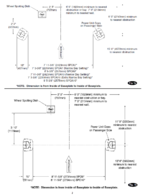
Here is the floor plan for my lift. As you can see, there are different spacings depending on which width you select when setting up the lift.
The plan specifies a 24' deep bay. Between my workbench and garage door, I had about 21' and my truck is 19' long. I had to be very precise in locating the lift so the truck would fit, and be balanced on the lift.
1668272405406.png
 

quakerj

Well-known member
Joined
Nov 11, 2021
Messages
171
Location
Meade County, KY
What's the deal with the poster who said concrete will crack around the thicker areas? Slabs around here have 2ft deep footings and only a 4in slab typically. I don't see cracking where the footings are.
FWIW, I had about 3' squares dug down deeper (to approx 10-12" depth) when they poured my 5" slab, and heavy #4 rebar reinforcement added to those areas.

I have had zero cracking issues in the area where the lift pads are. Cracks in many other places (where they shouldn't be), but nothing even remotely near the lift area.
 

SmackinHondas

Well-known member
Joined
Nov 12, 2021
Messages
73
Location
Houston
I have had zero cracking issues in the area where the lift pads are. Cracks in many other places (where they shouldn't be), but nothing even remotely near the lift area.
I will back you up here as well. My garage had 2 huge extra footings for a lift poured + rebar. No cracks there. All over the rest of the slab - sure, but not around the lift footings.
 
OP
H

Hobby_Man22

Well-known member
Joined
Nov 16, 2020
Messages
3,581
Location
tx
I will back you up here as well. My garage had 2 huge extra footings for a lift poured + rebar. No cracks there. All over the rest of the slab - sure, but not around the lift footings.

Guess we should just make 12" slabs then. That must be the secret. I know on my building the cracks stop when they meet the footing too.
 

quakerj

Well-known member
Joined
Nov 11, 2021
Messages
171
Location
Meade County, KY
Guess we should just make 12" slabs then. That must be the secret. I know on my building the cracks stop when they meet the footing too
If you believe some folks on this forum, there'd be no such thing as a monolithic slab with turn down footing. Which is extremely popular I might add, especially in areas with little to moderate frost depth requirements.

Moral of the story: don't believe everything you read on the internet 😛
 

quakerj

Well-known member
Joined
Nov 11, 2021
Messages
171
Location
Meade County, KY
What is the reasoning for wanting footers under your posts?
I can't speak for OP, but I'm guessing because concrete pullout and shear strength is largely derived by anchor embedment depth. 4-5" just isn't enough of a safety factor, for me at least, even with my Chinese (Derek Weaver) 9K lift.

I personally don't believe a huge footer is necessary as compressive forces are not at play here.

I wanted a good chunk of concrete (reinforced with steel) that will allow at least a 6" anchor to be embedded with room to spare, and keep that depth at least 6" or more past the anchor bolts on all sides.

When concrete fails and anchors pull out, it does so in a cone shape, assuming you don't have an edge / saw cut, etc nearby.

I'm 99% sure my concrete is not nearly 4k psi compressive strength that it should have been (2022 cement shortages, poured in super dry 95 degree temps in middle of summer, and concrete contractor rushing to get jobs done / cutting corners). The only variable I really had a say in was depth and reinforcement and I'm glad I chose to.
 
OP
H

Hobby_Man22

Well-known member
Joined
Nov 16, 2020
Messages
3,581
Location
tx
I can't speak for OP, but I'm guessing because concrete pullout and shear strength is largely derived by anchor embedment depth. 4-5" just isn't enough of a safety factor, for me at least, even with my Chinese (Derek Weaver) 9K lift.

I personally don't believe a huge footer is necessary as compressive forces are not at play here.

I wanted a good chunk of concrete (reinforced with steel) that will allow at least a 6" anchor to be embedded with room to spare, and keep that depth at least 6" or more past the anchor bolts on all sides.

When concrete fails and anchors pull out, it does so in a cone shape, assuming you don't have an edge / saw cut, etc nearby.

I'm 99% sure my concrete is not nearly 4k psi compressive strength that it should have been (2022 cement shortages, poured in super dry 95 degree temps in middle of summer, and concrete contractor rushing to get jobs done / cutting corners). The only variable I really had a say in was depth and reinforcement and I'm glad I chose to.
Only because I was going to have a 4" slab and most lifts now require a weird thickness like 4.25" or 4.5" minimum. Haven't seen anything about extra rebar being needed. Anyways, I just did the whole slab 5" that way I can change my mind on where I want to put it later. The contractor was being cheap about it and I just thought making little 3x3ft thicker spots seemed stupid. I think a 20ftx20ft spot would have made more sense though
 
OP
H

Hobby_Man22

Well-known member
Joined
Nov 16, 2020
Messages
3,581
Location
tx
I can't speak for OP, but I'm guessing because concrete pullout and shear strength is largely derived by anchor embedment depth. 4-5" just isn't enough of a safety factor, for me at least, even with my Chinese (Derek Weaver) 9K lift.

I personally don't believe a huge footer is necessary as compressive forces are not at play here.

I wanted a good chunk of concrete (reinforced with steel) that will allow at least a 6" anchor to be embedded with room to spare, and keep that depth at least 6" or more past the anchor bolts on all sides.

When concrete fails and anchors pull out, it does so in a cone shape, assuming you don't have an edge / saw cut, etc nearby.

I'm 99% sure my concrete is not nearly 4k psi compressive strength that it should have been (2022 cement shortages, poured in super dry 95 degree temps in middle of summer, and concrete contractor rushing to get jobs done / cutting corners). The only variable I really had a say in was depth and reinforcement and I'm glad I chose to.
My slab got rained on for a full day about 7hrs after they poured it. Timing couldn't be more perfect. Lol I'll probably water it once a day for a week or so now.
 
To avoid these ads, REGISTER NOW!
Top Bottom