To avoid these ads, REGISTER NOW!

Mining Equipment and Tools

MisterEd

Well-known member
Joined
Oct 3, 2019
Messages
742
Location
Florida
Growing up on the outer edge of the anthracite mining area of PA made mining a fascinating activity. ‘Course the too frequent mining disasters, minor and major, made it a distant fascination. Recently, we’ve found and added to our accumulation a couple of pieces of mining equipment. Surely there are more mining-specific tools amongst Garage Journal denizens.

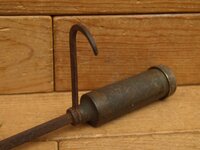
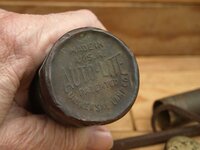
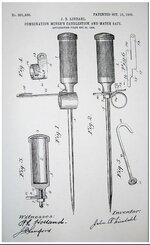
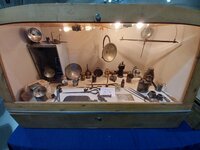
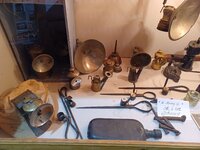
Here are an incomplete Auto-Lite Carbide Lamp (missing its reflector) by Universal Lamp Co. and a Combination Miner’s Candlestick and Match Safe (missing its candle holder) by Lindahl Manufacturing of Denver.
 

Attachments

  • Carbide and Caandlestick-01.jpg
    Carbide and Caandlestick-01.jpg
    814.7 KB · Views: 91
  • Carbide and Caandlestick-03.jpg
    Carbide and Caandlestick-03.jpg
    774.1 KB · Views: 54
  • Carbide and Caandlestick-08.jpg
    Carbide and Caandlestick-08.jpg
    795 KB · Views: 47
  • Carbide and Caandlestick-09.jpg
    Carbide and Caandlestick-09.jpg
    757 KB · Views: 47
  • Carbide and Caandlestick-10.jpg
    Carbide and Caandlestick-10.jpg
    726.7 KB · Views: 46
  • Miners Candlesticks_Lindahl Patent.jpg
    Miners Candlesticks_Lindahl Patent.jpg
    588.2 KB · Views: 77
To avoid these ads, REGISTER NOW!

Farmer J.

Well-known member
Joined
Sep 18, 2016
Messages
1,995
Location
UK, Cornwall/Hertfordshire.
I think I have a catalogue of Holman mining tools somewhere.. apart from that will have to see what I can dig up.

There was some nice blasting fuse pliers a while ago on this thread:
 

Farmer J.

Well-known member
Joined
Sep 18, 2016
Messages
1,995
Location
UK, Cornwall/Hertfordshire.
And another miner's lamp, a 'Davy Lamp'

Of course, I can't resist re-posting the statue of the inventor of the miner's safety lamp:
1847115_b210b59f.jpg
 

Oregon rock crusher

Well-known member
Joined
Jun 28, 2016
Messages
1,912
Location
West of Salem
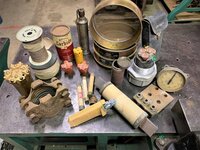
I have quite a collection mining items. Not all on purpose. A lot of them are not much different than those used in other industries. I always worked around open gravel pits and quarries. Never did work underground. Mine Safety and Health took over the industry around 77'. I had a few years in before the first MSHA inspector tracked down our little portable crusher out in the woods in 78'. It was an eye opener. Here are a few things I have laying around for a quick pic. I spent a lot of time early in my career reducing oversize boulders. Me and a helper would hand drill the big bastards and then load about 1/4 stick a hole and blast them. I could run two parallel strings of 10 caps off the magneto so 20 boulders/shot. Quite a show. Ed.
 

Attachments

  • IMG_3172.jpg
    IMG_3172.jpg
    865.7 KB · Views: 102

Zebedeewesty

Well-known member
Joined
May 31, 2013
Messages
4,150
Location
Wales, UK
My grandad used to be mine foreman at one of the lead and fluorspar mines in Rookhope in County Durham in the north east of the UK.
Theres still all sort of old bits and bobs in my parents loft and garage from when my grandad passed about 40 years ago. I know theres a few carbide lamps and helmets plus a blasting machine (dynamite plunger) and some other equipment. I think theres an old dynamite box in the back of their garage too. Not sure whats in it as i wasn't allowed near it when i was a kid.
 
OP
M

MisterEd

Well-known member
Joined
Oct 3, 2019
Messages
742
Location
Florida
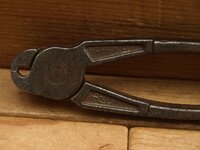
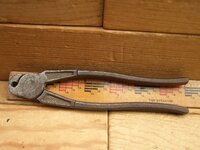
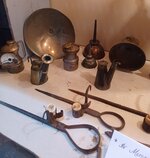
There seems to be minor controversy whether this tool is a Blasting Cap Crimper. Maybe someone actually knows. I like it as a wall hanger.
 

Attachments

  • Alleged  Blasting Cap Crimper-05.jpg
    Alleged Blasting Cap Crimper-05.jpg
    653.2 KB · Views: 67
  • Alleged  Blasting Cap Crimper-04.jpg
    Alleged Blasting Cap Crimper-04.jpg
    863.4 KB · Views: 58
  • Alleged  Blasting Cap Crimper-02.jpg
    Alleged Blasting Cap Crimper-02.jpg
    901.4 KB · Views: 63

Plombob

Well-known member
Joined
Oct 19, 2008
Messages
4,139
Location
Tennessee
Here are the picks. The one in the back was grandfathers and is unmarked.

The one in the front will set the Plomb aficionados crazy. It is a Plomb T.M. Co. pick from the very early 1900s. In 40+ years collecting Plomb tools, I never saw another, and the (now defunct) Plomb museum didn't have one!
20221201_085219.jpg

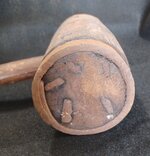
Now here's a hammer I can't figure out. What was it used for? Setting timbers? It's made of wood, there are iron rings on either end and there are five iron bars running the length. The head is 3-1/2" in diameter. The handle is very short - 8" long. Those are termite holes. Anyone have a theory? What kind of wood does it look like?
20221201_085526.jpg20221201_085540.jpg20221201_085556.jpg
 

Attachments

  • 20221201_085219.jpg
    20221201_085219.jpg
    985.3 KB · Views: 32
Last edited:

Jacobs976

Well-known member
Joined
Sep 11, 2020
Messages
831
Location
Indiana
here's a hammer I can't figure out. What was it used for? Setting timbers? It's made of wood, there are iron rings on either end and there are five iron bars running the length. The head is 3-1/2" in diameter. The handle is very short - 8" long. Those are termite holes. Anyone have a theory? What kind of wood does it look like?
20221201_085526.jpg20221201_085540.jpg20221201_085556.jpg
That would be a beetle. Don't know what the embedded iron would be for though. Maybe to increase the life of the mallet, making the face harder than what it was hitting. The rings were hot pressed on to keep the mallet from splitting(compression from steel cooling around the wood).

Beetles were/are used to drive stakes, hit chisels for wood working, and shift wood in building barns. Also for the carnival strongman game. This style was mainly used for stakes while the unbound style(no rings) were used for shifting wood and wood working to prevent marring.

Not the most educated on them but I have an unfinished (cut and ringed, hole partially augered, before sitting to cure) 8-1/2" diameter one that was pulled out of an old barn that's probably late 1800s-early 1900s and did some research on it when I got it. Your's is alot smaller(mine takes a long handle like a sledge hammer) but comparable to ones on eBay(last I checked, 3-1/2,6, 8-1/2 were the usual diameter).
 

Plombob

Well-known member
Joined
Oct 19, 2008
Messages
4,139
Location
Tennessee
Thanks for the details Jacob! A hammer for shifting wood makes sense when setting timbers in a mine 100 years ago.
 

Jacobs976

Well-known member
Joined
Sep 11, 2020
Messages
831
Location
Indiana
Thanks for the details Jacob! A hammer for shifting wood makes sense when setting timbers in a mine 100 years ago.
Never found anything about mining but didn't go much further than common use, a few wood working sites and an old booklet on the "perfect" beetle.

Would make sense though for braces and justify the embedded iron, make the mallet harder to break so you're not left down there with an unsupported ceiling and a broken tool.

Or just to increase the lifespan as much as possible since it'd be a necessity and takes a bit of work to make(don't know exact process on yours but this is at least close; find suitable wood, whittle to shape, toss rings and rods in the fire till red hot, press rods in, press rings on, toss some water over it, auger the hole for handle).
 

Mintgrun

Well-known member
Joined
Oct 7, 2015
Messages
2,141
Location
Kingston, Wa.
It's made of wood, there are iron rings on either end and there are five iron bars running the length.


I am wondering if those are wedges driven in from each end to keep the rings tight, as opposed to bars running all the way through the head. I suppose testing them end to end for continuity would answer that question.
 

2oolhound

Well-known member
Joined
Dec 18, 2010
Messages
5,918
Location
BC Canada
I'm not convinced on the beetle explanations. The metal rings are ferrules commonly used on wood tools. I've made a number of tools and fitted ferrules to them. I've always cut the wood to facilitate fitting the steel ferrule. Trying to burn it on when red hot I think would burn too deeply into the wood resulting in a loose fit.

2nd is the ferrules themselves. The lap joint where the rings join at their ends doesn't look to be forge welded. When those ends are properly forge welded with forge and anvil it results in a joint you can't see. The metal should be near liquid at the mating surfaces and then it is beat together using flux in the joints so that it fusses invisibly. Those ferrules could be just poorly forge welded though but just not fully stuck together by a good blacksmith. If they are made with a tool steel they will hold their shape regardless of being forge welded.

3rd. the steel bars. Trying to hammer red hot steel bars that thin into a wood mallet that length would only cause the hot bars to bend. I think the rods were pounded through cracks or checks in the wood when cold in order to spread the wood enough to tighten the ferrules that were probably coming loose. In a case like that I would sharpen points on the steel bars, drive them through and then cut the points off the other end.

Here is a yew wood* mallet I made fairly recently. I originally thought to make ferrules like your beetle (separate rings on each end) but then went with what you see here. There are 2 other types of ferrules seen on each of the wood chisels. There is no way you could drive even one steel pin through the length of this mallet hot of cold. This mallet is 3" diameter X 6" long.

* classed as softwood but very fine grained and harder than many hard woods

YewMalletSm_8238.jpg

Your beetle appears to be made from a limb off a tree and not a piece of quartered log. Back then they made things on site as needed and just quickly banged them out and got back to making ore cars etc. Their job was to get ore out not to make pretty tools like me here but I wanted to support my theory of the bars were likely hammered through checks to tighten the ferrules.

This is an interesting thread. There was another similar thread where a link was placed and guys at a museum were drilling holes in rock using a drill rod. One guy applied side pressure to turn the bit while another guy bashed the top of the bit with a sledge. They were drilling the rock but what a lot of work. I can't find the link or I'd post it. We've sure got it easy today.

MINTGRUN - I thought that too but the metal has the same pattern at both ends.
 
To avoid these ads, REGISTER NOW!

Jacobs976

Well-known member
Joined
Sep 11, 2020
Messages
831
Location
Indiana
Trying to burn it on when red hot I think would burn too deeply into the wood resulting in a loose fit.
The trick is to get the wood sized slightly larger than the ring so it starts burning the material that's not needed first and quench them immediately after pressing each one on. If it burns too long it won't be tight but if done right the rings compress the wood making it harder to split. On Plombob's it's hard to tell if it was hot pressed or just fitted, looks like it probably was just fitted going off a sliver of bare wood visible under the ring. Either works well enough though as long as the woods dried out enough.
The lap joint where the rings join at their ends doesn't look to be forge welded. When those ends are properly forge welded with forge and anvil it results in a joint you can't see. The metal should be near liquid at the mating surfaces and then it is beat together using flux in the joints so that it fusses invisibly. Those ferrules could be just poorly forge welded though but just not fully stuck together by a good blacksmith.
Looks like they might've been forged quickly and without a chisel on hand leading to a bad weld and excess material. Usually they were cut a bit long before forge welding so there'd be an overlap but it'd be basically invisible in the end. There's usually an imperfection in the steel's colour though because of the extra beating so you can still find the spot(oxidization is slightly off from the rest).
3rd. the steel bars. Trying to hammer red hot steel bars that thin into a wood mallet that length would only cause the hot bars to bend. I think the rods were pounded through cracks or checks in the wood when cold in order to spread the wood enough to tighten the ferrules that were probably coming loose.
I figured if it's from a dry climate it could be dry enough to work them in hot with less force but realistically it'd be a lot more visible. Hard to tell in pics but it looks like burned material around them, which would probably be a lot more severe, but could just be rust leaching into the wood or something else.

The wedges through preexisting cracks would make sense. Especially since some of the cracks on the sides look to match up with the bars and the rings most likely being cold fitted so it'd be a good way to tighten them up(initially or later).
Your beetle appears to be made from a limb off a tree and not a piece of quartered log. .
I think the same, most beetles were just a log or limb depending on size shaped a bit and a hole ran through the center. They usually didn't do anything fancy since it was going to be broken sooner than later.
 

Plombob

Well-known member
Joined
Oct 19, 2008
Messages
4,139
Location
Tennessee
Closer inspection of the hammer reveals:

The wood is charred at the top where the iron bands were attached. Interestingly there appears to be sulphur embedded in the wood and some of the iron has converted to Hematite, which would take a very long time. The white deposit is likely calcite, as there is a better preserved deposit of calcite on the other side and this one responds to ultraviolet light. This confirms it was used in mining.
IMG_6085.JPG

Here's a shot proving that the wood is only slightly burned the entire width of the band and that the wood was trimmed before the ring was installed.
IMG_6077.JPG


I am wondering if those are wedges driven in from each end to keep the rings tight, as opposed to bars running all the way through the head. I suppose testing them end to end for continuity would answer that question.
You are correct. There are 6 wedges on one side and 5 on the other. I should have counted them.

I'm not convinced on the beetle explanations. The metal rings are ferrules commonly used on wood tools. I've made a number of tools and fitted ferrules to them. I've always cut the wood to facilitate fitting the steel ferrule. Trying to burn it on when red hot I think would burn too deeply into the wood resulting in a loose fit.
The wood was cut before the rings were installed
2nd is the ferrules themselves. The lap joint where the rings join at their ends doesn't look to be forge welded. When those ends are properly forge welded with forge and anvil it results in a joint you can't see. The metal should be near liquid at the mating surfaces and then it is beat together using flux in the joints so that it fusses invisibly. Those ferrules could be just poorly forge welded though but just not fully stuck together by a good blacksmith. If they are made with a tool steel they will hold their shape regardless of being forge welded.
Not likely it is tool steel. The metals commonly available in primitive mining camps 100 years ago weren't high quality.
3rd. the steel bars. Trying to hammer red hot steel bars that thin into a wood mallet that length would only cause the hot bars to bend. I think the rods were pounded through cracks or checks in the wood when cold in order to spread the wood enough to tighten the ferrules that were probably coming loose. In a case like that I would sharpen points on the steel bars, drive them through and then cut the points off the other end.
See above. They were driven in from each side.
Your beetle appears to be made from a limb off a tree and not a piece of quartered log. Back then they made things on site as needed and just quickly banged them out and got back to making ore cars etc. Their job was to get ore out not to make pretty tools like me here but I wanted to support my theory of the bars were likely hammered through checks to tighten the ferrules.
I'm sure this was made in the mining camp. Most likely Colorado or Arizona. And you're right - they made the tools quickly to get back to mining.
This is an interesting thread. There was another similar thread where a link was placed and guys at a museum were drilling holes in rock using a drill rod. One guy applied side pressure to turn the bit while another guy bashed the top of the bit with a sledge. They were drilling the rock but what a lot of work. I can't find the link or I'd post it. We've sure got it easy today.

Read a book about a group of miners and a pair of them went around to drilling challenges. Before the events they frequented the bars and acted like greenhorns so men would bet against them. When they got to the contest, they rolled out an impressive array of finely sharpened drill steel that caused the other competitors to loose confidence. They won many a contest that way and pocketed a lot of gamblers' money. I am not sure which book it was, may have been The Bonanza King or Song of the Hammer and Drill.
 
Last edited:

2oolhound

Well-known member
Joined
Dec 18, 2010
Messages
5,918
Location
BC Canada
Thanks for the good photos Plombob. My one attempt at fitting red hot metal to wood failed miserably (but it was 3/8" X 2" by 100 lbs with the wood so not so easy to handle and quench fast) I'll definitely try this again on some ferrules etc.

I've collected quite a bit of bent and broken drill rod from old mine sites and the back woods. It's good steel to rework. A friend of mine has warned me against putting any in my forge due to the possibility of there being some explosive inside it. Can anyone else advise? Oregon rock crusher?

Traveling the back roads in central B.C. near the town of Likely I came across some restored relics of the steam age.

SteamShovelSm_7815.jpg

SteamShovelSm_7812.jpgSteamShovelSm_7809.jpg

Water Canon

WaterCanonSm_7804.jpg
 

Oregon rock crusher

Well-known member
Joined
Jun 28, 2016
Messages
1,912
Location
West of Salem
I wouldn't worry about drill steel exploding in the forge 2oolhound. I have cut and welded discarded and damaged sticks inumerable times. Most holes are drilled in virgin rock that has no explosive residue in it. Even if the previous shot misfired and there was unexploded product in the rock being re-drilled it wouldn't get inside the drill rod as air is being pumped through it to expell the cuttings.

Used up sticks worked pretty good stacked as chute liners at conveyor transfer points as well as temp handrails / toeboards. I never did try and forge any, and wouldn't fear it, but getting the center bore to weld closed might be a challenge. I suppose you could clean it out good and get some flux in there and give it a go...
 

2oolhound

Well-known member
Joined
Dec 18, 2010
Messages
5,918
Location
BC Canada
Thanks crusher, I thought it would be fairly safe. I think the fears must come from a single isolated incident. I just found this on google: DRILL ROD EXPLODED
I'm planing to dice off 3/4" chunks, anneal them, thread them inside and sell nuts. OK OK, seriously I'd slice chunks lengthwise and make chisels or whatever from the halfs. I'm just playing/learning but there's little access to scrap steel where I am so I scavenge where I can.
 

Oregon rock crusher

Well-known member
Joined
Jun 28, 2016
Messages
1,912
Location
West of Salem
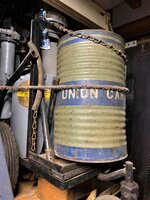
Exploding drill rod report! I guess if there was a stack of steel near a shot getting loaded with emulsion and the hose man sprayed the steel some could get inside. Seems like a very unlikely accident but I guess almost anything is possible although easily preventable. A couple more pics of a few more mining relics. I have quite a few old renewable link fuses and other elctrical items. Also a pic of a hand air hammer, one that I used a lot 45 years ago. It's leaning against the tire of a 64' h100 Hough loader with some other relic junk. I ran the Hough loading trucks the summer of 75'. It will still run but doesn't move so good anymore.
 

Attachments

  • IMG_3193.jpg
    IMG_3193.jpg
    854.8 KB · Views: 41
  • IMG_3194.jpg
    IMG_3194.jpg
    1.2 MB · Views: 40

2oolhound

Well-known member
Joined
Dec 18, 2010
Messages
5,918
Location
BC Canada
Crusher, what is in the carbide can? Is that what the bits in front of it come in?

Also what's the deal on those sieves? A buddy explained them to me a few years back but, well, I've got a good memory but it's short.

Lastly what size links in that chain around your loader? Looks like 5/8" or 3/4"!, Skookum chain!
 

Oregon rock crusher

Well-known member
Joined
Jun 28, 2016
Messages
1,912
Location
West of Salem
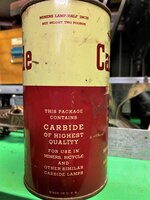
Thanks 2oolhound. The carbide is what powered miners lights as well as a few other uses as shown on the can. I think this was #10 size carbide. The same product was used in acetylene generators for cutting torches as well as lighting in homes prior to everyone getting connected to the grid. Of course those containers were quite a bit larger....I have a working acetylene generator but is kind of packed in tight right now but I added a pic of that too with a larger carbide container.

The sieves were used in our QC dept. As we had a small crew onsite, in the woods mostly, I spent a lot of time washing and shaking rock through sieves to get the gradation of the rock we were crushing. A lot of contracts had pretty tight specifications on the product and we usually tested twice a day for gradation and SE which is kind of a indicator of how much organic **** is in the mix. We adjusted crushers or changed screen sizes as needed to get "in spec".

Most of the chain was part of chain slings. The chain hanging on the stand is 7/8" and 15/16" diameter links. The chain on the ground is 1". The one on the ground was originally a four leg heavy *** ******* to get into or out of the shop truck. We used lighter chains or wire rope slings most of the time.
 

Attachments

  • IMG_3199.jpg
    IMG_3199.jpg
    731.2 KB · Views: 25
  • IMG_3197.jpg
    IMG_3197.jpg
    544.6 KB · Views: 17
  • IMG_3198c.jpg
    IMG_3198c.jpg
    531.7 KB · Views: 27

Provincial

Well-known member
Joined
Sep 21, 2011
Messages
6,874
Location
Near Salem, OR
One way to end up with explosive in a drill rod would be a rod broken off in a hole. The the blaster would have tried to load that hole with emulsion, then decide that it wasn't going to work and not shoot that hole. Either by not putting the cap + booster in the hole, or by not hooking up the cap to the rest of the shot.

Emulsion in the rod would take a lot to ignite. The stuff loses effectiveness pretty quickly, too. I've been away from blasts for a dozen years, and things may have changed since then.
 

Oregon rock crusher

Well-known member
Joined
Jun 28, 2016
Messages
1,912
Location
West of Salem
I suppose you are right Jock and an irresponsible crew could load a hole with a partial string stuck in the bottom. There are some hacks out there and we did occasionally pull steel from the shot rock. I would fire the driller immediately upon learning of that first offense. It wasn't common to loose holes in the pattern but if does happen. If a hole colapsed, had any obstruction, or had a stick of steel in it the right thing to do is drill a replacement hole near the failed hole and fill in the problem hole.

I stuck with the same driller for many years because if he had loose material to drill through or found voids below he would either mud in the holes or case them with pvc to get through the bad spots. He was not speedy but did an exceptional job of ensuring every hole could be loaded to full depth. Most blasters I worked with would deliver good results as long as they had good holes to load. I have seen the results of shots where every hole couldn't be fully loaded and it always cost's much more to clean up the mess it leaves.
 

Provincial

Well-known member
Joined
Sep 21, 2011
Messages
6,874
Location
Near Salem, OR
Tell me about it! BTDT.

An abandoned rod that shatters into small pieces that end up running through the crusher spoils your day.
 

2oolhound

Well-known member
Joined
Dec 18, 2010
Messages
5,918
Location
BC Canada
Thanks for all the explanation on the equipment. That 1" chain rattles my psyche. That looks like a purpose built spreader bar with the chains. I've never seen one like it.
 

Farmer J.

Well-known member
Joined
Sep 18, 2016
Messages
1,995
Location
UK, Cornwall/Hertfordshire.
Thanks crusher, I thought it would be fairly safe. I think the fears must come from a single isolated incident. I just found this on google: DRILL ROD EXPLODED
So, the core of the other unexploded rod had 150mm of tightly packed Ammonium Nitrate in there.. Well, that would do it.! Poor welding guy, but I suppose he never knew what happened though.:sad:
 

daddyopoppy

Well-known member
Joined
Oct 25, 2010
Messages
48
Location
Rock Falls Illinois
In the very small Illinois town of Cherry there was a coal mine from 1905-1935. I don’t know when my wife’s great grandpa worked there but I am blessed to now have a pick and shovel that he used in that mine. The shovel is 21” tall, I can’t even begin to imagine what that must have been like to use, but I’m 6’ 3” tall too. 9CF036DE-03A9-42D4-8DDA-3995B8829FBF.jpeg
 

WisJim

Well-known member
Joined
Dec 20, 2010
Messages
2,298
Location
Menomonie, WI
After visiting our son in Colorado we drove back to Wisconsin through Kansas so we could stop at the Big Brutus museum in West Mineral, Kansas. Nice little museum about coal mining in Kansas and the heart of the display is Big Brutus, supposedly the largest mobile machine in the country. It's a huge electric shovel about 165 feet tall and much more interesting than I had expected. Well worth the visit if you are ever near southeastern Kansas. Lots of interesting displays about strip mining for coal.
 

Attachments

  • Brutus b.jpg
    Brutus b.jpg
    714.4 KB · Views: 18
  • Brutus a.jpg
    Brutus a.jpg
    751 KB · Views: 20
OP
M

MisterEd

Well-known member
Joined
Oct 3, 2019
Messages
742
Location
Florida
Lots of interesting displays about strip mining for coal.
Strip mining evokes recollections of the dead Upper West Branch of the Susquehanna where there were neither fish nor bugs. Now, years later it's recovered because of sincere efforts to stop the acid run-off. If you strip now the overburden has to be returned. One curious result was spraying reclaimed water on the overburden to stimulate plant growth. The water apparently carried tomato seeds. "Wild" tomatoes became a thing for awhile.
 
To avoid these ads, REGISTER NOW!
Top Bottom