To avoid these ads, REGISTER NOW!

Flexible whips - where needed?

AntonLargiader

Well-known member
Joined
Nov 20, 2016
Messages
1,372
Location
Charlottesville, VA
Basic question that I haven't seen addressed. Where are flexible whips required?

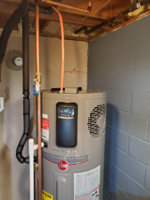
The main reason I'm asking is because I realized that pretty much every water heater and pressure tank that I've seen has NM-B hanging free in the air feeding it, and even my dishwasher had NM-B making more or less a flexible cord when I slid it out of the counter. None of these seem to meet the support requirements but they are commonplace.

Compressors, I can see the increased need due to vibration, although the pre-made MC whips I recently saw at Lowes seemed to be solid wire.

What's the simplest code-compliant way to wire water tanks and heaters? It looks like there is a maximum 18" unsupported length applying to these sorts of appliances, and even within that there is the fact that NM-B in that situation seems exposed to damage.
 
To avoid these ads, REGISTER NOW!

mike93lx

ALLIANCE MEMBER
Joined
Dec 9, 2013
Messages
37,599
Location
Richmond, VA
Curious to hear answers on this. I've only wired one water heater and I used a liquidtite whip for it.

On dishwashers, I have tended to use NM-B, but decided after the last one, when I need to do another, I'll put a receptacle in and wire up a cord. It always ***** messing with the wiring connections on the floor under a DW
 
Last edited:
OP
A

AntonLargiader

Well-known member
Joined
Nov 20, 2016
Messages
1,372
Location
Charlottesville, VA
I wired up a dishwasher cord, too. We were having some troubles with it (no more LG! Ever!) and it made disconnecting power very easy. I also made a cord for my furnace/AHU, so I can easily run it from an inverter.
 

jeepxj

Well-known member
Joined
Mar 2, 2008
Messages
17,866
Curious to hear answers on this. I've only wired one water heater and I used a liquidtite whip for it.

On dishwashers, I have tended to use NB, but decided after the last one, when I need to do another, I'll put a receptacle in and wire up a cord. It always ***** messing with the wiring connections on the floor under a DW

bluetooth supports
1670941627194.png
 

u2slow

Well-known member
Joined
Nov 20, 2011
Messages
3,597
Location
BC
Dishwashers and tank heaters are commonly done with AC cable whips up here. (Our AC has a #14 or larger copper bond wire.) NM shouldn't be exposed, so if used, it's usually sleeved with metallic flex.
 

kaymccampbell

Well-known member
Joined
Feb 27, 2015
Messages
29,549
Location
Upstate New York
For non moving items, I like MC to a box on the wall or ceiling. Except in moisture areas, then it's liquidtite. For obvious vibrators, like compressors , I make sure I've got stranded wire. Dishwashers get a chunk of SJ with a plug. I only use exposed NM -B to hotwire something in an emergency.
 

wyliesdiesels

Well-known member
Joined
Aug 14, 2012
Messages
20,023
Location
Modesto, CA
Dishwashers and tank heaters are commonly done with AC cable whips up here. (Our AC has a #14 or larger copper bond wire.)

all AC/armor clad cable has a bonding wire....

NM shouldn't be exposed, so if used, it's usually sleeved with metallic flex.
why is that? and sleeving it in FMC is more work and costlier than just running THWN in the FMC...
 

u2slow

Well-known member
Joined
Nov 20, 2011
Messages
3,597
Location
BC
all AC/armor clad cable has a bonding wire....


why is that? and sleeving it in FMC is more work and costlier than just running THWN in the FMC...

I seem to recall some discussion about differences with american and canadian AC cable.

When NM is a dedicated run from the panel it's easier to slip flex over the last few exposed feet than to have another JB, and change over to other wire.
 

alfredeneuman

Well-known member
Joined
Mar 3, 2011
Messages
4,581
Location
Fullerton, CA
That's one of those damned if you do, damned if you don't situations
A 90 degree connector on top of a water heater to the wall and another 90 degree connector to the box on the wall is IMO the best way.
 
Last edited:
OP
A

AntonLargiader

Well-known member
Joined
Nov 20, 2016
Messages
1,372
Location
Charlottesville, VA
With Romex? That's what I always see. Do you think it's compliant?

Don't get me wrong, I'm not trying to point fingers. I'm just surprised to realize that so many installations seem to be noncompliant and NOBODY cares. Not just the folks here on IfItsWorthDoingItsWorthOverdoing.com but the inspectors and everyone else. Free floating Romex seems to be the standard, even if it's exposed and not secured 18" after leaving the J box.

I had gotten the sense that liquid-tight with THHN from the water tank to the disconnect would be legal but now you're saying that all flex, I assume that includes liquid-tight, need protection. Isn't pretty much every outdoor unit in the country connected with liquid-tight?
 

sparky 1971

Well-known member
Joined
Oct 9, 2018
Messages
7,973
Location
Central Iowa
There is no definition of protected from physical damage, leaving it wide open for interpretation. Around here, water heaters get plain old 1/2 flex with #10 THWN in them. I've also seen plenty of older installs with romex and even a few with cords and 6-30's. Some might say that the odds of romex getting damaged is low so they might let that go. Nothing is damage proof. I've seen smashed RMC, pulled off the wall, broken couplings, the whole nine yards. What about air conditioners? 90% of them have a LFNC running to them from the disconnect with no straps. All it would take is something falling on it and it's getting ripped out of the connector. EMT isn't really all that safe from destruction, but I use it every day (almost).
 
Last edited:

wyliesdiesels

Well-known member
Joined
Aug 14, 2012
Messages
20,023
Location
Modesto, CA
With Romex? That's what I always see. Do you think it's compliant?

Don't get me wrong, I'm not trying to point fingers. I'm just surprised to realize that so many installations seem to be noncompliant and NOBODY cares. Not just the folks here on IfItsWorthDoingItsWorthOverdoing.com but the inspectors and everyone else. Free floating Romex seems to be the standard, even if it's exposed and not secured 18" after leaving the J box.

I had gotten the sense that liquid-tight with THHN from the water tank to the disconnect would be legal but now you're saying that all flex, I assume that includes liquid-tight, need protection. Isn't pretty much every outdoor unit in the country connected with liquid-tight?
:lol_hitti :bounce:
 
To avoid these ads, REGISTER NOW!

welder4956

Well-known member
Joined
Apr 8, 2010
Messages
3,071
Location
Birmingham, AL USA
"334.15(B) Protection from Physical Damage. Cable shall be protected from physical damage where necessary by rigid metal conduit, intermediate metal conduit, electrical metallic tubing, Schedule 80 PVC conduit, Type RTRC marked with the suffix -XW, or other approved means."

The words "...protected from physical damage where necessary..." seem to leave it open to interpretation by the installer and inspector. I suppose if the water heater is in a closet, or the wire is not out where people or objects would be contacting it easily, then protection could be considered unnecessary.
 
OP
A

AntonLargiader

Well-known member
Joined
Nov 20, 2016
Messages
1,372
Location
Charlottesville, VA
That is what the outer plastic sheeting is for or is it against?
The outer jacket on NM is not waterproof. Neither is the conductor insulation. It will all soak water up and short internally (or externally to the pipe!).
Hint, /s means sarcasm
Got that on the cooling, but zip-tied NM is something that the sparkies here probably find all the time.
 

mike93lx

ALLIANCE MEMBER
Joined
Dec 9, 2013
Messages
37,599
Location
Richmond, VA
The outer jacket on NM is not waterproof. Neither is the conductor insulation. It will all soak water up and short internally (or externally to the pipe!).

Got that on the cooling, but zip-tied NM is something that the sparkies here probably find all the time.
I insulate hot and cold, so condensation isn't an issue
 
To avoid these ads, REGISTER NOW!
Top Bottom