To avoid these ads, REGISTER NOW!

Chuck run out

Rod N

Well-known member
Joined
Jul 21, 2011
Messages
835
Location
Keswick, Ontario
Hi Gents
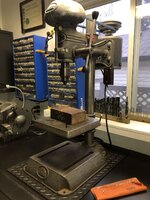
Finally got the motor for my old Beaver and the chuck isn’t true.
Whoever had it last, did a good job cleaning it and lubing it from top to bottom.
I figured I start with removing the chuck.
It has ball bearings?
Says Supreme Chuck on it.
Any advice?
 

Attachments

  • 659CA0AB-4169-46B7-81EA-E4B240171DA5.jpeg
    659CA0AB-4169-46B7-81EA-E4B240171DA5.jpeg
    287 KB · Views: 98
  • F297A163-69DF-43A6-B08F-827C450F70F5.jpeg
    F297A163-69DF-43A6-B08F-827C450F70F5.jpeg
    343.4 KB · Views: 91
To avoid these ads, REGISTER NOW!

Davefr

Well-known member
Joined
Jan 7, 2010
Messages
11,833
Location
OR
What do you measure? Start at the spindle vs the chuck and post the actual data.
 

Cleave

Well-known member
Joined
Jul 11, 2018
Messages
353
Location
Back Porch
Mount dial indicator to table.
If you don't have a dial indictator, use a 1-2-3 block or drill press vise or a block to do this visually...
Measure runout on the chuck sleeve (the part the key turns)
Put precision 1/2" shaft or drill rod in chuck, tighten the chuck in all three holes, and measure runout at the top of the shaft/rod.

If the accuracy isn't acceptable (less than 0.003 would be great), see if you can remove the chuck from the spindle and check the taper interface for burrs, etc. Then check the spindle for runout. If the taper is the problem a new chuck and/or a remachined taper could do the trick.
 
OP
R

Rod N

Well-known member
Joined
Jul 21, 2011
Messages
835
Location
Keswick, Ontario
Mount dial indicator to table.
If you don't have a dial indictator, use a 1-2-3 block or drill press vise or a block to do this visually...
Measure runout on the chuck sleeve (the part the key turns)
Put precision 1/2" shaft or drill rod in chuck, tighten the chuck in all three holes, and measure runout at the top of the shaft/rod.

If the accuracy isn't acceptable (less than 0.003 would be great), see if you can remove the chuck from the spindle and check the taper interface for burrs, etc. Then check the spindle for runout. If the taper is the problem a new chuck and/or a remachined taper could do the trick.
The run out is enough that when I drill into wood, all hell breaks loose.
The chuck has ball bearings and I'm worried if I try to "smack" it off the bearing will be all over the place.
Is it normal to have ball bearings in a chuck?
 

paulsomlo

Well-known member
Joined
Jul 16, 2013
Messages
3,890
Location
Northern Colorado
The run out is enough that when I drill into wood, all hell breaks loose.
The chuck has ball bearings and I'm worried if I try to "smack" it off the bearing will be all over the place.
Is it normal to have ball bearings in a chuck?
Yes - some chucks have ball bearings to reduce friction, so they can be more readily tightened. If you remove the chuck from the drill press taper, the ball bearings will not come out. And at this point, you need to measure the runout at the spindle taper anyway.
 

RoninB4

Well-known member
Joined
Jul 22, 2020
Messages
3,563
Location
Under My House
How much is it out? This is a drill press and some allowable run-out is acceptable. If it's at the spindle then that's a more involved repair. If it's at the chuck itself then this may be considered "normal" for age. A lot of chucks get over-tightened over the years to consider rebuilding the chuck itself. You need to determine where the run-out is and how much. Do not just "smack" the chuck to remove it, the shock isn't good for the spindle bearings if there are any.
 
OP
R

Rod N

Well-known member
Joined
Jul 21, 2011
Messages
835
Location
Keswick, Ontario
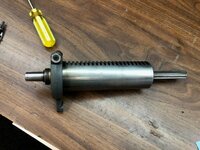
Finally got the chuck off. Wow.
Spindle is out 0.005 at the top as in picture. I measured with a bit in the chuck before I removed it and it was 0.040. So it’s bent.
Can this be fixed?
 

MShaw

Well-known member
Joined
Mar 2, 2015
Messages
1,013
Location
York, Pa.
Check runout at the top and the bottom of the taper. If they are the same amount in the same direction at both places the big error is in the chuck and the spindle is probably not far from original accuracy.
 
OP
R

Rod N

Well-known member
Joined
Jul 21, 2011
Messages
835
Location
Keswick, Ontario
Check runout at the top and the bottom of the taper. If they are the same amount in the same direction at both places the big error is in the chuck and the spindle is probably not far from original accuracy.
It gets steadily worse as I go down.
Here are my numbers. 5763CD74-EEE6-4B65-A1B0-2765CBF00F4D.jpeg
 

RoninB4

Well-known member
Joined
Jul 22, 2020
Messages
3,563
Location
Under My House
Let me begin by asking if .005 is the total amount of runout (0 on one side .005 on opposite side). If so then your runout is only .0025. This is quite acceptable for a drill press.

Did you try for lateral movent (side to side) with your fingers on the taper? This shows wear in the spindle housing bushing/bearing. Try this again at the top of the spindle where the belt pulley is (unplugged of course). This may show wear at the top bushing/bearing.

Next is inspection/evaluation of the taper fitment of spindle-to-chuck. There are several tapers used in machinery and they're all different. Some are close enough to appear to fit but do not make full contact. First make sure the chuck and spindle tapers are clean and free of burrs/nicks. Use a magic marker to get black evenly on the entire spindle taper, spin the drill press slowly under power is the easiest method. Now very lightly put the chuck on the taper but careful enough to NOT lock up the taper. A slight twist (1/4 rotation is enough) and allow the chuck to drop off the spindle. Now check the contact area. If you have "rings" where the black was wiped off but a large amount of black still remaining on the spindle taper then the tapers are only contacting on those wiped "ring" areas. The tapers don't match very well and could explain the excessive runout. Tapers are interesting in that they can provide a mating lock to work but only need about .002 to unlock. When non-technical people sometimes attempt to fix a taper they end up making it useless. Tapers can be repaired but this is a topic for another post.

If the contact/wipe pattern looks good then I guess it's time to consider a chuck rebuild or replacement. A ball bearing chuck is a better made piece of tooling but even those can be ruined by over-torque from ham-fist individuals. Even large chucks on lathes can become f*cked up the same way through over-torque and end up "sprung". Putting a cheater pipe on a chuck key (drill press or lathe) is the most common cause of making a chuck sprung. Rebuild kits may not be available for your chuck, things are different now than they used to be. If this is so you'll either have to get a new (used in good condition) chuck or live with the runout. I don't feel that a ball bearing chuck is essential unless you plan to do a LOT of drilling or just want one. Condition of the drill press makes a difference.

If your runout is .020 (half of your posted .040) then I wouldn't call it a show stopper but it depends upon what type of work you do. If a hole diameter/location is critical I don't expect a drill press to do the job accurately anyway and use other machines I have for better results. If you're drilling for a tapped hole where diameter is sorta important then try drilling under-size (.015-.030) and then go in with the correct size drill for tapping (65% of thread is good). Almost every machine will have something not perfect about it, a good machinist is able to work around those deficiencies. I have a couple of other tips for dealing with runout but first determine exactly where the problem is before we go further. Happy hunting.
 
Last edited:

mogandave

Well-known member
Joined
Nov 4, 2021
Messages
3,052
Location
Bangkok
Finally got the chuck off. Wow.
Spindle is out 0.005 at the top as in picture. I measured with a bit in the chuck before I removed it and it was 0.040. So it’s bent.
Can this be fixed?
That was quick! (just kidding)
 
To avoid these ads, REGISTER NOW!

RoninB4

Well-known member
Joined
Jul 22, 2020
Messages
3,563
Location
Under My House
I may be wrong but doubt it's a bent spindle. A bent spindle should show signs of impact somewhere on the machinery sheet metal. Less trouble to simply check it first as described above than disassemble the spindle. If I'm wrong you can blame me for wasting an extra 15 minutes of your life.
 

Provincial

Well-known member
Joined
Sep 21, 2011
Messages
6,869
Location
Near Salem, OR
I may be wrong but doubt it's a bent spindle. A bent spindle should show signs of impact somewhere on the machinery sheet metal. Less trouble to simply check it first as described above than disassemble the spindle. If I'm wrong you can blame me for wasting an extra 15 minutes of your life.
Bent drill press spindles often happen when the bit grabs a part that isn't being held down properly and the whole thing starts spinning. If the part is heavy and unbalanced, the centrifugal force puts a lot of bending force on the spindle. If the drill press doesn't get tipped over or thrown against something while dancing around, there will be no exterior damage.
 

Whitworth

Well-known member
Joined
Dec 26, 2011
Messages
2,093
It gets steadily worse as I go down.
Here are my numbers. 5763CD74-EEE6-4B65-A1B0-2765CBF00F4D.jpeg
If you're measuring the outside of the chuck body that won't give the most accurate data on runout.
Better to chuck up a new, clean drill bit and measure against the smooth part of the bit.
 
OP
R

Rod N

Well-known member
Joined
Jul 21, 2011
Messages
835
Location
Keswick, Ontario
If you're measuring the outside of the chuck body that won't give the most accurate data on runout.
Better to chuck up a new, clean drill bit and measure against the smooth part of the bit.
The last number is from a quality 1/2" drill bit.
 
OP
R

Rod N

Well-known member
Joined
Jul 21, 2011
Messages
835
Location
Keswick, Ontario
This drill press is around 65 years old with an unknown history. I assume the chuck is original as a threaded collar is pretty rare. I doubt it was used in a shop as it's in pretty good shape and the manual states it's a quality home press.

I don't want to pull the shaft out of the quill (not a 15 minute job) as I don't know if I can get new bearings and they don't look like they will press out too easily not to mention press back in. The bearings sound a little dry, but I do not feel any looseness when I try to pull the shaft away from the gauge. I'll oil the bearings when I'm done as there are inlets in the quill for this.

It took me hours to get the threaded collar off at 1mm per whack. Looking back, I'm thinking it was because the shaft was bent. No witness marks on the taper.

I'll be taking the shaft/quill to a local machine shop. This guy is pretty amazing with my past projects and he thinks he can true it up. If not, it's a parts machine.

Thanks again for all the replies.
quill.jpg
 

RoninB4

Well-known member
Joined
Jul 22, 2020
Messages
3,563
Location
Under My House
Bent drill press spindles often happen when the bit grabs a part that isn't being held down properly and the whole thing starts spinning. If the part is heavy and unbalanced, the centrifugal force puts a lot of bending force on the spindle. If the drill press doesn't get tipped over or thrown against something while dancing around, there will be no exterior damage.
-Not saying it's not possible, I did state that I may be wrong. But after 35+ years working in machine shops I've never seen a bent spindle from the conditions you've described and I've seen several instances where what you described happened. Standard length drills shatter before the greater cross sectional mass of a spindle bends IMO.

Doesn't matter what I think, OP has removed the spindle so it's an easy check for wear and/or bent spindle. Would advise the OP checking this before taking it to a shop intent on extracting a fee. JMO
 

whateg01

Well-known member
Joined
Mar 13, 2006
Messages
11,343
Location
doo dah, kansas, usa
-Not saying it's not possible, I did state that I may be wrong. But after 35+ years working in machine shops I've never seen a bent spindle from the conditions you've described and I've seen several instances where what you described happened. Standard length drills shatter before the greater cross sectional mass of a spindle bends IMO.

Doesn't matter what I think, OP has removed the spindle so it's an easy check for wear and/or bent spindle. Would advise the OP checking this before taking it to a shop intent on extracting a fee. JMO
The spindle on my 150 was cracked just above the taper. Started a new spindle but life got in the way. Bent/broken spindles happen whether you've seen it or not.
 

Provincial

Well-known member
Joined
Sep 21, 2011
Messages
6,869
Location
Near Salem, OR
Bent spindles are more common on Morse Taper versions where the spindle extends far beyond the bearing to provide access to the drift slot for removing bits. This places the working part of the bit far from the lower bearing, which provides a lot of leverage when a workpiece starts flailing around.
 

MShaw

Well-known member
Joined
Mar 2, 2015
Messages
1,013
Location
York, Pa.
At a company I worked for in Ct. many years ago we had an Allen multi head drill press. A night shift operator substituted a a reduced shank drill for a 1 1/4" diameter piloted counterbore when drilling a thin wall casting. The drill grabbed and bent the chuck arbor 30 degrees. bent the drill shank 30 degrees and then the whole mess came around and broke the head off where it bolted to the base. Seems unbelievable but I saw the results first hand.
 
OP
R

Rod N

Well-known member
Joined
Jul 21, 2011
Messages
835
Location
Keswick, Ontario
I could not be happier with the outcome. My guy took the quill apart. Took the bearings apart too. Straightened the shank.
It’s running 0.004 with a dowel in the chuck now.
As perfect as you can get.
Charged me $80 cdn. $50 usd?
 

Attachments

  • 9D54D78E-A655-449B-8006-37E4FB7D217B.jpeg
    9D54D78E-A655-449B-8006-37E4FB7D217B.jpeg
    690.1 KB · Views: 20
To avoid these ads, REGISTER NOW!
Top Bottom