

You are using an out of date browser. It may not display this or other websites correctly.
You should upgrade or use an alternative browser.
You should upgrade or use an alternative browser.
Everything else being equal, how much more torque can 1/2" drive take compared to 3/8" drive?
- Thread starter 809
- Start date
Dakotadadv8
Well-known member
- Joined
- May 30, 2021
- Messages
- 1,521
Interesting information. Since these tests are based on single-cycle tests not sure how durable they are over time. Nice to determine the tool durability.

dnschmidt
Well-known member
I own the big boy Milwaukee and the Aircat 1250K. WHAT'S A BREAKER BAR?
LWB
Well-known member
What I don't get about these torture test video's, is why would you take a 3/8" breaker bar to anywhere near those torque values? Doesn't it make them kind of pointless?
Garcky
Well-known member
Well, some guys insist that 3/8 drive can do it all. They break breaker bars frequently. That's why we have 1/2" drive stuff.What I don't get about these torture test video's, is why would you take a 3/8" breaker bar to anywhere near those torque values? Doesn't it make them kind of pointless?
LWB
Well-known member
Well, some guys insist that 3/8 drive can do it all. They break breaker bars frequently. That's why we have 1/2" drive stuff.
I've had anvils twist off like butter. I wouldn't want something "snapping" off like that while using it. Bigger is better if you have the room. That said, I mostly use 1/4" on any new car. Most bolts are 10 and 12mm hex
LWB
Well-known member
Hey, true. You couldn't probably dismantle half a vehicle with a $20 1/4" socket set lol
plinker
Well-known member
One way to find the limits of drive size is throw a reducer adapter on a breaker bar or other drive tool.
It does tend to hurt though, so not really recommended practice.
IMO, 150 ft lb is pushing it for 3/8 drive, as is 300 ft lb for 1/2 drive. 100lb & 250lb is probably more realistic, 600lb for 3/4 drive.
I dont remember the numbers for 1/4 drive but 30-ish ft lb is probably about right.
My theory is if it's that tight, move up in drive size when possible (sometimes it isnt) as it reduces the chance of something breaking, along with wear on tools.
It does tend to hurt though, so not really recommended practice.
IMO, 150 ft lb is pushing it for 3/8 drive, as is 300 ft lb for 1/2 drive. 100lb & 250lb is probably more realistic, 600lb for 3/4 drive.
I dont remember the numbers for 1/4 drive but 30-ish ft lb is probably about right.
My theory is if it's that tight, move up in drive size when possible (sometimes it isnt) as it reduces the chance of something breaking, along with wear on tools.
dnschmidt
Well-known member
If you want to find the answer to this question look at the world of torque wrenches. I know of no torque wrenches in 3/8" drive that go much above 100 ft-ib. 1/2 torque wrenches normally top out at 250 ft-lb. There likely is a reason for this.
strutaeng
Well-known member
When the breaker bar starts flexing and the damn bolt doesn't give, it's time to go to the next drive size up. How much flexing is a learned intuition.
I removed a gooseneck ball on my K3500 beater truck. Used a big a$$ Ridgid plumbing pipe wrench with a 8' round metal fence post I had laying around. I was literally laughing OUT LOUD, but it worked.
I removed a gooseneck ball on my K3500 beater truck. Used a big a$$ Ridgid plumbing pipe wrench with a 8' round metal fence post I had laying around. I was literally laughing OUT LOUD, but it worked.
Last edited:
You can also think of it in simplified math therms. Simplify the square anvil into a round one then look at the equations for torsional stiffness of a round shaft. This site, picked by the internet search gods, provides the equations

 byjusexamprep.com
Since we are just comparing two anvil sizes we can assume things like material properties are the same. We can also simplify our square shaft into a round shaft that has the same diameter as the flats of the square.
One way to look at this is as a pure stiffness question. From this link we get the following:

 www.fictiv.com
The deflection under load equation is:
theta= TL/JG, theta is the amount a beam twists for a given applied torque
where:
T=toque applied
L=length of beam
J=Polar moment of inertia ->this is the part of the equation that cares about the cross section of the part
G=Shear modulus -> this is the part of the equation that cares if we use aluminum vs steel.
Since we are only doing a comparison between two things we can assume T, L and G are the same in both cases (L isn't likely the same when we are talking about a 3/8 vs 1/2 anvil but we will assume since the difference is relatively small compared to the J part.
J is the part that cares about the shape of the anvil. Using the round shaft assumption J=πD^4/32. So increasing diameter (D) really increases stiffness. A 1/2" anvil is 3.16x as stiff as a 3/8" shaft. BTW, this is also why that hole down the center of a ratchet doesn't affect the stiffness much. Assume that's a 1/8" hole in a 3/8" shaft... (3/8)^4=0.01978, (1/8)^4=0.00024. The effective diameter of the 3/8" shaft with a 1/8 whole is (0.01978-0.00024)^.25= 0.3738" or a 2.99/8" diameter. The shaft with the whole is 98.8% as stiff as one without.
But, our maximum torque is a function of stress/strain in the part, not just stiffness. Since diameter also impacts torsional stress, the increase in diameter hurts us. Net result is instead of D^4 we have D^3.
τmax=16T/πD^3
τ is stress in the part (this is our material limit).
T is applied torque
D is again diameter of the assumed round shaft.
Since all we care about is maximum T we can shift things around like this:
T= τmax*πD^3/16
Since we are only comparing the D^3 part is all that matters. The rest stay the same. So .5^3 / (3/8)^3 = 2.37x stronger.
Incidentally, if we want to add that quick release hole then the effective diameter looks like this (Do^4-Di^4)/Do.
So for a 3/8 drive with a 1/8 hole, we have (.375^4-.125^4)/.375 = 0.05208 vs .375^3 = 0.0527. That change in effective diameter is a peek load of 96.5% of the 3/8 solid shaft. So that hole down the center costs you 3.5% of what the ratchet could have handled.
Torsional Shear Stress: Definition, Assumptions, Equation
Torsional stress is the shear stress that results from the action of a twist on a transverse cross-section. It is defined as the shear stress brought on by twisting a shaft.
byjusexamprep.com
Since we are just comparing two anvil sizes we can assume things like material properties are the same. We can also simplify our square shaft into a round shaft that has the same diameter as the flats of the square.
One way to look at this is as a pure stiffness question. From this link we get the following:
Design Methods to Improve Torsional Rigidity | Fictiv
This article will walk product designers and engineers through the methods used to analyze and improve torsional rigidity in design. Learn more!
www.fictiv.com
The deflection under load equation is:
theta= TL/JG, theta is the amount a beam twists for a given applied torque
where:
T=toque applied
L=length of beam
J=Polar moment of inertia ->this is the part of the equation that cares about the cross section of the part
G=Shear modulus -> this is the part of the equation that cares if we use aluminum vs steel.
Since we are only doing a comparison between two things we can assume T, L and G are the same in both cases (L isn't likely the same when we are talking about a 3/8 vs 1/2 anvil but we will assume since the difference is relatively small compared to the J part.
J is the part that cares about the shape of the anvil. Using the round shaft assumption J=πD^4/32. So increasing diameter (D) really increases stiffness. A 1/2" anvil is 3.16x as stiff as a 3/8" shaft. BTW, this is also why that hole down the center of a ratchet doesn't affect the stiffness much. Assume that's a 1/8" hole in a 3/8" shaft... (3/8)^4=0.01978, (1/8)^4=0.00024. The effective diameter of the 3/8" shaft with a 1/8 whole is (0.01978-0.00024)^.25= 0.3738" or a 2.99/8" diameter. The shaft with the whole is 98.8% as stiff as one without.
But, our maximum torque is a function of stress/strain in the part, not just stiffness. Since diameter also impacts torsional stress, the increase in diameter hurts us. Net result is instead of D^4 we have D^3.
τmax=16T/πD^3
τ is stress in the part (this is our material limit).
T is applied torque
D is again diameter of the assumed round shaft.
Since all we care about is maximum T we can shift things around like this:
T= τmax*πD^3/16
Since we are only comparing the D^3 part is all that matters. The rest stay the same. So .5^3 / (3/8)^3 = 2.37x stronger.
Incidentally, if we want to add that quick release hole then the effective diameter looks like this (Do^4-Di^4)/Do.
So for a 3/8 drive with a 1/8 hole, we have (.375^4-.125^4)/.375 = 0.05208 vs .375^3 = 0.0527. That change in effective diameter is a peek load of 96.5% of the 3/8 solid shaft. So that hole down the center costs you 3.5% of what the ratchet could have handled.
Garcky
Well-known member
Really, all you have to do is look at the socket sizes in a full set for any of the drive sizes. There's a reason for the largest size in each set being what it is.
Personally, I never use 1/4" drive with any socket over 9/16" or the metric equivalent. For 3/8" drives, I draw the line at 7/8" or metric equivalent. In 1/2" drive, I move up to 3/4" drive for any socket over 1 1/16" or equivalent. I never need anything over 2 1/4" socket size, so I don't need 1" drive stuff.
Personally, I never use 1/4" drive with any socket over 9/16" or the metric equivalent. For 3/8" drives, I draw the line at 7/8" or metric equivalent. In 1/2" drive, I move up to 3/4" drive for any socket over 1 1/16" or equivalent. I never need anything over 2 1/4" socket size, so I don't need 1" drive stuff.
GirlnAgarage
Well-known member
One way to find the limits of drive size is throw a reducer adapter on a breaker bar or other drive tool.
This is actually a pretty good demonstration. I remember early in my learning years putting on an adapter to aply a bigger breaker bar. It twisted the little square head right off.
Wakefield
Well-known member
I assume that a properly designed breaker bar will be able to drive the anvil/drivepiece to failure before the hinge/pin or fork breaks. Sometimes these things do fail however-wear and tear from repeated use? Flaws in the forging or broaching process? pin (or bolt) insufficient?
redwrench60
Well-known member
Never mind the test lab ********. Develop your mechanical intuition and learn to recognize the signs of a tool or machine nearing its limit. A big part of being a good hand is knowing when to stop and find another way before you get hurt, get someone else hurt, or break something.
Ever work with a guy who breaks **** and hurts himself all the time, and another guy doing the same work who almost never does?
Ever work with a guy who breaks **** and hurts himself all the time, and another guy doing the same work who almost never does?
Wakefield
Well-known member
There is a little S*K breaker bar in half inch that I have that is only about 9 and 1/2 inches long,fits where others don't,the fork and anvil look as robust as the longer ones although the shank is turned down to a bit smaller diameter than the long onesThat would explain why every 3/8 breaker bar I've had has turned into a broken bar!
it will easily snap Grade 8 SAE course thread 3/8" capscrew/bolts I think those fail at about 60 ft. lbs. One handed too if I remember correctly
Wakefield
Well-known member
Big sockets in 1/4" drive might be intended for use with thumb ratchets or plastic nutsReally, all you have to do is look at the socket sizes in a full set for any of the drive sizes. There's a reason for the largest size in each set being what it is.
Personally, I never use 1/4" drive with any socket over 9/16" or the metric equivalent. For 3/8" drives, I draw the line at 7/8" or metric equivalent. In 1/2" drive, I move up to 3/4" drive for any socket over 1 1/16" or equivalent. I never need anything over 2 1/4" socket size, so I don't need 1" drive stuff.
Garcky
Well-known member
I have a 3/8" thumb ratchet, too.Big sockets in 1/4" drive might be intended for use with thumb ratchets or plastic nuts
I have a 1/2” one… that I have never used…I have a 3/8" thumb ratchet, too.
I have never used a 3/8” breaker bar, either…
Garcky
Well-known member
Yeah, I've not found much use for my 3/8" breaker bar, either. I get a lot of use out of my 3/8" drive thumb ratchet, though. I use it with long ball-end hex bits when assembling flat-pack furniture. Saves tons of time for me. My wife keeps ordering furniture like that, despite my objections. I dutifully assemble it for her.I have a 1/2” one… that I have never used…
I have never used a 3/8” breaker bar, either…
laser3kw
Well-known member
I wonder if those calculations are for the drive lug (only). To me, the weak link is the ears at the swivel point. That is where I have seen failure.
BigLeagueSmoes
Well-known member
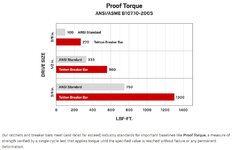
Here is a link to a thread about 3/8" drive ratchet failure loads, linked below. Most 3/8" ratchets will fail around 200 ft lbs of torque on the low end and 300 ft lbs of torque on the high end. Check out this discussion and the chart I put together for more detailed information
I don't have a ton of information on 1/2" drive ratchet failures in a testing setting because there aren't a ton out there but there's this one that is pretty simple.
Summary:
Pitsburgh 1/2" ratchet: 473 ftlbs of torque and the handle bent
Hazet 916HPL 1/2" ratchet: 721 ftlbs of torque and the anvil sheared
Thread: 3/8" drive Ratchet & Breaker Bar torque failure info
I don't have a ton of information on 1/2" drive ratchet failures in a testing setting because there aren't a ton out there but there's this one that is pretty simple.
Summary:
Pitsburgh 1/2" ratchet: 473 ftlbs of torque and the handle bent
Hazet 916HPL 1/2" ratchet: 721 ftlbs of torque and the anvil sheared
Video: HAZET vs Harbor Freight 1000NM Challenge Too Much Force said Everyone! 1/2 Drive
A few weeks ago, we had to torque the U-bolts on a Kenworth water truck. We had to use a 3/4" torque wrench because the final torque was 600ft/lbs. We used a 3/4" to 1/2" socket adapter and a 1/2" socket. I forget the socket size. We didn't have a proper sized 3/4" available at the time.
Anyway... We got to the very last pull on the very last bolt and the socket adapter broke. The torque wrench and the socket were fine. The weak point was the 1/2" anvil on the adapter.
I've got no experience to support it, but I doubt 3/8" could handle 600ft/lbs.
By the way, it was a Snap On adapter. Yes, Snap On tools do and can break. But my dealer was happy to warranty it for me.
Anyway... We got to the very last pull on the very last bolt and the socket adapter broke. The torque wrench and the socket were fine. The weak point was the 1/2" anvil on the adapter.
I've got no experience to support it, but I doubt 3/8" could handle 600ft/lbs.
By the way, it was a Snap On adapter. Yes, Snap On tools do and can break. But my dealer was happy to warranty it for me.
My very simplified math was for the drive lug. Certainly other parts might fail first.I wonder if those calculations are for the drive lug (only). To me, the weak link is the ears at the swivel point. That is where I have seen failure.
We spent a frustrating day torqueing 1 inch A490 bolts to 1,060 ft-lbs on a structural steel bank frame that is apparently built to withstand nuclear winter. We have about 400 to torque and broke 2 impact sockets and a 1 inch to 3/4 inch reducer in the first 50. 3/4 Ingersoll rand gun is supposed to make 1400 ft-lbs. To pass structural steel inspection we used a 600 ft-lb 3/4 drive clicker with a 3 to 1 torque multiplier. Clicker set to 354 ft-lbs to produce the required 1060 with multiplier. All bolts turned about 1/4 turn further with clicker. Then the sockets started shattering. IE our impact can't make the required numbers. Ordered a 1 inch IR and appropriate 1 & 5/8 shallow impact from Caterpillar to be overnighted tomorrow morning. These were quality sockets from Napa and Mac that broke. Crossing our fingers that this will work!
seber
Well-known member
The engineering solution is to use the actual math. H squared times w. so for 3/8 and using a shortcut method of H being the cross section. For 3/8" .187 squared x .375 = .013 for 1/2" .25 squared x .5 =.031. In other words, all else being equal the half inch is 2.4 times stronger.
American Locomotive
Well-known member
As mentioned, 1/2" drive is about 2.5-3x stronger than 3/8" drive.
But honestly, the vast majority of breaker bars I've used have failed somewhere other than the anvil square itself. In fact, I find breaker bars (even good ones like SK or Snap-On) to be so unreliable, that I use exclusively use ratchets these days. Pretty much any modern ratchet will shear the anvil off before the mechanism breakers from a cheater.
FWIW: I use 3/8" drive for basically everything but large suspension bolts where the sockets literally don't come in that size.
But honestly, the vast majority of breaker bars I've used have failed somewhere other than the anvil square itself. In fact, I find breaker bars (even good ones like SK or Snap-On) to be so unreliable, that I use exclusively use ratchets these days. Pretty much any modern ratchet will shear the anvil off before the mechanism breakers from a cheater.
FWIW: I use 3/8" drive for basically everything but large suspension bolts where the sockets literally don't come in that size.
Last edited:
oldschoolcraft
Well-known member
What's the largest size we should use on 3/8 drive? I always thought about stopping at 19mm in 3/8 drive but they do come in bigger socket sizes.Well, some guys insist that 3/8 drive can do it all. They break breaker bars frequently. That's why we have 1/2" drive stuff.
swsman
Well-known member
If the breaker bar anvil is getting sheared off, or the bar is getting pretzled that is due to a use outside of its design parameters.
I own a few of them in 1/2" size in different lengths, all still accounted for.
Added an Icon 3/8" not long ago, already used it a couple times while working on my friends '97 Camry. Mainly breaking the bolts loose on the alternator/belt tensioner to replace a belt.
There were some space constraints on one of the bolts, this is where 3/8" breaker bar worked out great and provided needed leverage.
After I switched over to a ratcheting wrench to finish it off.
I have no problem swapping the tool out and preserving my ratchets/ratchet wrenches.
I own a few of them in 1/2" size in different lengths, all still accounted for.
Added an Icon 3/8" not long ago, already used it a couple times while working on my friends '97 Camry. Mainly breaking the bolts loose on the alternator/belt tensioner to replace a belt.
There were some space constraints on one of the bolts, this is where 3/8" breaker bar worked out great and provided needed leverage.
After I switched over to a ratcheting wrench to finish it off.
I have no problem swapping the tool out and preserving my ratchets/ratchet wrenches.
Complicated answer.What's the largest size we should use on 3/8 drive? I always thought about stopping at 19mm in 3/8 drive but they do come in bigger socket sizes.
Generally the tools we use are roughly designed for twice the normal load. Knowledgible, responsible manufacturers tend to assemble sets including sizes:
1) for which there are standards, skipping non-std sizes (which GJ hates)
2) wherein the drive size capability = roughly 2X the specified torque for a bolt that socket fits.
For Example:
Depending on the standard, a 19mm socket could fit either an M12 or an M14 thread. Depending on the Grade (strength) of the bolt, the torque required could be as much as 111ftlbs for a Gr12.9 M12, or 177ftlbs for the same grade M14. That M14 torque is getting dangerously close to the roughly 250ftlb capability of a high quality 3/8" drive anvil, let alone the 2X factor engineering would prefer. So 19mm is fine for 3/8" drive for German cars (M12 max), but not fine for Japanese cars (M14 max). Now most people won't mind because Grade 12.9 hardware is pretty rare on passenger cars. If you looked at Grade 8.8 torques, M12 would be 63ftlbs, while M14 would be a 103ftlbs. These are easily handled with 3/8" drive. So 19mm is "safe".
In general, and this may be particularly helpful to @oldschoolcraft and others with Japanese cars, the JIS std has small bolt heads for any given thread size. So when you are needing the bigger sockets, maybe think about moving up in drive size. This also translates to greater risk of damaging a stuck bolt on a JIS vehicle. Combined with sometimes lowest possible quality hardware, this can make JIS vehicles difficult to maintain. Just looking at my handy dandy chart, I wouldn't recommend using anything over 19mm with 3/8" drive on a Japanese car. For German or US vehicles, 21 and 22mm would be fine in 3/8" drive.
For torx, the 3/8" line should be around T55. Anything above really should be 1/2".
