To avoid these ads, REGISTER NOW!

How Would You Make This Repair?

antman213

Well-known member
Joined
Nov 19, 2017
Messages
328
I have a Variable Speed Drill press with a Reeves Drive. The fork that varies the speed is broken (I don't have the broken off piece)

I'm interested in any ideas on how to make this repair.

I have a MP Welder (But I don't know TIG), I have torches, and tap & dies, and even epoxies.

My though so far was a braze or weld repair would be most ideal but I'd be going in without the original piece. Likely I'd use cold rolled and attach that to the cast iron.
This has me thinking maybe I'd be better off with just using fasteners though.

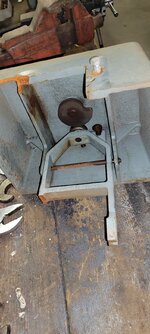
To clarify what the photo shows:
This item is a fork that raises and lowers a pin on the sheave pulley. One side of this fork is still there, the other side is whats broken off (See the rusty nub)
In the parts diagram its part #10

Let me know what you think would be the best way to make this repair without making things worse.
 

Attachments

  • 20221123_202414.jpg
    20221123_202414.jpg
    404.4 KB · Views: 182
  • Screenshot 2023-01-10 at 00-52-09 Delta Series 2000 Variable Speed Drill Press 70-301 eReplace...png
    Screenshot 2023-01-10 at 00-52-09 Delta Series 2000 Variable Speed Drill Press 70-301 eReplace...png
    76.3 KB · Views: 182
To avoid these ads, REGISTER NOW!

nbpt100

Well-known member
Joined
Oct 19, 2016
Messages
2,301
Location
Massachusetts
It is steel? right? Why are you reluctant to your your MP welder? It seems like the practiacla thing to do since you have the equipment. You could always use a mending plate on the out side with nuts and bolts.
 

American Locomotive

Well-known member
Joined
Jan 8, 2017
Messages
11,012
Location
Rhode Island
Brazing on a piece of steel, and then welding a "fork" onto that piece of steel would probably work. You could definitely also use fasteners and a plate as mentioned.

If it were mine, I would probably ditch the reeves drive, rig it into a fixed speed and put a 3 phase motor and VFD on it.

Reeves drives have proven to be very troublesome in just about every piece of equipment that came with one.
 

ipgenie

Well-known member
Joined
Jan 29, 2020
Messages
562
Location
Idaho
The same cast fork on my old Clausing broke. I was about to build one out of steel but a friend welded it for me. I didn't think it would hold but it's still there 6-7 years later.
I like the VFD idea. I'm really careful now if I change the speed but I mostly just leave it on the slowest setting. If I ever break it again I'll probably look into convertng it to fixed with a VFD controller. Probably not a ton more $$ than a replacement fork from Clausing.
 
OP
A

antman213

Well-known member
Joined
Nov 19, 2017
Messages
328
It is steel? right? Why are you reluctant to your your MP welder? It seems like the practiacla thing to do since you have the equipment. You could always use a mending plate on the out side with nuts and bolts.
It appears to be cast iron. This is the only reason I'm hesitant to weld it.

Similarly I'm hesitant to use mechanical fasteners because the cross section of cast iron is fairly thin and drilling a hole in it may weaken it.


This is what I was thinking so far, I just need to see if everything will clear or hit
Its a angle piece (Purple) and flat bar (Red) to add some reinforcement on the side
 

Attachments

  • Fix.jpg
    Fix.jpg
    501.1 KB · Views: 164

nbpt100

Well-known member
Joined
Oct 19, 2016
Messages
2,301
Location
Massachusetts
I like what your are thinking but you still need to fasten it with some kind of fastener or weld it. What are the dimesions of the bracket side walls. i.e. height, thickness.?? How much force is on the part? Just guessing, without knowing the answers to those questions, I would asume 1/4" screws should be fine. If you are very concerned use M6 or #10 SHCS with washers. With the approach you are showing You are distributing the load over two sound members of the bracket. But.... I do not like to assume if I do not have to.......How is the rest of the bracket. Have you inspected it for cracks? Do you understand why that piece broke?
 

JradM

Well-known member
Joined
Sep 4, 2019
Messages
1,820
Location
Alberta
That part doesn't look too complicated to make. I'd get some cold rolled flat stock and just make an entire new part, you already have the basic tools needed to make it in your arsenal.
I was going to suggest that too - e.g. it looks pretty simple, could you just make a new one from regular cold rolled steel?
 
To avoid these ads, REGISTER NOW!

MongoTA

Well-known member
Joined
Mar 10, 2018
Messages
1,017
Location
CT
I'm interested in any ideas on how to make this repair
I've only welded cast iron a couple of times. Got the recommended technique from a welder.
Clean the metal.
I stick welded it.
I used nickel rods.

I preheated the part, I actually used my wood-fired pizza oven. The first time I put the part to be repaired in the oven, then fired it up so the cast iron would slowly heat with the oven. Didn;t really think it through and the cast iron part sooted up. When I pulled it out it was a bit of a dance trying to clean the soot off the hot metal, so I aborted that mission and started over. Cleaned up the metal, then put it in the doorway of the heated oven. Let it heat up, moved it in further. Repeat, heating it up slowly. Oven can go to about 900F, but kept it around 500F. You can do the same in your kitchen oven if it'll fit.
After a thorough preheat, I pulled the part out, used a rag with mineral spirits to quickly wipe down the weld area, and did the weld. Stick welded using 99% nickel rods.
Put it back in the oven for a long overnight cooldown.
During the day I went out about every 4 hours or so while the oven was cooling. Pulled the part out, and lightly peened the welded area, that is supposed to remove some of the stress from the area as it cools. Then put it back in to continue the slow cool down.

Worked. Tractor parts that take a fair amount of abuse, still in service.
 
OP
A

antman213

Well-known member
Joined
Nov 19, 2017
Messages
328
I like what your are thinking but you still need to fasten it with some kind of fastener or weld it. What are the dimesions of the bracket side walls. i.e. height, thickness.?? How much force is on the part? Just guessing, without knowing the answers to those questions, I would asume 1/4" screws should be fine. If you are very concerned use M6 or #10 SHCS with washers. With the approach you are showing You are distributing the load over two sound members of the bracket. But.... I do not like to assume if I do not have to.......How is the rest of the bracket. Have you inspected it for cracks? Do you understand why that piece broke?
I'm not entirely sure how it got broken but from what I can tell i'm thinking someone may have tipped over the drill press and this broken in the process. I don't think it is a part that is under much stress so 2 fasteners on each portion of the tie-in should be sufficient.

I would remake the part out of steel, some basic fabrication and some machine work and it would be done.
If the broken part was there then a braze repair, but I would get someone else to do that.

Remaking the part may be a good option as well, I think some 1/4" flat bar would fit the bill. Luckily I do have a bender as well. and the part geometry isn't too crazy.

I've only welded cast iron a couple of times. Got the recommended technique from a welder.
Clean the metal.
I stick welded it.
I used nickel rods.

I preheated the part, I actually used my wood-fired pizza oven. The first time I put the part to be repaired in the oven, then fired it up so the cast iron would slowly heat with the oven. Didn;t really think it through and the cast iron part sooted up. When I pulled it out it was a bit of a dance trying to clean the soot off the hot metal, so I aborted that mission and started over. Cleaned up the metal, then put it in the doorway of the heated oven. Let it heat up, moved it in further. Repeat, heating it up slowly. Oven can go to about 900F, but kept it around 500F. You can do the same in your kitchen oven if it'll fit.
After a thorough preheat, I pulled the part out, used a rag with mineral spirits to quickly wipe down the weld area, and did the weld. Stick welded using 99% nickel rods.
Put it back in the oven for a long overnight cooldown.
During the day I went out about every 4 hours or so while the oven was cooling. Pulled the part out, and lightly peened the welded area, that is supposed to remove some of the stress from the area as it cools. Then put it back in to continue the slow cool down.

Worked. Tractor parts that take a fair amount of abuse, still in service.

This is how I was thinking as well for a weld repair, thanks for the process. Never have welded cast before
 

seber

Well-known member
Joined
May 31, 2016
Messages
4,205
Location
Deep East Tx.
Cast iron can be brazed far more easily than welded. Brass has very similar strength to CI so you are not losing anything by using that instead. What's more, welded cast iron will have a very weak haz that is is avoided with brazing.
 

lilredex

Well-known member
Joined
Apr 29, 2006
Messages
5,956
Location
Toronto
I would screw on the supports as pictured. Brazing is another option, welding...no, it will break next to the weld. Really, the best option is to make a new one from steel.
 

JradM

Well-known member
Joined
Sep 4, 2019
Messages
1,820
Location
Alberta
While I voted in favor of making a new one, looking at your pictures I don't see anything wrong with your plan either. Just probably won't look as tidy.

With that much surface contact between the new and old parts, I'd be tempted to epoxy and screw the two parts together. Epoxy alone might even be enough. There's lots of surface to get a strong bond.
 

Old Man Roger

Well-known member
Joined
Apr 6, 2017
Messages
17,778
Location
Palm Coast Florida
With your design, you could probably get away with just a few 1 inch welds, every couple inches. Probably wouldn’t even have to worry about preheating, it would likely be plenty strong enough.


Yes, technically the proper preheating and cooling process would be stronger, but I’ve mig welded steel to cast iron a zillion times without preheating, and without the proper cooling process.
 

Packard V8

Well-known member
Joined
Mar 16, 2009
Messages
7,380
Location
Spokane, WA
I'm a fixit guy from forever, but X2 on ditching the Reeves drive and converting to a DC treadmill motor or 3-phase with VFD.

jack vines
 
To avoid these ads, REGISTER NOW!
Top Bottom