To avoid these ads, REGISTER NOW!

What Makes A Good Bench Vise?

dr_clyde

Well-known member
Joined
Jan 7, 2009
Messages
6,461
Location
Holland, MI
The thread on the Fireball vise got me looking into the actual, factual logistics of making a USA bench vise at a price that is not complete highway robbery.

This is primarily an exercise in cost research and design, as well as manufacturing logistics for me at my shop, but if there's enough interest I might take it farther.

If this works out to be cost prohibitive or there isn't nearly the interest that seems so readily apparent, I'll probably just chalk it up to a fun research project, but if the stars align and we can make it happen, I'll make some vises and put them up for sale.

I have a couple questions for the vise nerds of GJ.

Let's assume the following. As much USA made as possible. Highest available workmanship and quality of materials. Well designed and ergonomic. Aesthetically pleasing and nice to use. Let's assume I can make a good product.

First, what size vise is the most useful for you and the most likely you'd buy?

What price point would you be willing to pay for a 3" vise, 4.5" vise, and a 6" vise?

Does material of the vise matter to you? Like ductile cast iron vs cast alloy steel vs machined wrought stock?

How important is the anvil surface of the vise? Do you use it regularly enough to warrant it being larger or more durable?

How often do you change the jaws? Would there be interest in different jaw shapes, materials or configs? Some easy ones that come to mind would be soft copper or aluminum, vee jaws for grabbing round stock, brake jaws for bending small sheet metal brackets, jaws with cutouts for A/N fittings or similar, or maybe hard plastic jaws like Delrin or UHMW for soft stuff.

Do you prefer hard jaws or soft? Serrated or smooth?

Would jaws that interchange with a Kurt style mill vise be a selling point or a feature for you?

How often do you use a swivel base? Is that something you would like to have as an option or come as a completely separate vise? Like, you can buy a swivel later if you want to or save the money and skip it if you don't use them.

Would a hex shape on the spindle be something you'd use? Like, you can use breaker bars or ratchets on it or maybe use a speed handle or torque wrench or something. I dunno. Just spitballing ideas.

How about an offset vise? The ability to hold stock vertically without interfering with the spindle or screw, much like the old Dawn vises from Down Under.

Are pipe jaws something anyone actually uses?

What about throat depth? How deep is useful enough without being excessive. I personally like a larger throat on my vises, but it comes with cost usually.

Is weight a concern? Would a 200+ pound vise be an issue to where you'd not buy it due to the size?

Let me know your thoughts.
 
To avoid these ads, REGISTER NOW!

Mr. Wonderful

Well-known member
Joined
Jan 15, 2018
Messages
1,779
Location
Pacific Northwest
Lots to think about here.. I'll try and answer in order

I'd probably say the 4.5 would be the most versatile

The price point is a tough one, I think a lot of members that are "into" vises compare new vs what vintage stuff costs in their area. My local CL often has $1000+ listed wiltons that are hard used. For me that does not mean $1500 is a good deal on a new one.

The anvil area is not needed for me. It's just an invitation for someone else to misuse the vise for striking in my opinion.

For the jaws I never change them unless they are ruined. Slip over covers are my go to weather it be copper, silicone or aluminum.

I think the modular use of a swivel base is a good idea to keep costs down as long as the model without the swivel base has sufficient tabs to bolt it down for hard use. I never liked how wiltons only have two holes for the ones without a base.

I don't think I'd use a hex spindle. And its probably an invitation to overstress the vise.

Offset vises are cool but I wouldn't pay more for one unless I was in a shop doing some specific work that it would benefit.

The larger throat depth is definitely a plus. Most of my combination vises are missing at least one pipe jaw. I'm assuming they were removed for one task and then lost.

Weight is not a concern for almost anyone looking for a hard use vise. I think 200lbs is fine.

Good luck and I hope this helps
 

CallumRD1

Well-known member
Joined
Jul 7, 2017
Messages
339
Location
Colorado
This is a very exciting prospect. I considered most of these questions when I designed my own vise (https://www.garagejournal.com/forum/threads/my-ultimate-bench-vise-a-long-journey.504985/) but I'm confident that you'll come up with an entirely different solution to the problem.

Here are my opinions about vise designs, my answers in italics. Please take my opinions as just that, they're based on my experience doing the work I do in the way I tend to do it. Others will feel differently.

First, what size vise is the most useful for you and the most likely you'd buy?
- I find that a vise too big for the task can be a bit unwieldy and tricky to work around. I like the 4-5" size for versatility as if built stout, there aren't too many advantages of wider jaws but there are definitely downsides. This is also shown in the designs of the past where jaw widths were much narrower for a given size vise body than today.

What price point would you be willing to pay for a 3" vise, 4.5" vise, and a 6" vise?
- N/A, I'm not in the market and don't have the disposable income to pick up another vise that would duplicate functionality I already have, unfortunately. And in a similar vein to my previous answer, pricing by jaw width isn't how I'd look at the problem. I'd pay way more for a well built, stout 4" vise than an anemic 6" vise.

Does material of the vise matter to you? Like ductile cast iron vs cast alloy steel vs machined wrought stock?
- It matters to me a lot, but only in that I don't want it to be brittle cast iron. Any quality material with the design properly engineered around the limitations of that material should be fine.

How important is the anvil surface of the vise? Do you use it regularly enough to warrant it being larger or more durable?
- I see two purposes for the anvil with two different answers. For me, I want a hardened anvil. If I'm setting roll pins on a precisely made part or tweaking something with a nice surface finish, a dinged up anvil is almost useless. On the other hand, a vise without an anvil surface at all invites people to use improper areas like the tail of the slide as an anvil. Obviously this is less than desirable so a sacrificial soft anvil can save the rest of the vise from the abuse.

How often do you change the jaws? Would there be interest in different jaw shapes, materials or configs? Some easy ones that come to mind would be soft copper or aluminum, vee jaws for grabbing round stock, brake jaws for bending small sheet metal brackets, jaws with cutouts for A/N fittings or similar, or maybe hard plastic jaws like Delrin or UHMW for soft stuff.
- I change jaws all the time. My preference is for copper as it's much more durable than aluminum but still soft enough to not damage parts and provide a secure hold. One feature I think is absolutely necessary for a high-end vise is having the jaw screws inserted from the vise side not the jaw-insert side. Tapping the jaw-inserts with blind holes allows for an uninterrupted working surface and prevents the heads of the screws from damaging parts that would otherwise only be touching copper (or whatever material you chose). It also prevents the screw heads getting deformed in use making it difficult to remove the jaws.

Do you prefer hard jaws or soft? Serrated or smooth?
- Copper soft jaws 95% of the time, smooth hardened steel 4% of the time, serrated hardened steel <1% of the time, usually only when I'm working destructively with something I need a super firm grasp of. I can't remember the last time I actually installed serrated jaws though.

Would jaws that interchange with a Kurt style mill vise be a selling point or a feature for you?
- Not really. They're too big for general use and I haven't yet found a situation where I wanted to mount my mill vise soft jaws in my bench vise for tertiary operations. I'm sure it's a fantastic feature for a few people (Orange's bench vise comes to mind) but it matters little to me.

How often do you use a swivel base? Is that something you would like to have as an option or come as a completely separate vise? Like, you can buy a swivel later if you want to or save the money and skip it if you don't use them.
- A swivel base is a requirement for me. So often I'm repositioning the vise to get better access on some part I'm holding in the vise.

Would a hex shape on the spindle be something you'd use? Like, you can use breaker bars or ratchets on it or maybe use a speed handle or torque wrench or something. I dunno. Just spitballing ideas.
- I love this feature for two reasons. First, it allows me to remove the handle entirely which I do when I need unobscured access around my work pieces. Second, it allows me to use a cordless drill to run the vise in and out quickly. This isn't essential but is very nice when I have to open the vise 10" on an 8 tpi screw.

How about an offset vise? The ability to hold stock vertically without interfering with the spindle or screw, much like the old Dawn vises from Down Under.
- Very occasionally I would like that feature, but to me it doesn't belong on a primary general purpose vise. The compromises aren't worth it.

Are pipe jaws something anyone actually uses?
- Very occasionally I've wished for proper pipe jaws, typically when applying destructive amounts of torque to something.

What about throat depth? How deep is useful enough without being excessive. I personally like a larger throat on my vises, but it comes with cost usually.
- I like a generous throat depth, but the trade offs to making it larger are significant. The greater the depth, the greater the bending moment on the slide for a given clamping force. And the greater the depth, the higher the working height becomes. If a vise is mounted to a primary work surface that's at a normal working height, this can make working on parts in the vise less pleasant because they're 8"+ above the work surface. One of the primary design considerations for my vise was minimizing the working height of the vise for a given throat depth.

Is weight a concern? Would a 200+ pound vise be an issue to where you'd not buy it due to the size?
- It's only a concern in the same sense that I don't like a vise that's too big for the task. I will add that when a vise becomes too heavy to comfortably lift and move the slide and base separately then it just becomes impractical, maybe 75 lbs each? I don't want to have to dig out an engine crane to move a vise. (And yes, I can lift more than 75 lbs, but that's a weight where it can get both obnoxious and dangerous, especially if it must be moved in less ergonomic positions.)

Let me know your thoughts.
- I think this is a great idea and I'm excited to see what you come up with. I'll add a couple points for you to consider:
-- Lead screw thread pitch: I'm a big proponent for a finer than normal thread (I used 8 tpi in my vises). It allows for great clamping force with minimal effort and makes the vise very pleasant to use.
-- Fully enclosed screw design: As my vise lives next to my belt grinder, I love that it has a fully enclosed screw/slide assembly that keeps grit and grime away from all the moving parts. I'm sure this is completely unnecessary for many, but it's great for me.
-- Thrust bearing under lead screw seat: this should be fairly obvious, but it dramatically reduces the amount of torque required to generate a certain amount of clamping pressure.
-- Removable anvil surface allowing for it to be made from hardened steel and resurfaced if it wears.
-- Indexing pins to lock the swivel base square to the vise body and reducing the reliance on the swivel clamps to prevent rotation.
 

exmaxima1

Well-known member
Joined
Jun 25, 2011
Messages
6,343
Location
Midwest
Most common size for vintage vises is 4-inch, and I've never paid more than $150 for that size. 4.5-inch is slightly more. 3-inch models are worth less than $50 to me, though maybe a Wilton would fetch $75. 6-inch vises are very rare, and pricey, but I was delighted to buy a minty Paramo No.6 for $125.
 

Leaflessshadetree

Well-known member
Joined
Aug 1, 2013
Messages
7,169
Location
Don't ask.
4" vises are common. I have a few, none are what I would consider heavy duty. Still I'll used the anvil portion but more for things that take a little tapping and not real pounding.
My most used vise is 5". Most of the time a smaller vise could work. But this one is heavier and sturdier and I have it mounted on a heavy bench. I do use the anvil part and also have pounded on things clamped in the jaws.
I use the swivels(horizontal and vertical) enough that I won't mount a vise without them.
Pipe jaws get used occasionally, and when they do I'm glad I have them. (Are slip on pipe jaws available for vises without them?)
I want the jaws to be parallel, especially on thin materials. I hate it when I'm working on something that slips because it's only being held by one side of the jaws. I want everything solid so nothing moves when I'm cutting, hammering, wrenching or bending.
Seems like no vises have too much clamping force. Many vises have bent handles, broken screws or the moveable jaw when someone has wanted more. If you are going to put a hex on the screw so a breaker bar or longer lever can be used the rest of the vise better hold up.
 

Zewnten

Well-known member
Joined
Jun 11, 2017
Messages
1,833
I'm currently in the market for a 4in vise. I like swivel bases. I also like flipping the vise over for pipe jaws. I don't use the anvil pretty much ever. I don't care what it's made from as long as it's strong (doesn't need to be ridiculous I have a leg vise for heavy stuff). I think 200# would be more than I need. But what I really want is something with good throat clearance that the jaws are close to parallel and rigidly so, like hold a coffee can sized object but not twist.
 

G-ManBart

Well-known member
Joined
Jan 24, 2015
Messages
2,059
Location
Michigan
Some general thoughts, not exactly in order of your questions...

I've been in so many fabrication and welding shops over the past decade that I've lost track. The overwhelming majority of vises I see are 4.5" models that weigh around 75lbs. The Army uses Wilton C2s (5" jaws 100lbs) on the trailers that service M1 tanks. Come to GJ and everybody needs a 150-200lb vise for some reason. The problem(s) with a 200lb vise are that you're forced into freight shipping, many people won't be able to physically handle that size and they normally have to be mounted on a pedestal or they're so tall the work is too high for most people.

I can't really talk to price point because I wouldn't pay $1,000+ for a vise, and I think that's where you'll wind up for anything in the 75+lb range if it's made nicely.

Forget the anvil...it doesn't work well as an anvil and only leads to damage to the vise. If you put a hardened surface on it people will just beat that much harder on the vise. Anvils have 10+ inches of wrought iron, cast iron or cast steel under the hardened face to withstand hammer blows. An inch or two thick metal under the insert isn't going to last long.

I like swivel bases, but I would suggest one that locks up rock solid, not like what most bench vises have.

Hard, serrated jaws as primary, but it would be great to offer smooth jaws and maybe something with a V groove for round stuff as mentioned.

I do like having pipe jaws...even just for stuff like cutting PVC with a sawzall they're handy.
 

IndyGarage

Well-known member
Joined
Apr 29, 2010
Messages
9,720
Location
Indy
Here are my thoughts:

My 4 1/2 inch Parker is about the finest vise I've ever used. It's still tight and works great - no idea how old it is - probably more than 60 years. I have a 6 inch Columbian that is nearly as good and a 3 1/2 inch Reed that is very good also. I use the heck out of them.

A vise is a tool. It's not a status symbol or a work of art to me. It takes about an hour to take a vise apart and wire brush it, paint it and grease it when they start to look bad. I do that about every 10 years.

I hate swivels - they never lock tight enough and move when you don't want them to - I got rid of all of them.

I could care less about removable jaws - I've never found the need to replace the jaws on a vise. Whatever those old vises are made of, that's what I want a vise made of. If the jaws go bad, I'll find another used one, clean it up and mount it to my workbench and go to work.

I couldn't see myself paying more than 300-400 for a good one, but as long as I can get an old name brand vise like the ones I have, there is no need nor reason to buy a new one - ever.

I saw that fireball vise - and it looks fantastic, but $1800 is money I can spend on other stuff. I wouldn't ever beat the **** out of an $1800 vise with a sledge hammer or even a body hammer like I did with my Parker last week.
 

General Geoff

Well-known member
Joined
Jan 12, 2013
Messages
3,878
Location
Allentown, Pennsylvania
Would a hex shape on the spindle be something you'd use? Like, you can use breaker bars or ratchets on it or maybe use a speed handle or torque wrench or something. I dunno. Just spitballing ideas.
One thing I would absolutely love to see is the traditional rod handle with large spherical knob ends, BUT add a robust ball detent in the middle to fix the handle halfway so it can be spun quickly with an assist from its own inertia.
 

F-22

Well-known member
Joined
Jan 23, 2022
Messages
1,830
Traditionally the anvil on a vise is not used much because vises are cast iron. If you make a machined or forged steel vise, that turns the table around and makes it a very useful surface where you don't need to worry about damaging anything. Steel vise is in my opinion on a totally different level since it will bend out of shape but spring back into it - you can do whatever you want with it, it's practically unbreakable. Even top quality cast iron is still cast iron. Even if you break a steel vise or chip it or whatever - it can always be simply welded. With cast iron, welding is not a good repair (really hard to weld properly, and even then it's questionable, but most commonly the weld is a major weak point anyway).

It's nice to have an enclosed spindle. I like the round shape of the Wilton guide. But even more, I like the adjustable guide on some German vises like the Heuer - by the way, on german ebay, a brand new 4.7inch drop forged Heuer is right around 160€ including shipping to EU. Probably very hard to get close to that...

I think a Heuer is very well thought out. Some key things - the slide is a double-dovetail and due to that very simply adjustable with a screw in the middle.

Detail2.jpg

It's very narrow/slim to allow you access around your work. I think this is what the Fireball vise kind of misses - it's undoubtedly massive, but in the end even a cheap hydraulic press is stronger and allows way more space around what you're doing. I think the Fireball is so massive that it looks cool but it actually makes it suffer on usability.
I saw he introduced "extended" jaws that overhang on one side to remedy that issue, but those are nowhere near as strong with no support at the back...

Another thing with the heuer - the lead screw is between the jaws and the slide, instead of "inside" the slide. Pros and cons to this - it makes it more exposed, but heuer solves that by simply making it longer and putting the nut far back towards the rear. The advantage is force distribution. When the lead screw is "inside" the guide like on most vises, it means all the clamping force is converted to torque/moment, trying to snap away the moving jaw at the 90 degree angle where it is connected to the slide. With the Heuer having it in the middle, that torque/moment is a bit reduced. Also, while the lead screw is closer to the jaws than the guide, it's also quite thin/narrow so it's not obstructing you a lot.

heuer-bench-vise-newpic1__35267.1472138813.jpg

The thread does not get exposed until the jaws are really wide open...

And another major advantage with this approach is that the nut is not "binding". On square guide vises where the bottom is cutaway to allow for the cast nut to extend up from the bottom, when you tighten a lot it wants to rotate it instead of pulling straight. So many vise designs try to avoid that (like the Wilton has the nut from the rear, as does the fireball vise...).


Also, obviously, user CallumRD1 on this forum made an amazing work on his own vise. Both functional and visually beautiful. All steel, and thought out in a way to use multiple smaller pieces without welding.

2022,04,28-CRD_8999.jpg

Here is his thread:

In my opinion, if someone were just to remanufacture that for ~1500$ they would definitely sell lots of them.
 

ecotec

Well-known member
Joined
Oct 5, 2010
Messages
5,460
I started with a made in USA Columbian that I got from Sears. It was as good of a vise as I ever needed.

Joining GJ and going to estate sales allowed me to upgrade to a couple Wilton bullet machinist vises for the cost of vises that are nothing special. As I mentioned above, the Columbian would have been fine for anything and everything that I would ever need. I gifted the Columbian to a friend when I bought the first Wilton bullet.

I also bought Panavises at estate sales and a couple clamp on vises (one is Littletown).

I am just saying that need had little to do with my vise purchases after the Columbian that I bought for my first home. Sometimes, if you learn about better… you want it… regardless of whether you really need it…

So, I never really need another vise… but I would love to find an offset vise, a fractal vise… there are still some vises that I am looking for…
 

GaryM909

Well-known member
Joined
Apr 11, 2016
Messages
1,534
Location
Calgary, Alberta, Canada
It would take guts to spend big money on a vice for a fabrication shop.
I currently use an English 6" Record and a 4" Irwin Record that work well for me. Those I use in my garage with the 6 " mounted on the bench and the 4" I use in a pipe stand.
Also 5" and 4" Gray Tools Canada which I believe are made in Argentina. The 5" Gray was outside and uncovered on the back of my truck for over 10 years with no problems.
I think vises in a fab shop where there are other employees using them are a consumable.
If I had a machine shop that would be another story.
 

65k10

Well-known member
Joined
Jul 25, 2016
Messages
619
Location
somewhere
I'm not sure my preferred vise would be popular given it's not substantially different from what is out there. However, most vises on the market don't necesarrily have the features I like in one vise. I have a number of bench vises, but the two that get used in a farm/ranch setting the most are a 4inch Milwaukee Tool machinist and a Wilton 6a mechanic's vise. I'm also looking at this from the perspective of a general use vise that is a little beefed up from what is usually available in this jaw size. A monster vise like the fireball would be neat, but between cost and having an adequate workbench/vise stand to take advantage of it means it would be hard to justify buying. Here's a few of my thoughts on what I would like to see which I know could be very different from others.

I think for all around use a jaw width of 5" would be a good compromise. A throat depth of 4.5" hopefully has enough depth to work in most cases without making it so tall that it doesn't match up well with most workbench heights.

I do not really use swivel bases and could live without it, but the ability to add one on would probably be worth it.

I never change the jaws on my vises, but that's because I do not have other types of jaws to use in their place. I would welcome having jaws that are easily changed out for different situations. I like the idea of the jaws being threaded for retaining screws instead of the vise being threaded for them. Also, regarding jaws, I like on my Milwaukee that the jaws are something like 1.25" tall which offers more vertical gripping area than the Wilton 6a.

I do not use the anvil on my vises. Partly because this site got me nervous to hammer on vises at all. Also because most of the time if I have to hammer something flat, it's something that requires at a larger hammer and some agressive blows. I'm not sure any vise anvil is really appropriate for the times I need to hammer on something.

While I do use the pipe jaws on the 6a, they aren't all that good due to being so narrow. If a set of pipe jaws could be fitted over or in place of the main vise jaws, that seems like it would be more useful.

A hex head on the spindle could be handy at times, but I do worry it could be abused by the wrong person.

Weight wise, I think so long as it doesn't go over what is practical to ship, make it robust. To be honest I'm not sure what would be an appropriate weight for a vise like I want. For example I have a newer Yost 205 (about 75lb) with comes somewhat close to my ideal vise dimensionally, but it does seem a bit underbuilt for a 5inch vise with a 5" throat depth. Especially compared to a much older Yost 205 which has less throat depth, but everything else is built heavier. A milwaukee 288 5" combo vise with swivel bases comes in around 100lb. I guess if the non swivel base version of what I'm describing comes in around that weight, I would think that would be robust enough but it's just a guess.

Cost? This is a tough one. Using what Milwaukee tool charges for their US made vises, I think I'd be good up to $1,000. That's said, that is not a very concrete number since I know nothing is cheap these days.

ETA. I'm going to undermine what I said earlier about what kind of vise I would like to see, but the more I got to thinking about it, I had an aditional thought. The reason the Fireball vise came into being was partially because there aren't many good or affordable options when it comes to very large bench vises. Then when even that vise ended up being more expensive than initially thought, we ended up with this thread. What I described is basically a refined and beefed up version of already existing bench vises. In all honesty, I could keep buying and using those currently produced models and make do just fine. However, if I did want something large I'm back to spending a lot of money on a very small number of options. Point being while there is a small market for a very large vise, maybe there is more need there for something new.
 
Last edited:

ecotec

Well-known member
Joined
Oct 5, 2010
Messages
5,460
When I was young, nobody cared if you took home cast-offs from construction jobs. They were going to go in giant recycling bins.

Now, you are not technically allowed to take home anything from a construction job, even if it is just going into the regular garbage.

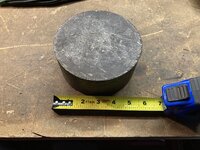
So anyways… I do not usually use the anvil on my vises. I use a “bench anvil”. Mine is just a cast off piece of 5 9/16” round stock that is about 2 1/2” tall. It works great for punching, stamping… everything that you would use a vise’s anvil for.

I was taught, as a kid, to not use a real anvil for this type of work. I was taught that a real anvil was for hot metal and a cast off chunk of metal was for cold metal.
 

Attachments

  • 0ACCA55E-D2AB-457B-AB5C-F9E89D3C09F0.jpeg
    0ACCA55E-D2AB-457B-AB5C-F9E89D3C09F0.jpeg
    1 MB · Views: 15

Southernbuild

Well-known member
Joined
Aug 25, 2012
Messages
408
Location
North MS
I don't care for or use the anvil on a vise.

No need for the pipe jaws, they tend to look like an after thought, and I have dedicated pipe vises.

Don't really need the swivel base, I think all my vices have them, but I don't remember ever using that feature. Feels like extra expense / a failure point.

It's easier for me to justify spending a lot of money, on an heavy duty 6" or so vise, since they're pretty rare / expensive on the used market already. 4" used American made vises are readily available on ebay, from $100-300+ so that size, though very convenient, seems like a tough sell, at the needed price point.

200ish pounds shouldn't be a concern to people with an actual need for a large heavy duty vise.

The $1,400 initial price for the Fireball vise was towards the top end of what I could justify price wise. It's not exactly something I have to use daily... Especially since acquiring a similar sized used, it's going to be tougher to justify a second one, but, I still want a new made in USA large bench vise. After looking forward to it for 13 months, before cancelling my Fireball order, it's an itch that wants to be scratched.

And, I have toyed with the idea of making my own. A journey that would make any vise look cheap no doubt.... But, metal casting is on the 5 year goal list, though a vise is probably pretty far up on the unrealistic beginner project list. ha

As I read though the replies here, it seems like everyone like a vise to be slightly different than anyone else. lol Guess that's why there's so many designs on the market!
 

slowtwitch73

Well-known member
Joined
Apr 18, 2019
Messages
5,876
Location
Hellgate
A well thought out vise/product would be available as a 'base' non swivel vise, with swivel bases available for purchase.. kinda like a Kurt mill vise.

I use my swivels all the time. One of my vises also has elevation adjustment which is also nice. A quick release option like the English vises would also be slick.

Not sure a vise anvil should be hardened anyways. A guy can just swipe a file across it to resurface or plop it on a mill if available.

I think Fireball kinda overshot on the size of their vise from a sales/business perspective. I know he likes huge machinery etc but....

I can only imagine smaller offerings will be coming, if the whole vise thing doesn't implode.
 

jonshonda

Well-known member
Joined
Jul 17, 2017
Messages
4,747
Location
Wisconsin
I would say a vise that is easily operated with one hand would be ideal. Easily actuated swivel mechanism, and not too long of a handle for tightening. A quick adjust similar to what a pipe/bar clamp uses to make major adjustments, so you don't spin and spin and spin for large/small part clamping. It would also be really nice if the static jaw protruded 4-6" out from the work surface for obvious reasons.

I will echo what others have said regarding size and usability. Yeah a 6" vise might make your pants tight in front, but it really isn't convenient to use on a daily basis unless you are dealing with big *** parts. I could see it being practical to have a 2", 4.5", and 6+" vise for different applications. Each with a variety of jaw inserts and what not.
 

slowtwitch73

Well-known member
Joined
Apr 18, 2019
Messages
5,876
Location
Hellgate
Re easy one hand tightening, I always drill and tap the end of the screw at the handle end and put a brass tipped set screw in it so I can lock the handle wherever I like it.. having it 50/50 makes for fast and easy turning.

Thats a feature I would want on the fireball if I was paying that kind of cash.. but can be done diy.
 

bb29510

Well-known member
Joined
Dec 27, 2022
Messages
1,216
i got a yost and its nice but i need to go buy a cheap china vice, something i can beat the chit out of and if it breaks, well $30
 
To avoid these ads, REGISTER NOW!

dutchgray

Well-known member
Joined
Sep 28, 2014
Messages
6,468
Location
Dorset. England.
If you did one of these, but high quality, you would sell the **** out of them.

It's amazing how many guys use these.. they are handy. Only negative is they are all MIC, but they serve.
1674144720417.png
Already exists, Swindens made in the UK and they don't appear to sell that many, but that may be because its hard to find one for sale, hard to find a price for one for sale (and they are expensive) and they basically do no advertising or have any brand awareness.
They do very well second hand on Ebay though.
 

noid

Well-known member
Joined
Jul 15, 2010
Messages
1,341
My only criteria for modern vises is that they be forged. Really no reason to get a cast vises nowadays.
 
OP
D

dr_clyde

Well-known member
Joined
Jan 7, 2009
Messages
6,461
Location
Holland, MI
My only criteria for modern vises is that they be forged. Really no reason to get a cast vises nowadays.
Forging is also not really necessary given the realistic longevity and durability of good ductile iron castings.

Yeah forging is stronger and lighter but it’s also not really required and costs more to make a vise that way.

Cast iron vises have proven to be durable if build correctly and not grossly abused.
 

noid

Well-known member
Joined
Jul 15, 2010
Messages
1,341
Forging is also not really necessary given the realistic longevity and durability of good ductile iron castings.

Yeah forging is stronger and lighter but it’s also not really required and costs more to make a vise that way.

Cast iron vises have proven to be durable if build correctly and not grossly abused.
I guess it depends if you fall into the 'good enough' or 'looking for the best' crowd.

Although its true that most well made cast vises will last, I just can't bring myself to willingly choose something objectively lesser.

Ridgid F60 is ~$600, the 180mm heuer ~$500; both made in Germany. I mean we really aren't talking about huge dollars here.
 

F-22

Well-known member
Joined
Jan 23, 2022
Messages
1,830
I guess it depends if you fall into the 'good enough' or 'looking for the best' crowd.

Although its true that most well made cast vises will last, I just can't bring myself to willingly choose something objectively lesser.

Ridgid F60 is ~$600, the 180mm heuer ~$500; both made in Germany. I mean we really aren't talking about huge dollars here.
The Ridgid design is used by a bunch of brands, I think the ""original" is the Peddinghaus.
 

American Locomotive

Well-known member
Joined
Jan 8, 2017
Messages
10,990
Location
Rhode Island
I guess it depends if you fall into the 'good enough' or 'looking for the best' crowd.

Although its true that most well made cast vises will last, I just can't bring myself to willingly choose something objectively lesser.

Ridgid F60 is ~$600, the 180mm heuer ~$500; both made in Germany. I mean we really aren't talking about huge dollars here.
The problem is a forged vise has a higher development cost. Creating forging dies and developing the process is not easy or cheap. On the other hand, you can get into iron casting in your background if you know how to use a saw and cut wood.

Also, doing things the "best" is a quick way to have costs spiral out of control with a project like this. OP needs to choose a set of specifications for this vise, and select a design, materials and components that can achieve those goals. Starting out with a type of material and components you want to use is a quick way to make something that's extremely expensive, but not tangibly better.
 
OP
D

dr_clyde

Well-known member
Joined
Jan 7, 2009
Messages
6,461
Location
Holland, MI
I guess it depends if you fall into the 'good enough' or 'looking for the best' crowd.

Although its true that most well made cast vises will last, I just can't bring myself to willingly choose something objectively lesser.

Ridgid F60 is ~$600, the 180mm heuer ~$500; both made in Germany. I mean we really aren't talking about huge dollars here.
I don’t know if you can say it’s objectively lesser though.

Cast iron is just different.

Cheap vises fail at a higher rate due to low grade materials and poor workmanship but higher quality vises don’t have the same issues.

Good engineering balances design with materials to achieve an objective. Over-engineering can be as bad as under-engineering.

Grey iron is a poor vise material. It’s brittle, low strength and cheap. Ductile iron is much much better and is more than suitable for 95% of vise work. If it is cheaper to manufacture and you get your engineered strength and design out of a casting, why would you invest extra cost and hassle with a forging?

Yeah the forged vises are strong and well made. No doubt about it. But it’s simply not practical to make the shapes and sizes a lot of vises are made from out of forgings when castings are cheaper, easier to make and work with and are sufficient in material.

We could machine vises from solid titanium or inconel and it objectively would be better than a cast vise too, but why would we? The cast vises work fine.
 
OP
D

dr_clyde

Well-known member
Joined
Jan 7, 2009
Messages
6,461
Location
Holland, MI
Fwiw, cast steel gives you most of the benefits of both and is only slightly more expensive than iron but is still way cheaper to engineer and manufacture than forgings, which is why I’m looking at casting out of steel vs iron.
 

noid

Well-known member
Joined
Jul 15, 2010
Messages
1,341
Fwiw, cast steel gives you most of the benefits of both and is only slightly more expensive than iron but is still way cheaper to engineer and manufacture than forgings, which is why I’m looking at casting out of steel vs iron.
With sufficent engineering up front, you could laser cut most of a vise and weld it together. All sorts of crazy strong steel becomes available using this method and is cost friendly for low production.
 
OP
D

dr_clyde

Well-known member
Joined
Jan 7, 2009
Messages
6,461
Location
Holland, MI
With sufficent engineering up front, you could laser cut most of a vise and weld it together. All sorts of crazy strong steel becomes available using this method and is cost friendly for low production.
Yeah, but that has a very low class aspect to it. DIY almost.

There is value in having a forging or casting, even if it’s just perceived value.
 

General Geoff

Well-known member
Joined
Jan 12, 2013
Messages
3,878
Location
Allentown, Pennsylvania
Ridgid F60 is ~$600, the 180mm heuer ~$500; both made in Germany. I mean we really aren't talking about huge dollars here.

These forged steel vises are not really in the same ballpark as large cast iron machinist vises. They are much smaller and lighter for a given jaw width than a cast iron machinist bench vise.

Forged steel Yost FSV-5 (5" jaws) vs a Starrett 324-1/2 (4.5" jaws):

20161129132703-f42c4916-xl.jpg


The little Yost is very strong and durable for its size, but it's still not nearly as robust as the Starrett and would bend if I did the same things with it that I do with the Starrett.

Yes, forged steel vises tend to bend and go out of true before they break. Cast or ductile iron vises will crack instead of deforming.
 

General Geoff

Well-known member
Joined
Jan 12, 2013
Messages
3,878
Location
Allentown, Pennsylvania
That’s a beautiful starrett I’ve had my eye out for one of those for years
It was a score of a lifetime. Got it and a 6" solid mount Columbian for $150 on Craigslist, back in 2013. With about $40 worth of abrasives, solvents, and rattle cans, now my dad has the big Columbian and I have the Starrett, both used nearly every day. Both will likely outlast me.

Pic from before restoration:

v3.jpg


I will say these old school iron vises are MASSIVE, and are not the best tool for someone with limited space. A compact forged steel vise is better if you have limited space on and around the bench that you're mounting to.
 

noid

Well-known member
Joined
Jul 15, 2010
Messages
1,341
Yeah, but that has a very low class aspect to it. DIY almost.

There is value in having a forging or casting, even if it’s just perceived value.

Do you perceive this as low class?
 

noid

Well-known member
Joined
Jul 15, 2010
Messages
1,341
These forged steel vises are not really in the same ballpark as large cast iron machinist vises. They are much smaller and lighter for a given jaw width than a cast iron machinist bench vise.

Forged steel Yost FSV-5 (5" jaws) vs a Starrett 324-1/2 (4.5" jaws):

20161129132703-f42c4916-xl.jpg


The little Yost is very strong and durable for its size, but it's still not nearly as robust as the Starrett and would bend if I did the same things with it that I do with the Starrett.

Yes, forged steel vises tend to bend and go out of true before they break. Cast or ductile iron vises will crack instead of deforming.
Not sure that's a feature or a bug that the vise has to be that big for the same jaw size and depth.

Can I ask what you do with the starrett? Setting aside that the Yost of Chinese origin and comparing to a German made 180mm Heuer or a F60, what do you feel that starrett will outperform at?

I would venture to say that starrett would be blown into a million pieces before you get a bend in an F60. Since size to size is your concern, the F60 will be closer versus the F-45 or F-50; your Yost is 27lb, an F60 is 63lb.

To me this is simple material science. Seems like cast vs forged would be non-debatable.
 
Last edited:

Aaron_W

Well-known member
Joined
Feb 6, 2018
Messages
2,929
Location
Northern California
If you did one of these, but high quality, you would sell the **** out of them.

It's amazing how many guys use these.. they are handy. Only negative is they are all MIC, but they serve.
1674144720417.png

That is what I have, and hard to beat the cost of free.


I think that is probably the hardest part of this project. Pricing has to consider the used market to some extent. Really small or larger than average is probably the most desirable for a new vise. Good used 4-5" vises are just so common, but new smallish 2-3" vises are often cheap ****, large vises very expensive and finding decent versions of either on the used market can be difficult.

Then again there is a reason 4-5" vises are so easy to find used, that is the largest market.
 

noid

Well-known member
Joined
Jul 15, 2010
Messages
1,341
The maker of it sure does.

He knows his margin is astronomically higher running cast; lets not confuse the intent.

Four questions:

1. Do you think he can enhance his initial design to get rid of the slop? Meaning is there an engineered solution for the slop?

2. Why is he okay with machining cast but not stock?

3. Do you think he would ever do a torture test between the two?
 

General Geoff

Well-known member
Joined
Jan 12, 2013
Messages
3,878
Location
Allentown, Pennsylvania
Not sure that's a feature or a bug that the vise has to be that big for the same jaw size and depth.
Both. Where space is at a premium, the smaller forged vise is better. If space and bench height allows, the larger/more massive vise is better.
Can I ask what you do with the starrett? Setting aside that the Yost of Chinese origin and comparing to a German made 180mm Heuer or a F60, what do you feel that starrett will outperform at?
1. The Yost is from Taiwan, not mainland China.

2. The Starrett is far superior for fine percussive work where mass is an asset. When drifting the sights off an older Kimber 1911 pistol to replace with fresh tritium night sights, the owner of the pistol could not get the damn things to budge on his small Home Depot sourced vise, as the entire fixture along with his bench kept rattling around and shifting with each hammer blow against the pin, resulting in the sight block not moving. He even tried a purpose-built sight drifting tool which broke during the attempt to move these particularly stubborn sights.

Clamping it up into my Starrett, which is bolted to a ~400lb bench which itself is bolted to a load bearing wall behind it, I was able to easily drift the sights out with just a few light taps of an 8oz ball peen hammer and brass punch. The sheer mass and rigidity of the entire fixture, particularly the inertia of the vise, turned what was an impossible task into an easy 5 minute job.

20161011223436-ff2af538-xl.jpg

3. Sheer clamping force and grip. Particularly stubborn pieces that I'm trying to remove stripped/corroded fasteners from, I have found can slip in the jaws of the Yost while the Starrett bites down harder and holds them fast. This is due to a confluence of factors including the better grip of the custom jaws that @KMScott made for the Starrett, along with the longer handle and thicker/beefier mainscrew of the Starrett compared to the Yost. As I try not to abuse my vises, I don't use cheater bars on the handles to tighten them further than I can get em just from putting my body weight on the handle itself.

If I had an ~80 lb forged steel vise, it would likely accomplish those same tasks just fine. Not saying it's impossible to do with forged steel, just that existing mass-produced forged steel vises tend not to be available in such size and mass.

I would venture to say that starrett would be blown into a million pieces before you get a bend in an F60. Since size to size is your concern, the F60 will be closer versus the F-45 or F-50.

To me this is simple material science. Seems like cast vs forged would be non-debatable.

You're right, the F60 at ~56 lbs is much closer in size and weight to my Starrett (which weighs about 79 lbs). If I didn't have the Starrett, it would probably be a suitable equivalent for most purposes, with the exception of non-replaceable jaw faces.
 
To avoid these ads, REGISTER NOW!
Top Bottom