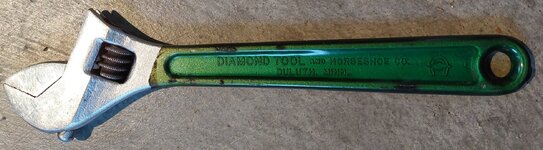
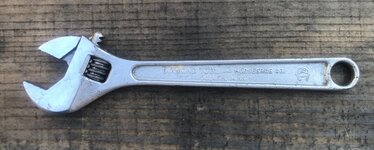
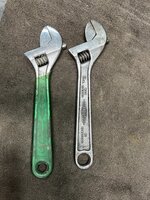
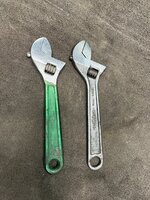
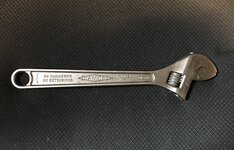
are you saying the screw is staked in place? Hard to tell from here what's in there.I got this 10" adjustable a while back, and I'm wondering if there is a way to take it apart. It's like the hole for the pin/screw is plugged, or the pin is one way.
Oh yeah, if bit is staked, small dremel bit to grind the ears back a bit, then whack it with a cold chisel when complete nd reassembled.are you saying the screw is staked in place? Hard to tell from here what's in there.


yeah... intended for working on your locomotive.ungodly thick
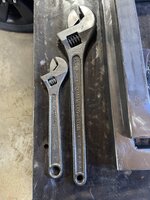
Those early heavy models don't bring a lot of money. I'd just buy a better one rather than spending time and money fixing a broken one.Dang, this thread has gone quiet, but my Diamond life suddenly got really busy, so a real reason for a bump. Over the past two Sundays, I have acquired three different sized Diamalloy adjustable wrenches from two sources. Since my first post was showing my five, this seems like a good way to go again.
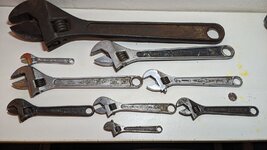
The top 18” is new, as is the rightmost 6”, both from last Sunday’s shop clear out. The bottom 4” is from today.
The 18” is kinda interesting, as it’s about 5-3/4 #, and the dynamic jaw is 1-1/4 # of that, marked Tool Steel. And ungodly thick, the catalogs say 1-3/16” at the thickest points. It appears all the Diamalloy wrenches I can see in catalogs are “lightweight” wrenches. I think it is substantially thicker and heavier than my other 18” wrench, a newer metric Crescent at 4.5+” and 1-1/16“ thick.
But the real heartbreak is that the dynamic jaw is broken. Didn’t notice it when I grabbed it, as the movements were all stuck. Turns out something with the consistency of dried mud was in the fixed jaw part of the body, the teeth of dynamic jaw, and a bit in the knurl. A little work at home quickly made the broken jaw obvious.
Spent part of the weekend driving the broken part out, softening the crud in Simple Green, which looked like dried grease at first, cleaning the mud out of the teeth, removing the peening and rust which resulted from someone using it as a BFH. Little work with ignition and 6” ******* files, the Dremel, and a Sharpie, got it to where the broken bit would slide all the way in. There was dried mud, and bent metal keeping things tighter than it should be, had to tap it in, then hammer it out with a punch. Now it slides in and out with just finger pressure.
So, the real question, does someone have an interest, or know someone who has the interest, and the skill, to weld this back together? Maybe in exchange for green pieces of paper, or maybe some fun tool I may currently own?
Or, even better, Diamond used to sell replacement parts, does someone have an 18” jaw laying around they want to sell or trade? None currently on eBay.
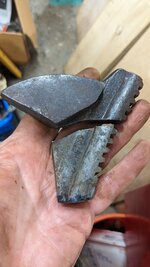
The rusty 4” hit the Evaporust before dinner, will grab it tomorrow, degunk, and reassemble.
Edit: and only the left 4" and 10" are Diamond Tool. The rest are Diamond Calk. And none of them have an unknown 68 mark down near the end of the handle. Bottom center 6" had the 1/2" hole broach.
Wording on the 18"
18" Diamond Tool Steel / Drop Forged Logo
Flip side
18" Made By Diamond Calk Horse Shoe Co. / Duluth, Minn USA Logo
And a question for those that own a 15 or 18”, how long is the spring in the knurl? Mine is ~1” long, compared to < two coils on the 4”, a huge % change.
Thanks.
Saw couple on ebay, $50- 75 plus $25 shipping, another at Around 90 plus 10 shipping (sold and still active). Waiting to see if someone "offers" me a cheap one.Those early heavy models don't bring a lot of money. I'd just buy a better one rather than spending time and money fixing a broken one.


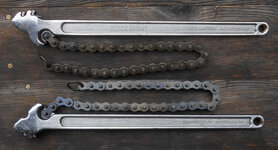
Diamond, like other major horseshoe makers, made and provided a special tool for extracting calks. One is shown at the top of the page you posted. They also made a double-ender. (see below) They do resemble wrenches in the sense of having a shank and an opening to fit around the calk, but they wouldn't fit standard boltage and they weren't adjustable. One of my favorite 1920's vintage lineman's pliers were made by a company here in NJ called Neverslip, and they, too, made horseshoes with calks for wintry weather and a special wrench to extract them, giving them their name.I guess the adjustable wrench was to turn the calk into the shoe
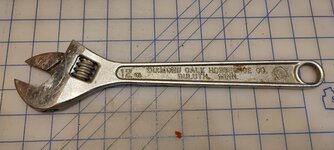
Here is one of mine.-Don
Thanks! That makes perfect sense for a guy who would have been building his tool collection after service in WW2 and then college .They are hard to date but according to AA the Calk was eliminated from their name in 1958 so yours must be older than that. They switched to the reinforced hanging hole after the WW2 period when many of the hanging holes were broached so your wrench is newer than 1945. So sometime between ‘45 and ‘58.
-Don


That's interesting, as well as amusing! I see that both of them have a right hand thread adjusting screw, so the makers didn't go to the trouble of reversing that for left hand users.. As you say, the choice is either 'Right Handed' or 'Ambidextrous' !I just noticed between the two later model 6” wrenches I have. The One with the grip has the thumb recess that the 1983 catalog shows for “right handed users”.
The other has the thumb recess on both sides of the wrench. This one also has a “44” in the casting in the corner of the inset on the “no extensions” side.
Perhaps an ambidextrous model that never made a catalog?
![]()
I found this 12” Diamond adjustable wrench at an estate sale yesterday. It is newer than Diamond Calk and Duluth isn’t mentioned, just USA. What is odd to me is that the depressed panel runs clear up to the adjuster on one side but not the other.
A little cleaner.
No hammering and no extensions kind of takes the fun out of it!
-Don
I posted one for a right hander in Feb of last year.
I try to find Minnesota marked tools, but for the right price won’t pass up others. That’s how I ended up with these two later versions several months a part. Couldn’t say no for a buck or two each.I posted one for a right hander in Feb of last year.
-Don
I don't think soso.... .did they do one for the lefties?
.... askin' for a friend....