FullRaceMerc
Well-known member
My first thought was "Don't show that to my wife"...
...(Who has an extra treadle that she doesn't want, & for the first time in 40 years just asked to borrow my workmate).
My first thought was "Don't show that to my wife"...
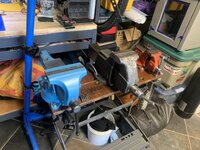
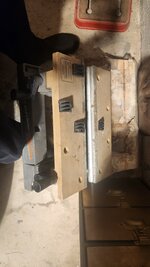
The one nice thing, you might be able to sit at it to work. With the low crossbar, you can’t do that with a WM. Not sure if the top cross piece they added is too low to interfere.Here's an...unusual...Workmate on craigslist. It's either really cool or an abomination. I haven't decided yet which way I lean.
I don't think it is but if it is, it's an easy fix. the cabinets usually had a front trim piece or tray about there.The one nice thing, you might be able to sit at it to work. With the low crossbar, you can’t do that with a WM. Not sure if the top cross piece they added is too low to interfere.
One doesn't sit at a Workmate; one sits on it. At least that was the original plan, as illustrated by this drawing from Hickman's own manual for his original single-height Workmate and this photo from Black & Decker's manual for their original UK model WM325 (North American 79-001 Type E). Needless to say, Black & Decker North America never depicted or endorsed this technique!The one nice thing, you might be able to sit at it to work.


Had not thought of that option. Good point.Ad actually let's think this through a bit. What if to had more than one tool you wanted to drive with the treadle? I can think of several that were adapted to a treadle:
jigsaw/scroll saw
small lathe - wood or metal
table saw
wet grinder
And, of course, sewing machines.
Maybe we are not seeing the whole picture?


Agreed - but that's a waste of a Workmate. By the way, how does that Capri stack up?I'd think it would be fine; I had my full-size benchtop DP on a 400 for at least 5-6 years no issues.
It is.. but I don’t often need that space to work on.. and it’s easy for me to move the vises off of it when needed.Agreed - but that's a waste of a Workmate. By the way, how does that Capri stack up?


I would worry about the top, depending on its material. If it’s a plywood top, much less worry. If it’s the composite particle board stuff, I’d worry more. The frame itself, I’d only worry if you drag the vises on and off, vs lifting them on, putting the frame into an attempted rhomboid shape.How sturdy is a Workmate 300 series? I believe the spec says it has a 300 lbs capacity.
This is an old picture, but if I were to keep around 100 lbs on it regularly, do you see that weakening the Workmate, destined for failure?
I assume you will post this to the OldTools list too, as we have a few inverted Galoots. Don't see it yet.Do we have any Australians following this thread?
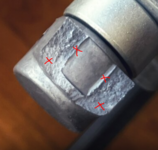
In the mean time, I would try JB Weld on that.Hi everyone, I recently purchased a Type-2 Workmate. Unfortunately, one of the alloy crank arms broke during shipping. I was wondering if anyone might have a spare they would be interesting in selling? This Workmate is in mint condition and I would really like to repair it with an original part. Many thanks!
I didn't think about reattaching the broken part when you asked me about this in your email, but I think that suggestion might work. How well do the parts fit together?Hi everyone, I recently purchased a Type-2 Workmate. Unfortunately, one of the alloy crank arms broke during shipping. I was wondering if anyone might have a spare they would be interesting in selling? This Workmate is in mint condition and I would really like to repair it with an original part. Many thanks!
If you try this, don't clamp it down to zero, that will squeeze out all the epoxy, and give you a weak joint. Had a failure on a similar effort. Hope an expert will weigh in on best methods for gluing this.In the mean time, I would try JB Weld on that.
I'd try to drill holes and JB Weld steel pins into the crank body.If you try this, don't clamp it down to zero, that will squeeze out all the epoxy, and give you a weak joint. Had a failure on a similar effort. Hope an expert will weigh in on best methods for gluing this.
I was going to suggest something similar to support and encircle the broken piece.If you epoxy it together at the break, wait for that to set, then rough up the outside surface of the arm and hub. Then take a strip (I would use 1/16" aluminum) of sheet metal, rough up one side, and with the rough size next to the arm, epoxy it in place.
This transfers most of the stress into pulling on the strip instead of bending the arm and trying to break it off the hub.


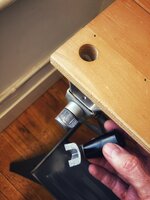
It looks as though replacement pivot nuts are available for the WM125 Type 1, and it's possible that they stayed the same for all Types in the 20+-year run. Are yours marked with a Type number anywhere?I have a couple of 125's and I broke a handle and stripped one of the pivot nuts. Not a great day. The handle I can fix but the pivot nut is the problem. Is there are mod or upgrade to get around the plastic nut? I pulled parts from one to so I have at least one that is functional. Thank you for your help in advance.
I've never owned a WM125, so I can't help with details. It's probably a double-start screw, like the earlier Workmates. How would you secure an added nut—glue it to the end of the pivot nut?Just the wm125. Is the thread pitch 1/2-10? Could you get away with adding a nut behind the pivot nut since the the pivot nut is stripped anyway?
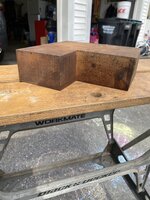
I think I saw a used pair on eBay once; that's probably the only hope. Note that the clamps for the Type 1 and Type 3 are different and aren't interchangeable. I'm pretty sure you could find some standard woodworking clamps that would have the right dimensions to do the job.
Think ping pong table net clamps. They would need to be reversed from what was shown above.I'm pretty sure you could find some standard woodworking clamps that would have the right dimensions to do the job.