RTM
Well-known member
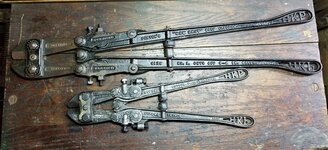
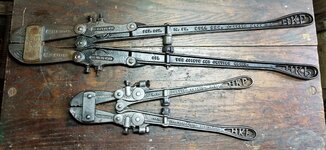
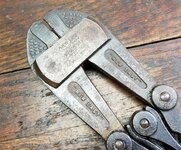
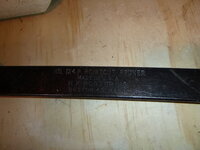
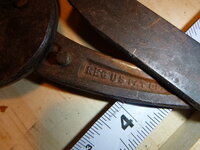
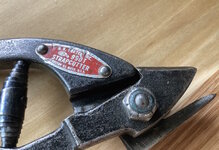
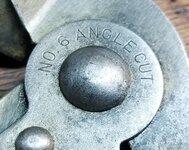
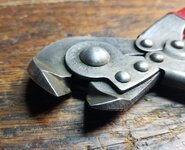
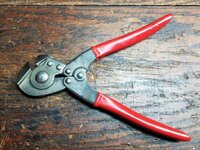
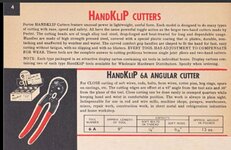
Just a note, this patent is not in DATAMPThe US Patent number may revel more useful information. The anvil is 1/4".
us pat 2.559.558

Just a note, this patent is not in DATAMPThe US Patent number may revel more useful information. The anvil is 1/4".
us pat 2.559.558

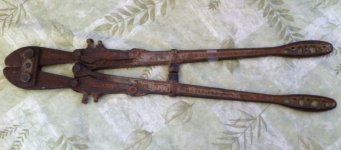
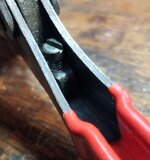
 ) I won't be doing much bolt or rivet clipping with either one given the condition of the jaws, but they're cool to have, and I do have some modern cutters.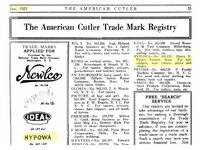


Yup, unfortunately, the beginning of the end of Disston as a quality saw.With my interest in vintage tools not extending much later than WWII, and only occasionally, usually for special reasons, into the 50's, I had no idea until I found this NOS envelope of spare coping saw blades at the flea market yesterday that H.K Porter had acquired Henry Disston & Sons. These were produced after that (1955) and before the Zip Code (1963).
Mine's bigger:Maybe like this?
-Don


Wonder why he picked Danville, Virginia, of all places. Danville is noted for tobacco, textiles, and being the last capital of the Confederacy. Seems an odd choice, to me.Yup, unfortunately, the beginning of the end of Disston as a quality saw.
From the Disstonian Institute webpage:
, the family decided to sell the company to H.K. Porter, a holding company owned by Thomas Mellon Evans. The company had been running on borrowed time, but Evans wasted none when it came to liquidating every asset at Disston. Any machines that could be sold for a quick profit were gone. Most members of the Disston family at that time had no interest in saw making, but they didn't want to close down the place, either. H.K. Porter moved the Disston factory to Danville, Virginia, starting in 1956. After Disston left Philadelphia, that was the end of an era.
1955-1990 Medallions
HK Porter-era Medallion
Disston continued to manufacture saws after the family sold their company to HK Porter, Inc. The variety and quality of saws decreased immediately, as did the number of employees in the factory. By the late '50's the factory had been moved to Danville, Virginia. Disston produced a line of electric saws, but they were not as popular as Black and Decker or Rockwell. In the 1970's Porter sold the company to Sandvick. In the 1990's the company stopped production
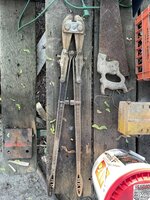
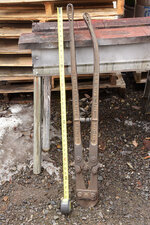
#5 rebar, actually.That's a beast. But it looks like the bolt won, at least once!
"That'll do it!", says the former member of the International Association of Bridge, Structural, Ornamental and Reinforcing Iron Workers.#5 rebar, actually.
Thanks Tym. Much appreciated.Given the 2-digit postal zone and no ZIP, I'd estimate 1943-1963.


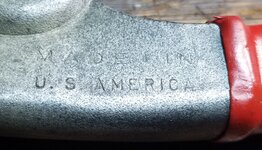
 ). Love the 'MADE IN U.S. AMERICA' COO marking.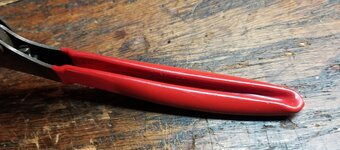





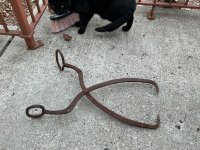
There are still several ponds hereabouts that were for harvesting ice. Recognizable due to (usually roughly) rectangular shape and shallow--around 3'--depth. There used to be several ice houses, too, but they've gone the way of all things in the last few decades.^ Those are "Ice Tongs". (see catalog illustrations below)
Ice Tool Collector website
Ice tools are a different world - we very seldom see them here, believe it or not.
Prior to the advent of modern refrigeration, the "Ice Tool" industry was huge - not just tool makers, but all manner of equipment was necessary to transport ice from lakes to the "iceboxes" in kitchens all over America.
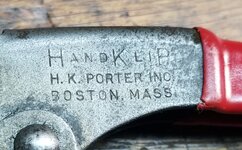
There were a LOT of players in the ice game, but the only devices I have seen in catalog pages named "H.K. Porter" were bolt cutters.
The manner in which those initials are stamped on that device leads me to think that's an owner's mark, not a manufacturer's mark.

 . Not sure how it made it all the way up here?