Wrench97
Well-known member
5/50 here, 5 minutes or 50 feet whichever occurs firstWe used to call it a "taillight warranty". Once we can't see your taillight, warranty is over.


5/50 here, 5 minutes or 50 feet whichever occurs firstWe used to call it a "taillight warranty". Once we can't see your taillight, warranty is over.


a pleasure box?Opened a Bezos Box of electronic joy.

Nice can you hop over and show me how you did it?Well, extraordinary claims require some kind of proof:
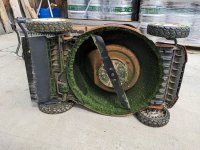
I mowed the foreground area with the tables and pads--fun layout--and the area the other side of the driveway. Nice, uniform cut, no clumps of wet grass dropped.
Absolutely. Two rolls of programmable LEDs. A box of double port USB power supplies. A roll of clear PETG. A couple packs of Blu-Tack. I'm gonna have so much fun!a pleasure box?


No air bag, thankfully.Looks like they used double wire of a smaller gauge.
Does it have a air bag in the steering wheel or just a contact ring?
Be careful washing it. Solvent and digestive cleaners can cook the varnish off the windings. I use Dawn and hot water. And lots of air to dry things off.Back to alternators (Subaru call it a generator).
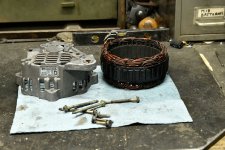
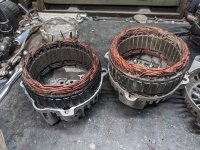
Comparing the stators of the two alternators:
Left is the genuine Mitsubishi. Right is the no-name that died in the rig while driving home at night.
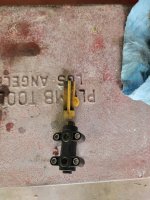
What puzzles me is this:
Only three connections to the electronics? All three are double-wires, where the stock one has three single wires and one double-wire--right where this one has none.
The no-name just feels like junk. Everything feels lighter than the Mitsubishi, and the windings sure look to be a smaller gauge wire. It also came apart much easier than the Mitsubishi, which makes me feel like the castings might not quite be to tolerance.
Outlaw suggested saving the electronics pack from the non-name, but it seems to be what died. While the brushes look fine--and lots left--thecommutatorsslip rings looked like someone took a black crayon to them, which might be what the failure was. I think this alternator goes in the scrap bin.
Waiting for the brewers to get done with the US cleaner so I can use it. Might not be tonight.
Meanwhile, I can pull the steering wheel center cover off of the Brick to see if I can find and fix whatever's causing the horn to honk randomly when driving.
But now, beer. A mile or so of following a mower around the front yard in an intermittent snow storm left me a mite bit thirsty.
Haven't take it apart yet. It's still beer break.A lot of times the beeping when turning is from under the steering wheel where the contact is, does it still beep with the horn button(center piece) removed?
That's what I recall, and what this appears to be. Older VWs had a single wire to the horn button that connected to ground when pressed. The wire came up through the center of the column and tended to get the insulation worn off near the bottom of the column, causing the honking issue. This has two wires, which still seem to be grounds, going to a slip-ring and brushed under the wheel--according to the manual.Back in the day, horns were two wire, one hot from the battery and the other to the horn button and then on to ground when the horn button was pressed.
Later a Horn relay was added to reduce the current through the horn button.
Any break down in the insulation of the wire Grounding the horn would cause it to blow. Intermittent contact of the wire going from the horn to ground, usually through the wire passing through the steering column would cause intermittent horn sounding.
Exactly what I used, right down to blowing the hell out of it.Be careful washing it. Solvent and digestive cleaners can cook the varnish off the windings. I use Dawn and hot water. And lots of air to dry things off.
Got a start on rebuilding an alternator--a first for me.
A little soap and a buzz in the ultrasonic, a little paint and
I removed the label and glued it back on after the cleaning. It's handy to have.
The other half is at the shop waiting its turn to get the bearings pressed off (too big for any of my vises).
Parts should be here early next week, so no hurry. This will be a spare to carry in my spares road box.
Um, uh, spotter?I am adding some gussets to a weight bench. It was designed to incline and unfortunately the lowest (flat) setting is the weakest. That's the position where you can lift the most. I broke it. Could have killed me, I guess, but anyway it didn't. I am also going to add some legs that primarily work in the flat position.
Back to alternators (Subaru call it a generator).
Comparing the stators of the two alternators:
Left is the genuine Mitsubishi. Right is the no-name that died in the rig while driving home at night.
What puzzles me is this:
Only three connections to the electronics? All three are double-wires, where the stock one has three single wires and one double-wire--right where this one has none.
The no-name just feels like junk. Everything feels lighter than the Mitsubishi, and the windings sure look to be a smaller gauge wire. It also came apart much easier than the Mitsubishi, which makes me feel like the castings might not quite be to tolerance.
Outlaw suggested saving the electronics pack from the non-name, but it seems to be what died. While the brushes look fine--and lots left--thecommutatorsslip rings looked like someone took a black crayon to them, which might be what the failure was. I think this alternator goes in the scrap bin.
Waiting for the brewers to get done with the US cleaner so I can use it. Might not be tonight.
Meanwhile, I can pull the steering wheel center cover off of the Brick to see if I can find and fix whatever's causing the horn to honk randomly when driving.
But now, beer. A mile or so of following a mower around the front yard in an intermittent snow storm left me a mite bit thirsty.
I wasn't aware that alternators are 3 phase. Delta and Wye I'm familiar with, but on the draw side. Thanks!Automotive alternators are 3Ø units. 3Ø stators have 6 wires, they can be connected either ∆ or Y. If there are 3 sets of 2, it's a ∆ connection. If 3 single wires plus one set of 3, it's a Y. Usually the center of the Y (3 wires) is spliced in the stator and is not brought out.
The advantage of a ∆ connection is higher output current for the same size of winding wire. The disadvantage is much lower current at slower speeds. Sometimes zero at idle.
The advantage to the Y connection is more current at slower speeds, the disadvantage is lower current for the same size wire as the ∆.
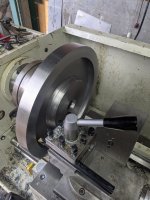
If you go to tear it off, it'll probably ruin the paint. You could glue the carpet to a piece of Masonite or thin plywood and just drop it in there.Question for the team, will double stick tape on the carpet like fabric ruin the shiny red paint, I'd like to adhere the mat to the tool cart, thoughts?
Question for the team, will double stick tape on the carpet like fabric ruin the shiny red paint, I'd like to adhere the mat to the tool cart, thoughts?
Excellent tutorial!Automotive alternators are 3Ø units. 3Ø stators have 6 wires, they can be connected either ∆ or Y. If there are 3 sets of 2, it's a ∆ connection. If 3 single wires plus one set of 3, it's a Y. Usually the center of the Y (3 wires) is spliced in the stator and is not brought out.
The advantage of a ∆ connection is higher output current for the same size of winding wire. The disadvantage is much lower current at slower speeds. Sometimes zero at idle.
The advantage to the Y connection is more current at slower speeds, the disadvantage is lower current for the same size wire as the ∆.
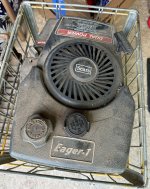

Took an old Teumsah (Craftsman) and a Briggs & Stratton lawn mower engine out of moth balls (after 30 years). Plan to sell once I identify them.....
@madison069 need any spare engines?
It appears to be an '85 or '86 GT.I have been helping a young man with his car. Has been fun, not my money. Motor is a 351w with a manual five speed.