To avoid these ads, REGISTER NOW!

Ground Stakes Getting Pulled Out of Ground by Ratchet Strap?

YoshiMoshi3

Well-known member
Joined
Nov 2, 2022
Messages
501
Trying to use a ratchet ******** a ground stake in dirt. I'm using a cheap ground stake from home Depot and trying to pair it with a ratchet strap, with a metal pole on the other side for a portable garage. Whenever a bit of tension is put on the ratchet strap, the spike slowly pulls out of the ground. Will this be the case we've with some higher quality ground stakes? A ground stake can't resist the force or tension pulling it up from a ratchet strap? Can someone recommend some ones that can if its possible?
 
To avoid these ads, REGISTER NOW!

UserNameAttempt3

Well-known member
Joined
Jun 27, 2014
Messages
412
Location
Hardin County, KY
Absolutely these. Used a few of these to set up a canvas tent for long use (3 months) and ratch strapped the front overhead covering down. Didn't budge. I had not those ones from Depot but some other from Amazon that came with a T handle to help drive them.
 

Firebrick43

Well-known member
Joined
May 12, 2015
Messages
14,096
Location
West central Indiana
Trying to use a ratchet ******** a ground stake in dirt. I'm using a cheap ground stake from home Depot and trying to pair it with a ratchet strap, with a metal pole on the other side for a portable garage. Whenever a bit of tension is put on the ratchet strap, the spike slowly pulls out of the ground. Will this be the case we've with some higher quality ground stakes? A ground stake can't resist the force or tension pulling it up from a ratchet strap? Can someone recommend some ones that can if its possible?
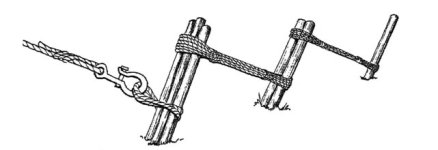
:needpics:


There are ratchet straps that put out a few hundred pounds of force and there are ones that that put out 16,000 lbs of force.

I assume you don't actually mean a ground stake which isn't structural, a rod, made typically of copper and used to ground electrical boxes.
But just like the ratchet straps, there a little one used to tie down a small tent and there are ones to that are huge ones that hold down massive circus tents?

And then there is the question of what kind of soil you have. Even the large screw in anchors used for utility poles are useless in sand or muck.
 

seber

Well-known member
Joined
May 31, 2016
Messages
4,199
Location
Deep East Tx.
I've never used the auger style stake but it seems like it would disturb the soil all the way down as it augers in, giving a less than ideal bite. I have used spiral anchors and I know they will hold almost anything.
 

larry4406

Well-known member
Joined
Jan 27, 2006
Messages
19,342
Location
Northern Virginia
I've never used the auger style stake but it seems like it would disturb the soil all the way down as it augers in, giving a less than ideal bite. I have used spiral anchors and I know they will hold almost anything.
For a tangent, google helical piers. Same concept except they are used for foundations, etc.
 
OP
Y

YoshiMoshi3

Well-known member
Joined
Nov 2, 2022
Messages
501
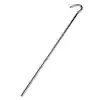
I was trying to use a ground stake similar to this one. But I guess my dirty is too rocky. I tried in multiple spots and kept hitting rocks.
1776780848232.png
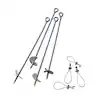
So I got ones like these from HD:
1776780907766.png
And tried paring it with Husky ratchet straps:
1776780971970.png
I guess I need ground stakes that are similar to the first one but shorter in overall length, or those orange spiral ones with a screw like design running the length of the stake, in order to resist the forces of a ratchet strap it seems?
 

cannuck

Well-known member
Joined
Nov 30, 2021
Messages
4,643
Location
Rural SK
We have a 10 x 20 tensioned fabric garden shed at our farm, and it sits fully exposed to prairie wind. Has 4 auger style anchors and stays put in any wind. This is in very rock infested soil, so when running them in you might have to try a few different locations.
 
To avoid these ads, REGISTER NOW!
OP
Y

YoshiMoshi3

Well-known member
Joined
Nov 2, 2022
Messages
501
Are the "auger" type or the "fully threaded screw" type better. And with these type of ground stakes, do you still need to put them at an angle when using these types, as opposed to the straight no threads or auger type? What is the optimum angle?

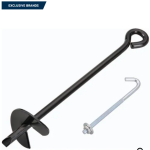
Auger Type
1776860388439.png
Fully Threaded Screw Type
1776860462505.png

Or does the difference really not matter much?
 
Last edited:

GeoBruin

Well-known member
Joined
May 5, 2018
Messages
3,742
For a tangent, google helical piers. Same concept except they are used for foundations, etc.

The difference is that helical piles are meant to support weight from above. When the load is pushing down, they are pushing against undisturbed soil. To Seber's point, when they are being pulled up, they are pulling against a column of previously disturbed soil. The ratings for the pull out capacity are always less than the ratings for compression capacity (typically between 16 and 33%).

These Pilex models are widely available and used. Here's a link to the overview on their site which denotes both the load bering capacity and the pull out capacity. (5,000 lb vs 2,000 lb). As always, these numbers are very dependant on soil conditions.

Pylex Regular 50'' - Pylex https://share.google/jqhEfagTYT5ohR4lP

The one thing I will say is that the screwing action of the helical "fins" on these piles do function to recompress the soil above the helix when they are being screwed. So while the soil has been disturbed, it's not like it's just loose soil above the helix. Also, a helical pile will still have much greater uplift resistance compared to a driven pile of similar shaft diameter.
 
Last edited:

cannuck

Well-known member
Joined
Nov 30, 2021
Messages
4,643
Location
Rural SK
The one thing I will say is that the screwing action of the helical "fins" on these piles do function to recompress the soil above the helix when they are being screwed. So while the soil has been disturbed, it's not like it's just loose soil above the helix. Also, a helical pile will still have much greater uplift resistance compared to a driven pile of similar shart diameter.
Helical ("screw") piles have become the norm for a great deal of construction in the Canadian oil patch - and they can get to be extremely large in diameter. Typical to see a sea of them bristling out of the ground, followed by an army of welders cutting them to length and welding on pads followed by burying conduit in ground then dropping a completely finished modular steel building onto the pads with extremely large cranes then connecting up the utilities. Happens very quickly compared with now obsolete scratch build-on-site.
 

GeoBruin

Well-known member
Joined
May 5, 2018
Messages
3,742
Helical ("screw") piles have become the norm for a great deal of construction in the Canadian oil patch - and they can get to be extremely large in diameter. Typical to see a sea of them bristling out of the ground, followed by an army of welders cutting them to length and welding on pads followed by burying conduit in ground then dropping a completely finished modular steel building onto the pads with extremely large cranes then connecting up the utilities. Happens very quickly compared with now obsolete scratch build-on-site.

I think they're awesome, and some of the R&D on the commercial applications has stated to trickle down to consumer grade products so you can now get them at Home Depot. The coolest part is that a guy can screw in a helical pile with a long enough 2x4 as a lever, rather than needing a gigantic pile driver or auger for driven or cidh piles.

I think the biggest issue is going to be local codes/inspectors catching up since all the previous guidance was developed for cidh type piles/piers.

Was thinking about trying my luck for an upcoming deck project.

Anyway, for the OP, you can hammer a stick of rebar into the ground where you intend to sink your helical anchor to test for rocks. Also, the orange vortex style anchors seem to more easily avoid rocks in my experience than one with helix plates.
 

dcg9381

Well-known member
Joined
Jun 20, 2018
Messages
11,778
Location
Austin, TX
Anyway, for the OP, you can hammer a stick of rebar into the ground where you intend to sink your helical anchor to test for rocks. Also, the orange vortex style anchors seem to more easily avoid rocks in my experience than one with helix plates.
This is the cheapest way I know to do it where the ground has rocks, just use rebar.. Sometimes If I want to go nuts, I'll run a hammer-drill with masonry bit in there initially.

Concrete framing stakes are also pretty good. You can get them in lengths up to 3', but they aren't particularly inexpensive. I can pound these through limestone...

Getting this stuff out is a different discussion.. :)
 

GeoBruin

Well-known member
Joined
May 5, 2018
Messages
3,742
This is the cheapest way I know to do it where the ground has rocks, just use rebar.. Sometimes If I want to go nuts, I'll run a hammer-drill with masonry bit in there initially.

Concrete framing stakes are also pretty good. You can get them in lengths up to 3', but they aren't particularly inexpensive. I can pound these through limestone...

Getting this stuff out is a different discussion.. :)
Yeeeeees! I know Bosh makes up to a 39 inch long carbide tipped sds masonry bit. You could drive the rebar in, then when you hit something, run the sds bit down and obliterate whatever's in your way!
 

tarbellb

Well-known member
Joined
Apr 17, 2011
Messages
5,760
Location
Oregon
Are the "auger" type or the "fully threaded screw" type better. And with these type of ground stakes, do you still need to put them at an angle when using these types, as opposed to the straight no threads or auger type? What is the optimum angle?

Auger Type
1776860388439.png
Fully Threaded Screw Type
1776860462505.png

Or does the difference really not matter much?

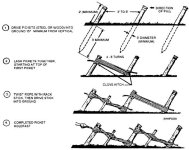
You want the load (ratchet line) to be 90 degrees to the stake or perpendicular. Typically you put the stake in at 45 degrees with the head furthest from the load.
 

larry4406

Well-known member
Joined
Jan 27, 2006
Messages
19,342
Location
Northern Virginia
You want the load (ratchet line) to be 90 degrees to the stake or perpendicular. Typically you put the stake in at 45 degrees with the head furthest from the load.
Learned that long time ago as a boy from setting up camping tents with dad. Thought this was common knowledge but guess not.
 

duneslider

Well-known member
Joined
Jan 20, 2013
Messages
2,262
Location
Riverton, Utah
Some pictures of what you are doing and what you are holding down would be great but I have switched to using 1/2-5/8 rebar cut to the length I want and driving those in. The ridges on the rebar hold onto the ground really well and I can make them as long as I feel is needed depending on what I don't want to blow away. I also have a stack of metal concrete stakes that I use if I want to be able to more easily pull them out. Also, its pretty easy to way over tighten a ratchet strap. You just need to snug it up, no need to crank it tight.
 

BombShelter

Well-known member
Joined
Nov 16, 2015
Messages
544
Location
State of Hockey
I have rocky ground as well, I put very heavy weights on the inside corners instead. An easy idea is concrete or sand in a five gallon bucket, I've also tied off on some of the equipment in it.
 

whateg01

Well-known member
Joined
Mar 13, 2006
Messages
11,370
Location
doo dah, kansas, usa
I have rocky ground as well, I put very heavy weights on the inside corners instead. An easy idea is concrete or sand in a five gallon bucket, I've also tied off on some of the equipment in it.
Depending on what is being held down, the wind may just laugh at your bucket of sand.
 
To avoid these ads, REGISTER NOW!
Top Bottom