To avoid these ads, REGISTER NOW!

Drywall Screws Attracting Metal

cavalry

Well-known member
Joined
Sep 5, 2006
Messages
168
Location
Upstate NY
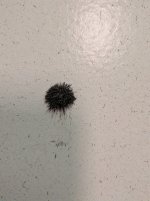
My shop has finished walls, and I do a significant amount of metal work. Apparently my drywall screws have become magnetic and are attracting any airborne metal not captured by filtration. The weird thing is it's not everywhere?
Any inexpensive/portable way to demagnetize the screw heads? I have a demagnetizer but it's not exactly something that you can carry around and hit screw heads.IMG_20260425_080217817.jpg
 
To avoid these ads, REGISTER NOW!

OccupantRJ

Well-known member
Joined
May 15, 2009
Messages
10,944
Location
Eastern North Carolina
Interestingly, I just noticed yesterday that I could see the outline of the screws in my shop restroom. I had not concerned myself enough to figure out why, but I will investigate it a bit today.
 
OP
C

cavalry

Well-known member
Joined
Sep 5, 2006
Messages
168
Location
Upstate NY
Interestingly, I just noticed yesterday that I could see the outline of the screws in my shop restroom. I had not concerned myself enough to figure out why, but I will investigate it a bit today.
I built my shop about 10 years ago, I didn't really notice anything for the first couple years. I made the mistake of trying to wipe the dust off, don't do that.
 

BillK

Well-known member
Joined
Aug 24, 2006
Messages
9,299
Location
Beautiful Southern Maryland
I dont think it is magnetism. I think it is just the slight recess around the screws. Same as in a painted cinderblock wall. The rough surface gets the same way and they are certainly not magnetic.
 

WillyBoy

Well-known member
Joined
Nov 10, 2021
Messages
634
Location
Genesee valley area of New York state
I believe it's a difference in temperature on an outside wall. Any soot or other airborne contaminates will accumulate on a cooler spot. I'm not sure what the actual mechanism is.
Depending on the amount and the type of vapor barrier, soot from candles and other contaminates will accumulate on ceilings under the roof trusses as well as on the walls over the drywall screws.
 

rlitman

Well-known member
Joined
Oct 18, 2010
Messages
24,579
Location
Long Island
I'm going to suggest another theory. Electrostatic attraction. Airborne particles are highly influenced by it, both in how they float, and in what they land on. I suspect the metal in the screws alters the surface voltage enough to cause this weirdness.

Magnetism might be plausible too, IF the screws were regularly showered in grinder spark spray. But if that were the case, the particles you wipe off would get picked up by a magnet, so this theory is easy to test.
 
OP
C

cavalry

Well-known member
Joined
Sep 5, 2006
Messages
168
Location
Upstate NY
Magnetism might be plausible too, IF the screws were regularly showered in grinder spark spray. But if that were the case, the particles you wipe off would get picked up by a magnet, so this theory is easy to test.
I can pull some of the dust off with a strong magnet
 
OP
C

cavalry

Well-known member
Joined
Sep 5, 2006
Messages
168
Location
Upstate NY
I dont think it is magnetism. I think it is just the slight recess around the screws. Same as in a painted cinderblock wall. The rough surface gets the same way and they are certainly not magnetic.
I guess I am not following you. the screws have been compounded over, sanded, primed and painted. There is no visible surface deviation
 
OP
C

cavalry

Well-known member
Joined
Sep 5, 2006
Messages
168
Location
Upstate NY
I think that's due to thermal bridging. I know I've seen pictures of smoke preferring to condense over studs.
Which is interesting in my case. Insulated 2x6 with staggered studs, 1" foil Polyiso on that. Interior on the polyiso. There is very limited bridging.
 

lund

Well-known member
Joined
Nov 2, 2019
Messages
757
Location
Michigan
It is almost for sure magnetized. It does not take a lot of field to attract small steel shavings/dust which will also be magnetized (will rotate for attractive polarity when near and suspended in air). When you made the wall, you may have put a steel bit in an impact driver with a magnetic retainer. The steel funnels the magnetic field to the screw making the screw stick to the bit. Steel has iron in it and is ferromagnetic. When the bit is is removed after driving the screw, the external field is removed, but iron has hysteresis. So the field in the screw will not go to zero when the external field is removed, but rather will remain at a residual value somewhat less than the original drive (depends on many details of material, field strength, path taken, etc).

You cannot generally demagnetize such things with a static field. Do not try. You will likely make it worse or magnetize weaker magnetized ones. You can use a special oscillating drive that will cycle to zero to demagnetize. You would need to special build that or buy something like a watch type demagnetizer (those usually work by putting the watch in bore, but if you rest the end of the bore by the screw head it might work). It is not super easy to fix.

The best fix is prevention. Do not use magnetic bit & screw holders if residual magnetization causes trouble.

You can also magnetize steel if the bit slips since surface shearing can align small dipoles in the material. This can be enough to do it too. So if you were not using a magnetic bit holder when building the wall, it might be this (which would explain why some are magnetized and some not).

I can go into detailed molecular theory if you want and point to ferromagnetic hysteresis curves if you want ;) I am a physicist and did some magnetic optics designs years ago. But I am a theorist (also work on stuff a lot).
 

jayemm

Well-known member
Joined
Dec 18, 2018
Messages
1,509
Location
up high down low
What about a stereo tape head demagnetizer where the field is concentrated at the tip.

 
OP
C

cavalry

Well-known member
Joined
Sep 5, 2006
Messages
168
Location
Upstate NY
It is almost for sure magnetized. It does not take a lot of field to attract small steel shavings/dust which will also be magnetized (will rotate for attractive polarity when near and suspended in air). When you made the wall, you may have put a steel bit in an impact driver with a magnetic retainer. The steel funnels the magnetic field to the screw making the screw stick to the bit. Steel has iron in it and is ferromagnetic. When the bit is is removed after driving the screw, the external field is removed, but iron has hysteresis. So the field in the screw will not go to zero when the external field is removed, but rather will remain at a residual value somewhat less than the original drive (depends on many details of material, field strength, path taken, etc).

You cannot generally demagnetize such things with a static field. Do not try. You will likely make it worse or magnetize weaker magnetized ones. You can use a special oscillating drive that will cycle to zero to demagnetize. You would need to special build that or buy something like a watch type demagnetizer (those usually work by putting the watch in bore, but if you rest the end of the bore by the screw head it might work). It is not super easy to fix.

The best fix is prevention. Do not use magnetic bit & screw holders if residual magnetization causes trouble.

You can also magnetize steel if the bit slips since surface shearing can align small dipoles in the material. This can be enough to do it too. So if you were not using a magnetic bit holder when building the wall, it might be this (which would explain why some are magnetized and some not).

I can go into detailed molecular theory if you want and point to ferromagnetic hysteresis curves if you want ;) I am a physicist and did some magnetic optics designs years ago. But I am a theorist (also work on stuff a lot).
Thank you for the detailed explanation. I assumed it was from using a magnetic bit, the impacting itself, or a combination. Its interesting that its still holding residual magnetism good enough to attract dust after being countersunk and compounded over from an one second incident 10 years ago.
Can you expand on demagnetizers? I have one for parts post surface grinding, I have not looked into the mechanism of how it works, I just assumed it was a AC electromagnet and by flipping at 60hZ it would demagnetize.
 
To avoid these ads, REGISTER NOW!
OP
C

cavalry

Well-known member
Joined
Sep 5, 2006
Messages
168
Location
Upstate NY
What about a stereo tape head demagnetizer where the field is concentrated at the tip.

Something in that form factor would be the ticket. No clue if it would actually work but the price is not terrible if its a failure.
 

alfadan

Well-known member
Joined
Mar 9, 2007
Messages
2,102
Location
Augusta, ks
An old trick to find studs was to rub steel wool between your fingers next to the wall at the top and the screws/nails attract the dust.

I think any piece of iron or steel becomes slightly magnetic from just being moved around in the earth's magnetic field.
 

mm08822

Well-known member
Joined
Jan 13, 2012
Messages
5,856
Location
NJ
I think that's due to thermal bridging. I know I've seen pictures of smoke preferring to condense over studs.
Just a week ago, I saw exactly that result from a gas fireplace that didn't have the damper open. By the time the owner realized it, it was too late.
The room was painted a year earlier. Now, the cathedral ceiling showed every rafter, blocking between rafters and shadowing around high hats. I assumed the high hat shadowing was a result of air leakage around the fixture. The rest??
 

lund

Well-known member
Joined
Nov 2, 2019
Messages
757
Location
Michigan
Thank you for the detailed explanation. I assumed it was from using a magnetic bit, the impacting itself, or a combination. Its interesting that its still holding residual magnetism good enough to attract dust after being countersunk and compounded over from an one second incident 10 years ago.
Can you expand on demagnetizers? I have one for parts post surface grinding, I have not looked into the mechanism of how it works, I just assumed it was a AC electromagnet and by flipping at 60hZ it would demagnetize.

You are welcome. It is interesting what problems can come up in various contexts. It surprises me sometimes how guys here store tools on magnet racks etc and do not seem to care at all about them becoming magnetized. But I guess in their applications it does not matter to them. In metalworking and electronics work, that is not a good idea.

Steel (ferromagnetic), once magnetized, will retain the residual field for a long time ... much longer than our lives. Metal shavings can also be very thin to remain aresolized in air and the surface cuts align dipoles so they are both light and have their own magnetic fields to respond to the residual field of the screws when they reach close proximity. You see the accumulation over time.

On demagnetizers: It *has* to be done with an oscillatory time-varying field that decays to zero (oscillating pulse). It *cannot* be done with a static magnetic field (you would have to calculate the exact field and orientation to bring into proximity -- this would be VERY difficult and need to be done for each screw). The time scale of the oscillation can be relatively fast (probably cycling over some 10s of milli-seconds with decaying amplitude would be fine). Something like that should have a button to trigger the pulse (I am not sure how the tape demagnetizer is supposed to work in that sense). That is why I suggested a watch demagnetizer and putting near the bore. You drive the ferromagnetic material around the hysteresis loop with decaying amplitude to zero so the residual magnetized amplitude will be zero. Something like this brought with bore proximity to the screw (lay flat on wall with open bore nearly centered on the screw and pulse) MIGHT work (I do not have one of these but it should, in principle, be able to work) without an R&D project to do it.

https://www.amazon.com/gp/product/B0058EDVFE/?tag=atomicindus08-20

By the way, using non-magnetic (stainless of a reasonable grade) screws would work if you make something again. It is more expensive but beats trying to fix problems like this.

Hope this helps.
 

rlitman

Well-known member
Joined
Oct 18, 2010
Messages
24,579
Location
Long Island
...(I am not sure how the tape demagnetizer is supposed to work in that sense). That is why I suggested a watch demagnetizer and putting near the bore...
Both the tape and watch demagnetizers I'm familiar with use 60hz line voltage to scramble the magnetic domains in their magnetized targets. It works well enough if you start the steel part closest to the demagnetizer and slowly pull it away with the field on. It's not magic. Yes, a pulse might work better, but the thing about magnetized steel parts is that they're probably not strongly magnetized to begin with, so it shouldn't take too much energy to fix the problem.
 

lund

Well-known member
Joined
Nov 2, 2019
Messages
757
Location
Michigan
Both the tape and watch demagnetizers I'm familiar with use 60hz line voltage to scramble the magnetic domains in their magnetized targets. It works well enough if you start the steel part closest to the demagnetizer and slowly pull it away with the field on. It's not magic. Yes, a pulse might work better, but the thing about magnetized steel parts is that they're probably not strongly magnetized to begin with, so it shouldn't take too much energy to fix the problem.

Ah, thanks on the tape "demagnetizer" explanation. That makes sense if it is randomizing things on the tape. But keep in mind, that is likely randomization in the sense of not being spatially aligned domains to represent a signal (one way or another being 1 or 0 or perhaps an analog waveform with a range of values). That does NOT mean it is removing the local magnetization of the domains, just that you are scrambling them. That might be good enough to not have light, air-suspended metal shavings (metal grinding dust) stick to them. Maybe, maybe not. Randomization, if on very localized spatial domains of a magnetic material, would be enough for no net macroscopic magnetic field. In this system, I would presume the field is oscillating at the tip and relies on the person moving it around physically combined with the oscillation to result in enough randomization to wipe the media. But magnetic domains are oriented on the tape too. So it may be a different problem.

A decaying pulsed system would be more "pure demagnetization that should stand a better chance of working well.

People here run into interesting problems ...
 

BurtEggley

Well-known member
Joined
Oct 8, 2024
Messages
849
buy a degausser wand or degausser coil and use it on the worst ones. I wonder if some electrical current is passing near them and causing it.
 
OP
C

cavalry

Well-known member
Joined
Sep 5, 2006
Messages
168
Location
Upstate NY
You are welcome. It is interesting what problems can come up in various contexts. It surprises me sometimes how guys here store tools on magnet racks etc and do not seem to care at all about them becoming magnetized. But I guess in their applications it does not matter to them. In metalworking and electronics work, that is not a good idea.
I got a smoking deal on a loaded toolbox awhile back that had its origins in aviation. All the tools had been magnetized for detection purposes. Not coming from aviation I knew nothing of such things until they were furry. Piece by piece they took a trip across my demagnetizer, Some still need another round.
 

lund

Well-known member
Joined
Nov 2, 2019
Messages
757
Location
Michigan
I got a smoking deal on a loaded toolbox awhile back that had its origins in aviation. All the tools had been magnetized for detection purposes. Not coming from aviation I knew nothing of such things until they were furry. Piece by piece they took a trip across my demagnetizer, Some still need another round.

Yes. A lot of people doing automotive work routinely use magnetic socket and wrench racks as well as magnetized parts trays. All with strong permanent magnets. This will often magnetize steel in tools to an appreciable level. Then you will pick up small metal shavings that respond to the induced material dipoles in the steel. It can then be a pain to demagnetize (if one cares). You do not want magnetized tools around high frequency electronics too since they will induce secondary magnetizations and metallic crud pick up that can generate all sorts of problems (low impedances, shorts, etc). Auto shops do not tend to have a lot of metal grinding dust. So mechanic types are often less aware of the potential issues.

If a pulse demagentizer does not work well enough, you might try to figure out the direction of the field in the tool and put it in with an orientation where the oscillating demagnetizer field aligns with the field (parallel or antiparallel best) and do it again. Iteratively with a few orientations if need be.

This kind of stuff is painful enough where it is easier to avoid. I keep permanent magnets stored alone and sequester magentized bits etc for use when I want them magnetized. They are useful in bit retainers for things like rapid drywall screw driving. Often magnets are stronger than they need to be though. Mechanical bit retainers that lock in grooves can also work well.

Good luck!
 

Codyboy

Well-known member
Joined
Jan 31, 2019
Messages
1,621
Location
S.E. TEXAS
buy a degausser wand or degausser coil and use it on the worst ones. I wonder if some electrical current is passing near them and causing it.
Years ago when I was a dumb kid I put a magnet near the TV.
O wow. Pretty rainbows!
Dad was pissed.
It stayed like that for years until I took electronics in high-school.
We had a degauser at school and the instructor let me borrow it.
Took it home a degaused the TV.
Dad was happy again.
 

LopezBart

Well-known member
Joined
Oct 13, 2023
Messages
2,521
Location
Lopez Island, WA
Interesting fact - a piece of steel oriented to match the Earth's magnetic field can be magnetized by striking it with a hammer several times; the shock scrambles the magnetic domains and they tend to orient to match the imposed external field.
 

rlitman

Well-known member
Joined
Oct 18, 2010
Messages
24,579
Location
Long Island
Interesting fact - a piece of steel oriented to match the Earth's magnetic field can be magnetized by striking it with a hammer several times; the shock scrambles the magnetic domains and they tend to orient to match the imposed external field.
Yes, and if you know the orientation of your magnetized steel, turning it 90 degrees and smacking it again can demagnetize it.
 

BombShelter

Well-known member
Joined
Nov 16, 2015
Messages
541
Location
State of Hockey
Nice Hammond Grinder Socal Steve! I worked a few night shifts at the factory in the 80's when Manpower was a thing. They'd have me doing the grunt work the union guys didn't want to do at 1/3 the wage.

A.M. Todd was a few blocks over, they'd farm mints for mint oil and ship it to Chicago for Wrigley's Gum. That whole area smelled great!
 

cpakalolo

Well-known member
Joined
Mar 30, 2026
Messages
48
I believe it's a difference in temperature on an outside wall. Any soot or other airborne contaminates will accumulate on a cooler spot. I'm not sure what the actual mechanism is.
Depending on the amount and the type of vapor barrier, soot from candles and other contaminates will accumulate on ceilings under the roof trusses as well as on the walls over the drywall screws.
I think you are right. I worked in the HVAC field for 20 yrs. The screws are cold when it is cold outside. The metallic dust sticks when the screw is wet and it also discolors when wet. If you do plasma cutting inside, you will always get this pretty bad. I am re-painting my shop and cleaning everything with chemicals due to this too. I am going to have to do a better fume evacuation system. Anything that is cold collected much more black that eventually turned to rust. It really stuck to unfinished wood.
 
To avoid these ads, REGISTER NOW!
Top Bottom