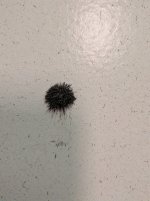
It is almost for sure magnetized. It does not take a lot of field to attract small steel shavings/dust which will also be magnetized (will rotate for attractive polarity when near and suspended in air). When you made the wall, you may have put a steel bit in an impact driver with a magnetic retainer. The steel funnels the magnetic field to the screw making the screw stick to the bit. Steel has iron in it and is ferromagnetic. When the bit is is removed after driving the screw, the external field is removed, but iron has hysteresis. So the field in the screw will not go to zero when the external field is removed, but rather will remain at a residual value somewhat less than the original drive (depends on many details of material, field strength, path taken, etc).
You cannot generally demagnetize such things with a static field. Do not try. You will likely make it worse or magnetize weaker magnetized ones. You can use a special oscillating drive that will cycle to zero to demagnetize. You would need to special build that or buy something like a watch type demagnetizer (those usually work by putting the watch in bore, but if you rest the end of the bore by the screw head it might work). It is not super easy to fix.
The best fix is prevention. Do not use magnetic bit & screw holders if residual magnetization causes trouble.
You can also magnetize steel if the bit slips since surface shearing can align small dipoles in the material. This can be enough to do it too. So if you were not using a magnetic bit holder when building the wall, it might be this (which would explain why some are magnetized and some not).
I can go into detailed molecular theory if you want and point to ferromagnetic hysteresis curves if you want

I am a physicist and did some magnetic optics designs years ago. But I am a theorist (also work on stuff a lot).