To avoid these ads, REGISTER NOW!

Useful shop cheat sheets, charts for printouts

Whiskeymike

Well-known member
Joined
Oct 31, 2013
Messages
775
Location
Austin, TX
I've started creating a binder of useful shop references that I can print out and keep in the binder without having to google each time. Here are some of the things I've found -

Jeep JK Torque specs - http://project-jk.com/jeep-jk-write-ups/jeep-jk-wrangler-torque-settings

Several Bolt & Fastener charts - https://www.boltdepot.com/fastener-information/Printable-Tools/Default.aspx

Fractions to Decimal & Metric - http://www.americanpunchco.com/fractions-decimals-millimeters-conversion-chart.htm

Electronics - http://wiki.smallroom.net/doku.php?id=electronics:general

Mig Tips - Hobart - http://www.hobartwelders.com/elearning/pdfs/MIG_Welding_Tips.pdf

Stick Welding - Hobart - http://www.hobartwelders.com/elearning/pdfs/Stick_Welding_Tips.pdf

Hobart 190 Guide for material thickness & settings -https://www.hobartwelders.com/pdf/spec_sheets/Handler_190.pdf

Miller Guide - http://www.millerwelds.com/pdf/mig_handbook.pdf

Added these per AMCguy's recommendations

Drill Speed Chart - http://www.abrasivestore.com/products/dynabrade-13/p134-135chart.php?lg

More in depth version - http://www.free-ed.net/sweethaven/IndustrialTech/machinist01/default.asp?uNum=3&iNum=0408

Sheet Metal Gauge (Thickness) chart - http://www.davidsonsales.com/docs_pdf/sheet_metal_gauge_chart.pdf

Another with weights - http://www.mcnichols.com/resources/gauge-chart

Added per Bwringer's suggestion -

Tap/Drill sizes - https://littlemachineshop.com/Reference/TapDrillSizes.pdf

Added per Grinder Bill's suggestion -

Bolt Specs - http://www.engineershandbook.com/Tables/torque.htm


What reference cheatsheets/guides do you find useful?


Mike
 
Last edited:
To avoid these ads, REGISTER NOW!

snowman3

Member
Joined
Aug 12, 2014
Messages
22
Location
Arizona
wow, thanks for bolt depot! Was just there yesterday looking for pilot hole sizes, but your summary page is best place to start. Thanks!
 

MushCreek

Well-known member
Joined
Jan 14, 2015
Messages
9,763
Location
Upstate South Carolina
Metric threads don't require a chart. You just subtract the thread pitch from the diameter. So if it was a 6mm thread with a 1mm pitch, you would use a 5mm drill. The same thing works for SAE threads, but it's more complicated. A 1/4-20 thread has a pitch of 1/20 of an inch, or .050". Subtract .050 from .250 (1/4 inch) and you get a drill diameter of .200. A #7 drill (.201) is commonly used. Handy to know if the tap you're using isn't on a chart, or if you don't have a chart.

I like having speed and feed charts handy for machining. It's quicker than figuring it out. For most normal diameters, I have a pretty good feel after 40+ years of machining, but when you get extremely small or extremely big, you need to know how to figure it, or have a chart.

I've always wonder why calculators don't come with a metric conversion button- maybe the fancier ones do?

A lot of stuff I just look up in the Machinery's Handbook.
 

RedRabbit

Well-known member
Joined
Jul 5, 2014
Messages
1,052
Location
SoCal
Metric threads don't require a chart. You just subtract the thread pitch from the diameter. So if it was a 6mm thread with a 1mm pitch, you would use a 5mm drill. The same thing works for SAE threads, but it's more complicated. A 1/4-20 thread has a pitch of 1/20 of an inch, or .050". Subtract .050 from .250 (1/4 inch) and you get a drill diameter of .200. A #7 drill (.201) is commonly used. Handy to know if the tap you're using isn't on a chart, or if you don't have a chart.

I like having speed and feed charts handy for machining. It's quicker than figuring it out. For most normal diameters, I have a pretty good feel after 40+ years of machining, but when you get extremely small or extremely big, you need to know how to figure it, or have a chart.

I've always wonder why calculators don't come with a metric conversion button- maybe the fancier ones do?

A lot of stuff I just look up in the Machinery's Handbook.

The machinary handbook is amazing but I was at Barnes and nobles and picked up a shop refrence manual for engineering students and it is a bit better in my opinion.
 

DC73

Well-known member
Joined
Dec 27, 2014
Messages
1,627
Location
Lubbock TX
The machinary handbook is amazing but I was at Barnes and nobles and picked up a shop refrence manual for engineering students and it is a bit better in my opinion.

Which reference manual are you recommending?

Thanks,

DC
 

Grinder Bill

Well-known member
Joined
Jan 11, 2011
Messages
217

Divcod

Well-known member
Joined
Jan 9, 2015
Messages
319
Location
Pacific Northwest
Thanks for the link to useful references. I purchased a used machinist handbook for $3.00 from Powell's Book in Portland OR which includes many shop references but also has formula's for many layout calculation. Book was published in the 40's but has been a addition to the shop.
 
To avoid these ads, REGISTER NOW!

Vegaman_Dan

Well-known member
Joined
Jun 1, 2012
Messages
2,453
Location
Pacific, WA
I have refs for metal Guage and welding settings printed out and laminated so they stay clean.

Engine rebuild checklists are also handy this way as the laminated plastic works with dry erase markers.
 

skulldrinker

Well-known member
Joined
Dec 25, 2011
Messages
1,171
Location
Bolingbrook, IL
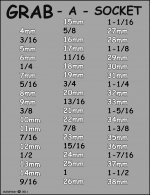
I'm old school and when I had to start dealing with Metrics I made this cheat sheet and have it hanging on my box. Helps me deal with what size MM is near or equal to an SAE size. Also helps when I need the next size larger or smaller.
 

Attachments

  • grab a socket BLK and WHT.jpg
    grab a socket BLK and WHT.jpg
    135.7 KB · Views: 97

sizem

Active member
Joined
Jan 20, 2021
Messages
29
Location
kentucky
I made a fraction to decimal chart that I use almost daily.
I can easily estimate that a decimal is approx 1/16 and 1/2 and tweak my wood saw, etc appropriately.
Enjoy!
 

Attachments

  • Chart Fractions to Decimals.pdf
    64.5 KB · Views: 40

RoninB4

Well-known member
Joined
Jul 22, 2020
Messages
3,511
Location
Under My House
-It was real nice of the OP to compile these charts for everyone to use, a very nice gesture.

-I will comment that not all the sizes listed in the above chart should be taken as gospel. A quick perusal through the "inch" sheet revealed at least two different sizes for "close fit" and "free fit" that I didn't agree with. There may be more, I didn't check the metric sheet. What was listed isn't wrong, per se, but there's a better "close fit" and a far more common "free fit" than what's in the chart for those two sizes. Not trying to find fault or throw rocks at a generous effort by the OP. What I'm saying is don't trust some chart on the internet blindly. Verify numbers before deciding if it's something to follow.
 

rharman

Well-known member
Joined
Apr 22, 2012
Messages
8,772
Location
SoCal
I bought this so long ago, I can't even remember. Looks like it came out in 1969 but I'll guess I picked it up 4-5 years later. Filled with soooo much useless information along with a ton of useful stuff too. I still refer to it for drill, tap, pilot sizes, etc. It's kind of cool/retro. There are newer versions available on Amazon and others.

1778043828791.png
 

rharman

Well-known member
Joined
Apr 22, 2012
Messages
8,772
Location
SoCal
So, here's a taste of some of the "useless" info from that book....

Need to dustproof your tennis court?
--or--
Need to make silver jewelry from dental amalgam?

1778135113200.jpeg

1778135074489.jpeg


Jgaz

Well-known member
Joined
Dec 16, 2016
Messages
1,654
Location
AZ
This is my new favorite chart.
IMG_1922.jpeg
With the chart I used for the last 40 years I always had to use a separate chart for the metric sizes.
 
To avoid these ads, REGISTER NOW!
Top Bottom