To avoid these ads, REGISTER NOW!

Help me remove a stuck bit in a keyless drill chuck removed from the drill

mikey03

Well-known member
Joined
May 17, 2024
Messages
2,035
I used a 1/2 drive male hex impact on a high torque impact and was able to get the chuck off since the hex key and hammer trick didn’t work. now the bit is stuck in the chuck. I want to keep the original chuck in case I warranty the drill to swap back on so honestly I don’t want to cut it off.

ive been trying all kinds of stuff without any luck so time to ask for help. Here’s what it looks like. I can twist the chuck in the middle I think one is locked other is unlocked I’m not sure which but either way I can’t get anything to turn. I got a 1/2 drive breaker bar here I can put in the socket end.
 

Attachments

  • IMG_0397.jpeg
    IMG_0397.jpeg
    369.4 KB · Views: 83
  • IMG_0396.jpeg
    IMG_0396.jpeg
    310.6 KB · Views: 81
  • IMG_0395.jpeg
    IMG_0395.jpeg
    475.6 KB · Views: 82
To avoid these ads, REGISTER NOW!
OP
M

mikey03

Well-known member
Joined
May 17, 2024
Messages
2,035
Do the jaws spin with the sleeve?
Nothing is really spinning it seems locked up I can twist the body relative to the socket but only a small amount and clicks in place left or right but that’s it. No spinning to be honest
 

RoninB4

Well-known member
Joined
Jul 22, 2020
Messages
3,480
Location
Under My House
-This is one of the reasons I don't like keyless chucks that don't have flats to use a wrench on. You can try wrapping some leather or rubber around the body and get a better grip without crushing/damaging the knurling. You'll have to rotate the body past that "click" to get it to unlock. Be wary of how much you squeeze it or you'll collapse the hollow knurled body, the wall thickness isn't very robust. You're wanting grip without crushing it. Good luck.
 
OP
M

mikey03

Well-known member
Joined
May 17, 2024
Messages
2,035
Just realized I could pop the rear plastic piece off now it looks like this. Wondering if I should try to use a punch and hammer to push out the socket IMG_0400.jpeg
 

whateg01

Well-known member
Joined
Mar 13, 2006
Messages
11,191
Location
doo dah, kansas, usa
Should be able to just stick a breaker bar in the hex key socket to keep it and the body from turning. Then unspin the sleeve like normal
 
OP
M

mikey03

Well-known member
Joined
May 17, 2024
Messages
2,035
Should be able to just stick a breaker bar in the hex key socket to keep it and the body from turning. Then unspin the sleeve like normal
By hand all I can do is twist it slightly left and right for the lock unlock click and it stops turning after those few degrees to be honest.
 
OP
M

mikey03

Well-known member
Joined
May 17, 2024
Messages
2,035
A chain or strap wrench should get that off in short order. Just work it against the socket.
Oh yea I got a rubber strap wrench somewhere I never used it but my uncle gave it to me I’ll give that a try
 
OP
M

mikey03

Well-known member
Joined
May 17, 2024
Messages
2,035
Angle grinder? Is the chuck still any good?
It’s a brand new chuck I honestly just hate the factory chucks Milwaukee uses and put some German metal ones on there from a place called Rohem or something like that.
 
OP
M

mikey03

Well-known member
Joined
May 17, 2024
Messages
2,035
That's not a lock or unlock
Oh sorry that’s what I thought idk what it is but I twist it slight left it clicks and stops moving and I can reverse and same thing happens. I figured it was the lock like after you tighten a bit in you twist it by hand until it clicks.
 

Nobody-named-Olli

Well-known member
Joined
Jan 9, 2025
Messages
1,550
Location
North Rhine-Westphalia; Germany
What is the chuck’s capacity, and what size hex did you insert?

I’m torn between a) thinking it is maxed out, and to overcome that, one needs to give it a quick and forceful turn in the direction of opening, then it will function like normal again. However, judging by the first picture, I think I can see the tip of the jaws, which would speak against it being maxed out. B) it didn’t like the impact and something isn’t right/ broken.

If you haven’t already, try the method I explained above trying to overcome it with a quick, forceful turn.

Kind regards,
Olli
 

KnurledNut

Well-known member
Joined
Jan 28, 2011
Messages
8,080
Location
n/a
@mikey03
I'd put a breaker bar in the socket and a pipe wrench on the chuck. It needs to turn clockwise to loosen, looking at it from the back.
If you have a pipe vise to hold the chuck that would work too.
 
Last edited:

neophyte

Well-known member
Joined
Apr 23, 2012
Messages
9,532
Location
Pennsylvannia
It’s a brand new chuck I honestly just hate the factory chucks Milwaukee uses and put some German metal ones on there from a place called Rohem or something like that.
The brans is Rohm or Roehm depending on whether one ignores the umlaut over the “o”, which should be spelled with an “oe” when not using the umlaut, but which routinely is not spelled as an “oe” when not using the umlaut.
 
To avoid these ads, REGISTER NOW!

KnurledNut

Well-known member
Joined
Jan 28, 2011
Messages
8,080
Location
n/a
It’s a brand new chuck I honestly just hate the factory chucks Milwaukee uses and put some German metal ones on there from a place called Rohem or something like that.
Many years ago Milwaukee was plagued with chuck issues. The one your dealing with doesn't look much different than one I had that was complete garbage. I ended up replacing it with a Metabo Futuro Plus chuck. At the time it was cheaper than other well known brands.
 
Last edited:

neophyte

Well-known member
Joined
Apr 23, 2012
Messages
9,532
Location
Pennsylvannia
Many years ago Milwaukee was plagued with chuck issues. The one your dealing with doesn't look much different than one I had that was complete garbage. I ended up replacing it with a Metabo Futuro Plus chuck. At the time it was cheaper than other well known brands.

Here's an old picture:
View attachment 2543354
There are two main German chuck manufacturers.
Rohm/Roehm, and Metabo, (and Albrecht, but Albrecht doesn’t make chucks meant for portable drills, just ultra precise machinist chucks).
Both manufacturers offer a few different qualities of keyless chuck for “portable drills”.
The all steel “lightweight” chucks are the Futuro Plus, from Metabo, and the Rohm Extra, from Rohm.
Both chuck types are available in various thread mounts, and both are available in single sleeve and double sleeve versions.
Double sleeve chicks are needed for drills without spindle locks, whereas single sleeve chucks are specifically intended for drills with spindle locks, usually cordless drills, although corded drills with spindle locks exist, and earlier cordless drills routinely didn’t have spindle locks.
The Rohm Extra, and Metabo Futuro Plus chucks are similar enough that both are likely manufactured by one or the other manufacturer, although I’m not sure which one.
The same chucks are also sold rebranded by Bosch, and KWB, and likely other power tool accessory suppliers.
There is also a version of the chucks with an outer sleeve molded from plastic, (both single and double sleeve versions).
A version of which is used by Festool.
I truly hate the plastic versions of these chucks, and don’t know why they exist, other than weight savings, or power tool companies trying to shave pennies off cost.
Technically, the plastic versions might be less likely to damage materials if the rub against them while a drill is running, but I find that sort of an excuse.
The Festool versions of the chucks in my opinion ****.
I don’t know the full history of the technicals of the chucks, but I know the similar, but nit identical Yukiwa keyless chucks from Japan, originally did not have the ratcheting feature found on most current chucks, and would not lock as well.
Yukiwa later added the ratcheting feature into their all steel cordless chucks, but the newer ratcheting versions look almost identical to the older non—ratcheting chucks.
Depending on where tools are being purchased, the various tool manufacturers will usually supply different chucks on the same tool models.
Milwaukee drills sold in Europe used to usually get the Rohm Extra style chucks.
The same drills sold in the USA, where usually supplied with Japanese Yukiwa chucks.
Drills sold in France may be supplied with chucks made in France by LFA.
Dewalt has offered drills in the USA using chucks from Rohm, LFA, Yukiwa (I think), and Jacobs, and maybe others.
As far as Yukiwa goes, the drill chucks they manufactured from the 1990s thru the early 2000s, that were used on Milwaukee drills where excellent from what I recall, and at least to me seemed better than the Rohm Metabo all steel keyless chucks.
Fein uses Rohm chucks, but other than some of the crappy plastic sleeved versions used on cordless drills, Fein mostly uses Rohm chucks from the Supra SK series, which are fully “billet” machined chucks, closer to the Rohm machinist chucks made for stationary equipment, just with slightly lighter dimensions.
Hilti uses Rohm Supra SK or Metabo Futuro Top keyless chuck for rotary hammer keyless drill bit adapters, but something similar to the Rohm Extra for some cordless drills, and some sort of plastic chick on other cordless drills.
 

KnurledNut

Well-known member
Joined
Jan 28, 2011
Messages
8,080
Location
n/a
Depending on where tools are being purchased, the various tool manufacturers will usually supply different chucks on the same tool models.
Milwaukee drills sold in Europe used to usually get the Rohm Extra style chucks.
The same drills sold in the USA, where usually supplied with Japanese Yukiwa chucks.
Drills sold in France may be supplied with chucks made in France by LFA.
Dewalt has offered drills in the USA using chucks from Rohm, LFA, Yukiwa (I think), and Jacobs, and maybe others.
As far as Yukiwa goes, the drill chucks they manufactured from the 1990s thru the early 2000s, that were used on Milwaukee drills where excellent from what I recall, and at least to me seemed better than the Rohm Metabo all steel keyless chucks.
The drill I mentioned was from around 2017-2018. I've slept a few nights since then, but if I remember correctly, the original chuck was a compact style Jacobs, as that drill was designed as a compact driver. It wasn't long after that Milwaukee discontinued using them and went with a 9/16" spindle, which chucks also had issues. The Metabo I installed has a steel nose and plastic sleeve. I had no problems with it. Even though it was longer, it was lighter which was an advantage on that model. The important thing to me was that it actually worked and didnt cost a fortune. Quality chucks can get expensive.

This Old Tony did a video about a similar one to mine:
(from 1:00 to 6:00)

A quick search here will reveal numerous threads on these issues including this one Ryan posted up:
https://www.garagejournal.com/forum/threads/the-milwaukee-chuck.431450/
 

Old tool guy

Well-known member
Joined
Apr 13, 2023
Messages
3,156
There are two main German chuck manufacturers.
Rohm/Roehm, and Metabo, (and Albrecht, but Albrecht doesn’t make chucks meant for portable drills, just ultra precise machinist chucks).
Both manufacturers offer a few different qualities of keyless chuck for “portable drills”.
The all steel “lightweight” chucks are the Futuro Plus, from Metabo, and the Rohm Extra, from Rohm.
Both chuck types are available in various thread mounts, and both are available in single sleeve and double sleeve versions.
Double sleeve chicks are needed for drills without spindle locks, whereas single sleeve chucks are specifically intended for drills with spindle locks, usually cordless drills, although corded drills with spindle locks exist, and earlier cordless drills routinely didn’t have spindle locks.
The Rohm Extra, and Metabo Futuro Plus chucks are similar enough that both are likely manufactured by one or the other manufacturer, although I’m not sure which one.
The same chucks are also sold rebranded by Bosch, and KWB, and likely other power tool accessory suppliers.
There is also a version of the chucks with an outer sleeve molded from plastic, (both single and double sleeve versions).
A version of which is used by Festool.
I truly hate the plastic versions of these chucks, and don’t know why they exist, other than weight savings, or power tool companies trying to shave pennies off cost.
Technically, the plastic versions might be less likely to damage materials if the rub against them while a drill is running, but I find that sort of an excuse.
The Festool versions of the chucks in my opinion ****.
I don’t know the full history of the technicals of the chucks, but I know the similar, but nit identical Yukiwa keyless chucks from Japan, originally did not have the ratcheting feature found on most current chucks, and would not lock as well.
Yukiwa later added the ratcheting feature into their all steel cordless chucks, but the newer ratcheting versions look almost identical to the older non—ratcheting chucks.
Depending on where tools are being purchased, the various tool manufacturers will usually supply different chucks on the same tool models.
Milwaukee drills sold in Europe used to usually get the Rohm Extra style chucks.
The same drills sold in the USA, where usually supplied with Japanese Yukiwa chucks.
Drills sold in France may be supplied with chucks made in France by LFA.
Dewalt has offered drills in the USA using chucks from Rohm, LFA, Yukiwa (I think), and Jacobs, and maybe others.
As far as Yukiwa goes, the drill chucks they manufactured from the 1990s thru the early 2000s, that were used on Milwaukee drills where excellent from what I recall, and at least to me seemed better than the Rohm Metabo all steel keyless chucks.
Fein uses Rohm chucks, but other than some of the crappy plastic sleeved versions used on cordless drills, Fein mostly uses Rohm chucks from the Supra SK series, which are fully “billet” machined chucks, closer to the Rohm machinist chucks made for stationary equipment, just with slightly lighter dimensions.
Hilti uses Rohm Supra SK or Metabo Futuro Top keyless chuck for rotary hammer keyless drill bit adapters, but something similar to the Rohm Extra for some cordless drills, and some sort of plastic chick on other cordless drills.
Curious why you know all that.
 

neophyte

Well-known member
Joined
Apr 23, 2012
Messages
9,532
Location
Pennsylvannia
Curious why you know all that.
Good drills can be ruined by crappy chucks.
I prefer keyless chucks because I once had to spend way too long finding a dropped chuck key.
I have occasionally purchased drills that either had a keyed chuck, or a worn out chuck, and and had a desire to switch the chucks out.
Sometimes I would like to, or need to, save money, so knowing the different options for decent drill chucks one can potentially swap to hives one potential for saving money.
I have purchased multiple chucks of various brands to have chucks on hand when I desire yo switch a chuck out.
The higher end Rohm Supra SK chucks, and Metabo Futuro Top chucks distinctly look like much closer to machinist chucks, and have key differences in appearance that make the chucks recognizable. Both chucks are also made to a higher degree of accuracy, but there is a downside, in that there is no central locking screw, and cannot be, due to the chucks mechanics, which then requires use of threadlocker to mount the chucks for reverse rotation.
 
OP
M

mikey03

Well-known member
Joined
May 17, 2024
Messages
2,035
@mikey03
DId you get it out?
Not yet I have to unbury my pins from the bins I got them in. I had to downsize how much of our garage I could use for tools and pulled out the top 20% and put in a small cart and the rest are stacked to the ceiling in bins. Hoping to do it later this week
 
OP
M

mikey03

Well-known member
Joined
May 17, 2024
Messages
2,035
Good drills can be ruined by crappy chucks.
I prefer keyless chucks because I once had to spend way too long finding a dropped chuck key.
I have occasionally purchased drills that either had a keyed chuck, or a worn out chuck, and and had a desire to switch the chucks out.
Sometimes I would like to, or need to, save money, so knowing the different options for decent drill chucks one can potentially swap to hives one potential for saving money.
I have purchased multiple chucks of various brands to have chucks on hand when I desire yo switch a chuck out.
The higher end Rohm Supra SK chucks, and Metabo Futuro Top chucks distinctly look like much closer to machinist chucks, and have key differences in appearance that make the chucks recognizable. Both chucks are also made to a higher degree of accuracy, but there is a downside, in that there is no central locking screw, and cannot be, due to the chucks mechanics, which then requires use of threadlocker to mount the chucks for reverse rotation.
Do you know which is the best chuck i can drop on my M18 hammer drill? I put a rohm of some kind on my m12 and was going to try to figure out which one fits my m18 once I got the old chuck off and could measure threads and stuff but since you seem to know alot about it maybe you can help?
 

neophyte

Well-known member
Joined
Apr 23, 2012
Messages
9,532
Location
Pennsylvannia
Do you know which is the best chuck i can drop on my M18 hammer drill? I put a rohm of some kind on my m12 and was going to try to figure out which one fits my m18 once I got the old chuck off and could measure threads and stuff but since you seem to know alot about it maybe you can help?
What is the arbor diameter and thread count?
At some point, Milwaukee supposedly switched to a non-standard Arbor size, making purchasing replacement chucks harder.
The Rohm Supra SKE chucks tend to be used on the highest end drills, like Fein, but they’re expensive, and possibly a bit heavier.
The Metabo Futuro Plus /Rohm Extra all steel keyless chucks are routinely used on better cordless drill models, and should be faitly reliable.
Buy a version with carbide jaws.
Yukiwa varies.
They have made excellent chucks in the past, and are still used on well regarded drills, but it seems like they occasionally screw up.
LFA is a French manufacturer, and Dewalt at ine point used LFA keyless chucks on some of their top of the line cordless drills, but later dropped them, although I don’t know whether this was due to cost or performance issues.
LFA does not seem to have a USA cstalog though.
I have no clue what the current status of Jacobs is. I used to ignore Jacobs because their keyless chucks used plastic outer sleeves, and the higher end keyless Jacobs chucks were made in Spain by Llambrich.
 

Attachments

  • IMG_0402.png
    IMG_0402.png
    1.1 MB · Views: 11
  • IMG_0403.png
    IMG_0403.png
    1.1 MB · Views: 9
  • IMG_0401.png
    IMG_0401.png
    1.3 MB · Views: 5
  • IMG_0400.png
    IMG_0400.png
    1.5 MB · Views: 3
  • IMG_0398.png
    IMG_0398.png
    1.7 MB · Views: 3
  • IMG_0399.png
    IMG_0399.png
    1.2 MB · Views: 3

Nobody-named-Olli

Well-known member
Joined
Jan 9, 2025
Messages
1,550
Location
North Rhine-Westphalia; Germany
Lot’s of great information there @neophyte !

Only thing I don’t agree with is the “****” part in regard to Festool’s chuck variants. I’m running two of their drill/drivers for round about 10 years now, one 1/2” capacity + plastic sleeve, one 3/8” capacity + plastic sleeve. Absolutely trouble free. And the plastic sleeves, at the end of the day, are non-marring which I like, especially on the CXS that really does go places … .

But again, great & valuable information shared right here!

Kind regards,
Olli
 

neophyte

Well-known member
Joined
Apr 23, 2012
Messages
9,532
Location
Pennsylvannia
Lot’s of great information there @neophyte !

Only thing I don’t agree with is the “****” part in regard to Festool’s chuck variants. I’m running two of their drill/drivers for round about 10 years now, one 1/2” capacity + plastic sleeve, one 3/8” capacity + plastic sleeve. Absolutely trouble free. And the plastic sleeves, at the end of the day, are non-marring which I like, especially on the CXS that really does go places … .

But again, great & valuable information shared right here!

Kind regards,
Olli
The non-marring aspect might be helpful to some users.
I have had the plastic sleeved chucks slip on round shank drill buts when I needed to use a half inch spec’ed drill drill a hole in cast iron.
I gave not had this issue with the Yukiwa chucks on a Milwaukee drill, or with the steel sleeved Rohm Extra/Metabo Futuro plus chucks.
Nor have I had the issue with the heavier soec Rohm SK chucks or Metabo Futuro Top chucks, which both have steel jaws.

For lightweight use the plastic chucks might be fine.
I personally hate these chucks, and consider the designs a potential exclusion factor on drills.
 
OP
M

mikey03

Well-known member
Joined
May 17, 2024
Messages
2,035
What is the arbor diameter and thread count?
At some point, Milwaukee supposedly switched to a non-standard Arbor size, making purchasing replacement chucks harder.
Im honestly not sure what to measure

the outer part of the chuck itself is near exact 43mm

the male threads on the drill are about 14.5mm on the outer part of the threads

the length of the male thread on the drill is 16mm

the thread pitch seems to be 1.5M though just in case I ran SAE gauge and it showed a match for 18 too idk how close they are

when I go inside the chuck on the female threads it’s about 12.8mm

so honestly idk if there using SAE for some reason the 12.8mm is really 1/2” and the 14.5m, is really 9/16” I’m not too sure how to use the caliper to measure over a threaded shaft. I’m just moving it around and closing it gently and looking for the highest number and figure that’s the middle.
 

neophyte

Well-known member
Joined
Apr 23, 2012
Messages
9,532
Location
Pennsylvannia
Im honestly not sure what to measure

the outer part of the chuck itself is near exact 43mm

the male threads on the drill are about 14.5mm on the outer part of the threads

the length of the male thread on the drill is 16mm

the thread pitch seems to be 1.5M though just in case I ran SAE gauge and it showed a match for 18 too idk how close they are

when I go inside the chuck on the female threads it’s about 12.8mm

so honestly idk if there using SAE for some reason the 12.8mm is really 1/2” and the 14.5m, is really 9/16” I’m not too sure how to use the caliper to measure over a threaded shaft. I’m just moving it around and closing it gently and looking for the highest number and figure that’s the middle.
9/16-18 is now a standard drill chuck mount size.
Drill chucks with threaded mounts are usually fractional inch sizes and threadings.
For hammer drills, threaded mounts are almost always used.
Some rotary drills use tapered arbors, but it has become increasingly rare.

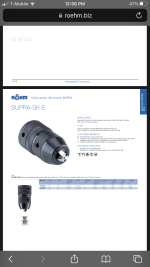
This is a Rohm single sleeve keyless chuck in the 9/16-18 mount.


The double sleeve version of the same chuck.


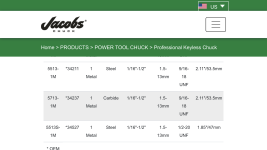
Jacobs apparently also makes a drill chuck in the 9/16-18 mount, but I have no clue about quality, or if it’s a Jacobs made product or subcontracted.
 

Attachments

  • IMG_0409.png
    IMG_0409.png
    286.9 KB · Views: 11
OP
M

mikey03

Well-known member
Joined
May 17, 2024
Messages
2,035
9/16-18 is now a standard drill chuck mount size.
Drill chucks with threaded mounts are usually fractional inch sizes and threadings.
For hammer drills, threaded mounts are almost always used.
Some rotary drills use tapered arbors, but it has become increasingly rare.

This is a Rohm single sleeve keyless chuck in the 9/16-18 mount.


The double sleeve version of the same chuck.


Jacobs apparently also makes a drill chuck in the 9/16-18 mount, but I have no clue about quality, or if it’s a Jacobs made product or subcontracted.
Thanks man those both look good and damn I didn’t think it would be SAE but I kinda nailed it as maybe being 9/16x18 🤣

what’s the difference between single and double sleeve and what are the good and the bad with each other than the $20 price diff
 

neophyte

Well-known member
Joined
Apr 23, 2012
Messages
9,532
Location
Pennsylvannia
Thanks man those both look good and damn I didn’t think it would be SAE but I kinda nailed it as maybe being 9/16x18 🤣

what’s the difference between single and double sleeve and what are the good and the bad with each other than the $20 price diff
Single sleeve chucks are made for drills with a locking spindle.
Most cordless drills from professional brands have had locking spindles for the past two decades or more.
Double sleeve chucks are made for drills without locking spindles, so you can hold the lower fixed sleeve, and twist the mobile front sleeve to open and close the chuck jaws.
Usually single sleeve chucks are used on cordless drills with a spindle lock, but double sleeve can be used instead.
The double sleeve might add a slight bit of extra weight or length, but I haven’t checked the specs on that.
If the chuck gets stuck shut, the lower sleeve may also give a place to put a strap wrench in order to try to open the chuck up.
The Rohm chucks have hex flats on the tip for a wrench in case the chuck jambs in place.
Some drills have a gap between the chuck and tool body, so you can access flats for a wrench, but not all drills do.
 

KnurledNut

Well-known member
Joined
Jan 28, 2011
Messages
8,080
Location
n/a
I used a 1/2 drive male hex impact on a high torque impact and was able to get the chuck off since the hex key and hammer trick didn’t work. now the bit is stuck in the chuck. I want to keep the original chuck in case I warranty the drill to swap back on so honestly I don’t want to cut it off.

ive been trying all kinds of stuff without any luck so time to ask for help. Here’s what it looks like. I can twist the chuck in the middle I think one is locked other is unlocked I’m not sure which but either way I can’t get anything to turn. I got a 1/2 drive breaker bar here I can put in the socket end.
So maybe I missed it, but that chuck appears to have little use. Why are you wanting to replace it?
 
OP
M

mikey03

Well-known member
Joined
May 17, 2024
Messages
2,035
@neophyte i think the spindle locks I’ve seen on like a dremel tool are a spring button you push and hold down. I never seen anything like that on any drill I owned.

there is this click lock feature on there idk what it’s called where when you’re done tightening on the bit by using the drill in forward mode, you twist it slightly and it locks.

i was just messing around with my m12 that already got a rohm put on there and honestly idk if it’s double or single sleeve or if the m12 got a spindle lock or not. But I noticed if I twist to lock it with no bit in, and twist the other way, it gives a jumping clicking sound for a bunch until it eventually catches and unlocks. I feel like that might be breaking it so I just did it once.
 
OP
M

mikey03

Well-known member
Joined
May 17, 2024
Messages
2,035
So maybe I missed it, but that chuck appears to have little use. Why are you wanting to replace it?
I honestly don’t like Milwaukee factory chucks. I replaced my m12 with a Rohm and it’s so much nicer Tbh.
 

neophyte

Well-known member
Joined
Apr 23, 2012
Messages
9,532
Location
Pennsylvannia
@neophyte i think the spindle locks I’ve seen on like a dremel tool are a spring button you push and hold down. I never seen anything like that on any drill I owned.

there is this click lock feature on there idk what it’s called where when you’re done tightening on the bit by using the drill in forward mode, you twist it slightly and it locks.

i was just messing around with my m12 that already got a rohm put on there and honestly idk if it’s double or single sleeve or if the m12 got a spindle lock or not. But I noticed if I twist to lock it with no bit in, and twist the other way, it gives a jumping clicking sound for a bunch until it eventually catches and unlocks. I feel like that might be breaking it so I just did it once.
Can the drill arbor actually turn freely when you let go of the trigger?
If not, the drill has a “spindle lock.
Some tools have a “manual spindle lock”, that requires pushing a button, usually to engage a pin that locks into the arbor, preventing the arbor from turning.
This negates the need for two wrenches to loosen or tighten a router collet, requiring only one wrench, which typically makes the job easier.
On cordless drills, the spindle lock is usually automatic when the trigger is not depressed.
On older drills using keyed chucks, no spindle lock is generally needed, because the chuck key sits in the chuck at a right angle, and gears the chuck open and closed, so the spindle mostly won’t turn when using the chuck key.
Once a bit is locked in place, if you can turn the chuck and have the chuck spin the arbor freely, then there is no spindle lock.
If the spindle won’t turn, then there is a spindle lock.
I don’t think Milwaukee has made a cordless drill without a spindle lick since the 1980s, or early 1990s.
 
OP
M

mikey03

Well-known member
Joined
May 17, 2024
Messages
2,035
Can the drill arbor actually turn freely when you let go of the trigger?
If not, the drill has a “spindle lock.
Some tools have a “manual spindle lock”, that requires pushing a button, usually to engage a pin that locks into the arbor, preventing the arbor from turning.
This negates the need for two wrenches to loosen or tighten a router collet, requiring only one wrench, which typically makes the job easier.
On cordless drills, the spindle lock is usually automatic when the trigger is not depressed.
On older drills using keyed chucks, no spindle lock is generally needed, because the chuck key sits in the chuck at a right angle, and gears the chuck open and closed, so the spindle mostly won’t turn when using the chuck key.
Once a bit is locked in place, if you can turn the chuck and have the chuck spin the arbor freely, then there is no spindle lock.
If the spindle won’t turn, then there is a spindle lock.
I don’t think Milwaukee has made a cordless drill without a spindle lick since the 1980s, or early 1990s.
On my m12 now Rohm chuck with no finger on the trigger I can twist the outer part of the chuck, idk if it’s called the arbor? And idk if it’s single sleeve or double sleeve. I just learned those terms from you tonight!

but I can twist it and the three chuck jaws will move and tighten or loosen. With my finger off the trigger. By twisting the chuck. this is with the rohm chuck.
 
To avoid these ads, REGISTER NOW!
Top Bottom