Also @neophyte idk if this means anything but on the m18 that the chuck is removed, with finger off trigger I can’t twist the threaded spindle at all by hand. Idk if that means it’s a spindle lock. also with finger depressing trigger and battery out, I also can’t turn it by hand. No chuck on it though so idk if the spindle lock is related to how the chuck interface to the drill head


You are using an out of date browser. It may not display this or other websites correctly.
You should upgrade or use an alternative browser.
You should upgrade or use an alternative browser.
Help me remove a stuck bit in a keyless drill chuck removed from the drill
- Thread starter mikey03
- Start date
neophyte
Well-known member
That means the drill has an arbor lock.Also @neophyte idk if this means anything but on the m18 that the chuck is removed, with finger off trigger I can’t twist the threaded spindle at all by hand. Idk if that means it’s a spindle lock. also with finger depressing trigger and battery out, I also can’t turn it by hand. No chuck on it though so idk if the spindle lock is related to how the chuck interface to the drill head
I don’t know how the arbor locks currently work, so it may be electric, requiring the battery.
Damn man @neophyte now you got me thinking like a scientist here I never put so much thought into drill chucks but now I’m real curious. Here’s my m12 one. I labeled the parts with colors since idk what there called.
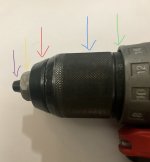
if I power the drill in forward or reverse on the trigger then all 5 color marked pieces turn.
when the drill is off I can twist the blue part by hand. When I do that, blue and red both twist and the teeth (purple) retract or advance depending on which direction I twist. The green and yellow parts don’t move when I turn blue by hand.
if I twist red by hand, nothing else turns or moves it just free spins
if I activate the trigger and hold the blue part down then it also seems to lock red Into blue and both blue and red stay frozen even though I’m just holding onto blue. And this either advance or retract the teeth. This is how I always put in bits and remove bits normally.
similar I can hold just red down while using trigger and it locks blue part and then forward or retract the teeth. So when trigger is on, the blue and red are both locked. When trigger is off, the red will free twist by hand and not engage anything else. But with trigger off blue will lock onto and also turn red. But if by hand I turn blue while holding red in place, it’s fine, blue will turn independent of red even if I force red in place blue still turns but once I let go of red, it turns along with blue.
yellow part btw I can never turn by hand, it’s locked when the drill is off. And when drill is on trigger on turning it then it moves with the drill motor.
i honestly don’t know if I bought the right chuck the model was listed on Reddit as compatible with this m12 drill and it works fine. But maybe this is a double sleeve and maybe I don’t actually need double because maybe this drill got a spindle lock?
if I power the drill in forward or reverse on the trigger then all 5 color marked pieces turn.
when the drill is off I can twist the blue part by hand. When I do that, blue and red both twist and the teeth (purple) retract or advance depending on which direction I twist. The green and yellow parts don’t move when I turn blue by hand.
if I twist red by hand, nothing else turns or moves it just free spins
if I activate the trigger and hold the blue part down then it also seems to lock red Into blue and both blue and red stay frozen even though I’m just holding onto blue. And this either advance or retract the teeth. This is how I always put in bits and remove bits normally.
similar I can hold just red down while using trigger and it locks blue part and then forward or retract the teeth. So when trigger is on, the blue and red are both locked. When trigger is off, the red will free twist by hand and not engage anything else. But with trigger off blue will lock onto and also turn red. But if by hand I turn blue while holding red in place, it’s fine, blue will turn independent of red even if I force red in place blue still turns but once I let go of red, it turns along with blue.
yellow part btw I can never turn by hand, it’s locked when the drill is off. And when drill is on trigger on turning it then it moves with the drill motor.
i honestly don’t know if I bought the right chuck the model was listed on Reddit as compatible with this m12 drill and it works fine. But maybe this is a double sleeve and maybe I don’t actually need double because maybe this drill got a spindle lock?
neophyte
Well-known member
The purple part is the chuck jaws.Damn man @neophyte now you got me thinking like a scientist here I never put so much thought into drill chucks but now I’m real curious. Here’s my m12 one. I labeled the parts with colors since idk what there called.
if I power the drill in forward or reverse on the trigger then all 5 color marked pieces turn.
when the drill is off I can twist the blue part by hand. When I do that, blue and red both twist and the teeth (purple) retract or advance depending on which direction I twist. The green and yellow parts don’t move when I turn blue by hand.
if I twist red by hand, nothing else turns or moves it just free spins
if I activate the trigger and hold the blue part down then it also seems to lock red Into blue and both blue and red stay frozen even though I’m just holding onto blue. And this either advance or retract the teeth. This is how I always put in bits and remove bits normally.
similar I can hold just red down while using trigger and it locks blue part and then forward or retract the teeth. So when trigger is on, the blue and red are both locked. When trigger is off, the red will free twist by hand and not engage anything else. But with trigger off blue will lock onto and also turn red. But if by hand I turn blue while holding red in place, it’s fine, blue will turn independent of red even if I force red in place blue still turns but once I let go of red, it turns along with blue.
yellow part btw I can never turn by hand, it’s locked when the drill is off. And when drill is on trigger on turning it then it moves with the drill motor.
i honestly don’t know if I bought the right chuck the model was listed on Reddit as compatible with this m12 drill and it works fine. But maybe this is a double sleeve and maybe I don’t actually need double because maybe this drill got a spindle lock?
The yellow part is the hex that allows a wrench to be used to open the chuck if the chuck gets jammed.
The Red part should just be a loose turning collar, that spins somewhat freely, in case the chuck rubs up against something. This part is supposed to spin freely.
The blue part is the outer sleeve used for opening or closing the jaws.
The way you are supposed to use open and close the chuck jaws is to let your finger off the trigger, and then spin the sleeve clockwise or counter clockwise to open or close the jaws.
Some people just hold the sleeve and then run the drill in forward or reverse to spin the drill arbor to open and close the chuck jaws.
The green is just a bottom piece of the chuck, that may be attached to the fixed part of the chuck or may be attached to the rotating sleeve. I forget, and don’t have a drill handy to check.
Not all keyless drill chucks have that part. (Or the top freely rotating “protective disc/collar”)
Your drill does not have free access to the drill arbor for a wrench.
Some drills have a gap between the green part and the drill body, or torque setting collar, that allows access for a wrench to hold the arbor.
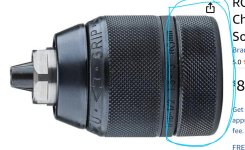
Double sleeve keyless chucks have a separate collar, below that piece marked by the green arrow, that is firmly or permanently connected to the threaded arbor hole, so that the arbor can be held stationary while the rotating tightening/loosening collar can tighten or loosen the chuck jaws.
@neophyte thanks man yea I see that double sleeve piece here from the Amazon link you posted and I marked it light blue. But at least on my m12 since I can tighten or loosen when the drill is turned off just by turning the single sleeve then I guess that means the drill got an arbor lock? And so I don’t need one of these double sleeve ones.The purple part is the chuck jaws.
The yellow part is the hex that allows a wrench to be used to open the chuck if the chuck gets jammed.
The Red part should just be a loose turning collar, that spins somewhat freely, in case the chuck rubs up against something. This part is supposed to spin freely.
The blue part is the outer sleeve used for opening or closing the jaws.
The way you are supposed to use open and close the chuck jaws is to let your finger off the trigger, and then spin the sleeve clockwise or counter clockwise to open or close the jaws.
Some people just hold the sleeve and then run the drill in forward or reverse to spin the drill arbor to open and close the chuck jaws.
The green is just a bottom piece of the chuck, that may be attached to the fixed part of the chuck or may be attached to the rotating sleeve. I forget, and don’t have a drill handy to check.
Not all keyless drill chucks have that part. (Or the top freely rotating “protective disc/collar”)
Your drill does not have free access to the drill arbor for a wrench.
Some drills have a gap between the green part and the drill body, or torque setting collar, that allows access for a wrench to hold the arbor.
Double sleeve keyless chucks have a separate collar, below that piece marked by the green arrow, that is firmly or permanently connected to the threaded arbor hole, so that the arbor can be held stationary while the rotating tightening/loosening collar can tighten or loosen the chuck jaws.
Nobody-named-Olli
Well-known member
The non-marring aspect might be helpful to some users.
I have had the plastic sleeved chucks slip on round shank drill buts when I needed to use a half inch spec’ed drill drill a hole in cast iron.
I gave not had this issue with the Yukiwa chucks on a Milwaukee drill, or with the steel sleeved Rohm Extra/Metabo Futuro plus chucks.
Nor have I had the issue with the heavier soec Rohm SK chucks or Metabo Futuro Top chucks, which both have steel jaws.
For lightweight use the plastic chucks might be fine.
I personally hate these chucks, and consider the designs a potential exclusion factor on drills.
Since the plastic sleeve is just that on my Festool chucks, a sleeve - everything else is steel - I don’t really see how that affects drill bit retention. And I’ve drilled iron/steel pipe with a step drill (other bits/ large diameters as well) and my PDC - but I honestly don’t remember if that step drill bit had a round shank or a design including flats. I actually only have few round shank drill bits, wich might explain why our experiences are different. Then again, I do have the same Röhm Extra chuck, but with the metal sleeve, on one of my Würth drill/drivers, can’t say it makes a difference in use for me - except the non marring part. Both work flawless.
But it’s definitely interesting to hear about different experience and that you consider them a exclusion factor!
Kind regards,
Olli
are you running drill bits with a hex base or with hole body got some shape? Does it make a big difference? I always figured the hex base bits might be weaker since how are they joined together? Unless it’s cut from one piece of steel which I doubt tbh.I actually only have few round shank drill bits, wich might explain why our experiences are different.
RoninB4
Well-known member
-Example of "joined" bits?I always figured the hex base bits might be weaker since how are they joined together?
Nobody-named-Olli
Well-known member
are you running drill bits with a hex base or with hole body got some shape? Does it make a big difference? I always figured the hex base bits might be weaker since how are they joined together? Unless it’s cut from one piece of steel which I doubt tbh.
As usual, the (my) answer is it depends. My regular, non-proprietary, drill bits have three flats on the shank and will not slip. That makes a huge difference. Then there are hex shanks of varying diameters, which also will not slip. My current step drill bit has three flats. (…) And when we get to the proprietary Festool Centrotec stuff, the drill bits come with one flat and are seated into a Centrotec (hex-shaft) holder & secured with a grub screw. Others are one piece with Centrotec compatible hex shafts - nothing is “joined”.
My bi-metal hole saws have round shanks. Others have hex shanks. …
Other drill bits come with a single ridge that prevents slipping after an initial slip and the ridge is seated against one of the jaws.
In mobile/ handheld operation the non-slip shanks with 3 or 6 (hex) flats shafts make a big difference in my experience, which doesn’t mean that any of my chucks wouldn’t secure a round shank as well, I just have a preference for non-slip shafts.
All that said, I do have some odd-ball round shank drill bits as well. It all depends on what I’m drilling & where.
I’d also like to see an example of a joined drill bit - unless you mean joined as with my Centrotec holders + drill bit.
Kind regards,
Olli
RoninB4
Well-known member
^ I agree with the above in that a bit with flats will be far more secure than a round shank bit. This is a large part of the reason I don't favor keyless chucks in a machine shop. The keyless chucks either don't grip a round shank drill enough and causes bad scarring when it slips or it can cause problems "unlocking" it. Keyless chucks work ok with hand held drills but they can cause potential problems in machine shop duty. Speed in switching bits? Perhaps, but not if it locks up under heavy drilling (they can) or the bit "grabs" the material. If there's no provision for using a wrench on a keyless chuck I wouldn't want it. Lose the chuck key? Either use a lanyard, dedicated location for it, or acquire more than one. Whether it's in the lathe, mill, or DP all the chucks use the same key unless it's a third world import. Use what works for you.
-A "joined" drill bit? Only ones I've seen are carbide tipped or poorly made ones. Maybe I need to get out more.
-A "joined" drill bit? Only ones I've seen are carbide tipped or poorly made ones. Maybe I need to get out more.
idk how these are made if they are milled out of one piece of metal honestly but I assume they are pressed together friction fit joined somehow, two pieces which I figure can make them slight bend and cause runout. Idk I never used them-A "joined" drill bit? Only ones I've seen are carbide tipped or poorly made ones. Maybe I need to get out more.

RoninB4
Well-known member
-I'll have to admit this is a first for me and they do look to be joined. Perhaps this is because the bulk of my experience is with metal working tooling. This one you've shown (thank you) is a brad-point and is commonly used for wood or composite materials. If this is the type of material you're accustomed to drilling then there shouldn't be any real concern about weakness or it coming apart on you. With metal there are much greater cutting forces that can shatter/destroy a drill bit, especially true under certain conditions I won't bore you with unless you really want to know. I use metal working tooling/cutters on wood 99% of the time.idk how these are made if they are milled out of one piece of metal honestly but I assume they are pressed together friction fit joined somehow, two pieces which I figure can make them slight bend and cause runout. Idk I never used them
-You were correct about it looking like a "joined" bit. If working with wood it shouldn't be a real concern unless it seizes in the hole. If working with metal I'd have some reservations (several) about if/how I'd use this. Cutting/drilling/grinding is always about the conditions it operates under and the material. Don't mean to be vague or persnickety but those are facts.
Nobody-named-Olli
Well-known member
That is a first one for me as well, and yes, looks joined. Thank you for sharing! Can you share who manufacturers them as well?
Kind regards,
Olli
Kind regards,
Olli
neophyte
Well-known member
The other difference between the plastic sleeve, and steel sleeve keyless chucks is grip.Since the plastic sleeve is just that on my Festool chucks, a sleeve - everything else is steel - I don’t really see how that affects drill bit retention. And I’ve drilled iron/steel pipe with a step drill (other bits/ large diameters as well) and my PDC - but I honestly don’t remember if that step drill bit had a round shank or a design including flats. I actually only have few round shank drill bits, wich might explain why our experiences are different. Then again, I do have the same Röhm Extra chuck, but with the metal sleeve, on one of my Würth drill/drivers, can’t say it makes a difference in use for me - except the non marring part. Both work flawless.
But it’s definitely interesting to hear about different experience and that you consider them a exclusion factor!
Kind regards,
Olli
The plastic chucks tends to be more “slippy” providing less secure grip when tightening the chucks.
Steel sleeve chucks are usually knurled, and provide Excellent grip for tightening the chucks, although there are some weird examples, like Yukiwa designed that have been way too smooth for a steel sleeved keyless Chuck.
neophyte
Well-known member
are you running drill bits with a hex base or with hole body got some shape? Does it make a big difference? I always figured the hex base bits might be weaker since how are they joined together? Unless it’s cut from one piece of steel which I doubt tbh.
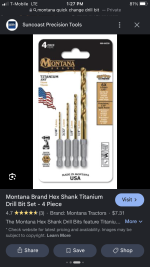
There is a major manufacturer of “quick change” hex shank bits, that casts what I presume is s zinc alloy hex shank around the base of steel drill bits, as an affordable way to manufacture the hex shank.-Example of "joined" bits?
The US manufacturer used to be known as Jore, but I think the name was changed when the company went bankrupt at one point, and may now ne known as Montana brand.
Jire used to license a huge number of brands, and sell bits under the brands at retailers like Lowes and Home Depot, as well as making store brands likely for both.
Makita, Hitachi, Black & Decker, Kobalt, etc. all had bits snd drilling accessories that were made by Jore.
They could fo steel shanked bits, but usually didn’t for actual drill bits.
The other method, particularly for small drill bit sizes, was machines or tolled hex shanks that were brazed on the ends of HSS drill bits.
Some manufacturers do make hex shank drill bits made from a single piece of steel, with Dewalt being one with their “Impact Ready” bits, but is was fairly uncommon for years.
Attachments

I hammered off the stuck socket bit with a punch, it took about 20 hits with the hammer and I didn’t think it was working but I saw it slowly moved out. I jacked up the inside of the chuck a bit as the punch jumped since I was holding it in my hand and honestly not too steady because I had to get rid of the workbench with my vice from the garage last year due to space.
but it came off and I’ll keep it in case I got to warranty this drill. And I ordered the higher quality replacement.
but it came off and I’ll keep it in case I got to warranty this drill. And I ordered the higher quality replacement.