To avoid these ads, REGISTER NOW!

Blackhawk S-4 Restoration

OP
M

MBeaty

Well-known member
Joined
Feb 1, 2010
Messages
237
Location
Middle Tennessee
I see where there were pic issues earlier, and if those final 4 bold lines are supposed to be links (or pics?), they don't show anything to me except the bold text. I'm likely to be going into mine to fix some leak issues, and hoping that our local major seal/bearing supplier can provide generic alternatives (as opposed to ~$200 kit), so any reference is appreciated.

I am still confused by the pictures, I and some others can see them fine. I checked them on my work computer and it was like you described, not even a broken link or image symbol, just nothing.

The pictures that you could not see, showed the packing arrangement, but no dimensions. I can try to get some dimensions, but apparently, there are a few various packing configurations over the years with these jacks. Unfortunately I already have all the V packings soaking in oil, so I am note sure if this will change any of the dimensions or not, but I will try to measure them as good as I can.

MBeaty, any thoughts on how tight to pack the seals for assembly??

I am not sure of a specific amount. For the main ram both the V packings and the regular packings can be torqued separately. From what I have read, for the v packing's, there should be a health drag but not too tight. For reference, with the packing nuts removed, I was able to pull the main ram out of my jack by hand without much effort. The jack was not leaking when I started the process, so it must have been fairly close to proper.

The pump packing spacer that is located between the V packings and the packing rings on the main ram have a series of holes in the face that should take a specialty tool to help torque the v packings. I have heard of using punches to turn this ring, but a safer bet would be to make some sort of pin spanner tool to do the job to prevent any accidental damage to the OD of the ram.
 
To avoid these ads, REGISTER NOW!

TheBadDog

Well-known member
Joined
Dec 9, 2012
Messages
112
Location
Phoenix
Thanks.

Yeah, those packing nuts are going to take a custom tool of some sort. I wouldn't want to be using a punch on those unless out of desperation. I recall reading where someone broke a finger off one of them doing just that. I'm thinking a simple 2 prong scissor type setup should be sufficient. If I expected to be doing it more than once, I would make a tool like used for the (similar) spindle nuts used on floating axles.
 
OP
M

MBeaty

Well-known member
Joined
Feb 1, 2010
Messages
237
Location
Middle Tennessee
Thanks.

Yeah, those packing nuts are going to take a custom tool of some sort. I wouldn't want to be using a punch on those unless out of desperation. I recall reading where someone broke a finger off one of them doing just that. I'm thinking a simple 2 prong scissor type setup should be sufficient. If I expected to be doing it more than once, I would make a tool like used for the (similar) spindle nuts used on floating axles.

That was kind of what I had in mind. I need to find some bit of material, preferable plastic that is large enough to slip over the ram and drill two small holes and place pins in it. The picture below shows the ram packings better. There metal piece in between the V packings and ring packings is threaeded on the OD and is adjusted to set the V packing preload independent of the ring packings.

Main%20Ram%20Seals.jpg

This is the portion that optimally needs the custom tool. The pin holes are for 1/8" diameter pins and they measure out to right about a 2.55" bolt circle diameter and the tool would need to fit over the ram, which is 2.25" OD. Luckily this is not too far down in the bore, so the two prong scissor would probably work.

The external packing nuts are pretty straightforward and can easily be turned with an adjustable spanner.

Adjustable%20Spanner.jpg
 
Last edited:

TheBadDog

Well-known member
Joined
Dec 9, 2012
Messages
112
Location
Phoenix
Thanks. I've even got one like that.

For the one down the hole, I may just make one from a piece of tubing if handy, otherwise maybe get creative with an built for purpose end-pin spanner. Or something like a crows-foot wrench, something along the lines of a small purpose built gland nut wrench maybe. Of course until I get in that far, all this is just spit-ballin'.

This forum software just doesn't like Chrome. I can't see the images on this one either, but just tried the much maligned IE, and I can see the images there...
 

Vahispd

Well-known member
Joined
Nov 21, 2012
Messages
141
Location
SE VA
The pics aren't showing for me either. MS Edge browser. No issues with other threads.
 

whateg01

Well-known member
Joined
Mar 13, 2006
Messages
11,210
Location
doo dah, kansas, usa
They don't appear on my android phone either. I can see the url if I do a quote and I can paste that into a new window and see them. This happened on somebody else's post awhile back and I thought they just didn't include the pics but when I got home I could see them on my PC.
 
OP
M

MBeaty

Well-known member
Joined
Feb 1, 2010
Messages
237
Location
Middle Tennessee
I'm likely to be going into mine to fix some leak issues, and hoping that our local major seal/bearing supplier can provide generic alternatives (as opposed to ~$200 kit), so any reference is appreciated.

Here is what I measured so far on my jack, all the dimensions are based off the bore and cylinder measurements. Bear in mind there are some variations in the seal configurations on these, so you best bet would still be to take yours apart and cross reference dimensions. Also, I am not sure of all the materials and coatings on the parts of the rebuild kit. All of the vee packings are leather and based off my research there are many configurations available for which material the packing's are impregnated with and how firm the packing is.

Ram Components

  • Vee Packings - Qty 4 - 2.75" OD x 2.238" ID. Each vee packing had a stack height of about .112", for a total height of the stack in between the male and female vee packing adapter of .45" This height is pretty critical, or else the ream stop ring will not be aligned properly with the bleed off hole in the casting, which stops the ram from overextending.
  • Rubber Packings - Qty 4 - 2.75" OD x 2.238" ID x .25" thick. These are string reinforced rubber rings what appear to be cut from a sheet.

HP Pump Components

  • Vee Packings - Qty 5 - 1.062" OD x 0.625" ID. Each vee packing had a stack height of about 0.1", for a total height in between the 3 male and female adapters of 0.5"

LP Pump Components

  • Vee Packings - Qty 3 - 2.16" OD x 1.682" ID. Each vee packing had a stack height of about 0.116", for a total height in between the 2 male and female adapters of 0.35"
  • Rubber Packings - Qty 3 - 2.16" OD x 1.682" ID x .2" thick. These are string reinforced rubber rings what appear to be cut from a sheet.

Various Components

  • Qty 7 - Rubber packing for release valve - 0.690" OD x .413" ID x 0.18" thick
  • Qty 3 - 5/16" steel balls for check valves
  • Qty 1 - 7/32" steel ball for check valve
  • Cork gasket for reservoir
  • Qty 4 - Copper crush washers 0.60" OD x 0.44 ID x .032" thick (The originals were a little larger, OD and a 5/8" OD would probably fit)
 
Last edited:

Teufelshund1097

Active member
Joined
Jan 14, 2016
Messages
33
Location
The Great Lakes State
For those who are referring to this thread but cannot view all the pictures - try using another web browser. I was unable to view some pictures using MS Edge. I switched to Firefox (my usual browser) and all the pictures appeared.
 
OP
M

MBeaty

Well-known member
Joined
Feb 1, 2010
Messages
237
Location
Middle Tennessee
After a brief pause on this project for the birth of our 3rd child, I was able to get back to work actually assembling the hydraulic unit.

For the most part all of the parts only required cleaning without any real repairs aside from polishing every moving/sliding component.
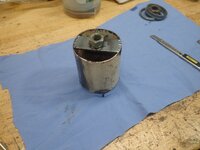
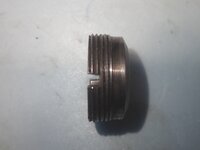
While starting the reassembly process, I quickly ran into an issue with the HP piston packing nut. The bore that this nut threads into is the same bore that the chevron seals and go into. This is the same element of the pump that has 3 chevron seals facing one direction and two facing the opposite orientation to seal the suction side of the pump stroke. With the chevron seals already fitting tight, once they were installed into the bore, I feared damaging them if I had to pull them back out. When I tried to tighten the packing nut after installing all the seals, I found that the first few threads of the packing nut were damaged and would not engage with the internal threads in the pump, not allowing me to load the packings and help to seat them in place. Fortunately, the material that the pump piston is made from is a hardened carbon steel, so the internal threads were in good shape despite the packing nut being ruined.

You can see the first few threads have the crown galled off of them, preventing them from engaging.

Hp%20Piston%20Packing%20Nut%20Bad%20Threads.jpg

This is a model of the seal arrangement. I created CAD files for nearly all of the components for future reference. The soft goods were hard to measure accurately, but the files are quite good for all the hard components of the pumps and rams.

HP%20Piston%20Packing%20Section.jpg

My father has a lathe at his home and has always wanted to become more confident in his threading ability, so I sent the old packing nut his way and let him play around with it. Luckily it is a pretty simple part. I realized I put it all together before even taking pictures of the new part, but everything worked smoothly. There are still a few quirks though. On the original packing nut, it appears to have been staked to the pump ram after assembly. When I disassembled it and when I put it back together, the chevron seals would have to be way over tightened to get the packing nut to seat far enough down for the face of it to be staked. Because of this I relied on some Loctite to hold the packing nut in place. I am not sure what the difference is, but I will probably pull the pump ram after a few times using to the jack to see if the chevron seals consolidated more. It is also possible that the original Blackhawk packings had a slightly lower stack height, accounting for the difference.

The amount to tighten this packing nut was a guess at best. With the seal arrangement on the pump any leak through will be from the HP piston to the LP piston, so it will not be visible from the exterior of the jack. I tightened it snugly to the point where the HP pump had a fair amount of smooth drag on the piston without any of the rubber packing seals installed.
 
OP
M

MBeaty

Well-known member
Joined
Feb 1, 2010
Messages
237
Location
Middle Tennessee
For the chevron seals on the main ram, the seals are preloaded independently of the rubber packings. The ram stop ring is threaded and is designed with 4 pin holes in the face used to tighten the stop ring against the chevron packings. After they are loaded, the packing rings can be installed and loaded independently using the packing nut.

Apparently, Blackhawk used to have a specialty tool to use for torquing the ram stop ring. In a pinch, it could be done with a narrow punch or two in the pin holes. The difficulty with this approach is the preload on the chevron seals is not very repeatable and there is a higher potential to slip causing the punch to contact the surface of the main ram. To remedy this, I made a face spanner using some 1/8” rods and an old section of pipe split and bent to the appropriate size. I added a nut to the top of the tool so I could use a torque wrench to set the preload, allowing me to have a number to adjust from if it did not work properly after reassembling.

Here is a picture of the bore where you can see one of the pin holes on the ram stop ring for the face spanner.
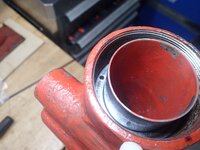
Ram%20Bore%20With%20Ram%20In.jpg

Here is the custom spanner, its not a looker, but it worked well.

Pin%20Spanner.jpg

Pin%20Spanner%20Top.jpg

Initially I torqued the chevron seals down to 70 in*lbs. All appeared to work fine on the jack, but while load testing, the ram slowly lowered. I opened the top cover on the reservoir and could see oil flowing from the ram over travel port from the front of the jack to the rear, which indicated oil as bypassing the main ram chevron seals.

I took the hydraulic unit back off the jack, pulled all of the main ram rubber packings and tightened the ram stop ring to 100 in*lbs this time. The ram still was able to be pushed in by hand, but with slightly more drag than the initial assembly. With 100 in*lbs, the jack held firm for the 2 hours that I tested it without dropping at all. I do not know if this is the proper tightness, but it appears to be working and is not terribly hard to adjust later if it needs to be further tightened.


Overall Thoughts

After finishing the functional portion of the rebuild, here are my thoughts. I do have a good functioning jack, but this work has to be a labor of love. Between the cost involved in the rebuild kit and the time required, most people would be better off getting a newer jack. I enjoyed this project though and learned quite a few things.

Thanks to help from this forum and others who have rebuilt jacks, such as Steve Bryant whose thread can be found here with advice from Willy-C and Highball.

https://www.garagejournal.com/forum/showthread.php?t=101909&highlight=blackhawk+steve

Here is a quote from Steves Thread by Willy-C that I used as my guide.

"strip all pistons, packing nuts, retainers, valve plugs.....leave the adjustable overload cartridge together but remove it to expose the valves....

Scrub, flush base with solvent cleaner or carb spray....use carb spray with nozzle to reach inside the ports where valve ball reside.....one thing that I remember about the valve seats is the 7/32 suction valve ball seat can be worn too deep......hopefully you won't run into that......

Do not mix up valve balls and 2 stage trip spring/poppet

Polish everything that moves or drags on moving parts (glands, sleeves ect)....

Inside the pump chamber in the back there is a stud that can be removed with an allen wrench......I used to remove it for polishing (bore too) and use the same part to adjust the tension on the small v packings inside the pump piston when you start putting it back together.....

When you start to put everything back together you should be on clean table/rags.....clean tools, clean grease AND CLEAN HANDS..!!....then blow out completely with compressed air

Soak the packings in oil (some folks do it overnight)....use clean grease sparingly on the v packings......

Best to install valves, 2 speed poppet, overload valve (DON'T OVERTORQUE IT) first (in case you have to blow it out with air)

preload the v packing set inside the pump piston using the stud that was removed inside the pump chamber.....the stack height of all these v packing sets are very sensitive so be careful to put back the same amount of v packings......there should be a healthy drag on the v packing set but not too tight......

when installing the v packings in the pump chamber and ram chamber put them in loose and tighten them up with the plungers installed (not too tight) with a healthy drag using a small punch (don't marr the piston surfaces), then the pump and ram packings can be installed afterwards (one at a time), then the packing nuts......

The overload may not need to come apart cuz you can visually see if it's not holding a load when testing.....If needed then you can pull it after the whole jack is together if it leaks by......

I'm sure I missed something, the others can chime in if so.....

It has been a while since I've done one but the principle is the same as any jack, they all have there strange tricks.....

Most of the blunders I've seen was the V packings not in right, too loose, too tight, not the right height, twisted in place......well you get the picture

Hope this helps....

Willy-C...."


In addition to the advice from above, I would add in the following.


  • Insert all of the rubber packings very slowly and work in small steps incrementally around the circumference of the seal. It is easy to get the seals to “capsize”, but difficult to pull them back out. I ended up ruining one that did “capsize” while removing it, but fortunately the kit came with a spare.
  • Be sure everything is ready for assembly prior to putting any of the chevron seals in. They fit quite tightly and depending on the orientation of the lips would be nearly impossible to remove without damaging.

  • If you want to rebuild an older jack like this, be prepared for the project to take a while, especially if there are unknown issues, such as the galled threads I found on the HP piston packing nut.
 
Last edited:

Teufelshund1097

Active member
Joined
Jan 14, 2016
Messages
33
Location
The Great Lakes State
MBeaty; thanks for all the work you've done documenting the process of rebuilding the S4. I recently acquired one of my own and have read this thread over several times, along with others like it. The information contained in your post, especially the recently added details, will help tremendously when I get to the the point of putting it all back together. Unfortunately, I've wasted a ton of time trying to figure out how to rebuild one the the rear casters on my own S4, which must have sat in a puddle of salt water in the corner of somebody's shop for several years... It seems that the bearing/race design has no modern equivalent, at least none that I've found. So, at this point, I am only half way (more/less) through the disassembly. I hope you will be around and check in from time to time in case anything comes up in the future...;)
 
To avoid these ads, REGISTER NOW!

Kazimodo

Member
Joined
Jun 17, 2013
Messages
9
Impossible to see any of the images posted by MBeaty ,
all i getis a description of the image , clicking on that gives nothing ...
using Google Chrome browser on win 10
same issue with Microsoft Edge.
.
switching from Canada to USA with VPN does not help ...
.. MBeaty  (1225).png
 
Last edited:

ALTEREGO

Well-known member
Joined
May 15, 2018
Messages
420
Location
@HOME
Impossible to see any of the images posted by MBeaty ,
all i getis a description of the image , clicking on that gives nothing ...
using Google Chrome browser on win 10
same issue with Microsoft Edge.
.
switching from Canada to USA with VPN does not help ...
.. MBeaty  (1225).png
Can't see his pictures either, I'm in the US.
 

CACO4X4

New member
Joined
Aug 17, 2025
Messages
1
Read the whole post but missed what to use to clean the old gunk from inside the pump.
Was it kerosene that doesn't damage the seals.
Thanks for any advise
Caco
 

dunerdr

New member
Joined
Jun 3, 2026
Messages
4
I have a S4 that is complete it will raise fast, but when it is put under a load it will go no further.
Any help would be most appreciated. I have changed the fluid and did a little clean up.
 

dunerdr

New member
Joined
Jun 3, 2026
Messages
4
I raised a car with a different jacck and then put my old jack under it and released the newer jack and it held.
It will raise about 100 lbs.
 

Hiball

Well-known member
Joined
Apr 30, 2009
Messages
14,027
Location
Missery
Any History on it? Rebuilt Recently? Anybody messing with the Valve components? It’s possible based off the design for the Power side to be compromised and not show immediate signs of leakage.
 

dunerdr

New member
Joined
Jun 3, 2026
Messages
4
I have no history on what has been done to my jack. If you have any thing that my help i would appreciate it.
 
To avoid these ads, REGISTER NOW!
Top Bottom