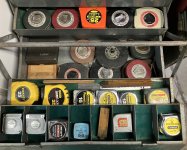
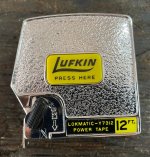
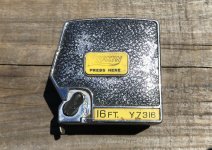
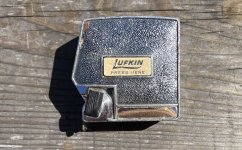
It's a lot cleaner than the one that's been carried in my tool bucket or bags for decades, too.Yours is cleaner than the one I have. I just learned the ease of use of that extension in the very recent past.
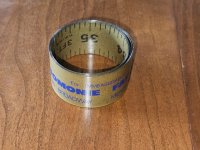
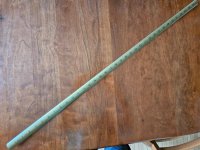
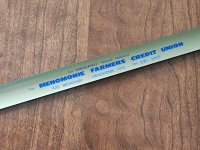
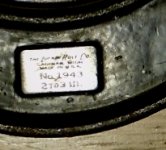
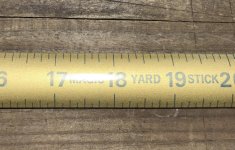
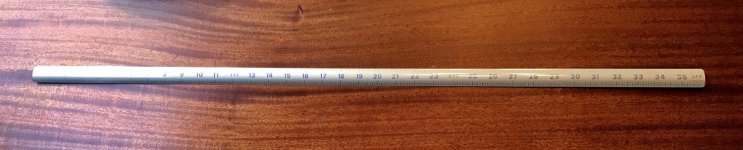
This sounded very familiar, Jim.Discovered this collapsible yardstick in my desk the other day. It's a Lufkin and I would guess late 1990s due to the name of the credit union which changed in the 90s. This would have been a patron gift at an annual credit union meeting.
@PelicanPines posted one to the Rules and Tape Measures thread. His, too, was a complementary gift, from a funeral home of all places!If anyone else is interested in the patent (2,956,795, Oct 18, 1960), it was for the underlying mechanism at work, a spring constructed of a flat band or ribbon wound into a coil, and not owned by Lufkin. The inventor (Foster, Austin, TX) intended it for many uses, such as a retractable lamp. He did include a tape measure in his diagrams.


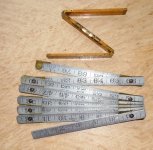
Researching this level/rule I found Lufkin also made a similar 2 foot tri-fold rule with a level, No. 2062, and another 12" No.2051. God knows how many other models/makes were on the market...^Nice! I've never seem the tri-fold with level before!
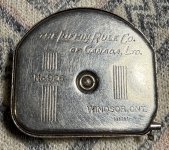
I’m guessing the difference might be that mine is Canadian and yours is American. There might have been different rules to follow. But then I’m only guessing.

Some Mezuralls had patent numbers on the tape itself, as well; that could help narrow it down more.
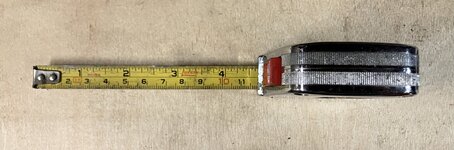
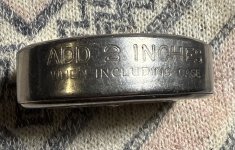
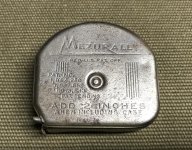
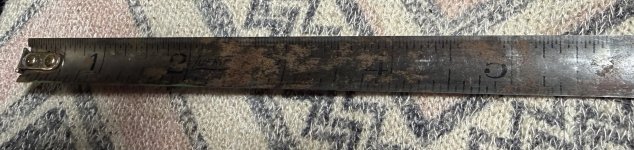
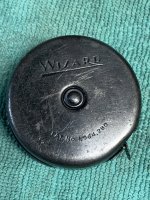
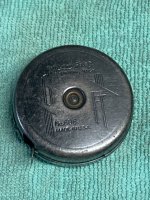
Unfortunately my tape is not the cleanest. The only marking I could find was the Lufkin logo just past the 2” mark on the tape. I pulled it out to 58 inches.FWIW, the US one was made after January 15, 1935 and before June 26, 1951. The Canadian one was made after June 1936 and definitely no later than November 8, 1949. Some Mezuralls had patent numbers on the tape itself, as well; that could help narrow it down more.
Both were probably made before 1949 (1947 is the last Lufkin catalog that shows plain steel cases on the Mezurall; the 1949 catalog shows inset plates on the sides).
At the time these patents were granted, the expiry was 17 years from the day the patent was granted, in both the US and Canada. (US patent 1,964,280 was granted on June 26, 1934, so would not have appeared after June 26, 1951, and so on.)
For the US, the Pat. Pending unfortunately doesn't help; it means Lufkin filed for another patent, but unless there's another Mezurall 926 with a later patent number, there's no way of knowing if it was granted, and there is no way I know of to look up rejected patent applications.
The Canadian one is different because it has patents that were filed in Canada, and while the term was still 17 years, the rules for dispolaying them on items were different. The November (8th), 1932 patent is 327477; that was the only patent that month assigned to the Lufkin Rule Co of Canada. It's the Canadian version of US patent 1,973,843. (Yes, it was granted nearly two years before the US patent; both applications were filed in 1931, the Canadian one was just granted faster.)
The July (30th), 1935 patent is at least 352026 (equivalent to US 1,964,280). Patent 352027 (equivalent to US 2,022,756) was also granted to Lufkin Canada that same date, but I don't know if both patents were used for the Mezurall.
On June (9th), 1936, Lufkin Canada was granted four patents - 358400, 358397, 358398, and 358399 (this last one is equivalent to US 1,987,652, and I am calling that good enough because it's nearly lunchtime).

With high magnification in my case. 6-10x and a bright light seems best.passed on it because I couldn’t figure out how to operate it