To avoid these ads, REGISTER NOW!

Kennedy Kits Discontinued

DocsMachine

Well-known member
Joined
Sep 16, 2006
Messages
1,857
'Couple of notes;

One is that in the old days- and to a certain extent today- a person's tools were his own. You bought and owned them, and carried that box from job to job. The latter meaning both in different factories, but also in different parts of the factory.

The company would provide cutters and some specialty tools, but you were responsible for your measuring tools.

The problem there is that Machinist A may have a shiny new mic, and Machinist B has an old and worn one. Machinist B keeps rejecting A's parts as being out of spec, or worse, cutting them to the wrong dimension.

Eventually companies had to start supplying and calibrating the necessary measuring tools.

Another is the fact that switching to a different part is basically just loading a different program. The operator no longer has to carefully fit and adjust a cutter, adjust depth stops , and so on. And, in the case of the above photos of a nice tool assortment, hardly any production machinist needs a tap or die holder, a center gage, a height gage or a spring caliper.

And finally, the simple fact is there just aren't that many of us anymore.

We've all seen pictures of old factories with row after row after row of lathes or mills and the like. That's how production was done back then- a blank would go into the first lathe, where all that guy did was drill centers into each end. That would get handed off to lathe #2 where the guy would set it up between centers and turn the OD to a single size. Off to #3 where a step might be machined on one end. And so on 'til a finished pump shaft came out the other end.

An old article about Smith & Wesson said that a revolver sideplate went through something like a hundred and thirty machines before getting hand-fitted to a receiver. Mills, drills and shapers, each one making just one cut using a jig or fixture.

And of course with the advent of CNC, one machine and one operator can now do the job of those hundred-plus machines, each one needing a separate operator. (Ian at Forgotten Weapons has spoken a couple of times about display that FN has at their Belgian plant, showing a whole row of a dozen or more separate machines used to produce a single part.)

Doc.
 
To avoid these ads, REGISTER NOW!

Lassen Forge

Well-known member
Joined
Apr 26, 2014
Messages
15,115
Location
The romantic hills of central Umbria, Italy,
My son is a junior in high school, and he’s in CNC machining class at the Tech Center. The first year of the course is strictly manual machining , they don’t even get to look at a CNC machine until they pass all the manual mill and lathe benchmarks the first year.


Funny enough…upon graduation they a US General box full of Starret and Haas measuring tools.

You don't know how much this makes my heart sing, and gives me hope for the future!!! :love::love: That a high school actually values and teaches the "ancient and archaic arts" of machining?? My God, maybe there is still hope left in this old world!!!

Thank you for that shot of encouragement and hope!!! And my best wishes to Lillysdad, jr... you keep on rockin'! You got someone pulling for you 9 time zones away!!! :cool:
 

dr_clyde

Well-known member
Joined
Jan 7, 2009
Messages
6,438
Location
Holland, MI
You don't know how much this makes my heart sing, and gives me hope for the future!!! :love::love: That a high school actually values and teaches the "ancient and archaic arts" of machining?? My God, maybe there is still hope left in this old world!!!

Thank you for that shot of encouragement and hope!!! And my best wishes to Lillysdad, jr... you keep on rockin'! You got someone pulling for you 9 time zones away!!! :cool:
I still think this is pretty common, at least in the tech school world.

On the job training is a bit different as employers tend to only teach the things that will directly make money.

It is a lot cheaper to teach the basics on a manual machine, vs crashing a CNC right out of the gate...
 

Sweetcorn

Well-known member
Joined
Feb 14, 2018
Messages
671
Location
North Central Ohio
I'm sad to hear about the Kennedy boxes, and a little surprised. Theyre still very popular with my guys, even though they've really jumped in price in the last few years.

As far as training and new people is concerned...

I manage and train a lot of people, including apprentices in Tool and Die and Mold Making, among other apprenticeships. I have a lot of connections to others in my "world" with apprentices of their own as well.

If you are comparing training at a production machine shop to training at a tool or mold shop, thats not really a fair comparison. I make sure all my apprentices are well versed in manual machines all the way up to 5 axis CNC mills and everything in between. The successful people I know who are also bringing up apprentices do the same. Of course, we aren't training people for production jobs that will be replaced with robots ASAP, either.

Toolmaker and production machinist are two entirely different worlds. It's skilled labor vs labor.

There are plenty of shops that do a ****** job training people, for sure, but as someone in the thick of it, I see a lot of great programs amongst the people I know.

Everyone likes to dump on how lazy the younger workers are, too, but man I see a lot of smart and talented younger people out there. They adapt to the tech side of things so fast and want to learn.

It's not all bad out there.
 

CHI_Tool&Die

Well-known member
Joined
Jul 20, 2021
Messages
1,379
Location
Chicago, IL
Manual machinists around here will never compete with CNC guys for pay. We are also at the point where a good CNC machine with the right tools and programming can do so, so much more than anything a manual guy can do. It’s absolutely crazy watching the new stuff come out of IMTS. The shop I’m at is slowly starting the process of moving the tool and die guys and machinists into a more automated system. Heavy focus on PLCs, set-ups, and maintenance and less on speeds, feeds, and the rest. Automation, robots, and multi-purpose CNC machines are where it’s at now. Knowing the basics on manual machines is nice but I am a firm believer that new guys entering the field should be well-versed in blueprint reading, GD&T, G-code/basic programming and/or CAD/CAM. Those things are crucial. Every shop is going to teach their way of machining but they are absolutely going to expect new guys to understand blueprints and the lingo without any OTJ training.

We recently received a post-Cornwell takeover Kennedy and I think they have taken a step back. It’s just not as nice as my pre-Covid stack which isn’t as nice as some of the guys older boxes. I’ve been eying a new Matco box with their veined texture paint just because it comes so close the Kennedy brown wrinkle. I wonder if Kennedy won’t be able to provide replacement parts for their Signature Series boxes moving forward.
 

Zebu Fellenz

Well-known member
Joined
Aug 3, 2010
Messages
1,687
Location
Phelps, NY
I'm not surprised, they built a lot of those boxes and a whole lot of them are still in use or at least usable condition. I just checked Marketplace and found more than 20 Kennedy boxes locally. Several listings of really nice condition boxes that note new cost of $800 or more priced a 2-$300 and not selling.
 

MiteyF

Well-known member
Joined
Feb 26, 2022
Messages
137
Manual machinists around here will never compete with CNC guys for pay. We are also at the point where a good CNC machine with the right tools and programming can do so, so much more than anything a manual guy can do.

CNC can make things that a guy on a manual machine could never make. But there is plenty of work that's just not feasible for a CNC. The first thing that comes to mind (most of what I was doing at my last 2 jobs) is repair work. Fixing old parts that haven't been available for years or decades. The work isn't always necessarily complicated, but the setup for each part is unique enough that a CNC just doesn't work.
 

Brandon_oma#692

Well-known member
Joined
Apr 20, 2011
Messages
263
Location
North West corner of Illinois
I have a Craftsman 52"? I think it is roller with the top box for all my metrology stuff. New US made one that worked well for this. Dad brought most of his and put it in a Us general series 2 44" roller with his Gerstner on top.

I have a US general series 2 26" roller with top for the cnc lathes with collets, tool holders and inserts, indexable drills, reducer bushings, additional tool turret blocks, live centers, and soft jaws. Soft jaws need to go to something else. US general series 2 26" roller at the cnc mills with inserts, collets, boring head stuff, Haimer and commonly used indicators. On top of it is hold downs, parallels, haas cat 40 fixture that doubles as a "surface plate". I had cat 40 tool holders in it with tools also until i got a couple carts made to hold them. I feel the series 2 us general boxes have a good drawer layout for this. Not sure what I will buy when I need another one.

Old side of the road free twisted craftsman roller full of end mills with drill bit cabinet on top of it. Little snap on one above it for taps and carbide drills.

I looked at used Kennedys and like them. Just not enough space for what I wanted. Sad to see them go.
 
Last edited:

CHI_Tool&Die

Well-known member
Joined
Jul 20, 2021
Messages
1,379
Location
Chicago, IL
CNC can make things that a guy on a manual machine could never make. But there is plenty of work that's just not feasible for a CNC. The first thing that comes to mind (most of what I was doing at my last 2 jobs) is repair work. Fixing old parts that haven't been available for years or decades. The work isn't always necessarily complicated, but the setup for each part is unique enough that a CNC just doesn't work.
Set-up can **** for sure. I ran a CNC VMC as a first year journeyman doing nothing but one-off rework and repairs. It was annoying but doable. Really depends on what resources are available at your shop and how much you trust your program.
 

MiteyF

Well-known member
Joined
Feb 26, 2022
Messages
137
I prefer one-off work myself. It keeps things interesting. I don't think I've ever machined more than a handful of any one part.
 

zendriver

Well-known member
Joined
Dec 10, 2014
Messages
29,822
Location
Indiana
I just scanned some listed manual machinist jobs in my region.

Most under $30/hr. Is that a lot of money? :headscrat

As far as the typical "machinist tool box", does one ever own more than one their entire career? :dunno: Might be why Kennedy is in the doldrums. An industry that has lost any growth, decades ago.
 

1982fxr

Well-known member
Joined
Jan 7, 2012
Messages
10,003
Location
Phoenix
Just picked up a 3611. I know people will say that big top middle drawer is for the Bible but, it's way deeper than it would need to be for that and has no hole in the bottom of the drawer to pop it up through. A weird thing for a company like Kennedy to miss if that was its intended purpose.

The new ones with a separate lock would suggest personal items. Again, way deeper than needed.

I wonder if they were simply matching the standard combined height of the 3 drawers next to it.
 

driftpin

Well-known member
Joined
Dec 22, 2016
Messages
11,226
Location
Miami-Dade/Broward Co. Florida
I'm not a machinist. I do have a couple of Kennedy 7-drawer toolboxes, and a Kennedy cantilever box. The cantilever sits nearly-empty but the one 7-drawer holds some tools I still use, including a Craftsman jeweler's screwdriver set in a dark-blue and clear-plastic friction-fit upright container. That bears scars of being 'discovered' by my red doberman who was about 2 when I got him. It has his chew-marks, but no-way would I have taken the entire case/back to Sears in an attempt to get it replaced.

The doberman was an ex-police dog, and after a short time to acquaint himself with me, we became the best of friends. He lasted 17 years from birth before he was euthanized, due to cancer.

I have a probably 1960's Sears Roebuck red machinist's chest, 11 drawers I think it has, filled w/a mix of HSS drill bits, taps, and a variety of other things, mostly hand tools. About the only precision tool I own is a 0-1" Starrett micrometer. Bought used, I sent it back to the factory for cleaning and re-setting. I use it to measure DOHC valve settings on my motorcycles.
 

mikey03

Well-known member
Joined
May 17, 2024
Messages
2,085
With the advent of CNC, modern machinists, I believe, don‘t need, use, own (or even know about) the tools these boxes were designed to store. Even inspection is pretty much a CNC process now or digital caliper based.
what tools used to be in them that aren’t needed no more?
 

mikey03

Well-known member
Joined
May 17, 2024
Messages
2,085
Just picked up a 3611. I know people will say that big top middle drawer is for the Bible but, it's way deeper than it would need to be for that and has no hole in the bottom of the drawer to pop it up through. A
you mean like a actual bible or a machinists bible book of some kind? Like a reference?
 

CHI_Tool&Die

Well-known member
Joined
Jul 20, 2021
Messages
1,379
Location
Chicago, IL
Just picked up a 3611. I know people will say that big top middle drawer is for the Bible but, it's way deeper than it would need to be for that and has no hole in the bottom of the drawer to pop it up through. A weird thing for a company like Kennedy to miss if that was its intended purpose.

The new ones with a separate lock would suggest personal items. Again, way deeper than needed.

I wonder if they were simply matching the standard combined height of the 3 drawers next to it.
I keep my handbook in there along with my work ID and a bunch of quick reference books. The extra lock I assumed was due to just how pricey the bibles have become. Mine was >$100 15 years ago. It fits perfect in there.
what tools used to be in them that aren’t needed no more?
Probably thinking of things like v blocks, Grindalls, end-mills, taps, dial indicator stands, and all the other stuff that a lot of shops today have available for people in the tools crib or in the CMM labs. Most shops still expect machinists to have basic hand tools and inspection tools.

I still think Kennedy ***** for discontinuing their machinist’s boxes.
 
To avoid these ads, REGISTER NOW!

AEAdam

Well-known member
Joined
May 27, 2023
Messages
2,737
Location
SE PA
what tools used to be in them that aren’t needed no more?
Look back at page one for some pics.

Spring calipers were pretty essential for lathe work. Layout tools of course.

Bear with me: Years ago I saw this tv show about the German WW2 Messerschmitt Bf (Me)-109 engine. It was fuel injected and inverted, so a zero g push over didn’t starve the engine. The show was about the tolerances (fits I think) inside that engine that were so precise, those engine parts could not be manufactured today with modern machinery. ********, I thought. There’s this fantasy about ww2 Germany, and their (alien) technology. They were clever for sure, but couldn’t seem to make a decent 4 engine bomber.

Here’s the deal: Before CNC machines, precision was achieved by sneaking up on dimensions, cutting measuring, tweaking, recutting, honing. In this way, manual machinists could work to the tenths (.000X“). Bf-109 engines would have been bored incrementally then honed. If you compare these tolerances with those of a bog standard CNC mill, yes the manual methods could produce amazingly accurate parts (but not faster). Since that show, I forget how long ago, CNC mills can now measure while they cut. These are sometimes called “closed loop” systems.

But here’s the point, inspection tools weren’t just for QA, they were used during the machining operations. You cut and measure, cut and measure. So all those tools were in all those machinists boxes.
 

MushCreek

Well-known member
Joined
Jan 14, 2015
Messages
9,763
Location
Upstate South Carolina
I know in the mold making trade we had all sorts of polishing equipment- ruby sticks, regular stones, holders, etc. Although the company usually provided new stones, it's common to shape them for a specific task and then store (hoard) them for future use. I still have hundreds of them six years into my retirement.
 

mikey03

Well-known member
Joined
May 17, 2024
Messages
2,085
Look back at page one for some pics.

Spring calipers were pretty essential for lathe work. Layout tools of course.

Bear with me: Years ago I saw this tv show about the German WW2 Messerschmitt Bf (Me)-109 engine. It was fuel injected and inverted, so a zero g push over didn’t starve the engine. The show was about the tolerances (fits I think) inside that engine that were so precise, those engine parts could not be manufactured today with modern machinery. ********, I thought. There’s this fantasy about ww2 Germany, and their (alien) technology. They were clever for sure, but couldn’t seem to make a decent 4 engine bomber.

Here’s the deal: Before CNC machines, precision was achieved by sneaking up on dimensions, cutting measuring, tweaking, recutting, honing. In this way, manual machinists could work to the tenths (.000X“). Bf-109 engines would have been bored incrementally then honed. If you compare these tolerances with those of a bog standard CNC mill, yes the manual methods could produce amazingly accurate parts (but not faster). Since that show, I forget how long ago, CNC mills can now measure while they cut. These are sometimes called “closed loop” systems.

But here’s the point, inspection tools weren’t just for QA, they were used during the machining operations. You cut and measure, cut and measure. So all those tools were in all those machinists boxes.
Is there any reason to do it the old way today? Idk anything about this stuff. How much is a small CNC machined compared to a old school lathe?
 

Firebrick43

Well-known member
Joined
May 12, 2015
Messages
14,018
Location
West central Indiana
None of the factories I have worked in required any tool box what so ever. Few of the guys under 45 had any tool box. Many older machinist had a gerstner or kennedy top box but it was more for personal effects storage than actual personal tool storage. I have seen some with more condiment packets and plastic cutlery than anything.

Listas and Kardex vertical storage was provided for all tool/cutter storage as well as measuring tools at/near the machine. Serious measuring done in the CMM rooms. No layout needed with nearly everything CNC performed with CAD/CAM.

Most of the tool room guys still had a gerstner or kennedy set, a few that could't throw anything aways had a second box packed with drills and endmills that "some day" would get resharpened. But these guys were a small percentage of the workforce compared to 40 years ago.
Even in my personally in my small shop, I have pulled everything out of my traditional wrinkle brown machinist top box and put it in a 26" HF general box. Better organization especially coupled with gridfinity and my surface plate and height gauge has a nice place to sit on top.
 

AEAdam

Well-known member
Joined
May 27, 2023
Messages
2,737
Location
SE PA
Is there any reason to do it the old way today? Idk anything about this stuff. How much is a small CNC machined compared to an old school lathe?
A CNC mill or lathe will produce work based on its stiffness, quality, wear etc etc. Pro grade commercial CNC mills can churn out parts accurate to around +/-.005” all day long. If that’s good enough, and it very often is, they are the right tool for the job.

A decent manual machine is really only limited by its user. This is more true of Mills than lathes, though one can make good parts on a worn lathe. It’s just harder.
 
OP
D

DaveAndStuff

Well-known member
Joined
Feb 3, 2026
Messages
305
Is there any reason to do it the old way today? Idk anything about this stuff. How much is a small CNC machined compared to a old school lathe?
Volume makes a big difference. One-off simpler parts, or higher volume parts that that can be fixtured are often cheaper on manual machines.

With stampings, we'd say that up to about 5,000 parts a year, a turret press was cheaper. Over that, you can justify hard tooling.
 

AEAdam

Well-known member
Joined
May 27, 2023
Messages
2,737
Location
SE PA
One more thing about CNC etc. Some imported parts are built cheaply by hand. The machines are cheap and the labor is cheaper.

Next level up are parts machined on CNC. And there’s a huge range of cost and quality.

Up at the top of quality are products made by hand again. Some aircraft and most spacecraft are hand made. The really important parts of jet or rocket engines are hand made. Most cars are assembled by robots. But the highest end race cars etc are hand built.

For a look at the highest level of machining by hand, search for Robin Renzetti @Robrenz on YouTube.
 

MushCreek

Well-known member
Joined
Jan 14, 2015
Messages
9,763
Location
Upstate South Carolina
When I was building connector molds, they didn't lend themselves to a lot of automation. Tiny parts held to .0001" tolerance. Lots of sharp inside corners, and back then .004" WEDM wire was the cutting edge (pun intended). Now they're down to much smaller wire, but it still only works on a through hole. We did lots of blind pockets, so a lot of EDM work. Some of the parts we made were measured in millionths and had to be lapped to size. Very expensive, labor-intensive molds.
 

hailwood1965

Well-known member
Joined
Nov 28, 2014
Messages
160
I do hand layouts. It’s often the way I design/prototype. So I blue up parts, use my surface gages for actual surface gage work (scribing, not just as indicator bases) in conjunction with my surface plates. I use hss and carbide scribes, various squares, bevels, the protractor heads on combination squares, rulers, then *****, center punch or transfer punch hole centers.

I prefer my old school depth gage for a lot of layout work. I also use my tiny diemakers' double squares. It's good to have more than one for repeated measurements/layout work. Of course, depending on the size of part I have larger versions of all this, 6 and 8” calipers, many sizes of squares, etc.

I'm between metal lathes at the moment, but sometimes turn stuff on my mill. I have beautiful round armed spring calipers (and dividers) I use to check diameters, bores, features in a range of sizes. These look like tools from a bygone era, but are really fast accurate ways to check work on a lathe, even (especially) while turning.

Then there’s all the inspection and measuring tools that I advise are the first tools home shop machinists need, just so they know what they have. So that’s the afore mentioned surface plate(s), master squares, I have a granite square, granite parallels, super good 123 inspection” blocks", then gage blocks. I need a set of gage pins. Then mics in a range of sizes (I have 0-6"), a dizzying array of indicators and their holders, rulers, hole gauges, feeler gages, thread pitch gages, taper gages etc etc.

The Kennedy 520s and 526 boxes were made to store all the hand layout stuff. I'd call this "basic machinist's tools" and I personally think every machinist should know what these tools are, know how to use them, and I think hobby machinists should have all this stuff. And it's cheap to buy second hand. This is the stuff that was in Grandpa's box that was stolen, sold, given away and has left the box only with the random lathe bits.

In addition to these tools are what I would call machinists' "tooling". That list includes (in my mind) tool and work holding fixtures, like drill bits, cutters, taps, sometimes dies, speciality collets, stuff like boring heads & bars, fly cutters, I'd put center finders and edge finders in this pile. Not sure where they belong, but hones, scrapers, de-burring tools I keep with my cutters.

For work holding, manual machinists used a variety of setup tools and a lot of creativity. 123, 456 blocks, vee blocks, parallel clamps, edge clamps), parallels & adjustable parallels. dowels, the ever present copper wire and cigarette rolling papers (for uses only machinists understand).

You can see why machinists might need more than 1 Kennedy box.

Note: The list above doesn’t include the hand tools a machinist needs every day. The base rollers are where machinists might store their wrench and allen wrench sets, screwdrivers, pliers, hammers, punches, drifts, files, hack saw, scrap materials etc.

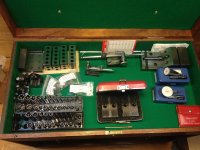
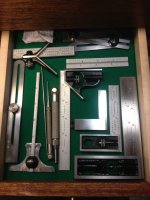
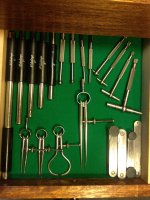
These aren't recent pics and obviously not my Kennedy boxes but it will hopefully give everyone an idea of the tools Machinists tool boxes were designed to store. These tools aren't special or unique. They would have been pretty typical 50 yrs ago. And while I've polished some, these tools aren't new and weren't expensive:

IMG_0863.JPG
One reason for tiny layout tools is that I sometimes am doing layout work on workpieces already in the mill vise, possibly already squared up/worked. You can see my depth gage on the left which I really like using. It retains a tiny bit of the original "salt bluing" which produces a psychedelic multi-color pattern that is a corrosion inhibitor. That's a "junior" combination square set which uniquely can interchange its blades with the 4" double square. The normal 6" combination square cannot. That gives me a little more flexibility.

IMG_0868.JPG
Just a few of my many spring calipers, hole gages, mic standards, then feelers.

IMG_0855.JPG
Upper right is a Hermann Schmidt grind vise. Below that are a few of my many test indicators. Top center are surface gages. A set of Starrett "inspection" blocks are below them. Top left is a Schmidt angle block and 2 pairs of 123 blocks. Below that are Starrett Vee blocks then obviously sockets. (Hermann Schmidt stuff is really special.)

IMG_0865.JPG
Including this pic just for you to look at what tap and die handles used to look like. The die handles are from Greenfield Tap & Die, Greenfield Mass and are probably 75 yrs old. These were made by people who really gave a **** about their work, took pride in making fine tools for people who would use these tools professionally. I touch up the bluing using cold blues to keep this sort of stuff looking like this (including the thread pitch gage screws).

A lot of these tools can be found really cheap and often pretty corroded. But this is what they would have looked like in their day and when well cared for. I find stuff like this inspiring. It sets the standard that I strive for in my own machine work. Elegance, superb surface finishes, & beautiful functionality.
I'm convinced drawers this clean mean exactly zero work gets done with any of those tools.
 

MiteyF

Well-known member
Joined
Feb 26, 2022
Messages
137
I'm convinced drawers this clean mean exactly zero work gets done with any of those tools.

That's about how my 11 drawer looked when it was my work box. Granted, mine doesn't have any felt, because you can't clean it.

More work gets done with tools in a neatly organized box, because you don't spend an hour looking for the tool you need, grinding a new piece of HSS, tracking down the oddball tap you know you used a week ago, or asking Johnny where the **** he put your favorite dial calipers when he borrowed them.

I also know people who wipe down each tool before they put them back in the box, because when you enjoy using your tools, you do a better job, and when your tools are nasty and dirty, you don't enjoy using them.

Clean box, clean work.
 

dr_clyde

Well-known member
Joined
Jan 7, 2009
Messages
6,438
Location
Holland, MI
One of the things that always frustrated me about Kennedy boxes is how people used them for things they weren’t intended for and then complained when they didn’t hold up.

They are not supposed to hold tooling. They are meant to hold *precision hand tools*.

Taps, tool bits, cutters, inserts, vise jaws, all manner of setup tools, etc don’t belong in a Kennedy top box. That stuff gets HEAVY and it should be in a *tooling cabinet* such as a Vidmar or Lista.

Kennedy boxes are meant to hold stuff like calipers, micrometers, indicators or other small and delicate hand tools that would be otherwise damaged, buried or hard to access in a typical mechanics box.

I recently sold a Kennedy setup, and while asking a die maker friend if he knew anyone interested in buying it his words were “no one uses those anymore, they can’t hold up when you fill them full of carbide cutters”. I just was floored that people’s instinct was to try to load these friction slide, tiny drawer toolboxes with end mills, blocks of tool steel and other heavy equipment and then complain when they fail.

If they are used as intended, they’re fantastic boxes. If you try to load them like a Vidmar or Snap-on roller, you’re going to have a bad time.
 

MushCreek

Well-known member
Joined
Jan 14, 2015
Messages
9,763
Location
Upstate South Carolina
My old Kennedy rolling chest had drawer slides without bearings. They got so bad that the thing would move when you tried to open a drawer. Even cleaning and greasing didn't help much. I retired it and bought a Harbor Freight with rollers. Still have it; still works perfectly.
 

dr_clyde

Well-known member
Joined
Jan 7, 2009
Messages
6,438
Location
Holland, MI
My old Kennedy rolling chest had drawer slides without bearings. They got so bad that the thing would move when you tried to open a drawer. Even cleaning and greasing didn't help much. I retired it and bought a Harbor Freight with rollers. Still have it; still works perfectly.
Yeah the old roller cabs with friction slides are trash.

The top boxes had small enough drawers that the friction slides weren’t a problem, but it was way too easy to overload the roll cab drawers.
 

MiteyF

Well-known member
Joined
Feb 26, 2022
Messages
137
My old Kennedy rolling chest had drawer slides without bearings. They got so bad that the thing would move when you tried to open a drawer. Even cleaning and greasing didn't help much. I retired it and bought a Harbor Freight with rollers. Still have it; still works perfectly.

I had a kennedy roller with friction slides. Got it for a killer deal. Hated it. If it's got wheels on the bottom, it better have bearings on the drawers.

My Craftsman, US General, and other boxes are all worlds ahead of the Kennedy roller, for a fraction of the price.
 

MushCreek

Well-known member
Joined
Jan 14, 2015
Messages
9,763
Location
Upstate South Carolina
When I bought it in the 70's, they were considered to be the best. Being a tool maker, I had a LOT of weight in it with sine plates, 1-2-3 blocks, angle plates, grinding vises, you name it. Way more weight than wrenches, sockets, and screwdrivers.
 

ecotec

Well-known member
Joined
Oct 5, 2010
Messages
5,431
This is going to be more of an issue in the middle of nowhere. Places far from industrial areas.

There are a lot of Kennedy boxes in this area, and they often sell for very little.
 

dr_clyde

Well-known member
Joined
Jan 7, 2009
Messages
6,438
Location
Holland, MI
According to a quick google, ball bearing drawer slides weren't really a thing until the late 80's for toolboxes, and even then it was limited to the higher end boxes.

It seems up until the last 20 years or so friction slides were the norm. Not sure what took toolbox makers so long to change, but it probably is the biggest shift in box quality and longevity that I can think of.

For some reason, Kennedy resisted that change for way longer than other makers.
 
To avoid these ads, REGISTER NOW!
Top Bottom