To avoid these ads, REGISTER NOW!

Tool Organisation Was the Wrong Question — We Should Optimize for Speed of Retrieval, Certainty of Return & Protection of Value of tools.

OP
S

sarel.wagner

Well-known member
Joined
Jun 2, 2010
Messages
346
Location
Centurion, Gateng Province, South Africa
^^^Exactly^^^ It really is this simple.

No offense intended, but from here it appears that the OP is overthinking this issue.
No offence taken. That was nowhere near enough for me. As stated in the beginning, I still managed to mess it all up. I need more than that, hence me following this route, and posting here about my journey.
 
To avoid these ads, REGISTER NOW!
OP
S

sarel.wagner

Well-known member
Joined
Jun 2, 2010
Messages
346
Location
Centurion, Gateng Province, South Africa
I worked in a commercial wood shop for many years.
Each workbench had a work-in-progress (WIP) bin mounted on the side. If you were temporarily done with a tool or material, it would go into the WIP bin. This does 2 things. It unclutters the workbench and it makes for easy retrieval if the item is needed again. At the end of the day, all items in the WIP bin were returned to their proper storage location. I use that system in my home workshop now but I’m less strict about the end of day reset.
Now that is smart, better than only “point of use” because now you can have a place to store tools and not bury them under WIP.
 

NostraThpmas

Active member
Joined
Jul 17, 2023
Messages
35
We also implemented "Put the solution with the problem". For instance, each fixed tool had appropriate measuring and marking tools mounted nearby. Does that create duplication? Yes. Is it more effecient? Also Yes.
 
Last edited:

OccupantRJ

Well-known member
Joined
May 15, 2009
Messages
11,045
Location
Eastern North Carolina
We also implemented "Put the solution with the problem". For instance, each fixed tool had appropriate measuring and marking tools mounted nearby. Does that create duplication? Yes. Is it more effecient? Also Yes.
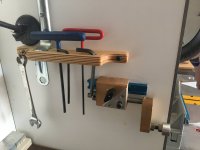
I agree. My point of use strategy has duplicate tools all over the shop. I basically run with the method that when I am working at any given point in the shop and it is noticed that a tool or an infrastructure will improve efficiency and reduce walking a tool gets positioned there. A case in point is files. Since I do mostly refurbishment, repair, and metalwork, there are 7 positions in the shop with files at hand either in custom hangers or in a drawer of the work table. If I am working at a work surface and have to leave where I am to get a tool, one generally gets positioned there. Buying multiple tools at yard sales and flea markets has made this very affordable to do. File rack example in pic.
 

Attachments

  • IMG_1727.jpeg
    IMG_1727.jpeg
    502.1 KB · Views: 53

NostraThpmas

Active member
Joined
Jul 17, 2023
Messages
35
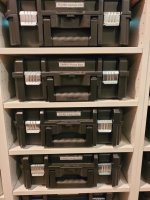
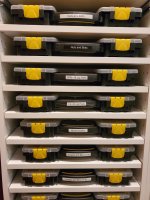
Label anything you can’t see.

I don’t like drawers and cabinets because they are often used as a crutch to hide clutter. Also, you have to open them up to see what’s inside. On the plus side, in a wood shop, drawers and cabinets keep your tools from getting covered in a layer of fine sawdust.

Another term for clutter is “uncategorized”. Once you come up with a category and assign a place for that category, it is no longer clutter.

I tackle the visibility problem by labeling all of my toolboxes, drawers and cabinets.

Note: I do about ½ of my work remote to my shop. I prioritize portability, hence my use of standardized tool boxes.
 

Attachments

  • 20260616_105929.jpg
    20260616_105929.jpg
    589.6 KB · Views: 37
  • 20260616_110111.jpg
    20260616_110111.jpg
    567 KB · Views: 34

mikedodge

Well-known member
Joined
Jun 27, 2017
Messages
2,779
Ive got a a couple different areas I work in. Anything casual or wood related usually goes on in my basement and tools are on a peg board or shelves. In my garage/shop things in the open get dirty faster so everything is in tool boxes. Common to use tools like sockets, wrenches and screw drivers are in the easiest level to reach drawers the less common stuff is in drawers higher up or lower down. Ease of retrieval is speed of retrieval.

Im usually not one to put tools away until a project is done if they're going to be used again unless it's going to be a while before I get to it again or I've got multiple things on the go. I'd rather be able to pick up where I left off with the tools I've been using right there then have to spend time putting things away only to get them out again.
 
Last edited:

NostraThpmas

Active member
Joined
Jul 17, 2023
Messages
35
Im usually not one to put tools away until a project is done if they're going to be used again unless it's going to be a while before I get to it again or I've got multiple things on the go. I'd rather be able to pick up where I left off with the tools I've been using right there then have to spend time putting things away only to get them out again.
Exactly. That's why I'm not too fussed about end of day rules in my home shop. If I break the rules, nobody suffers but me. In a shared shop space it's a whole 'nother can of worms.
 

richfinn

Well-known member
Joined
Jan 29, 2011
Messages
4,813
Location
Leeds, Yorkshire, England
IMG_20251012_150350_168.jpg

I found that I like my most used tools stored vertically with handles pointing up, I also try and stick to Red tools wherever possible (the flash of colour helps you not leave them under the hood), I like this tool bag as every tool has its own pocket or storage tube and you don't need to move another tool to access. I also only carry the most popular sizes to keep the weight reasonable (I have other less popular sizes of sockets and wrenches in the van). It's great for working at different heights as you can place the bag under the hood, on the floor or inside a vehicle depending on what task you need to complete. It's slowly evolved into a auto electrical diagnostics grab bag.

It's been heavily customized by me over a few years to get to this stage of organization and efficiency.IMG_20250629_155331_338.jpgIMG_20250629_155311_778.jpgIMG_20250629_155247_298.jpg
 

OccupantRJ

Well-known member
Joined
May 15, 2009
Messages
11,045
Location
Eastern North Carolina
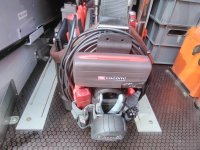
Machine placement is also a consideration of tool efficiency for me. The lathe and mill are inside this 10x10 cell together and either one can be operated when in position by taking one step. There is just enough machine offset that two people can run the machines if needed. All the tools for the processes are in this picture. If a tool is needed for operation and is not there, one gets positioned properly for use.IMG_1715.jpeg
 
Last edited:

bigfunwmu

Well-known member
Joined
Oct 26, 2013
Messages
407
Location
S. MN
I worked in a commercial wood shop for many years.
Each workbench had a work-in-progress (WIP) bin mounted on the side. If you were temporarily done with a tool or material, it would go into the WIP bin. This does 2 things. It unclutters the workbench and it makes for easy retrieval if the item is needed again. At the end of the day, all items in the WIP bin were returned to their proper storage location. I use that system in my home workshop now but I’m less strict about the end of day reset.
I also do this with a cart. Tools and put-away parts from conversions go on the cart and at the end of the day (or earlier if it fills up) tools get cleaned and put away, parts get labeled and inventoried into stock.
 
OP
S

sarel.wagner

Well-known member
Joined
Jun 2, 2010
Messages
346
Location
Centurion, Gateng Province, South Africa
Another:
  • Having tools where you use them is better than walking between work and tool storage all the time
  • A few tools are universal, no matter what you do, markers of some sort, measuring tools, hearing and eye protection etc. Keep these on you or at the work
A tool’s value is in using it. If it is misplaced or lost, you lost its value twice, and time and effort in trying to find it, or getting a replacement
 

richfinn

Well-known member
Joined
Jan 29, 2011
Messages
4,813
Location
Leeds, Yorkshire, England
Another:
  • Having tools where you use them is better than walking between work and tool storage all the time
  • A few tools are universal, no matter what you do, markers of some sort, measuring tools, hearing and eye protection etc. Keep these on you or at the work
A tool’s value is in using it. If it is misplaced or lost, you lost its value twice, and time and effort in trying to find it, or getting a replacement

I think that the "normality" of big tool boxes with drawers (particularly amongst mechanics) has dictated how tools are organized and stored to a large extent.

When I went mobile 20 years ago this was no longer feasible for me so I looked at what other trades who worked out on the road did to stay organized, I looked at electricians/plumbers/locksmiths/carpenters and adopted a lot of their ideas and started breaking my tools down into smaller dedicated kits, focusing on specific tasks.

Obviously if you are in a shop environment security is a challenge, but for guys working at home I think this approach could help.
 

pcmeiners

Well-known member
Joined
Aug 13, 2009
Messages
7,898
Location
In the only town in Pennsylvania, Bloomsburg.
Speed of retrieval: How fast can I grab exactly what I need (and only what I need) when I'm in the middle of a job?
For me this is critical.....Have multiple 60" 10-15 draw Vidmars with plastic bins. Not as organized as I like due to other priorities as of yet but
I can open and close the draws very fast, and have pretty much memorized what is in the 10 plus Vidmars . Should I forget were something is I can open and close every draw in all the cabinets within a couple minutes. Love it, before the Vidmars I would waste time digging through boxes, not finding what I needed half the time, ending up aggravated most of the time.
Protection of value in use: Keeping tools clean, undamaged, rust-free, and ready to perform when I actually need them. Don't just take this point on face value...
Couple issue I had with Vidmar or Vidmar type boxes. Mice and chipmunks love them for multi story condos, nest building and ******* on expensive contents, the other issue is air flow through the cabinets causing condensation. This resulted from a number of circular holes on the bottom of the cabinets so I purchased small thin steel plates to cover the holes on Ebay. Eviction was successful.

Overall Vidmar or Vidmar type cabinets, and bins are the best investment I have made for my shop and sanity.
 
Last edited:
To avoid these ads, REGISTER NOW!

shaune

Well-known member
Joined
Dec 5, 2006
Messages
187
Location
La Ronge Sask
This is an interesting and deeper thread than I comprehend. I have always wondered why people label their drawers “wrenches” “hammers” etc, being in a mechanic field for 41 years i know where every tool is in any of my boxes, it is repetitive and logical in my mind for their placements. If I have a helper I can call out; third drawer down on left, 2nd from bottom, small drawer on right, I know where everything is. With an aviation background we learned to spot when something is missing, from foam cut outs, racks or what ever. I agree that anything requiring 2 hands to remove from storage did not last long in my system. Even working from an open pit type tool box, a quick review and I can spot something missing if it isn’t jammed too full. We know our tools, the feel of them. A co worker and I have the same Snap On Blade screwdriver, his handle is clocked slightly different from mine and i can tell (as can he). I worked with another guy, he was a horrible mechanic in every way, eventually got moved into a desk position but his tools were cheap and junky and he never had any organization, stuff just rolled around randomly.
Not sure the speed of retrieval is a factor for me as I’m not in a NASCAR pit
These photos were from a few years ago, for insurance purposes and only a sampling of drawers
 

Attachments

  • IMG_0581.jpeg
    IMG_0581.jpeg
    1,010.5 KB · Views: 24
  • IMG_0582.jpeg
    IMG_0582.jpeg
    777.7 KB · Views: 25
  • IMG_0583.jpeg
    IMG_0583.jpeg
    807.6 KB · Views: 26

BlackhawkMC

New member
Joined
Sep 17, 2024
Messages
3
This is overthinking 5S methodologies. There's a lot of back-and-forth too, in the first post you mention that color coding is 'organization' and that it doesn't matter but in a later post you list color coding as an ideal to strive for.
A place for everything, everything in its place:
-Where is the tool going to be used, and how often? If you're using a wrench for your mill's drawbar and have the ability for it to be dedicated to that task, try to find a spot on or near the mill. If you have tools for that mill's annual maintenance, it can be put away in a central location.
-Shadow boards and foam cutouts are listed as form over function, but they're the same thing as having contrasting colors to indicate a missing tool. The point is to be obvious. A label with specifics for the tool is great if it's not a set (if a single wrench is in the area vs. a standard set).
-Using foam cutouts or other organizing tools, especially those that block open space, keeps one from pack-ratting. If you have open space you may be tempted to fill it. We use only a handful of tools at most of our machines so we've started removing drawers from the machinist benches, they were becoming repositories for random extra hex key sets, busted tool holders, gloves, and tissues.

Another thing to keep in mind is the type of work being done. If you're doing woodworking where you need a handful of wrenches and screwdrivers only, a shadow board using pegboard or similar systems with everything else tucked away is great. If you're doing mechanic work and never know what you'll use then you're better suited to have the tools you anticipate using the most in reach and the specialty tools put away but still accessible. My ratchets, sockets, wrenches, and pliers are all in my rolling toolbox, while things like my oil/fuel pressure gauge, wire crimpers, borescope, items that are only used once in a while for specific projects, are all in boxes in overhead cabinets.

Like a lot of things, I believe that tool organization or 5S was poorly implemented. People went out and started doing this with an understanding of how, but not why. Proper organization leads to your goals of faster retrieval, missing tool identification, and tool protection.
 

JradM

Well-known member
Joined
Sep 4, 2019
Messages
1,816
Location
Alberta
I think it makes sense to have a limited set of highly-used tools organized for easy access, but beyond that it's better to simply have things organized so that you know where to find them.

For me, that looks like:
  • My main tool bag is an 11" electrician's open-top bag that has a heavily curated set of tools allowing me to 90%+ of my small tasks without having to retrieve anything from my shop. Things have been added and removed from that bag overtime until there's nothing that isn't used regularly or repeats a use. It's not EVERYTHING I need or I wouldn't be able to carry it. Nevertheless, I think this 100% fits the concept.

  • My main tool chest, has my best and most-used versions of most of my tools, heavily focused on automotive work. It's metric-only, but I'm not about to organize my sockets by which ones I use the most - they can stay in numerical order. I did experiment for awhile with using a paint-pen on the socket tips for a quick visual-ID of 8mm, 10mm, 12mm, etc. It's not really needed if you have labels on the tray, but it was kinda nice.

  • After that, I'm mainly organizing for storage. I have another tool chest with SAE, some reduntant pliers and screwdrivers, etc. I know where to find those tools if I need them, but they're not as precisely laid-out as the main chest.

In my mind, I'm making the argument that it depends on what level of organization we're talking about. I wouldn't go putting my #2 Phillips somewhere separate from the rest of my screwdrivers just because I use it more, nor is my 10mm socket extra-prominent. It is more useful to me that I have sets all together. However, I AM organizing those sets by frequency of use across my storage options.
 

pcmeiners

Well-known member
Joined
Aug 13, 2009
Messages
7,898
Location
In the only town in Pennsylvania, Bloomsburg.
I would say, if you wrench professionally, earning by using those tools, speed of retrieval is money
For me speed of retrieval is anti-aggravation and lower blood pressure.

It also keeps down the number of duplicate tools and materials. Still I have at least 5 utility knives. ;)
 
Last edited:

joecon

Well-known member
Joined
Oct 4, 2010
Messages
680
Organization is great but if at some point you change how you put your tools away, it will take a long time before you relearn where they are. I keep my tools in the same drawer locations as my brother did, because that is where I learned them to be. he kept his tools in that location because that is where our father kept his.
 
OP
S

sarel.wagner

Well-known member
Joined
Jun 2, 2010
Messages
346
Location
Centurion, Gateng Province, South Africa
Me Overthinking this, is a constant reminder by many. I do agree I am thinking critically about this.

Everywhere I look and read, I find ideas and I have used many of these ideas. Yet, everywhere I work turns into a mess from WIP. For me, nothing worked, my toolboxes, I do have a few, start out neat and organised, but the end result remained the same, sockets and wrenches everywhere but back in their drawers. That became frustrating, in the extreme. So extreme measures, I guess, is what I need, and that includes exploring the extremes for solutions, see how deep the rabbit hole goes.

My main aim is to understand what is happening, why do I do this. Seemingly I do not have the ability to return them tools to where they should be.

What I now do understand somewhat better is, I was focused on the wrong thing completely. That thing was an organised toolbox. My problem was never the toolbox organisation. It was tools at WIP and buried in there somewhere. When I do machining, I wear an apron with some of my most used items in its pockets. This prompted me to think about why that worked. The items always naturally and without thinking, went right back to its spot on the apron. So that bit worked.

So this was a trigger for me when I thought about it, why could I return my tools in this case? So the overthinking started, critical thinking really. Let’s define what it really means.

Critical thinking is the intellectually disciplined process of actively and skillfully conceptualizing, applying, analyzing, synthesizing, and evaluating information gathered from observation, experience, reflection, reasoning, or communication. It is purposeful, self-directed thinking that aims to make reasoned judgments based on sound evidence and logic, rather than emotion, bias, or unexamined assumptions.

Overthinking defined me thinks…. What I dont know is if my thinking is skilful and logical, but we can cover that another day.
 
OP
S

sarel.wagner

Well-known member
Joined
Jun 2, 2010
Messages
346
Location
Centurion, Gateng Province, South Africa
For now, my initial thoughts are as follows:

  • Keep on my person some of the most used tools, prevent them from scratching or marring whatever I work on while these tools are on me.
  • WIP, keep a tray or something to set tools down on at my work in progress.
  • Keep my most frequently used tools within easy reach, either in a mobile cart, or if possible on the outside of this mobile cart
  • Train the mobile cart to follow me around my work 🐕😜
  • Rest of tools stored normally, but add missing tool shadows and ensure no friction return and grab tools by their working end.
This be the basics, me thinks 🤷
 

Lorydr

Well-known member
Joined
Sep 10, 2015
Messages
665
Location
Piqua, oHIo
The most organized tool section of my garage.
1781876262806.png

Tools and small parts stay on my bench until the WIP is done, for the quick grab. If I grab tools from a drawer, the drawer stays open until
the tool is returned.
 

OccupantRJ

Well-known member
Joined
May 15, 2009
Messages
11,045
Location
Eastern North Carolina
I want some of that mind enhancing **** you fellows in South Africa have been smoking!🤪 (joke)
I have six half sheet baking trays with a 3/4 (19 mm) lip around them that are kept stashed at floor level in gaps between tables and tool boxes around the shop. There are also about as many round magnetic hardware trays that get placed where work is going on to prevent items from escaping and to keep hardware and tools from becoming entangled in the work. Most of my work is repair, rebuild, refurbish, or machining. It gets organized and used pretty much solely from a standpoint of what works. I don’t overthink it. If it is needed there it gets stored and used there If used often enough. That method will take care of itself If room is available.
 
OP
S

sarel.wagner

Well-known member
Joined
Jun 2, 2010
Messages
346
Location
Centurion, Gateng Province, South Africa
Just finished troubleshooting a Toyota Yaris 2006, family…. Broke out the scanner to look for fault codes since we had to lowbed recover and transport it to my place. It died while driving, just cut out. Family is now on a loner. Got some time last weekend to look into this, no codes, at all.

Got compression, crank no start situation, could smell the fuel On cranking. Did the clear flooding but still no start. Had the scanner, the powerprobe and some sockets and pliers out to where the Yaris was dropped off. Needless to say the battery was low so on to the tender and left the tools out, like always.

Got back to it a week later this morning and thought must be missing spark. Indeed no spark. Tested everything, coil packs, trigger signal, crank position sensor, all fine. Found it to be a broken ground. Only got to bringing in all them tools now. Still need to clean em and than put away.

so there again, WIP kept me from putting things away. It appears I am slow learner 🤷🤬👀
 

NostraThpmas

Active member
Joined
Jul 17, 2023
Messages
35
This is overthinking 5S methodologies.
...
Like a lot of things, I believe that tool organization or 5S was poorly implemented. People went out and started doing this with an understanding of how, but not why. Proper organization leads to your goals of faster retrieval, missing tool identification, and tool protection.
Most workshops are divided into "workstations" where specific types of work are performed. 5S was designed to organize workstations, not whole workshops. If you don't have task focused workstations, 5S may not be the right "tool" for the job. I'm not telling anyone to redesign their shop around workstations, but without that, you might be biting off more than you can chew.
 
To avoid these ads, REGISTER NOW!
Top Bottom