To avoid these ads, REGISTER NOW!

Questions on Sistering New Rafters/Rafter Ties/ Ridge Board

bobbuilder440

Member
Joined
Apr 14, 2026
Messages
18
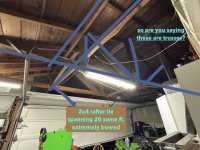
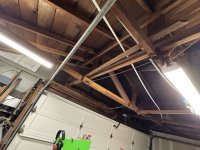
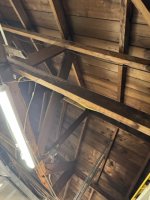
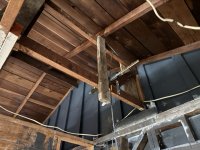
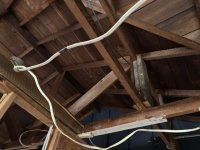
I have 2x4 rafters 24" on center and rafter ties only ever 48" 23 foot span and only 2x4's rafter ties. No collar ties were previously installed. Looks like they used some type of midspan purlin web truss midspan of the rafters that sits on the rafter ties to transfer load of the rafters. However the rafter ties being only 2x4's spanning 22ft or so are obviously now sagging and the roof has sagged you can see from the street. One side of the garage shares a wall with the house and one rafter tie has pulled the stud it was toe nailed into (below the top plate) out of the wall a few inches.

Trying to do some repairs and have a few questions.
With a cracked rafter tie (it is split like down the middle. Is it best to just replace it completely or sistering on new boards acceptable?
What is the best methodology for repairing a cracked / split reidge board (not load bearing but still cracked in multiple spots its like a 1x10 or something.

Also, any ideas on how if I lift the roof and try to pull walls back, on one side I am pulling on a wall that also is butted up to / connected to the house wall. That make it impossible?

I dk if any of that makes sense or if I am wrong about certain things but any help appreciated.
 
To avoid these ads, REGISTER NOW!

NUTTSGT

Super Moderator
Staff member
Joined
Sep 14, 2009
Messages
50,930
Location
Northern Central Ohio
Pictures are going to be very helpful here.
Pics would be very helpful, especially when you mentioned something like this...

"some type of midspan purlin web truss midspan of the rafters"

Also, a location would help, nothing specific but if you are dealing with heavy snow loads or hurricane type weather...some needed information is pertinent to correcting the issue.
 

firebirdparts

Well-known member
Joined
Jun 8, 2016
Messages
10,609
Location
Kingsport, TN
To answer your first question, it's very important to get a good connection directly to the rafter. I would replace.

To answer your second question, it's practically impossible. The best thing to do is to unload it and be sure you're right.

To answer your "any ideas" question, You can push the roof up with very simple framing lumber techniques. Stand up a post on top of a bottle jack and insert prop poles if you get it to move. We have had some guys in this forum pull the walls together using cables, and so you can do that, but it takes much more force to push up a low roof this way. Keep in mind here that attaching the roof to the top of the wall is not that easy to do well. You may break the rafters loose if you just start pulling the walls with a winch.
 

mike93lx

ALLIANCE MEMBER
Joined
Dec 9, 2013
Messages
37,507
Location
Richmond, VA
2x4 rafters? I don't think I've ever seen a span table with 2x4 and I wouldn't use them on even a 12' wide shed.

What condition is the roofing material and decking? If it nerds replacing, tearing all of the existing off and properly rebuilding will be a lot faster and easier
 

PCustoms

Well-known member
Joined
Jul 23, 2011
Messages
22,769
Location
VT
I was thinking that, but the mention of a ridge board threw it off.

Pretty much everything in the OP is throwing me off.

The section @NUTTSGT bolded especially, but the span is listed as 22ft and 23ft as well...

I'll just sit back to see if OP comes back
 

dscheidt

Well-known member
Joined
Apr 26, 2017
Messages
2,892
2x4 rafters? I don't think I've ever seen a span table with 2x4 and I wouldn't use them on even a 12' wide shed.

What condition is the roofing material and decking? If it nerds replacing, tearing all of the existing off and properly rebuilding will be a lot faster and easier
The garage at the house I grew up in was built like that. The house was built in the 20s, the garage was newer and would have comfortably held two full-size 60s station wagons, plus the lawnmower and general stuff. so bigish two car garage, with a single big door. It was spindly as all hell, it was all 2x4s, with a bigger ridge beam. But the roof deck was done with tongue and groove planks on an angle, and it had horizontal wood siding. Lots of stiffness in that skin, and lots of nails to move a bit as loads shift. The dudes that built these things knew what they were doing, and produced pretty good result -- an inexpensive structure as possible given the available materials that last a reasonably long time. It would be insane to build like that now, but 75 years ago?
 
OP
B

bobbuilder440

Member
Joined
Apr 14, 2026
Messages
18
Hey I am back my account got like bot banned so i emailed the site and was like hey wth that *****. and i just checked now because i came to this site on a google search for another topic and what do you know it let me login. So yes I will post some pictures. and no I am probably describing everything wrong and have no idea what I am talking about-- I agree with you.

So yeah any schooling or any fatherly stern talking to is much appreciated before I make a mistake and f it up.

Thanks

Ill put up photos tomorrow
 
OP
B

bobbuilder440

Member
Joined
Apr 14, 2026
Messages
18
2x4 rafters? I don't think I've ever seen a span table with 2x4 and I wouldn't use them on even a 12' wide shed.

What condition is the roofing material and decking? If it nerds replacing, tearing all of the existing off and properly rebuilding will be a lot faster and easier
roofing material is single layer composite shingles that are probably 10 years old in decent shape. You could probably get away with just shingling the garage with a close matching color but it owuld look weird. I got a quote from a guy doing side work and it was going to be 7000$ he said roughly to reframe it inside without removing the roof. But he didn't really explain anything about what that entailed / lumber sizes / the plan etc. Just kinda said that number.

But that is more than I want to spend. It is junk garbage right now. I figure sistering on some new rafters and two beams running perpendicular to the rafters-- garage door wall top plate to opposite top plate on exterior wall of garage. Throw two posts in the framing stud bay so that the beam can sit on those and be a little shorter to be able to get it into place. Then brace the midspan of the rafters off of that. Only issue is whether my garage door header would support that. I beefed up the jack and king studs near it just slapped some in.

I also am dealing with finding termite damage around and some framing was pretty well and eaten. I would surmise that maybe a few of the rafters have termite damage so that adds to it. Also someone was storing stuff for awhile on the 4ft on center 2x4 rafter ties and that also led to them having a huge dop.


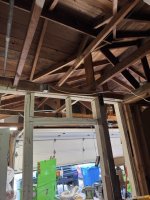
The photos kind of **** its confusing. You have like a hip and a gable meeting. Then you have an addition onto the exterior wall opposite the garage door. that is why it looks like not an exterior wall. Then you had someone built an addition in the garage so that is running directly below a rafter tie and looks intentional but its not.
 

Attachments

  • IMG_1675 Medium.jpeg
    IMG_1675 Medium.jpeg
    94.5 KB · Views: 21
  • IMG_1678 Medium.jpeg
    IMG_1678 Medium.jpeg
    69.5 KB · Views: 22
  • IMG_1679 Medium.jpeg
    IMG_1679 Medium.jpeg
    122.2 KB · Views: 22
  • IMG_1681 Medium.jpeg
    IMG_1681 Medium.jpeg
    93.8 KB · Views: 21
  • IMG_1682 Medium.jpeg
    IMG_1682 Medium.jpeg
    92.3 KB · Views: 19
  • IMG_1684 Medium.jpeg
    IMG_1684 Medium.jpeg
    78.6 KB · Views: 19
  • IMG_2519 Medium.jpeg
    IMG_2519 Medium.jpeg
    81.4 KB · Views: 17
  • IMG_2520 Medium.jpeg
    IMG_2520 Medium.jpeg
    78.5 KB · Views: 17
  • IMG_2521 Medium.jpeg
    IMG_2521 Medium.jpeg
    59.6 KB · Views: 16
  • IMG_1282 Medium.jpeg
    IMG_1282 Medium.jpeg
    121.4 KB · Views: 14
  • IMG_2859 Medium.jpeg
    IMG_2859 Medium.jpeg
    78.4 KB · Views: 14
  • IMG_2530 Medium.jpeg
    IMG_2530 Medium.jpeg
    82.7 KB · Views: 14
  • IMG_2524 Medium.jpeg
    IMG_2524 Medium.jpeg
    104.1 KB · Views: 16
  • IMG_2523 Medium.jpeg
    IMG_2523 Medium.jpeg
    81.3 KB · Views: 15
  • IMG_2522 Medium.jpeg
    IMG_2522 Medium.jpeg
    62.1 KB · Views: 16

driftpin

Well-known member
Joined
Dec 22, 2016
Messages
11,249
Location
Miami-Dade/Broward Co. Florida
Professional Engineer (P.E.) time! Find an engineer and do it properly.

#1] hire a P.E. to see what you have, and make a determination of the shape it's in. You may still have an active infestation. That needs to be dealt-with. Finding eaten structural pieces, whether or not it's an active colony, could affect your structural integrity, as I'm sure you seem to know. Let's say, no active colonies are located. Do your work, and once it's completed, then have it tented. If you use the Chinese gas instead of USA Vikane, it's less-expensive. I wouldn't want to count on a significantly-damaged rafter or other structural component to 'sister-to' as you could be nailing into something which has no support presently sufficient to bear a load.

Any re-roof, the shingles should be a full removal/tear-off to the decking, and consider re-nailing the sheathing in a pattern concurrent w/the current code.

I got a discount on my house insurance because I used a membrane on the sheathing before the underlayment/shingles.
 
Last edited:
To avoid these ads, REGISTER NOW!

Bert_

Well-known member
Joined
Dec 24, 2016
Messages
9,719
Location
NW Iowa
Really doesn't look that bad. It's a home made truss. Common for the time. If the ridge is sagging, look at where the ties connect to the rafter at the top of the wall.

I see a few joist hangers. If those are on the ties, then whoever put those in didn't have a clue about the forces exerted by a rafter/truss. Those are a potential issue.
 
OP
B

bobbuilder440

Member
Joined
Apr 14, 2026
Messages
18
Professional Engineer (P.E.) time! Find an engineer and do it properly.

#1] hire a P.E. to see what you have, and make a determination of the shape it's in. You may still have an active infestation. That needs to be dealt-with. Finding eaten structural pieces, whether or not it's an active colony, could affect your structural integrity, as I'm sure you seem to know. Let's say, no active colonies are located. Do your work, and once it's completed, then have it tented. If you use the Chinese gas instead of USA Vikane, it's less-expensive. I wouldn't want to count on a significantly-damaged rafter or other structural component to 'sister-to' as you could be nailing into something which has no support presently sufficient to bear a load.

Any re-roof, the shingles should be a full removal/tear-off to the decking, and consider re-nailing the sheathing in a pattern concurrent w/the current code.

I got a discount on my house insurance because I used a membrane on the sheathing before the underlayment/shingles.
so ive done a lot of termite work before and ive been treating by drilling holes in anything that looked suspicious but i havent found any new frass. there was subterranean evidence but it is old too. I am trenching for those as well. But ive tested like every board one or two were eaten badly the rest feel really pretty solid. and anywhere i saw any kick out holes i just treated. going to treat my attic with boracare as well
 
OP
B

bobbuilder440

Member
Joined
Apr 14, 2026
Messages
18
Really doesn't look that bad. It's a home made truss. Common for the time. If the ridge is sagging, look at where the ties connect to the rafter at the top of the wall.

I see a few joist hangers. If those are on the ties, then whoever put those in didn't have a clue about the forces exerted by a rafter/truss. Those are a potential issue.
Can you just walk me through it. And yeah home made trusses makes sense now. But hte bottom piece of the truss is a 20ft long 2x4 that doesn't really make any sense regardless right? there still has to be force down on the truss? Maybe I am confused on trusses because I thought you would have at truss every junction you would have a typical rafter spacing. I have plenty of 2x4 rafters that are not part of the truss system they are just going from top ridge board (1 x 10) cracked in places down to the top plate.

As far as brackets are concerned just ignore them if they get you distracted. Lots of boards were pulling away from very few nails and any brackets were just put there temporarily to hold stuff al ittle stiffer. I am positive they aren ot hurting anything most of them are only nailed once or twice to not split the wood just add a bit of temporary support.
 
OP
B

bobbuilder440

Member
Joined
Apr 14, 2026
Messages
18
Can you just walk me through it. And yeah home made trusses makes sense now. But hte bottom piece of the truss is a 20ft long 2x4 that doesn't really make any sense regardless right? there still has to be force down on the truss? Maybe I am confused on trusses because I thought you would have at truss every junction you would have a typical rafter spacing. I have plenty of 2x4 rafters that are not part of the truss system they are just going from top ridge board (1 x 10) cracked in places down to the top plate.

As far as brackets are concerned just ignore them if they get you distracted. Lots of boards were pulling away from very few nails and any brackets were just put there temporarily to hold stuff al ittle stiffer. I am positive they aren ot hurting anything most of them are only nailed once or twice to not split the wood just add a bit of temporary support.
However it is laid out right now is exactly how they built it to code in the 50s. Or someone else came in and did some stuff but all the wood looks the same amount of weathered.

The boards used to build the homemade truss were like 1 x8s or 1x10s. what are you calling the purlin things that are running mid span of the rafters?
 
OP
B

bobbuilder440

Member
Joined
Apr 14, 2026
Messages
18
I wouldn't want to count on a significantly-damaged rafter or other structural component to 'sister-to' as you could be nailing into something which has no support presently sufficient to bear a load.
so far i only found one stud in the kitchen to garage framing that was eaten pretty well through then it stops in both directions. old subterranean evidence. My neighbor had subterranean and treated awhile ago and maybe it killed off my colony as well. I have poked every rafter a million times to find soft spots and used a small drill bit in any i was suspect and then termidor foamed anything I did find. Most of the rafters are strong there may be a few with some rot from old roof leak etc. but they are plenty strong to nail into and transfer roof sheather nails into the new ones in my opinion
 

Bert_

Well-known member
Joined
Dec 24, 2016
Messages
9,719
Location
NW Iowa
Can you just walk me through it. And yeah home made trusses makes sense now. But hte bottom piece of the truss is a 20ft long 2x4 that doesn't really make any sense regardless right? there still has to be force down on the truss? Maybe I am confused on trusses because I thought you would have at truss every junction you would have a typical rafter spacing. I have plenty of 2x4 rafters that are not part of the truss system they are just going from top ridge board (1 x 10) cracked in places down to the top plate.

As far as brackets are concerned just ignore them if they get you distracted. Lots of boards were pulling away from very few nails and any brackets were just put there temporarily to hold stuff al ittle stiffer. I am positive they aren ot hurting anything most of them are only nailed once or twice to not split the wood just add a bit of temporary support.

A joist hanger is for downward force. A rafter tie does not exert much downward force. A rafter ties main function is to act in tension, keeping the walls from spreading apart. A joist hanger has very little strength in tension.

A rafter tie/bottom cord does not hold anything "up". Get that idea firmly planted in your head and you will be in a lot better place to make any repairs.
 
OP
B

bobbuilder440

Member
Joined
Apr 14, 2026
Messages
18
A joist hanger is for downward force. A rafter tie does not exert much downward force. A rafter ties main function is to act in tension, keeping the walls from spreading apart. A joist hanger has very little strength in tension.

A rafter tie/bottom cord does not hold anything "up". Get that idea firmly planted in your head and you will be in a lot better place to make any repairs.
Well where those joist hangers are where someone had cut the lower rafter tie and toe nailed it into another 2x4 running perpendicular that was then toe nailed again into another rafter tie on one end and the top cord on an exterior wall. So I would imagine there is some weight in the downward vortice where adding a joist hanger isn't going to hurt anything especially since it is two nails holding the board in toe nailed from 1950. And I don't think you are supposed to cut a rafter tie and run a horizontal 2x4 to transfer the load to another undersized rafter tie. I get that rafter ties aren't supposed to have much downward force acting on them. But gravity is always at play and people put storage and other stuff in a garage thinking they are ceiling oists so .
 

MovingAlong

Well-known member
Joined
Aug 17, 2013
Messages
1,221
Looks more like overspan rafters with a purlin in the middle, not trusses. Pics are hard to make sense of, no real "overall" shot from above the ceiling line.

Larry Haun talks about them here:
 
OP
B

bobbuilder440

Member
Joined
Apr 14, 2026
Messages
18
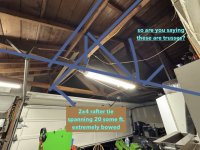
People are telling me these are trusses but I am at a loss. Garage roof California no snow load everything built with 2x4’s and the “trusses” obviously were built in place.

What I was calling rafter ties / may actually be “bottom chords” are over 20ft long 2x4. Ridge board is non structural.

There is also a hip roof? that comes and ties into the same area. Everything is sagging to sh**.


Trying to figure out how to rebuild it or beef it up.


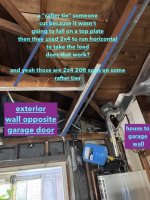
(this was email to Gregvancom on youtube) Ive watched a ton of your videos but nothing quite looks like what I got going on. Seems completely under built. There are two “purlins” what I am calling them that run from garage door mid span wall to the opposite exterior wall top plate. That is built from 2x4’s and then angled 2x4’s inside.


Here are some pics figure could make an interesting video. Watched hours and hours of your stuff and learned a lot.

IMG_2859 Medium.jpeg
I filled intros gap at the garage door area to beef it up thinking I may run a beam near there to run new midspan supports for the rafters. But it isn’t really midspan however I think they could be run at a slight angle and still be okay. Otherwise I could put the beam further towards the middle of the rafters (or whatever that board would be called on a truss) which would put the beam over the garage door header which seems strong doesn’t have any termite damage but unknown if I can move the beam in a little ways from the king and jack studs and it would still effectively load transfer easily to those studs. Like is it linear the load transfer for how far away you are from the end of the header the potential for sag in the header. If that makes sense.


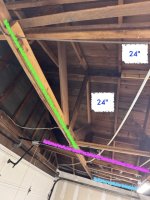
IMG_2530 Medium.jpeg
Green** That is a 2x4” running 20ft at least with what people are telling me is a “truss” which the diagonal supports are built out of 1x10 or something like that and notched into the top ridge board which is all starting to crack etc.

BLUE line ** The spacing between the bottom chords or rafter ties I dk what to call them from now on I am going to stick with rafter ties is 4ft the rafters are spaced 24” apart and 2x4’s as well.

VIOLET The board running from above the garage header perpendicular to the truss sitting on top of its bottom chord also runs from the top plate header of garage door 20ft back to the top plate of the exterior wall. There is no support for it and all the weight is pushing down then on the truss bottom chord or the rafter tie whichever one is which. Which a guy on the forums is saying those should have no downward force on them at all (the rafter ties / truss bottom chords) but it seems to me if you are supporting mid span down to those then by all definitions they have a downward force on them.

IMG_2524 Medium.jpeg

One of two purlins (I am calling them) or maybe they are web trusses built midspan of the rafters which in this photo I just beefed them up before I figure out what to do because they were pulling apart etc. I got it to tighten up by lifting up on the bottom of it with a jack a little bit and then added the brackets and the vertical 2x4 and the plywood gusset.


IMG_1679 Medium.jpeg


IMG_1684 Medium.jpeg


IMG_1682 Medium.jpeg


IMG_1681 Medium.jpeg


IMG_1678 Medium.jpeg

By beam I meant post. Like from the floor to that cut 2x4" instead its load is just transferring through the toe nails into that other 2x4 which is then toe nailed into a bottom chord or rafter tie. Stupid


IMG_1284 Medium.jpeg
The room in the back was added on after it was built so this wall was the original exterior wall of the house.


Any help much appreciated.
 
OP
B

bobbuilder440

Member
Joined
Apr 14, 2026
Messages
18
Such an AWESOME video. Those dudes drive nails so incredibly fast and effective. cool that they had fun editing back then too to make it look like they never check for plumb or level just wam bam thank you ma am. But still awesome. Yeah so basically a purlin but a purlin without a load bearing wall under it and there never was one. So effectively useless on under sized ceiling joists rafter ties. I could remove the existing purlin and run a beam and then support the rafters mid span that way. But how would I get a beam 20ft long? would I need an LVL or somethign else. and I would need 2x top and bottom. Or could I do like they do and side nail them together but that is because they are sitting on a load bearing wall so they aren't supporting the weight themselves just transferring it down. So yeah I am still confused.

Did they try to build the purlin like a web truss so that none of the weight actually is on the bottom chord and somehow it works like a beam and transfers the load all the way to the other top plates? is that the idea?
 
OP
B

bobbuilder440

Member
Joined
Apr 14, 2026
Messages
18
is it trying to be a web truss? do those supposed to pass load only to the two opposing walls and not sag in the middle at all?
 
OP
B

bobbuilder440

Member
Joined
Apr 14, 2026
Messages
18

I am thinking if I built these on the rafters that have nothing on them (they are just rafters) no truss built that that could beef it up. Like build this on all the eones that are empty
 
To avoid these ads, REGISTER NOW!
Top Bottom