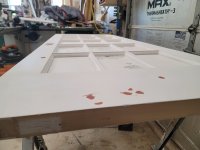
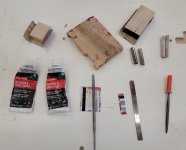
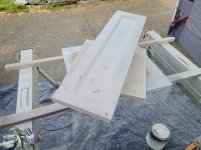
I have been touching up woodwork in my house now that my sons are older and no longer destructive maniacs (and they can now also join in the fixing of their damage ... yea!!). This touch up is mostly painting over numerous bump and scrape dings. Sometimes the wood underneath was compressed without breaking the paint. Other times, the paint (several layers thick) is chipped off over some limited region. If I directly paint over these damages, of course, the result is not so hot up close. So I have been filling and sanding before painting.
First, I tried using drywall compound/mud. That did NOT work well. Drywall mud shrinks too much and sands off too easy when used in thin layers (with a damp wipe after sand before paint) and it also absorbs paint and primer leaving the patches noticeable (both scrapes and dings) under the new paint. Sanding perfectly flat through a few layers of paint, if one would take that approach, is also a lot of work with a messy cleanup. I typically use drywall mud for filling small brad nail holes in new woodwork. That works ok, but is also not so hot due to the shrinkage and absorption issues for larger repairs. But it is easy and good enough (unless very picky) for small brad type nail holes.
Next, with the fail of drywall mud, I tried Bondo type spot and glazing putty:
https://www.amazon.com/3M-Pinholes-Scratches-Hairline-Fiberglass/dp/B0002JM8PY/?tag=atomicindus08-20
This is typically used for auto body touchups. It dries fast (solvent based), sands reasonably well though more effort than drywall mud), and does not appear to change shape via moisture absorption when washing for paint prep and then painting. The end results of this are super. HOWEVER, I find that I need to prime the spots and cover with 3 coats at least (rather than two) to not have the red putty show through the paint (even with high quality trim paint). So it generates more work via the 3 coats of paint. However the Bondo spot putty goes on easy with a putty knife (easy to get little excess to sand) and has very minimal shrinkage on setting. Primer and paint adhere well to it. But if one does any touchup and resand for more spot iterations (often takes another pass when things are quite banged up), then one needs multi-layers blended in at the touch up point where you expose the bright red Bondo again. I think this see through issue does not occur on auto body work to a similar degree since they spray prime and paint several coats very uniformly with spray and they want a color (like the dark red used) to enhance viability of issues in spot touchup before priming and painting.
Do you guys have any suggestions on something that would preform like the Bondo glazing putty and would be less of a problem painting over (just two coats rather than prime + 3 coats)?
Doors I fixed look like newafter the Bondo chain though. The only real issue is avoiding 3 coast + primer. One door was damaged by my son at 2 ish was playing "fireman" with a plastic axe. He must have dinged the door a hundred times (was kind of humorous at the time so it was hard to get mad at him but it looked like ****). It came out near perfect. I guess option #2 is to paint over everything and let the house have it's history shown. That path of least resistance is the typical path how old houses look like old houses when not extensively renovated. I can see why people do things like replace doors and trim over a lot of scuffs and dings rather than repair them due to the effort and mess (though replacing a lot gets involved too). However, the older woodwork (on doors in particular) is much better quality than all but the most expensive new stuff. So I think it is worth sprucing up.
Thanks in advance for the advice!
First, I tried using drywall compound/mud. That did NOT work well. Drywall mud shrinks too much and sands off too easy when used in thin layers (with a damp wipe after sand before paint) and it also absorbs paint and primer leaving the patches noticeable (both scrapes and dings) under the new paint. Sanding perfectly flat through a few layers of paint, if one would take that approach, is also a lot of work with a messy cleanup. I typically use drywall mud for filling small brad nail holes in new woodwork. That works ok, but is also not so hot due to the shrinkage and absorption issues for larger repairs. But it is easy and good enough (unless very picky) for small brad type nail holes.
Next, with the fail of drywall mud, I tried Bondo type spot and glazing putty:
https://www.amazon.com/3M-Pinholes-Scratches-Hairline-Fiberglass/dp/B0002JM8PY/?tag=atomicindus08-20
This is typically used for auto body touchups. It dries fast (solvent based), sands reasonably well though more effort than drywall mud), and does not appear to change shape via moisture absorption when washing for paint prep and then painting. The end results of this are super. HOWEVER, I find that I need to prime the spots and cover with 3 coats at least (rather than two) to not have the red putty show through the paint (even with high quality trim paint). So it generates more work via the 3 coats of paint. However the Bondo spot putty goes on easy with a putty knife (easy to get little excess to sand) and has very minimal shrinkage on setting. Primer and paint adhere well to it. But if one does any touchup and resand for more spot iterations (often takes another pass when things are quite banged up), then one needs multi-layers blended in at the touch up point where you expose the bright red Bondo again. I think this see through issue does not occur on auto body work to a similar degree since they spray prime and paint several coats very uniformly with spray and they want a color (like the dark red used) to enhance viability of issues in spot touchup before priming and painting.
Do you guys have any suggestions on something that would preform like the Bondo glazing putty and would be less of a problem painting over (just two coats rather than prime + 3 coats)?
Doors I fixed look like newafter the Bondo chain though. The only real issue is avoiding 3 coast + primer. One door was damaged by my son at 2 ish was playing "fireman" with a plastic axe. He must have dinged the door a hundred times (was kind of humorous at the time so it was hard to get mad at him but it looked like ****). It came out near perfect. I guess option #2 is to paint over everything and let the house have it's history shown. That path of least resistance is the typical path how old houses look like old houses when not extensively renovated. I can see why people do things like replace doors and trim over a lot of scuffs and dings rather than repair them due to the effort and mess (though replacing a lot gets involved too). However, the older woodwork (on doors in particular) is much better quality than all but the most expensive new stuff. So I think it is worth sprucing up.
Thanks in advance for the advice!
Last edited: