To avoid these ads, REGISTER NOW!

Repairing aluminum

bluedog225

Well-known member
Joined
Jan 31, 2012
Messages
3,351
Location
Texas
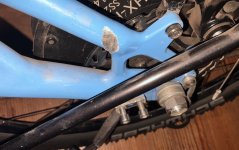
UPS took a bite out the bike I recently purchased used.

Components are worn and I’m doing a frame up rebuild.

I don’t think it’s structurally significant. But I’d like to repair it. Either cosmetically or structurally. Without doing any damage to the remaining metal.

What do you guys think? Something like bondo and repaint or can metal be flowed in without compromising the existing structure? Or something like a clamshell repair. I’m open to any ideas.

Or best just to lightly sand, repaint that little area, and move on. Photos below. The last is a stock photo. The electric motor stuff you see is being removed. It will have a Pinion drive on the front and just a chain tensioner on the rear.

Thanks
IMG_5791.jpegIMG_5790.jpegIMG_5789.jpegIMG_5787.pngIMG_5793.jpeg
 
To avoid these ads, REGISTER NOW!
OP
B

bluedog225

Well-known member
Joined
Jan 31, 2012
Messages
3,351
Location
Texas
It looks deep in a critical part of the structure. Have you considered welding (filling)? What do you want to do?
Recoveryman

That’s what I’m hoping for input on. I don’t know what is possible with welding/filling.
 

whateg01

Well-known member
Joined
Mar 13, 2006
Messages
11,631
Location
doo dah, kansas, usa

theoldwizard1

Well-known member
Joined
Feb 22, 2011
Messages
43,391
Location
SE MI
Components are worn and I’m doing a frame up rebuild.

I don’t think it’s structurally significant. But I’d like to repair it. Either cosmetically or structurally. Without doing any damage to the remaining metal.
If it is not structural and you are doing a frame up rebuild, bondo and paint.
 
Last edited:
OP
B

bluedog225

Well-known member
Joined
Jan 31, 2012
Messages
3,351
Location
Texas
The frame is hinged under the seat. The rear part pivots and has a shock. Strictly touring. But gravel roads.

I don’t know if it’s tube or solid at that point. I was assuming solid. I’ll ask my Azub guy.

The replacement frame piece is about $700 delivered. The guys says it‘s trouble to install. But I don’t know the details. Though well packed by a bike shop, UPS forked the box. And tore it open on one end. They did cover the cost of the new piece. Not the install. And it has to come from Europe.
 

mrvm

Well-known member
Joined
Feb 12, 2014
Messages
3,858
Location
PA
If the replacement cost has been covered I’d use it. IMO there’s enough material past the divot and supporting structure left to handle road load…….SEND IT
 

matt_i

Well-known member
Joined
Mar 14, 2008
Messages
10,760
Location
SE Michigan
I'd run it until it breaks, if that's ever.

Going to have to strip paint all around, some is going to get burned by the radiant heat. Likely never get it coated back the same.

It's in the thicker cross section above where it's already joined to the flat stock. That top tube of the triangle is mostly in compression.
 
OP
B

bluedog225

Well-known member
Joined
Jan 31, 2012
Messages
3,351
Location
Texas
I looked into frame builders around here that deal with alu. And talked to the Texas dealer. He thinks it’s good to go. Even given his financial incentive to sell a new part. And the tig welding introduces a bunch of complications.

I’m going bondo and spray paint. Haven’t done that since 1980.

Thanks all.
 

MOwens

Well-known member
Joined
Sep 20, 2007
Messages
87
I would tig weld that back in myself. But I am also a machinist/welder with some certs. Any decent welding shop should be able to fix that right up.
 
OP
B

bluedog225

Well-known member
Joined
Jan 31, 2012
Messages
3,351
Location
Texas
My light research indicated that the bike frame alloy surrounding the weld would need to be heat treated to restore its strength. Which is a hole can of worms. Any idea if that’s true?
 
To avoid these ads, REGISTER NOW!

Firebrick43

Well-known member
Joined
May 12, 2015
Messages
14,261
Location
West central Indiana
My light research indicated that the bike frame alloy surrounding the weld would need to be heat treated to restore its strength. Which is a hole can of worms. Any idea if that’s true?
Was the frame heat treated to begin with? I could find no mention of it and its not common with many manufactures unless they are going for minimum weight which seems to be the opposite goal of azub, to make a durable long life frame with large diameters and heavier gauge tubing.

Its actually insane to me that that tube is not worn thru and has a hole in it. That is some thick tubing.

If UPS is paying for a new one why not replace it. It looks very easy and straight forward to replace it, especially if you are removing the electric motor anyways, that is where the majority of the work with the wheel set and derailleur would be anyways. its just a pivot point and shock mount other wise.
 
OP
B

bluedog225

Well-known member
Joined
Jan 31, 2012
Messages
3,351
Location
Texas
Was the frame heat treated to begin with? I could find no mention of it and its not common with many manufactures unless they are going for minimum weight which seems to be the opposite goal of azub, to make a durable long life frame with large diameters and heavier gauge tubing.

Its actually insane to me that that tube is not worn thru and has a hole in it. That is some thick tubing.

If UPS is paying for a new one why not replace it. It looks very easy and straight forward to replace it, especially if you are removing the electric motor anyways, that is where the majority of the work with the wheel set and derailleur would be anyways. its just a pivot point and shock mount other wise.

Thanks. I’m checking on the heat treatment.
 
OP
B

bluedog225

Well-known member
Joined
Jan 31, 2012
Messages
3,351
Location
Texas
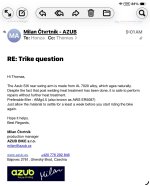
All I have is this from the website. Waiting on a response to the email.

“Built from specially developed thin-wall AL 7020 tubing, the asymmetric rear fork delivers exceptional stiffness at extremely low weight.”
 

MoonRise

Well-known member
Joined
Nov 5, 2010
Messages
4,038
Location
NJ
UPS paid to replace the frame/piece?

Replace the frame/piece.

IMNSHO, that damage IS structural. It is big enough and in a structural area.

Not within the main diamond structure, true. But can the bike actually work without the rear axle and chainstays, nope.

7020 aluminum is weldable. But with some big conditions and caveats. It is heat treatable, and welding ruins any heat treatments. And the weld filler rod/wire used to weld 7020 is usually NOT a heat treatable alloy, so the weld bead will NEVER really be as strong as the base 7020.

The welding and resultant HAZ are not only weaker but also can corrode easier and is not as fatigue resistant.

If you do nothing to the 7020 after welding regarding heat treatment but let is sit for 90+ days at room temperature, the aluminum will "naturally age" and get back up to ~75% of the original heat treated strength.

Replace the frame/piece IMNSHO. 🍺
 

Hohn

Well-known member
Joined
Aug 25, 2016
Messages
2,773
Location
Diesel Central, Indiana
Take it to a welding shop, they can fill it in


Frame builder is gonna tell him its junk to cover their asses and making a claim like that with UPS is like screaming at the ocean to move

Find a good welding shop and have it TIG welded. That looks like a pretty significant divot. Hard to believe that happened in shipping ?

I would tig weld that back in myself. But I am also a machinist/welder with some certs. Any decent welding shop should be able to fix that right up.
These guys where where I was leaning until I did a bit more research. Then I came to think @MoonRise is bang on.

The only reason to use 7020 is for a good strength to weight ratio that all but necessitates heat treat. And you simply can't just TIG that with 5356 or whatever. The location is CRITICAL on that bike and given how thin the tubing probably is, there's little to no wall thickness left. A crack is almost certain to form quite soon if you ride it a lot.

This is weldable and repairable, but it's specialty work for a dedicated bike frame specialist who has access to a a full heat treat after the repair and knowns what he's doing with 7020.

This isn't something any old guy with an AC TIG can handle. THe tube will lose over half its strength when the heat treat is lost, and aluminum without heat treat has very poor fatigue life.

Personally I'd be considering some powder filled epoxy filler or epoxy with glass fiber reinforcing. You could do worse than wrapping the area in several layers of fiberglass tape and saturating with a good epoxy resin.
 
Last edited:

The Cobbler

Super Moderator
Staff member
Joined
Oct 24, 2013
Messages
26,041
Location
Niagara Region, Ontario, Canada
to me it looks like a break on the RH said . not sure what to make of the LH side ... I have mixed thoughts . I am guessing that bondo/epoxy & paint would be a sufficient fix, then keep an eye on it for future cracks

1784581301498.png
 

egdede

ALLIANCE MEMBER
Joined
Dec 20, 2009
Messages
2,108
I'd wonder about non obvious damage where that Frame was 'backstopped' when the forks speared it. Be glad you were afforded a replacement piece. Use it (I know it SEEMS like a $700 hit, but it's really just you being made whole : )
 

MoonRise

Well-known member
Joined
Nov 5, 2010
Messages
4,038
Location
NJ
Like I said, 7020 aluminum is weldable with conditions and caveats.

Using 5087 weld filler/electrode is one of those conditions and caveats. 5087 is usually not a stocked item, costs ~2 to 3 times MORE than 5356 filler/electrode, and would usually have minimum order requirements.

Lincoln (the welding company) flat out says that 5087 wire is not available in the USA (per their website). Several other suppliers list it but say to "request a quote". Not a good sign for price or availability.

You'd have to remove the frame/piece, strip the paint and check for any other damage (bending or other dimensional problems, any cracking, etc), remove all of the gouged metal back to clean and uncompromised metal, then weld it without warping it (Hah!), let it "naturally age" at room temperature for ~90 days or more and hope for maybe ~60-70% of the original strength of the 7020 while the welded 5087 will be ~50% of the strength 7020 (if you are lucky).

16-28 ksi yield strength for 5087 filler vs 40-45 ksi yield strength for 7020-T6 aluminum, both in best case conditions.

And what you are doing is not welding some 7020 together with a weld, but REPLACING a big chunk of 7020 with a big chunk of 5087 in multiple little weld puddles. You no longer have 7020 strength there, you have a big chunk of 5087 at 50% of the yield strength of the original 7020.

Do you want to find and pay someone to perform some non destructive inspections on that welded up chunk of aluminum? Dye penetration testing to check for surface cracks is not too bad, but the ultrasonic or x-ray testing to check for and quantify all of the inevitable inclusions and voids (there is no such thing as a PERFECT weld, but there can be "acceptable" welds) is much more expensive.

Your welded and naturally aged 7020 would then be down around 30 ksi yield strength (75% of 40 ksi) and the big chunk of 5087 weld filler would be around 16 ksi yield strength.

Then grind and polish the weld area for cosmetic and structural reasons (any discontinuity is a Crack waiting to happen in a fatigue loading case), prime and paint it, then reassemble everything.

Replace the frame/part.
 

welder4956

Well-known member
Joined
Apr 8, 2010
Messages
3,087
Location
Birmingham, AL USA
My light research indicated that the bike frame alloy surrounding the weld would need to be heat treated to restore its strength. Which is a hole can of worms. Any idea if that’s true?
What alloy was used? If the frame was manufactured from a heat treated aluminum (such as a T6 grade), then welded in the assembly with no heat treatment after final welding, then repair welding the gouge is no issue. If the entire frame was heat treated after welding, then the entire frame would need to be heat treated after the repair. The type of heat treatment and parameters depends on the alloy.

Edit: I just saw your last post. I should have read the rest of the thread first. 7020 is a precipitation hardening grade, so the heat from the welding process will anneal the metal adjacent to the weld. Fortunately, this alloy will age harden over time even at room temperature. I would follow the manufacturer's recommendation to allow at least a week for the aging to occur. Filler rod should be ER5087 or ER5356.

https://canadaweldingsupply.com/products/5087-aluminum-tig-rod?variant=31810880569430
 
Last edited:
OP
B

bluedog225

Well-known member
Joined
Jan 31, 2012
Messages
3,351
Location
Texas
Like I said, 7020 aluminum is weldable with conditions and caveats.

Using 5087 weld filler/electrode is one of those conditions and caveats. 5087 is usually not a stocked item, costs ~2 to 3 times MORE than 5356 filler/electrode, and would usually have minimum order requirements.

Lincoln (the welding company) flat out says that 5087 wire is not available in the USA (per their website). Several other suppliers list it but say to "request a quote". Not a good sign for price or availability.

You'd have to remove the frame/piece, strip the paint and check for any other damage (bending or other dimensional problems, any cracking, etc), remove all of the gouged metal back to clean and uncompromised metal, then weld it without warping it (Hah!), let it "naturally age" at room temperature for ~90 days or more and hope for maybe ~60-70% of the original strength of the 7020 while the welded 5087 will be ~50% of the strength 7020 (if you are lucky).

16-28 ksi yield strength for 5087 filler vs 40-45 ksi yield strength for 7020-T6 aluminum, both in best case conditions.

And what you are doing is not welding some 7020 together with a weld, but REPLACING a big chunk of 7020 with a big chunk of 5087 in multiple little weld puddles. You no longer have 7020 strength there, you have a big chunk of 5087 at 50% of the yield strength of the original 7020.

Do you want to find and pay someone to perform some non destructive inspections on that welded up chunk of aluminum? Dye penetration testing to check for surface cracks is not too bad, but the ultrasonic or x-ray testing to check for and quantify all of the inevitable inclusions and voids (there is no such thing as a PERFECT weld, but there can be "acceptable" welds) is much more expensive.

Your welded and naturally aged 7020 would then be down around 30 ksi yield strength (75% of 40 ksi) and the big chunk of 5087 weld filler would be around 16 ksi yield strength.

Then grind and polish the weld area for cosmetic and structural reasons (any discontinuity is a Crack waiting to happen in a fatigue loading case), prime and paint it, then reassemble everything.

Replace the frame/part.

Good info. Thanks
 

alfadan

Well-known member
Joined
Mar 9, 2007
Messages
2,124
Location
Augusta, ks
I sure don't see one of those restoring the strength lost with the material that appears to be missing. Or is it just dented? Bike frames are not usually very thick.
I don't think it works that well on a little bit thicker stuff. I filled up a gouge in an aluminum casting and it took A LOT of heat to get it to flow out. That much heat will affect the aluminum heat treating in a bike frame I imagine.
 

rlitman

Well-known member
Joined
Oct 18, 2010
Messages
24,704
Location
Long Island
...And what you are doing is not welding some 7020 together with a weld, but REPLACING a big chunk of 7020 with a big chunk of 5087 in multiple little weld puddles. You no longer have 7020 strength there, you have a big chunk of 5087 at 50% of the yield strength of the original 7020...
Yes, but that's how all of the factory welds on this frame worked too. And with aluminum welds in particular, having a more ductile (softer but also thicker) weld is a desired part of the process, as it softens the discontinuities and prevents cracking.

I think you're overthinking this for other reasons too. That dropout is welded to the chain stay and seat stay tubes, and from the looks of it, the tubes are slotted to fit over the plate of the dropout (that's one common method used in frame building). That would explain why the area that was gouged seems to be solid, when in fact it is part of a tube. In that light, the welded area has a whole lot more section that the rest of the tube, so 50% loss of yield strength may not mean much. Especially when you consider that the seat stays are loaded in compression.
 

BurtEggley

Well-known member
Joined
Oct 8, 2024
Messages
891
It was welded when it was built, the frame builder answered how to repair it. Your choice is fix it or live with it. Doing a cosmetic repair is not really a repair, just hiding the appearance. Good bicycle frames are made to flex. Anyone who hangs around high end shops that build frames, they would understand this. Personally, I would find a welding shop that does aerospace type work, and have them tig it. Then grind that back down and paint it. The builder even gave instructions on which filler rod to use.

The other thing you might consider is finding a real frame builder and having them check to see how true the frame still is. It may be seriously warped, enough that it will reduce the quality of the ride. Years ago I had Joe Bell (the shop he was in built the frames for the USA racing team) https://joebell.net/Joe-Bell-big-website.html go thru a frame for me, upgrade it a little and true it. I was blown away how much the ride improved. Now I am mid-70's and have a bad back so I don't ride anymore. But I can't bring myself to sell the bicycle because most people do not appreciate a good one and all anyone offers these days is $50 because so many bicycles are for sale here. I do hope you either replace the fork or have it repaired properly. Were it me I would get three quotes to fix it properly and try to get UPS to pony up for the damage they did.
 

rlitman

Well-known member
Joined
Oct 18, 2010
Messages
24,704
Location
Long Island
...The other thing you might consider is finding a real frame builder and having them check to see how true the frame still is...
Fair point, but there's only so much persuading you can do to an aluminum suspension frame.
I've worked on re-welded steel framed recumbent bikes (before the days of suspension) that were run over by cars, and they can take about as much of a beating as the repairs you see on crumpled brass band instruments, but not so with aluminum.
 
To avoid these ads, REGISTER NOW!
Top Bottom