drivesitfar
Well-known member
Very cool tech and happy your little girl likes the challenge and results!!


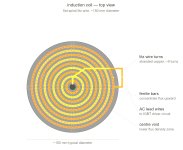
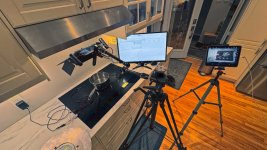 In my research for the video, I learned a lot about Litz wire , which is the essential component of an induction hob coil...call it the burner. The hob is formed from Litz wire which is stranded copper wire, insulated, and coiled into mult-stranded bundles. The resulting hob coil is typically ~ 5mm high, and ~150mm across for a 6" small hob, and ~250mm (10")across for a large hob. One obvious take-away is that there is a center portion of every hob, where there are no coils and therefore a dead zone in the center with ALL induction hobs. The cheaper pans I tested typically have a magnetic insert that looks like a grid pressed into the base, and normally the center portion is bare. If you look at the thermal camera images, you can almost visualize these coils in the first few moments, but that pattern quickly disappears as the base heats up. Now I tested a LOT of pots and pans over the last month or so, and I'd say that this pattern is not signfificant with respect to the performance of the pan. The best predictor of performance I saw is how well the pan couples to the burner magnetically. In other words, how much magnetic material is in the pan base, and well is it matched to the size of the hob? The pan essentially becomes part of the circuit, if you will, when operating an induction cooktop. The cast iron pan pulled the most power of any of hte pots, at close to 3700 watts on the large hob but took a tiny bit longer to boil the water (about 3 minutes) likley due to the mass of the pan. This likely points to cast iron as the best possible solution for even heat (and it is for my thin Finn pancakes!), but it was the power hog in the test. The smaller 1.9L Tramontina pot boiled the liter of water fastest on the SMALL hob at about 2:37 minutes and pulled up to 2500 watts during the test. The same pot took 5 minutes on the large hob with a max of 1300 watts, likely as the larger hob's electronics throtlled power output.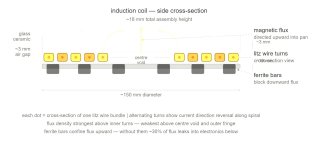
Funny thing about the vids. The ones that I just shot on a whim and spent nearly zero time on have done the best. A short I did comparing Milwaukee impacts to old school air has over 407K views. Shot in like 30 minutes, no script, verbal fumbles, no planning, no lighting:Maybe a different title cause as you now marketing is key to almost anything. As far as content your videos are amazing.
Unfortunately the world works off quick gratification and the majority don’t want to learn. Maybe do a short video under a minute or two and title it something like does your cookware measure up to old cast iron or use your words.
Sorry about the loss of your summer and we’ve lots a few months of ours the past few years with the smoke from the fires.
. This will go at the foot of his bed. The important thing is my pal can call for help now by using his feet. This must not be a common situation as the call pad cord is pretty much too short to go at the foot of the bed, and apparently they don't have extensions....
 The family is only just beginning to forgive me for taking over the kitchen for half a day...