To avoid these ads, REGISTER NOW!

Can ac electric “leak” to ground?

vavet

Well-known member
Joined
Mar 6, 2012
Messages
5,358
Location
Ashland, VA
Rental house we’ve owned since 2006 and lived there until 2015. While we lived there, I hired an electrician to come out and install an outlet in the living room floor so we could have an end table with lamp there.

Our current tenants, moved in there last month, noticed the outlet didn’t work. Previous tenant did not mention it, but maybe they didn’t use it.

I pulled the outlet cover off and measured 20v ac with my meter across the black and white wires.

I go down in the crawl space, I know this is on the same circuit as the crawl space lights. Those are working, as is a receptacle in the crawl space. I go to find the outlet box. It’s just one piece of 14/2 times going in, then I find a junction box a few feet away that is feeding that single piece of romex. It has romex running back towards the crawl space light switch where it gets power. It also has a piece of romex running perpendicular towards the front of the house. The third piece is feeding the floor outlet.

I remove the blank cover plate off the jb. Nothing is wire nutted. One of the black wires kinda falls loose from the other two black wires that are half- heartedly twisted together. The two that are together are the source line and the mystery destination that appears to run through the front foundation wall. The black wire that fell loose is the one for the floor outlet.
I can’t imagine what the power going through the foundation wall is for. But does this somehow explain the 20v ac on the floor outer?

Ultimately, I disconnected the mystery wire, reconnected and wire nutted the floor outlet to line voltage, and reattached the face plate. The floor outlet now has 120v, although… plot twist… I can only insert my outlet tester into one of the receptacles. It’s not one of the child proof outlets. Perhaps something fell down in there and is jamming it? That’s another mystery for another day.

So It seems like whatever was happening with the mystery wire running through the foundation wall was causing the drop to 20v. If that wire is running underground and got partially or completely cut, would it “leak” to ground? Wouldn’t the circuit breaker trip?
For the record, there is a planting bed just on the other side of that foundation wall and there is a black round cable in that area- I always figured that was an abandoned cable tv line, but I don’t really know. I did some digging in that area a couple months ago to put in some new bushes. Maybe I hit it then?
The circuit looks something like the attached drawing.
 

Attachments

  • IMG_1075.jpeg
    IMG_1075.jpeg
    443.8 KB · Views: 20
To avoid these ads, REGISTER NOW!

wyliesdiesels

Well-known member
Joined
Aug 14, 2012
Messages
20,236
Location
Modesto, CA
A "leak to ground" wouldnt cause the voltage to drop. that defies electrical theory.

what you had was a poor connection, that when resistance is put on it, causes the voltage to drop because the connection is poor.
 

rattle_snake

Well-known member
Joined
Jun 25, 2015
Messages
5,325
Location
Chandler, AZ
Yes, the current all goes to earth ground. That is the other half of the circuit from the power plant.

Actually the electrons come out of ground not in.

A GCFI is a ground leak detector.
 

wyliesdiesels

Well-known member
Joined
Aug 14, 2012
Messages
20,236
Location
Modesto, CA
Yes, the current all goes to earth ground. That is the other half of the circuit from the power plant.

100% wrong for a split phase or 3 phase service to a building. the current returns to the source (transformer). The earth is a very poor conductor of electricity especially at low voltages. the current returns to the transformer via the service drop or lateral.

and comparing electrical service on a building to a SWER (single wire earth return) primary power distribution is a flawed comparison.

Actually the electrons come out of ground not in.

wrong again. where do you come up with this ****? The EGC on a circuit isnt even used during normal operation so how could the electrons come out of the ground?

A GCFI is a ground leak detector.

yup and a GFCI doesnt even measure current on the ground. there goes your bogus theory about electrons coming out of the ground
 
OP
V

vavet

Well-known member
Joined
Mar 6, 2012
Messages
5,358
Location
Ashland, VA
What you had was just a poorly made wire junction in the wire nut.
so a poor connection would drop the voltage from 120 to 20?
I didn’t know that.


Could the line going out of the wall might have powered a post lamp that is no longer there?
it certainly could. There’s no other evidence of that and no other houses have that, at least not that I’ve noticed. I think most houses in the neighborhood were built around the same time by the same builder. I will take a drive around next time I’m over paying attention to the presence or absence of post lamps.


A "leak to ground" wouldnt cause the voltage to drop. that defies electrical theory.

what you had was a poor connection, that when resistance is put on it, causes the voltage to drop because the connection is poor.
I didn’t think it did, but I also didn’t think a poor connection would drop the voltage like that either. Both you and manwithtools are thinking the same thing, so…what is it, Ockhams razor that says the most likely cause is the one that requires the least assumptions.
 

dave*99

Well-known member
Joined
May 5, 2009
Messages
4,357
Location
Coastal NJ
so a poor connection would drop the voltage from 120 to 20?
I didn’t know that.
What type of meter did you use? If it is a digital multimeter with the typical 1 or 10 megohm input resistance, it's quite possible you are measuring capacitively coupled (phantom) voltage. The broken connection at the wire nut you mention can provide such a voltage.
An analog meter or a DMM with a Lo-Z (low impedance) setting for AC volts would read zero if this is the case.

Try sticking the red meter probe into the receptacle (the side connected to the black wire) and leave the black lead on the floor.
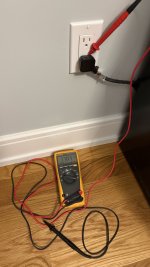
This receptacle is properly connected to 120 VAC, but the open lead makes it read 17.07 VAC. The bad connection you found can yield similar results. This loosely demonstrates the principle I am describing.

1787183917612.jpeg
 
Last edited:

dcg9381

Well-known member
Joined
Jun 20, 2018
Messages
12,003
Location
Austin, TX
100% wrong for a split phase or 3 phase service to a building. the current returns to the source (transformer). The earth is a very poor conductor of electricity especially at low voltages. the current returns to the transformer via the service drop or lateral.
So, explain it to me like I'm an engineer. The "main" has a bonded N/G connection, so it's always going to "leak" some current to "earth" based on the split between neutral connection (high impedance?) and that N has "low impedance" by residential GFI? AS long as the split doesn't trigger GFI limits, you're good...

Basic ohms law... School me.
 
OP
V

vavet

Well-known member
Joined
Mar 6, 2012
Messages
5,358
Location
Ashland, VA
What type of meter did you use? If it is a digital multimeter with the typical 1 or 10 megohm input resistance, it's quite possible you are measuring capacitively coupled (phantom) voltage. The broken connection at the wire nut you mention can provide such a voltage.
An analog meter or a DMM with a Lo-Z (low impedance) setting for AC volts would read zero is this is the case.

Try sticking the red meter probe into the receptacle (the side connected to the black wire) and leave the black lead on the floor.
This receptacle is properly connected to 120 VAC, but the open lead makes it read 17.07 VAC. The bad connection you found can yield similar results.


f
fluke 87 digital meter.
 
To avoid these ads, REGISTER NOW!

wyliesdiesels

Well-known member
Joined
Aug 14, 2012
Messages
20,236
Location
Modesto, CA
so a poor connection would drop the voltage from 120 to 20?
I didn’t know that.

I didn’t think it did, but I also didn’t think a poor connection would drop the voltage like that either.

yes. a poor connection creates a high resistant connection. this causes the voltage to drop when a load is applied. you can also have "ghost" or induced voltage as previously explained.
 

wyliesdiesels

Well-known member
Joined
Aug 14, 2012
Messages
20,236
Location
Modesto, CA
So, explain it to me like I'm an engineer. The "main" has a bonded N/G connection, so it's always going to "leak" some current to "earth" based on the split between neutral connection (high impedance?)

unless you have a poorly connected neutral at the service, it should be low impedance. The earth is not a good conductor of electricity so you wont see more than a few amps if that flowing on the ground rod with a poorly connected neutral. and its not leaking to earth. earth isnt the source of the electricity.

and that N has "low impedance" by residential GFI? AS long as the split doesn't trigger GFI limits, you're good...

totally flawed thinking. A GFCI doesnt care whats going happening on the line side of the GFCI. so discussing some imaginary split happening on the line side of the GFCI makes no sense whatsoever.

a GFCI only cares about whats happening on the load side of the GFCI. It is checking to make sure that the urrent going out to the load on the black/hot/ungrounded conductor is the same amount (within 4-6ma) as the current returning on the white/neutral/grounded conductor. If its not, it trips. The GFCI doesnt care about whats happening on the EGC or whats happening on the GEC going to the grounding electrode.

If you think otherwise, you clearly dont understand how a GFCI functions and need to go back to school
 

rattle_snake

Well-known member
Joined
Jun 25, 2015
Messages
5,325
Location
Chandler, AZ
Does putting other down make you feel better about yourself?
It is clear from your comments you don't understand the physics and theory of electrical systems. No point in any further discussion. Have a nice day.
 

wyliesdiesels

Well-known member
Joined
Aug 14, 2012
Messages
20,236
Location
Modesto, CA
Does putting other down make you feel better about yourself?
It is clear from your comments you don't understand the physics and theory of electrical systems. No point in any further discussion. Have a nice day.

where did i put you down? more bogus **** from you

and your reply is very ironic. you may want to look in the mirror regarding not understanding physics and theory of electrical systems especially when you make a claim that "electrons come out of the ground"

smh
 

dave*99

Well-known member
Joined
May 5, 2009
Messages
4,357
Location
Coastal NJ
Actually the electrons come out of ground not in.

It is clear from your comments you don't understand the physics and theory of electrical systems. No point in any further discussion. Have a nice day.

If you are going to play the physics card, lets try not to reference a DC phenomenon regarding electron flow when describing an AC system. Better to be right more than half of the time.....
 

TRWham

Well-known member
Joined
Aug 11, 2017
Messages
2,007
Location
East Cobb County, Georgia
So, explain it to me like I'm an engineer. The "main" has a bonded N/G connection, so it's always going to "leak" some current to "earth" based on the split between neutral connection (high impedance?) and that N has "low impedance" by residential GFI? AS long as the split doesn't trigger GFI limits, you're good...

Basic ohms law... School me.
You are right, as the return current will follow ALL paths of less than infinite resistance, not just the mythical one of least resistance. You may find it hard to detect the leak assuming there is a nice low impedance path available, but I have seen a building operating with a severed POCO neutral simply by returning all the neutral current via earth.
 

dave*99

Well-known member
Joined
May 5, 2009
Messages
4,357
Location
Coastal NJ
The earth/ground path is complicated. It can include metal water pipes, cable tv wires and other unintended paths when an neutral is open.
You can often see this effect on streetlights. When the neutral is open to the power source, but still bonded to the street light standard (pole), the lamp current can go through the mounting rods into the earth. The lamp usually glows at about half brightness.
 

mm08822

Well-known member
Joined
Jan 13, 2012
Messages
6,247
Location
NJ
Yes, the current all goes to earth ground. That is the other half of the circuit from the power plant.

Actually the electrons come out of ground not in.

A GCFI is a ground leak detector.
Current does not travel back the the power plant. There are several transformers in between the big gens and the little center-tapped trani outside the house. Each trani provides isolation between the different voltage levels due to primary and secondary winding isolation (meaning different circuits). The transformer secondary outside the home is the source of the voltage that the home receives.

The neutral wire (messenger wire) is the intended path back to the transformer center tap. It has a predictable low resistance level based on wire size, materials, length and connection integrity. There is a lot of seasonal variability in ground resistance due to salt, minerals, moisture content, soil type, distance, connection integrity. All of this affects resistance of that path and could be in the megohms (virtually open) or fairly low if wet enough.

Some current (a very small amount) may travel through the earth, if and only if, there is a path back to the transformer secondary where the center tap is connected to a driven ground rod at the base of the pole and a grounding electrode connected to the neutral at the service. The wild card is the soil.

As for ground rods and grounding electrode conductors, yes bonded to the neutral in the enclosure providing the first point of over current protection. It's primary purpose is to bleed off any static charge that may be on the lines, the building surface from wind and differently charged regions of the earth surface and atmosphere during storms. It tries to keep the immediate earth surfaces at the same potential of all the intentionally bonded (grounded) conductive surfaces. Think of lightning. Lightning neutralizes the charge imbalance between surfaces.

A GFCI receptacle would be better called an imbalance detector or leakage detector device. Use of the word ground has so confused the function/purpose of the device. Too many people now think the soil beneath our feet is always involved. Not the case.

A ground fault is only a particular case of leakage. (Neutral - ground connection.)
Two neutrals from different circuits could touch and share current between them.
Two hots from different circuits (on the same phase side of transformer) could also touch each other and share current between them.
All 3 of these conditions could cause an imbalance between the measured hot and neutral passing through the gfci device.

Also, b/c of the ability to measure hot-neutral imbalance, a ground wire (equipment grounding conductor, the bare wire, green wire, the wire dummies cut off) doesn't need to be connected to the gfci for it to function properly.
 

mm08822

Well-known member
Joined
Jan 13, 2012
Messages
6,247
Location
NJ
Rental house we’ve owned since 2006 and lived there until 2015. While we lived there, I hired an electrician to come out and install an outlet in the living room floor so we could have an end table with lamp there.

Our current tenants, moved in there last month, noticed the outlet didn’t work. Previous tenant did not mention it, but maybe they didn’t use it.

I pulled the outlet cover off and measured 20v ac with my meter across the black and white wires.

I go down in the crawl space, I know this is on the same circuit as the crawl space lights. Those are working, as is a receptacle in the crawl space. I go to find the outlet box. It’s just one piece of 14/2 times going in, then I find a junction box a few feet away that is feeding that single piece of romex. It has romex running back towards the crawl space light switch where it gets power. It also has a piece of romex running perpendicular towards the front of the house. The third piece is feeding the floor outlet.

I remove the blank cover plate off the jb. Nothing is wire nutted. One of the black wires kinda falls loose from the other two black wires that are half- heartedly twisted together. The two that are together are the source line and the mystery destination that appears to run through the front foundation wall. The black wire that fell loose is the one for the floor outlet.
I can’t imagine what the power going through the foundation wall is for. But does this somehow explain the 20v ac on the floor outer?

Ultimately, I disconnected the mystery wire, reconnected and wire nutted the floor outlet to line voltage, and reattached the face plate. The floor outlet now has 120v, although… plot twist… I can only insert my outlet tester into one of the receptacles. It’s not one of the child proof outlets. Perhaps something fell down in there and is jamming it? That’s another mystery for another day.

So It seems like whatever was happening with the mystery wire running through the foundation wall was causing the drop to 20v. If that wire is running underground and got partially or completely cut, would it “leak” to ground? Wouldn’t the circuit breaker trip?
For the record, there is a planting bed just on the other side of that foundation wall and there is a black round cable in that area- I always figured that was an abandoned cable tv line, but I don’t really know. I did some digging in that area a couple months ago to put in some new bushes. Maybe I hit it then?
The circuit looks something like the attached drawing.
The disconnected wire in the jbox was the same wire you measured 20 volts on at the floor receptacle. That was the 1 hot wire that "fell out" of the originally 3 spliced wires. @dave*99 's explanation is what you discovered.

Debris got in the receptacle and is why you couldn't get probes into it. That's the problem with floor recepts. Best to use plates with covers and keep closed while not in use.

As for the wire going outside......if you don't have a lamp post light and a switch near the front door, I'd suspect you never have one. Probably for an abandoned recept.
If you had "leakage to earth" on this cable, it probably would have tripped the cb once the knick got wet enough and completed the circuit to either ground wire or neutral wire. Pulling 120v down to 20v would have otherwise required a lot of current to create a 100v drop due the wire resistance. No way all that current was going back through the soil and up the pole on a ground wire.
Since it was getting 120v in the jbox and being the wire still spliced to the source, I'd say that cable is fine other than being unknown as for its purpose.
 

rooster59

Well-known member
Joined
Nov 16, 2014
Messages
999
Location
Land of the Pines
I would abandon the cable through the foundation. Go through every junction box you can find and make sure every connection is wire nutted properly. If they made connections without wire nuts once that may not be the only one. You can check outlets with a good power strip and a with a lamp that has say a 75 w bulb. Plug the lamp into the strip, strip into the outlet, lamp is on. Check the voltage in a power strip outlet. Should be full voltage or something is wrong; nail, drywall screw, bad connection.
 
To avoid these ads, REGISTER NOW!
Top Bottom