vavet
Well-known member
Rental house we’ve owned since 2006 and lived there until 2015. While we lived there, I hired an electrician to come out and install an outlet in the living room floor so we could have an end table with lamp there.
Our current tenants, moved in there last month, noticed the outlet didn’t work. Previous tenant did not mention it, but maybe they didn’t use it.
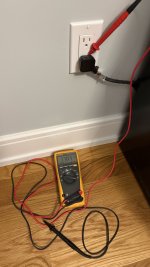
I pulled the outlet cover off and measured 20v ac with my meter across the black and white wires.
I go down in the crawl space, I know this is on the same circuit as the crawl space lights. Those are working, as is a receptacle in the crawl space. I go to find the outlet box. It’s just one piece of 14/2 times going in, then I find a junction box a few feet away that is feeding that single piece of romex. It has romex running back towards the crawl space light switch where it gets power. It also has a piece of romex running perpendicular towards the front of the house. The third piece is feeding the floor outlet.
I remove the blank cover plate off the jb. Nothing is wire nutted. One of the black wires kinda falls loose from the other two black wires that are half- heartedly twisted together. The two that are together are the source line and the mystery destination that appears to run through the front foundation wall. The black wire that fell loose is the one for the floor outlet.
I can’t imagine what the power going through the foundation wall is for. But does this somehow explain the 20v ac on the floor outer?
Ultimately, I disconnected the mystery wire, reconnected and wire nutted the floor outlet to line voltage, and reattached the face plate. The floor outlet now has 120v, although… plot twist… I can only insert my outlet tester into one of the receptacles. It’s not one of the child proof outlets. Perhaps something fell down in there and is jamming it? That’s another mystery for another day.
So It seems like whatever was happening with the mystery wire running through the foundation wall was causing the drop to 20v. If that wire is running underground and got partially or completely cut, would it “leak” to ground? Wouldn’t the circuit breaker trip?
For the record, there is a planting bed just on the other side of that foundation wall and there is a black round cable in that area- I always figured that was an abandoned cable tv line, but I don’t really know. I did some digging in that area a couple months ago to put in some new bushes. Maybe I hit it then?
The circuit looks something like the attached drawing.
Our current tenants, moved in there last month, noticed the outlet didn’t work. Previous tenant did not mention it, but maybe they didn’t use it.
I pulled the outlet cover off and measured 20v ac with my meter across the black and white wires.
I go down in the crawl space, I know this is on the same circuit as the crawl space lights. Those are working, as is a receptacle in the crawl space. I go to find the outlet box. It’s just one piece of 14/2 times going in, then I find a junction box a few feet away that is feeding that single piece of romex. It has romex running back towards the crawl space light switch where it gets power. It also has a piece of romex running perpendicular towards the front of the house. The third piece is feeding the floor outlet.
I remove the blank cover plate off the jb. Nothing is wire nutted. One of the black wires kinda falls loose from the other two black wires that are half- heartedly twisted together. The two that are together are the source line and the mystery destination that appears to run through the front foundation wall. The black wire that fell loose is the one for the floor outlet.
I can’t imagine what the power going through the foundation wall is for. But does this somehow explain the 20v ac on the floor outer?
Ultimately, I disconnected the mystery wire, reconnected and wire nutted the floor outlet to line voltage, and reattached the face plate. The floor outlet now has 120v, although… plot twist… I can only insert my outlet tester into one of the receptacles. It’s not one of the child proof outlets. Perhaps something fell down in there and is jamming it? That’s another mystery for another day.
So It seems like whatever was happening with the mystery wire running through the foundation wall was causing the drop to 20v. If that wire is running underground and got partially or completely cut, would it “leak” to ground? Wouldn’t the circuit breaker trip?
For the record, there is a planting bed just on the other side of that foundation wall and there is a black round cable in that area- I always figured that was an abandoned cable tv line, but I don’t really know. I did some digging in that area a couple months ago to put in some new bushes. Maybe I hit it then?
The circuit looks something like the attached drawing.