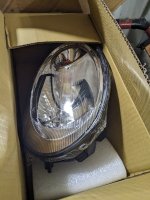
Finallygotit
ALLIANCE MEMBER
We can no longer buy parts from Rock Auto if we live in Arizona. Some legal ******** stopped that. 


Seems Arizona says Rockauto owes the state taxes. So they just stopped selling in AZWe can no longer buy parts from Rock Auto if we live in Arizona. Some legal ******** stopped that.

Seems Arizona says Rockauto owes the state taxes. So they just stopped selling in AZ

Yes, well.. the only time I had a core charge was on the brake shoes, themselves. Never a drum. From what I understand, drums were considered as consumables, rotors, too. Brake shoes, a person could put new lining on, never a disc brake pad. The thing I had to be careful of when I was turning my own drums and rotors was to leave enough material left for wear, the final time I turned one. In the case of a drum, the maximum diameter. In the case of a rotor, minimum thickness. That's not numbers I could find in a Haynes or Chilton's repair manual. I was supposed to depend on the size, either stamped in or cast into the drum or rotor. In many cases, those numbers were rusted beyond recognition. In many cases, I bought a new drum or rotor, just to get that number. Then I'd pencil that into my manual so that I knew what to do at the next brake job. I always tried to keep myself honest and my family safe.Sounds like you've already bought both brake pads so you can just move forward on the job. Or, if you are thrifty and energetic, you could mailorder brake pads that you fancy, and for less, from RA, and return the other pads at the store.
I've been a mailorder fiend since forever. Had a funny little furrin car and am persnickety about parts quality. And I'd rather deal with somebody who knows my type of car and is enthusiastic about them, than, in those days, some counter guy who resented their very existence.
Yeah, better learn to do the internet shopping.
Core charges can be a bummer. I did buy reman calipers for our Durango more than ten years ago, and the shipping cost on those heavy things meant that my core refund got 80% eaten up by the postage. Boo! Yeah, I remember the days when brake shoes might get returned as cores -- and customers were buying remans! I didn't know about drums, though.
I'm still persnickety about quality, and RockAuto is actually kind enough to categorize parts by their quality range, from "you must be broke/you might be a shady used car lot/you should be ashamed of yourself you tightwad" to good to very good/heavy duty.
All that being said, I mostly buy from Amazon. I'm getting free shipping there and returns can be easy. But the filtering at Amazon stinks (make, year, model, engine, show me brake pads for, etc) whereas the RockAuto filtering is outstanding and really shows you the whole world of parts available in the aftermarket for your car. Even Mopar, Motocraft parts can show up at RA or Amazon.
So I look up part numbers at Rock Auto sometimes then start searching at Amazon and compare prices. For bigger jobs I might make an order with each, depending on each part's price.
Ohoh...We can no longer buy parts from Rock Auto if we live in Arizona. Some legal ******** stopped that.
Good on Rock Auto. Off soapbox, before I get trip to band camp.Seems Arizona says Rockauto owes the state taxes. So they just stopped selling in AZ
Ok I will go first.Good on Rock Auto. Off soapbox, before I get trip to band camp.
No more, please, or the mods will send you to band camp for violating the TOS.Ok I will go first.
What happened to the “we the people”?
In Michigan the gas tax was raised by 21c to 52c , nominally to pay for fixing the roads. I have not seen any improvements and roads are as crappy as they have always been. Leave it to freaking politicians and bureaucrats to squander and piss away hard earned tax payer money.
Next please.
But id agree with most people that a brake rotor doesn't really warp. That's not the issue... What really happens is that the thickness changes. A warped rotor pushes the brake pads side to side. Axial runout. And possibly a tilt to the spindle axis. Thus, making the pads try to grab at the maximum diameter of the rotor on the outside with one pad verses the minimum diameter with the inside pad, within the range of the pads. But very out of parallel between the pads and the rotor. That could very well happen, I do not disagree, but I've not witnessed that happening, myself. (I should actually see (witness) some of that, as I turn rotors)(And I have in some extent) Mostly, the thickness changes, making the pulsation happen. Now..... Bob, Squankum, Kay could speak otherwise. Bob owns Corvette cars. Squankum really got into car racing. Kay has done many brake jobs. But I really think pulsations come from thickness variations, not warping and parallelism.
That's pretty neat that you drilled holes in your rotors to save weight. I would've never thought of that. But in your racing scene, every little bit helps. I always thought that by drilling holes in your rotors was a way to add to the cooling efforts of the rotor. I'm sure you've seen where a ball endmill was used to create grooves in the rotor surface, to also add to the cooling efforts.The peculiar form of racing I was involved in was very easy on brakes! At least on our car, which kept getting lighter and lighter. So easy that we "backdated" the front rotors from the vented discs found on later VW's of that era, to the solid/unvented rotors of the diesel model. That also solved a wheel clearance problem, but it also saved weight. Then my friend laid out a pattern on these solid rotors and we whacked away on them with a 1/2" drill bit in the drill press, to save even more weight! Never had a problem with cracking that I know.
Since I gave up on the sport I think my friend has reduced even more weight out of the brakes, but in other ways, mostly calipers, as the rules got looser about what you could run for brakes.
So again, we didn't get a lot of heat or wear into our brakes, but one year we went to nationals, and famous road race care preparer Carroll Smith was there, and he gave a talk in a nearby hangar, so we went to see what he learned. According to my googling and my ten fingers tonight, that was over 20 years ago!
He didn't say anything about brakes that day that I can remember, but he did write this about brake rotors and it's worth reading:
Something else that changed in our modern times is that manufacturers took a lot of mass out of rotors, I think for EPA mpg testing. Less room for error when they get too hot. Less meat to machine -- if any.
I call ******** on the No Warped Rotors statement. I've turned too many rotors back into parallelism to believe that. Now the fact that the braking vibration returns quickly to turned rotors, I can attribute to cheesy modern rotors. Old school rotors had enough mass that you had a chance of restoring them to usefulness. But then they warped a lot less, if at all. Right now, I've got a warped rotor on the Escape. And it's really warped. And I'll replace it because it was too thin when new, let alone now that it's worn and warped.The peculiar form of racing I was involved in was very easy on brakes! At least on our car, which kept getting lighter and lighter. So easy that we "backdated" the front rotors from the vented discs found on later VW's of that era, to the solid/unvented rotors of the diesel model. That also solved a wheel clearance problem, but it also saved weight. Then my friend laid out a pattern on these solid rotors and we whacked away on them with a 1/2" drill bit in the drill press, to save even more weight! Never had a problem with cracking that I know.
Since I gave up on the sport I think my friend has reduced even more weight out of the brakes, but in other ways, mostly calipers, as the rules got looser about what you could run for brakes.
So again, we didn't get a lot of heat or wear into our brakes, but one year we went to nationals, and famous road race care preparer Carroll Smith was there, and he gave a talk in a nearby hangar, so we went to see what he learned. According to my googling and my ten fingers tonight, that was over 20 years ago!
He didn't say anything about brakes that day that I can remember, but he did write this about brake rotors and it's worth reading:
Something else that changed in our modern times is that manufacturers took a lot of mass out of rotors, I think for EPA mpg testing. Less room for error when they get too hot. Less meat to machine -- if any.
I put the dial gauge on it. It's warped.I still firmly believe that the reason that you experience pulsations is because of thickness changes, not parallelism.
Good point. Just for reference , most of our early roads in Australia were built by convicts that we imported from England. A little bit before my time, but was a cheap solution a couple of centuries ago, as they cost very little rum to run. @gman007 : not sure if that scheme is still running but might be worth looking into for your state ?No more, please, or the mods will send you to band camp for violating the TOS.
Thank you, that was indeed a concern of mine. And here I was ready to book an appointment....I still firmly believe that the reason that you experience pulsations is because of thickness changes, not parallelism.

I call ******** on the No Warped Rotors statement. I've turned too many rotors back into parallelism to believe that. Now the fact that the braking vibration returns quickly to turned rotors, I can attribute to cheesy modern rotors. Old school rotors had enough mass that you had a chance of restoring them to usefulness. But then they warped a lot less, if at all. Right now, I've got a warped rotor on the Escape. And it's really warped. And I'll replace it because it was too thin when new, let alone now that it's worn and warped.
That's pretty neat that you drilled holes in your rotors to save weight. I would've never thought of that. But in your racing scene, every little bit helps. I always thought that by drilling holes in your rotors was a way to add to the cooling efforts of the rotor. I'm sure you've seen where a ball endmill was used to create grooves in the rotor surface, to also add to the cooling efforts.
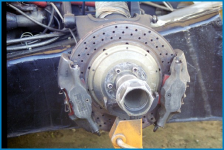

Great and interesting info. Thx for sharing !Was no invention on our part, drilling (or better, casting) holes to improve braking performance started with the Porsche 917 race cars of the of the late 60's/early 70's.
I believe the goal of drilling in those days was getting the gasses from the brake pads out so the gasses didn't make the brake pad float above the rotor surface. I don't think cooling was the real goal. Later on, yes, grooves were a way of getting this done, too. If you have a keen eye you can spot another tactic for extreme braking performance in the picture above.
These brake rotors and the calipers (one per wheel) did eventually make their way to some of Porsche's street cars. Dual calipers, to my knowledge, didn't show up on a street car until the Mercedes-Benz Maybach sedan/limo around 1997.
But we already knew from seeing real race cars at the autocross, and from race parts catalogs, that Formula Ford race cars were doing crazy things like this with brake rotors:
Now that's about rotational mass and unsprung weight! Although I suppose the surface area for cooling has increased, too.
Sprint cars and high-tech motorcycles have since gone on to have crazier rotors.
Was no invention on our part, drilling (or better, casting) holes to improve braking performance started with the Porsche 917 race cars of the of the late 60's/early 70's.
I believe the goal of drilling in those days was getting the gasses from the brake pads out so the gasses didn't make the brake pad float above the rotor surface. I don't think cooling was the real goal. Later on, yes, grooves were a way of getting this done, too. If you have a keen eye you can spot another tactic for extreme braking performance in the picture above.
These brake rotors and the calipers (one per wheel) did eventually make their way to some of Porsche's street cars. Dual calipers, to my knowledge, didn't show up on a street car until the Mercedes-Benz Maybach sedan/limo around 1997.
But we already knew from seeing real race cars at the autocross, and from race parts catalogs, that Formula Ford race cars were doing crazy things like this with brake rotors:
Now that's about rotational mass and unsprung weight! Although I suppose the surface area for cooling has increased, too.
Sprint cars and high-tech motorcycles have since gone on to have crazier rotors.
We were drilling rotors on motorcycles back in the 1970's. I'd say 99% or more were just for the "cool" factor - and, we're not talking temperature.
Depends on the bike. My Burgman's mags are made of some concrete alloy. Losing 4 ounces of rotational mass from a road wheel assembly that weighs 40 lbs is not worth it.Many modifications are done to make something like a race car. Not necessarily effective like a race car, just, look at this! It's like a race car! Ditto motorcycles, I guess. I bet a reduction in rotational mass can really be felt on a motorcycle. But start those mods with flywheel and wheels.
Kay, you checked for runout, not thickness changes. Calipers are meant to float a bit, but are pretty determined in thickness changes, with the hydraulics involved.I put the dial gauge on it. It's warped.
The micrometer says consistent thickness.Kay, you checked for runout, not thickness changes. Calipers are meant to float a bit, but are pretty determined in thickness changes, with the hydraulics involved.
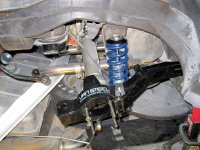
Michael, that doesn't sound that crazy. Off-the-shelf coilovers and rear (big tire) suspension arms for my '72 Corvette made me cringe.My buddy's shocks are $2600 a shock plus tuning he sells customized versions of Penske shocks think the Cadillac endurance team runs them.
Rick, those lathes would have to do more than save me the price of new rotors.Holy smokes... And to think I could turn my own rotors. I had two brake lathes, so I could turn (both) rotors or drums. One of my lathes had an attachment to "true up" brake shoes to a certain radius. I've not used that feature, but had that available to me. It had a spindle sandpaper type of contraption on it. Using Dad's words, it didn't cost me a dime to turn my own rotors and drums. I didn't get my brake lathes from my Dad, but he sure had the biggest grin on his face when he saw me using mine. When I bought the first lathe, and that one only did drums, I asked Dad if I could take a couple of drums out of his scrap iron pile to practice on. He says... Sure. That way I could practice and not worry about holding size (less than maximum diameter) or in the case of my second lathe, less than minimum thickness on a rotor. But wow... The prices on... even brake pads are astronomical nowadays.
Kay, you are way smarter than me.And this is why I drive cheap sboxes.
Rick, Cadillac offered Brembo brakes on quite a few of their performance models. My CTS-V came with Brembo brakes on all four wheels.Bob, I didn't know that Brembo brakes were part of a Cadillac's line-up from the car manufacturer. Or was it an upgrade, an option, so-to-speak...??? Like buying a radio, as an option, back in the day.
Rick, on several occasions I thought about buying a pickup. When I thought about how often it would be used as a pickup, I decided renting one or using the trucks from Home Depot would make more sense. Two of my three vehicles accumulate less than a thousand miles a year and the third one (PT Cruiser) rings up about two thousand.That's pretty awesome. Much different than my square body Chevy pickups. The only "Really sporty car" I've ever owned was my 1976 Trans-am. My main focus was on Chevy pickups so I could handle a very large trailer so I could haul very large machine tools home. Ha. Don't get me wrong, the Trans am was a blast to own, but I only replaced brake parts and some things to keep it going. I didn't do any upgrades on it. Much of my money was spent on keeping my Chevy pickups going, so I could haul more machine tools home. Those 14-1/2 diameter size tires were not cheap for my triple axle trailer.
@Squankum, I use Rock Auto first and then do a search for the lowest price elsewhere. Amazon or Advance Auto often wins because they get it to me for free (box or bag from Amazon in a day or two) or a 2 mile round trip to the Advance Auto store (to pick up my pre-paid order).Peeking at RockAuto.com, it appears the clue is the diameter of the brake rotor, 330mm or 350mm. Do they have UPS or the US Postal Service where you live? They have a zillion options for brake pads showing there.
Rick, I like Rock Auto because they offer different grade parts. I no longer look for the cheapest stuff, especially when I'm doing the labor.Actually, yes. I have ordered many parts from Rock Auto over the years, but always had Cheryl do the ordering. I'm kind of a cash-only person so that limits my success on ordering things online. I'll get better with this in the future, I promise.
Edit: if you think I should look into this from Rock Auto, I'll certainly do that.
Rick, the core charge bothers me as well. I'd rather keep or throw out the old part myself. Sometimes I upgrade something so my core isn't acceptable.These are disc brakes, so a core is not needed for return, like drum brakes used to be. Although, when I fixed the rear brakes on the Dodge Neon, there was no concern for a core on those brake shoes... That was always a concern with something that had a core charge, from Rock Auto and how to return something.
Emil, I decided not to buy a clam or oyster for the demonstration but I had some frozen English muffins.Good to see you being productive but wouldn’t expect anything else.
Substituting English muffins for oysters in a recipe is an interesting thought.
Good to hear you have finished surgery on the PT Cruiser hopefully it serves you faithfully. My wife has been casually mentioning our 2003 Montana is likely past its best before date. It has served us well and has fairly low mileage but I think it has a few more miles in it after all it is a PontiacSo I placated my wife that once her RRIF kicks in she can buy anything she wants. I may regret that statement
but time will tell.
I had MagnaRide on my Denali and it was going to cost me $1k CDN per corner before labour. :yikes I eventually went with the delete kit with Bilstein shocks (if I remember correctly) from Rock Auto, so far so good.
Hope you have a great summer or what is left of it anyway. Tomorrow I’m going to burn up some of that fuel in the SeaDoo before we have to yank them out of the water for the year.
Rick, I didn't get my driver's license until I was 17.5 and Liane was the one who arranged it.I should specify that my Chevy pickups were of that vintage. I didn't get my driver's license until I was the ripe old age of 16 years old. That would've been the year, 1981. But really, those front brakes on the Durango lasted forever as compared to my Chevy pickups. It seems like I'd have to replace pads about every year on those trucks. I'm sure either set of pads will work just fine in my Durango.
@Squankum, we're on the same page.Sounds like you've already bought both brake pads so you can just move forward on the job. Or, if you are thrifty and energetic, you could mailorder brake pads that you fancy, and for less, from RA, and return the other pads at the store.
I've been a mailorder fiend since forever. Had a funny little furrin car and am persnickety about parts quality. And I'd rather deal with somebody who knows my type of car and is enthusiastic about them, than, in those days, some counter guy who resented their very existence.
Yeah, better learn to do the internet shopping.
Core charges can be a bummer. I did buy reman calipers for our Durango more than ten years ago, and the shipping cost on those heavy things meant that my core refund got 80% eaten up by the postage. Boo! Yeah, I remember the days when brake shoes might get returned as cores -- and customers were buying remans! I didn't know about drums, though.
I'm still persnickety about quality, and RockAuto is actually kind enough to categorize parts by their quality range, from "you must be broke/you might be a shady used car lot/you should be ashamed of yourself you tightwad" to good to very good/heavy duty.
All that being said, I mostly buy from Amazon. I'm getting free shipping there and returns can be easy. But the filtering at Amazon stinks (make, year, model, engine, show me brake pads for, etc) whereas the RockAuto filtering is outstanding and really shows you the whole world of parts available in the aftermarket for your car. Even Mopar, Motocraft parts can show up at RA or Amazon.
So I look up part numbers at Rock Auto sometimes then start searching at Amazon and compare prices. For bigger jobs I might make an order with each, depending on each part's price.
Dan, I assume you aren't prevented from shopping at the Rock Auto site. The shipping charges and time make it my least favorite place to get parts.We can no longer buy parts from Rock Auto if we live in Arizona. Some legal ******** stopped that.
Cody, makes sense. California doesn't allow a bunch of auto paint to be shipped there either. Florida is full of us old people so we're allowed to have all the deadly chemicals we want.Seems Arizona says Rockauto owes the state taxes. So they just stopped selling in AZ
I notice only one is carrying a firearm.
Rick, we're fortunate in Florida to have a lot less rust problems. I stopped having my rotors or drums turned a long time ago. I dropped off the drums for my GTO and didn't learn they couldn't be turned until three days later. In my working years that was totally unacceptable because we had two cars and my goal was always to finish repairs on the weekend. Liane could survive without a car but it was a black cloud hanging over my head when it was my fault she didn't have wheels.Yes, well.. the only time I had a core charge was on the brake shoes, themselves. Never a drum. From what I understand, drums were considered as consumables, rotors, too. Brake shoes, a person could put new lining on, never a disc brake pad. The thing I had to be careful of when I was turning my own drums and rotors was to leave enough material left for wear, the final time I turned one. In the case of a drum, the maximum diameter. In the case of a rotor, minimum thickness. That's not numbers I could find in a Haynes or Chilton's repair manual. I was supposed to depend on the size, either stamped in or cast into the drum or rotor. In many cases, those numbers were rusted beyond recognition. In many cases, I bought a new drum or rotor, just to get that number. Then I'd pencil that into my manual so that I knew what to do at the next brake job. I always tried to keep myself honest and my family safe.
When I checked the rotors on the PT Cruiser they could have been turned but once again, the places that could do the turning wanted a day or two. In the old days I waited in the parts store or machine shop and watched them do the job right away.In many cases I had about .075 stk on a brand new rotor thickness. Using ceramic pads, I could turn those rotors a couple of times, and still leave .015 stk for wear on my final turning. In my experience, with your own brake lathe, it really did make sense to turn the rotors. Drum brakes, on the rear of the vehicle lasted forever... Well, the front brakes do the majority of the braking as far as percentages go. But when it came time to turn a rear drum... Those drums looked like a very small cut would clean things up. But what you didn't see is how out-of-round those things were!! ( Well maybe not out of round, but off-center...) It took many cuts to clean up a drum. It took much of your tolerance, just to get those drums to minimum clean-up.
I feel blessed to have a three-car garage but I would much rather fill it with vehicles rather than machines.Both of my brake lathes would only have power feed in one direction. That bothered me at first, but I understand now. You always had to feed the boring bar into the cut with the machine running while the bar was at the furthest inside of a drum. That bothered me. My machine was set up so the boring bar swung around while the drum stayed stationary. Try to adjust that bar to an accurate size, while it was in motion, swinging around.... When you are at the very inside of the drum. The machine came equipped with a rheostat to begin with, so it had variable speed. When I bought the machine, the rheostat had failed, so I bypassed that and ran it with a Variac, instead. So I could throttle the boring bar down to a slow crawl, adjust the boring bar on the fly, then start the power feed, then crank up the Variac to a decent RPM, but not high enough to tip the machine over in this unbalanced condition... (I didn't have the machine bolted to the concrete floor). But the reason that I had to start from the inside, then feed outwards was so I could never crash that machine, because I walked away and did something else. I'd always listen to it, once I could hear that it wasn't cutting anymore, I knew to come over, reset for another cut. My rotor lathe worked in the same way.
Ohoh...
I have only one customer doing business with my garage. He's a cheap and lazy SOB and tells me to buy new rather than turn them on a lathe. Years ago I needed to rebuild the 454 ci engine in the '72 Corvette. A buddy in the Corvette club owned a machine shop and wanted to get into building offshore powerboat engines. The 454 GM engine was the most common engine used in the '80s. My engine was his first patient so I got to help with the align boring machine, milling machine and CK10 Sunnen hone. Better to pay for parts and get to use a million dollars worth of machines to blueprint my one engine than to buy all that equipment. Parts cost me less than $3,000 and I had a blue printed big block. Only thing I lost was the matching numbers on the engine block.Quite frankly, that drum lathe is pretty small in comparison to size of the metal trunk that holds all of the rest of the attachments... There's another spindle in it, so I could turn anything from a motorcycle sized drum to something on a semi- truck, and everything in between.... So, I've heard whence I bought such. I have no reason to doubt things. It's gonna be easier to move the machine than the metal trunk full of attachments. Lots of steel cones, lots of cast iron inside-out "cones" for support on the spindles. Lots of things I haven't even tried out yet...
I feel fortunate to have never warped or hot spotted my disk brakes. I did have to pull the drums on the PT Cruiser to clean out the dust and rust. The rear brakes would lock up sitting in the driveway for a week or two in either downpours or super high humidity weather.But id agree with most people that a brake rotor doesn't really warp. That's not the issue... What really happens is that the thickness changes. A warped rotor pushes the brake pads side to side. Axial runout. And possibly a tilt to the spindle axis. Thus, making the pads try to grab at the maximum diameter of the rotor on the outside with one pad verses the minimum diameter with the inside pad, within the range of the pads. But very out of parallel between the pads and the rotor. That could very well happen, I do not disagree, but I've not witnessed that happening, myself. (I should actually see (witness) some of that, as I turn rotors)(And I have in some extent) Mostly, the thickness changes, making the pulsation happen. Now..... Bob, Squankum, Kay could speak otherwise. Bob owns Corvette cars. Squankum really got into car racing. Kay has done many brake jobs. But I really think pulsations come from thickness variations, not warping and parallelism.
Sounds like fun.As I turn a rotor, there's a cutting tool on both sides of the rotor, cutting at the same time. It takes more than one cut, to clean things up. As it takes a few passes to clean things up, I tend to watch the pattern, of cutting and non,- cutting.
Kay, well said and warning appreciated. I remember getting amoebic dysentery at camp so I would really like to avoid the GJ variety.Good on Rock Auto. Off soapbox, before I get trip to band camp.
@gman007, no comment.Ok I will go first.
What happened to the “we the people”?
In Michigan the gas tax was raised by 21c to 52c , nominally to pay for fixing the roads. I have not seen any improvements and roads are as crappy as they have always been. Leave it to freaking politicians and bureaucrats to squander and piss away hard earned tax payer money.
Next please.
Kay, I have managed to avoid being TOSsed. Reminder appreciated.No more, please, or the mods will send you to band camp for violating the TOS.
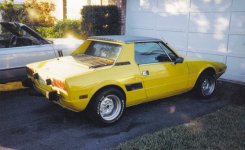
@Squankum, most of my autocross events were in the Fiat X1/9 and I rarely had to use the brakes. The Corvettes and Mustangs and even the Porsches had the power to get up to speed quickly but then had to brake hard for the turns. I just floored it and took my foot off the gas for the turns, then floored it to the next turn. The tires on my Fiat were huge (9.5" wide rear and 8.4" wide front) for an 1,940 pound car.The peculiar form of racing I was involved in was very easy on brakes! At least on our car, which kept getting lighter and lighter. So easy that we "backdated" the front rotors from the vented discs found on later VW's of that era, to the solid/unvented rotors of the diesel model. That also solved a wheel clearance problem, but it also saved weight. Then my friend laid out a pattern on these solid rotors and we whacked away on them with a 1/2" drill bit in the drill press, to save even more weight! Never had a problem with cracking that I know.
Since I gave up on the sport I think my friend has reduced even more weight out of the brakes, but in other ways, mostly calipers, as the rules got looser about what you could run for brakes.
So again, we didn't get a lot of heat or wear into our brakes, but one year we went to nationals, and famous road race care preparer Carroll Smith was there, and he gave a talk in a nearby hangar, so we went to see what he learned. According to my googling and my ten fingers tonight, that was over 20 years ago!
He didn't say anything about brakes that day that I can remember, but he did write this about brake rotors and it's worth reading:
Something else that changed in our modern times is that manufacturers took a lot of mass out of rotors, I think for EPA mpg testing. Less room for error when they get too hot. Less meat to machine -- if any.
Rick,I copied all our CDs to 32 gigabyte iPods and put adapters in the Corvettes and PT Cruiser (Cadillac came with USB ports) so I can listen to 2,000+ songs played randomly without commercial interruptions. The garage stereo has two Sony 400CD changers that are more storage units now because that surround sound system also has an iPod. The workshop also has one but the stereo out there is very basic -- it makes happy noises.Well, I had a pretty good evening. (Always take Fridays off as PTO). When I went out to the shop, I wanted to take a gander on my stereo, as last time out there, it would turn on, but no noise... Hmm. I hit every button on the remote, then went over and started turning knobs and things. I finally got it to work again. Whew!. That owner's manual is about 80 pages long. You just about need a college degree to run the thing. I still haven't found the tone controls on it yet, but considering buying a graphic equalizer to help with things. Anyways, my first song of choice was Fever 333, Animal. Got that downloaded to Spotify and let 'er buck about a half-dozen times in a row, at some volume while I found the new headlight assy for the Dodge Neon. I did find the headlight, that I bought in 2023....
I put drilled and slotted rotors on the PT Cruiser and both Corvettes but the Cadillac's fancy brakes have smooth rotors.That's pretty neat that you drilled holes in your rotors to save weight. I would've never thought of that. But in your racing scene, every little bit helps. I always thought that by drilling holes in your rotors was a way to add to the cooling efforts of the rotor. I'm sure you've seen where a ball endmill was used to create grooves in the rotor surface, to also add to the cooling efforts.
Kay, as you say, the rotors on the '72 Corvette are beefy. The ones on the '87 Corvette are slightly less and the original rotors on the PT Cruiser were near their limit at 30,000 miles. I upgraded them to a larger diameter Turbo rotor and caliper setup and they look new 20.000 miles later. I've never warped rotors on any of my cars but I know it happens.I call ******** on the No Warped Rotors statement. I've turned too many rotors back into parallelism to believe that. Now the fact that the braking vibration returns quickly to turned rotors, I can attribute to cheesy modern rotors. Old school rotors had enough mass that you had a chance of restoring them to usefulness. But then they warped a lot less, if at all. Right now, I've got a warped rotor on the Escape. And it's really warped. And I'll replace it because it was too thin when new, let alone now that it's worn and warped.
Rick, you may be right but I don't remember ever experiencing pulsations either.I still firmly believe that the reason that you experience pulsations is because of thickness changes, not parallelism.
Kay, I bought a dial indicator to check the rear hubs on the '72 Corvette when I put new bearings in.I put the dial gauge on it. It's warped.
Greg, I didn't understand why the roads in The Rocks in Sydney were so narrow and not very well laid out but someone explained they were built by convicts who had no desire to build anything straight or square. Of course, the Aussie convict who told me the story may have been pulling my leg.Good point. Just for reference , most of our early roads in Australia were built by convicts that we imported from England. A little bit before my time, but was a cheap solution a couple of centuries ago, as they cost very little rum to run. @gman007 : not sure if that scheme is still running but might be worth looking into for your state ?
HTH !
It might also be caused by the steering wheel being on the other side of the car.Thank you, that was indeed a concern of mine. And here I was ready to book an appointment....
It's entirely possible Carroll Smith's perspective is narrow, living in racecar land!
@Squankum, I thought I was going overboard.Was no invention on our part, drilling (or better, casting) holes to improve braking performance started with the Porsche 917 race cars of the of the late 60's/early 70's.
I believe the goal of drilling in those days was getting the gasses from the brake pads out so the gasses didn't make the brake pad float above the rotor surface. I don't think cooling was the real goal. Later on, yes, grooves were a way of getting this done, too. If you have a keen eye you can spot another tactic for extreme braking performance in the picture above.
These brake rotors and the calipers (one per wheel) did eventually make their way to some of Porsche's street cars. Dual calipers, to my knowledge, didn't show up on a street car until the Mercedes-Benz Maybach sedan/limo around 1997.
But we already knew from seeing real race cars at the autocross, and from race parts catalogs, that Formula Ford race cars were doing crazy things like this with brake rotors:
Now that's about rotational mass and unsprung weight! Although I suppose the surface area for cooling has increased, too.
Sprint cars and high-tech motorcycles have since gone on to have crazier rotors.
Great and interesting info. Thx for sharing !

Roger, I have to agree. Many of the things I've done to my vehicles is just to impress the cool kids.We were drilling rotors on motorcycles back in the 1970's. I'd say 99% or more were just for the "cool" factor - and, we're not talking temperature.
@Squankum, I remember a whole bunch of drag cars with holes in their frames and beam front axles.Many modifications are done to make something like a race car. Not necessarily effective like a race car, just, look at this! It's like a race car! Ditto motorcycles, I guess. I bet a reduction in rotational mass can really be felt on a motorcycle. But start those mods with flywheel and wheels.
Kay, I've always figured losing 40 pounds from my fat *** was a better way of making my wheeled vehicles faster.Depends on the bike. My Burgman's mags are made of some concrete alloy. Losing 4 ounces of rotational mass from a road wheel assembly that weighs 40 lbs is not worth it.
@Squankum, I remember a whole bunch of drag cars with holes in their frames and beam front axles.

@Squankum, most of my autocross events were in the Fiat X1/9 and I rarely had to use the brakes. The Corvettes and Mustangs and even the Porsches had the power to get up to speed quickly but then had to brake hard for the turns. I just floored it and took my foot off the gas for the turns, then floored it to the next turn. The tires on my Fiat were huge (9.5" wide rear and 8.4" wide front) for an 1,940 pound car.

@Squankum, I remember a whole bunch of drag cars with holes in their frames and beam front axles.
$1 per millimetre, seems like a reasonable pricing strategy, but could get expensive for larger itemsNext up was to find an 11mm hex key wrench ... Cost me about 11 bucks...
That being said, I've been doing a brake job on my Durango. No biggie, amirite? F-that. My first was to find a 22mm socket for the lug nuts.
I never learned either, because I just bought 2 complete sets, so there'd never be any confusion. The sad part is that my SAE set has kinda languished since the 80s. But I still buy one of each breed when I buy new tools, cause you never know, and I've been bit in the *** before by not having whatever the other one was.Now now, you're the machinist. I'm the Eurofoofoo and even I don't mind putting a 7/8" on such a thing... and with a big burly American thing like that, I'm not sure what measuring system they wanted me to use for that lug nut!
0.009" difference.
But that's okay, this is GJ, and now you have a more complete set of tools, which always feels good. A lot of guys in the 70's and 80's suffered through the move to metric and memorized which SAE wrench would work acceptably on which size metric fastener. I never learned that because I lived in a metric world and had metric wrenches... but I did learn that when it came to 22mm and 7/8", because of the top strut nuts on my car.
Yes, you really do "git" me... I really did try a 7/8 deep socket on thems lug nuts. It didn't feel right, being slightly loose, that's when it became important to drive to town to buy another socket of correct size. I ended up with a 1/2" drive socket. Still chrome plated, of course. I bought two sockets. Actually. One deep socket, 12 point. Another one, standard length, 6 point. What I really wanted was a deep, impact, 6 point socket, 3/4 drive. What I found in this small town was much less than that. I fully expected to break at least one of these new sockets, as I ended up taking a 3/4 drive ratchet, reduced down to 1/2"drive to fit one of the sockets. I put the ratchet and socket on the first lug nut, with the handle, horizontal, pointing to the left. I grabbed a hold of the fender, stepped onto the ratchet handle, then had to bounce on said handle, to make the lug nuts come loose. I fully expected the socket to break. I never abuse my tools that way, but felt I must, this time. I never abuse my tools. If something does not come loose, I increase the size of my tools. In that order. I've never had to "warrantee" a tool because it was my fault that it broke.Now now, you're the machinist. I'm the Eurofoofoo and even I don't mind putting a 7/8" on such a thing... and with a big burly American thing like that, I'm not sure what measuring system they wanted me to use for that lug nut!
0.009" difference.
But that's okay, this is GJ, and now you have a more complete set of tools, which always feels good. A lot of guys in the 70's and 80's suffered through the move to metric and memorized which SAE wrench would work acceptably on which size metric fastener. I never learned that because I lived in a metric world and had metric wrenches... but I did learn that when it came to 22mm and 7/8", because of the top strut nuts on my car.