To avoid these ads, REGISTER NOW!

South Bend Lathe

Luntz

Well-known member
Joined
Jul 13, 2020
Messages
212
Location
Franklin TN
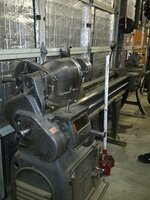
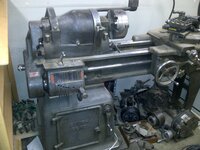
Saw this lathe in the storage area of a local "picker". Pretty cool looking looped tube frame for the "desk" support.
Couple of questions for the machine gurus here:
Is this set up for a left handed operator?
Any idea what year it's from?
How desirable is it?
TIA-cheers
 

Attachments

  • Lathe.JPG
    Lathe.JPG
    433 KB · Views: 200
  • Lathe badge.jpg
    Lathe badge.jpg
    468.7 KB · Views: 179
  • Lathe draweer.JPG
    Lathe draweer.JPG
    342.5 KB · Views: 130
To avoid these ads, REGISTER NOW!

cvairwerks

Well-known member
Joined
Aug 12, 2016
Messages
7,182
Location
Within hearing distance of Texas Motor Speedway
It's sitting on the cabinet backwards. Headstock should be by the control lever on the left end of the cabinet.
Desirability is fluid. Depends on what one wants to turn, how big an envelope they need and what shape the ways, shafts and bearings are. Does it have the rest of the covers and the tailstock? How about the taper attachement?

Should look like this:


Whitworth

Well-known member
Joined
Dec 26, 2011
Messages
2,082
Flat belt drive. Lathe is ancient. Probably has substantial wear in the bed, cross feed screw and lead screw.
If you're a beginner it's probably the worst machine to try to start machining and learn on.
 

isb cornbinder

Well-known member
Joined
Nov 3, 2010
Messages
7,073
Location
Pacific South West, BC, Canada
I bought a 1945 16X120 South Bend for $900. This lathe has some wear, probably less than a 76 year old lather might be expected to have. The accuracy is good enough for anything I might turn, so far.
I think the lathe the OP posted is a South Bend Heavy 10. For me, I would pay about $500 for it. The situation with these older lathes is the man-cavers tend to push the prices up. It may be important to have a lathe for appearance more than it is for real work. One of my neighbours has a nice looking SB 7". He does not have a clue. Just after he bought his SB, he called me to ask why his 7" was not cutting. He had his SB in reverse.
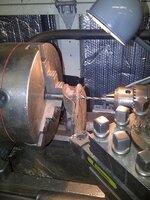
I use my SB to drill out the studs on spring perches. The last picture shows an adapter I made to fit an NVG 241C to a TH475 automatic. The lathe was accurate enough to .001".
 

Attachments

  • PERCH CORROSION TYPICAL.jpg
    PERCH CORROSION TYPICAL.jpg
    53.4 KB · Views: 115
  • PERCH DRILLED OUT ON LATHE.jpg
    PERCH DRILLED OUT ON LATHE.jpg
    52 KB · Views: 95
  • PERCH RUSTED AND BENT.jpg
    PERCH RUSTED AND BENT.jpg
    81.1 KB · Views: 93
  • perch pin drilling.jpg
    perch pin drilling.jpg
    97 KB · Views: 88
  • GM TH475 REAR MOUNT ON TRANSFER CASE ADAPTER.jpg
    GM TH475 REAR MOUNT ON TRANSFER CASE ADAPTER.jpg
    56.9 KB · Views: 88
  • SOUTHBEND 16 X 120.jpg
    SOUTHBEND 16 X 120.jpg
    60.2 KB · Views: 83
  • SOUTHBEND 16.jpg
    SOUTHBEND 16.jpg
    342.2 KB · Views: 80
  • LB FUEL TANK SQUARING THE TANK.jpg
    LB FUEL TANK SQUARING THE TANK.jpg
    69.9 KB · Views: 140

paulsomlo

Well-known member
Joined
Jul 16, 2013
Messages
3,857
Location
Northern Colorado
Flat belt drive. Lathe is ancient. Probably has substantial wear in the bed, cross feed screw and lead screw.
If you're a beginner it's probably the worst machine to try to start machining and learn on.
I've had two South Bend lathes, one built in 1938, the other in 1960. Both saw little use and were far from worn out. The lathe pictured is probably a 10L, aka Heavy 10, based on the spindle bore. How desirable? Depends on how badly you want a lathe.
 

tombell572

Well-known member
Joined
Oct 3, 2015
Messages
1,034
Location
Sea Cliff, NY & Portland, OR
As noted by cvairworks, the lathe is sitting ***-backwards on its bench which, by the way, is an actual SB lathe cabinet for the underneath drive setup. it looks like remnants of a taper attachment are still attached to the back of the carriage. If you are serious about this lathe, check thoroughly to see that you have all the tooling and attachments that may be laying around. Just the complete taper attachment would be an expensive item by itself. Buying tooling after you buy the lathe may soon exceed the purchase price of the lathe. If it is truly a "Heavy 10", its a beefier machine than the basic SB 10" lathes.

Examine carefully for obvious damage, weld repairs, etc. Some quick, easy tests for condition: rotate the spindle by hand--it should turn easily, smoothly and silently. Crank the carriage the full length of the bed using the hand wheel. Many lathes tend to be used most frequently near the headstock for chuck working mot of the wear is in that area of the ways. If the carriage begins to bind and becomes hard to crank toward the tailstock end, its an indication of substantial wear. If you have a friend with machining skills, perhaps bring him along for an inspection. South Bend lathes are good machines and often carry a price premium because there are extremely well-known. buy a copy of "How to Run a Lathe" originally published by South Bend Lathe Works and available in reprint on line.

Tom B.
 

Jim C.

Well-known member
Joined
Jan 8, 2010
Messages
2,598
Flat belt drive. Lathe is ancient. Probably has substantial wear in the bed, cross feed screw and lead screw.
If you're a beginner it's probably the worst machine to try to start machining and learn on.
What’s the best machine to try to start machining and learn on?

Jim C.
 

kmacht

Well-known member
Joined
Apr 12, 2010
Messages
2,765
Location
Connecticut
I have this same lathe with the under mount drive and as it sits in the pictures I would not pay very much at all for it. There are many parts missing. The cross slide screw and handle are gone, the back cover is missing, the power switch arm that normally comes off an arched tube on the back is missing as the power switch was moved underneath. Unless given it for free you would be better buying another southbend that has all the parts to start
 

Whitworth

Well-known member
Joined
Dec 26, 2011
Messages
2,082
What’s the best machine to try to start machining and learn on?

Jim C.
I suppose the "best" is any quality machine that isn't worn out and has features found on lathes intended for (relatively) modern industrial or vocational use; such as variable speed, Aloris style tool post, DRO, an E stop, etc.
 

Maui

Well-known member
Joined
Sep 16, 2012
Messages
2,863
Location
Upstate NY
I suppose the "best" is any quality machine that isn't worn out and has features found on lathes intended for (relatively) modern industrial or vocational use; such as variable speed, Aloris style tool post, DRO, an E stop, etc.
The best lathe to learn on is the one that is least likely to hurt you when you make stupid mistakes such as driving the carriage into the chuck, taking too deep of a pass for the set-up, turning with too dull of a tool bit, feeding too quickly, etc. I’d probably pass on this one myself. The OP may be better served by purchasing a smaller bench top model, learning on that, and then passing it along when he is prepared to upgrade to a more competent model.
 

RoninB4

Well-known member
Joined
Jul 22, 2020
Messages
3,479
Location
Under My House
What’s the best machine to try to start machining and learn on?

Jim C.

This is just my opinion and it's worth what you pay for it. Best lathe to start learning on depends upon the answer to a couple of questions.

1) What you intend to do with the machine. This may be hard to answer when you're starting out. Bushings and small shafts can be done on most any lathe, even small ones, but larger size work will almost require a large enough bed length and swing over the bed. If you have aspirations of doing Ag-Con machinery work then the small bench top lathes won't be a good choice.

2) How many years do you anticipate using this? Not a lot of point in getting an expensive piece of machinery if you're 70, not an issue if you're 25.

3) Are you own a house or renting? Moving a larger lathe isn't terrible but it's not a lot of fun either so if you'll be moving in a few years you may want to limit the lathe to something that weighs under a ton that you can move by yourself.

4) Budget dictates a lot with machinery. All expectations for performance/results have to be balanced against what the budget will allow. Some digging on-line should reveal what your budget will buy you. Often the larger machines are going for a cheaper price than the smaller machines due to footprint, available electric (1 Phase vs. 3 Phase), and weight. Most home shop owners don't have the available space, electric, or ability to transport the new machine. If you have a lot of room and 3 Phase electric you have more choices.

5) How far are you willing to travel for it? Not knowing your location, you may need to travel some distance to be in an area where there are more machines available as some areas didn't have an industrial base or everything went out of business some time ago and all machines were sold off. I had to travel about 300 miles for my surface grinder, less for other machines.

You really need to do some research (reading, videos, etc.) on what constitutes an acceptable or unacceptable lathe in bed wear, bearing condition, and gearing problems. You don't really want a "project", an ad that reads "Simple Repair", or something missing critical tooling that may no longer be available (or expensive). Machinery will also be somewhat priced per the make. A Hardinge HLV-H or a Schaublin is going to be expensive, other lathes like a Monarch will be much less expensive but still a very well made machine. Learn what makes are within your price range.

I'd almost advise NOT getting one of those tiny 7x12 benchtop lathes unless it's for under $100. They aren't very well made, aren't very durable, and have tiny little controls/levers that can be very clumsy to use with average size hands. I sold all my larger machines when I relocated from Chicago but kept the tinker toy lathe because I could move it. I still have it an do occasionally use it for secondary operations (polishing, de-burr) but detest using it. Some of the Chi-Wan machines are ok, some are just **** and you don't need to learn on something while fighting it's limitations.

Southbend is ok for a light duty, hobby level lathe, there are many other brands you may not have heard of but would be a better choice. You can look up unknown brands at the website: lathes.co.uk and get a good assessment of them. I bought a brand I'd never heard of from Germany after doing some reading. You can get something considered a "starter" and upgrade but it won't be worth much when you try to sell it. If it's worn out, it will never be good enough by the time you are ready to do precision or close fit type of work. Also consider what tooling you'd be getting with it. Tooling can be just as expensive (or more) than the machine itself. Read, watch, ask questions.

One more thing, I cannot stress learning safety enough if you've never run machinery. Machines are hard, flesh is soft, and machines don't care what's in the way. Learning safety around machinery is not a casual affair you just pick up, you need to learn where the potential hazards are. An accident is not a matter of IF it's a matter of WHEN and how severe. It can be as simple as a ****** laceration or it can be life changing in severity. Happy hunting
 
Last edited:
To avoid these ads, REGISTER NOW!

ER70S-2

Well-known member
Joined
Jan 2, 2015
Messages
796
Flat belt drive. Lathe is ancient. Probably has substantial wear in the bed, cross feed screw and lead screw.
If you're a beginner it's probably the worst machine to try to start machining and learn on.

Sorry, but this is pretty bad advice. You have no idea what condition any lathe is in until you inspect it. South Bend lathes are perfect to learn on. The only thing you can say, based on the pics, is that it's been partially disassembled because the lathe is backwards on the cabinet and there are some parts missing (but they may be in the drawers).
 

cvairwerks

Well-known member
Joined
Aug 12, 2016
Messages
7,182
Location
Within hearing distance of Texas Motor Speedway
One huge thing to add to Ronin's Item #4... IF you decided to look at 3 phase equipment, check and see what hp limitations your POCO has for where you want to place the lathe. In my case, there is a 7.5 hp limit. It's a hard limit and they will not approve anything higher. If I want anything bigger, I've got to generate my own power for it.
 

Whitworth

Well-known member
Joined
Dec 26, 2011
Messages
2,082
Sorry, but this is pretty bad advice. You have no idea what condition any lathe is in until you inspect it. South Bend lathes are perfect to learn on. The only thing you can say, based on the pics, is that it's been partially disassembled because the lathe is backwards on the cabinet and there are some parts missing (but they may be in the drawers).
I think it's safe (and wise) to extrapolate that a decades old Southbend lacking flame hardened ways has a measurable amount of wear on it. Even a few thousandths wear on critical parts will be bear to repair and difficult for any novice to notice before purchase.
It's missing parts, and maybe that tailstock will magically turn up in a drawer. Or maybe it won't. It's been disassembled. Why? That probably means something was wrong and someone started to take it apart.
Inspect it? How is a novice to inspect it? Bring along his imaginary "machinist friend"?
I could blow smoke and tell the OP how a Southbend like that is a great lathe. Yeah, I'm sure it was a great lathe, 60 years ago.
Otherwise it's just a huge restoration project.
What I'd do is buy it, part out the lathe and get my money back and keep the stand as a workbench for my drill presses.
 

RoninB4

Well-known member
Joined
Jul 22, 2020
Messages
3,479
Location
Under My House
I can already see that this discussion is heading where they usually do. Eventually somebody is going to tell the OP that he needs a Monarch 10EE.

OK I forgot to mention that a Monarch 10EE is NOT a good choice for a beginner based upon price, assumed wear, and the problematic electronics as issued when new. There's still plenty of other makes like Sheldon, Weiler, Clausing, Monarch (other models), Leblond, Logan, and some of the Taiwanese imports. OP hasn't stated buying parameters so there's no need in rushing to absurdity just yet.
 

larry_g

Well-known member
Joined
Apr 28, 2007
Messages
16,861
Location
oregon
To the OP; you have a few different opinions above and none are really right or wrong, but you need to choose which is right for you. Are you looking for a project and learning about what is this machine called a lathe. OR Do you need a machine to plunk down and start making parts where the parts are the most important thing to you. Machine tools are a bit like cars. You can nurse along an old car while restoring it, or you can get a newer one that you can just jump in and travel cross country without a worry.

lg
no neat sig line
 

Steve from Socal

Well-known member
Joined
Jan 27, 2009
Messages
3,490
Location
Hutchinson Ks.
As someone who has a Monarch 10EE along with a 13EE and 2013, I would say learning on a South Bend 10 is just about perfect.

The particular lathe in question is incomplete and may have a number of issues but, a flat belt lathe with basic controls and features are just perfect to learn the "art of turning" A more powerful lathe with a geared headstock is great but far less forgiving of novice mistakes. I learned to use a lathe like many kids in the past on a machine similar to the one shown and South Bend has been the school lathe of decades in the US school system.

A flat belt lathe is neither good nor bad it is what it is. That the flat belt can slip is a saving grace for a new user. I couldn't recommend the lathe pictured because of the condition/state of the machine but a SB 10 is a great learning machine and handy tool in general. I had a war baby Heavy 10 for years and it served me well.

Steve
 
OP
L

Luntz

Well-known member
Joined
Jul 13, 2020
Messages
212
Location
Franklin TN
Wow. That's a lot of useful information, combined with years of your personal experience. Thank you every one and all.
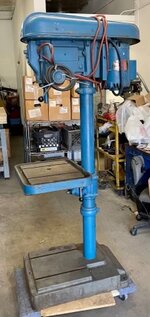
I actually purchased an ugly blue paint slathered on 1982 Rockwell 17" drill press from the guy that was also selling the South Bend.
I'm right in the middle of a resto on the drill press, just pulled the quill apart this afternoon, needs bearings etc.
I've been a cameraman in the motion picture industry for over 35 years, and have always been in awe of the precision machinists involved with making everything from complicated camera movements to entire lenses to one of special projects required for shooting everything from MIB 3 to Fast and Furious 9. The pictured lathe was something I had not seen before, a lathe on top of a purpose built desk/work table. I'm not in the market for a lathe right now, but posted the pictures in case the said lathe was of interest to anyone else.
It's located in Los Angeles, and I would be willing to a assist if anyone is interested.
 
OP
L

Luntz

Well-known member
Joined
Jul 13, 2020
Messages
212
Location
Franklin TN
It's a shame what they done to it. Gonna make her shine again.
 

Attachments

  • Rockwell.jpeg
    Rockwell.jpeg
    50.3 KB · Views: 112

cvairwerks

Well-known member
Joined
Aug 12, 2016
Messages
7,182
Location
Within hearing distance of Texas Motor Speedway
Luntz: If you want your mind blown, talk to your lens guy and see if you can hang out and watch tearing down something like a 10 or 20:1 zoom lens.... When I worked for a network, we had a dedicated lens guy in our shop. He was out at White Sands for a shuttle landing and one of the camera towers got dumped. He tore that lens down and redid it on a king size bed in a hotel room and had it back on ghe camera in time for the landing.
 

Cleave

Well-known member
Joined
Jul 11, 2018
Messages
353
Location
Back Porch
What’s the best machine to try to start machining and learn on?

Jim C.

While I think the OP question has already been answered, I can speak to this discussion about what makes a good beginner lathe.

In engineering school we had a 1 hour machine shop course - not much but some basic exposure. Then in my internship I did some work in the machine shop making a manufacturing machine, and used a manual mill and lathe.

A few years ago, I got a circa 1900 WF Barnes #6 lathe locally for $300. It needed a bit of work (new chuck and 3d printed change gear), and still isn't very accurate. But I've managed to thread a little, turn a few self holding MT2 devices for the tailstock, a few small items requiring press fit bearings, and some other miscellaneous including wood turning. It isn't very accurate or fast. It requires files and repetitive measuring to creep up on an accurate dimension, and the accuracy can't be maintained easily over a longer length. It industrial/production use is quite limited. But for the occasional hobbyist project it is fun and educational. There is some educational value in making a less accurate machine do more accurate work I suppose. If I ever had a bigger shop with a concrete floor, and frequent, precision work, I'd replace it immediately and put it in the back corner. The flat belt and 1/2 hp motor are safety features as the belt slips before anything too bad will happen.

I can't emphasis this enough - the best lathe to learn on is the one you have available to you.
 

AR1911

Active member
Joined
Jun 30, 2011
Messages
26
That lathe is likely a 10L, as others have said. A 10L is a highly-favored model among gunsmiths.
That said, this one looks rather neglected at best.
So it depends on the price and your willingness to get your hands dirty.
If this were a few hundred dollars, I'd be taking it home. I would clean it up and evaluate what you have. Is it complete? Are the ways fairly unworn (experienced evaluation recommended). If the ways are in good shape, it's likely a keeper no matter what else is wrong.
Even if it's a total wreck, there is easily $1000 in parts in what I see plus what those drawers probably hold.
I have done this with a number of old South Bend lathes. I have never lost money on any of them.
 
To avoid these ads, REGISTER NOW!
Top Bottom