To avoid these ads, REGISTER NOW!

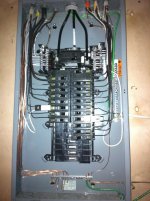
pictures of your electrical panels here

mebedave

Well-known member
Joined
Jan 17, 2010
Messages
260
Location
Atlantic county area, New Jersey USA
I’m hoping you guys will use this thread to post pictures of your main panel/load center or whatever you would like to call it. This could be very educational for us d.i.y’ers that need just a little help, and we all know how pictures help! So show off your work and picture post away !!!!


:needpics:
 
Last edited:
To avoid these ads, REGISTER NOW!

Aceman

Well-known member
Joined
Jan 28, 2007
Messages
2,513
Location
Eastern Oregon
I'll try and snap a couple pics for you at work. There's a guy I work with who does the cleanest panels I've seen, we've got an office rough-in going on right now with a couple panels still with the covers off I might be able to get some pics of.
 

Ludacriss

Well-known member
Joined
Nov 13, 2010
Messages
190
Location
Ontario
Sorry for the post
read the rest of yours and this is not what you are asking for
 
Last edited:

mtne

Well-known member
Joined
Dec 3, 2007
Messages
113
Location
Denver
If the neutral isn't bonded to ground where your pulling it from, then you'll want to treat this as the first point of service and use the provided green screw to bond the neutral buss to the panel. If it is already bonded, keep the neutrals and ground separate everywhere beyond that point. And while it's electrically the same point I too prefer to use two ground buss's and keep things clean. You'll be able to find lug adapters that allow for larger wire to the ground buss which uses two of the slots. You'll need at least one ground rod, and since you don't have the testing equipment, I'd just go ahead as set two rods at least 6' apart. If there's water going to the building you'll need to bond that (#4 bare for 200A) to within 5' of where the water enters the building and preferably before the first joint. It's not NEC but the way I understand things, your gas line should be bonded as well. It's not a grounding electrode for NEC purposes but I think building code covers that. Hopefully someone else can clarify where that requirement comes from.


Here's a little subpanel I did.......
smugshot3896532-L.jpg
 

MrMark

Well-known member
Joined
Jan 25, 2010
Messages
4,626
Location
Southern Cal.
That bonding the water pipe within 5 feet is only if the water line is being used as the grounding electrode. You only need to bond it somewhere if the house has a modern service with ground rods or ufer grounds.
 

mtne

Well-known member
Joined
Dec 3, 2007
Messages
113
Location
Denver
250.30.A.4 - to paraphrase ..... GEC shall be the nearest of 1. metal water pipe.
2. structural metal.

Most existing not so modern buildings don't have a ufer (structural) ground. In either case I've never not been required by the AHJ to bond to water, if it's in the building. Again, not in new construction with ufer grounds.

250.53.A.2 - requires the supplemental electrode. Which because it's cheap and easy means a ground rod.......

No?

No water to the building and no structural steel. Then two ground rods should be fine...................
 
Last edited:
OP
M

mebedave

Well-known member
Joined
Jan 17, 2010
Messages
260
Location
Atlantic county area, New Jersey USA
If the neutral isn't bonded to ground where your pulling it from, then you'll want to treat this as the first point of service and use the provided green screw to bond the neutral buss to the panel. If it is already bonded, keep the neutrals and ground separate everywhere beyond that point. And while it's electrically the same point I too prefer to use two ground buss's and keep things clean. You'll be able to find lug adapters that allow for larger wire to the ground buss which uses two of the slots. You'll need at least one ground rod, and since you don't have the testing equipment, I'd just go ahead as set two rods at least 6' apart. If there's water going to the building you'll need to bond that (#4 bare for 200A) to within 5' of where the water enters the building and preferably before the first joint. It's not NEC but the way I understand things, your gas line should be bonded as well. It's not a grounding electrode for NEC purposes but I think building code covers that. Hopefully someone else can clarify where that requirement comes from.


Here's a little subpanel I did.......
smugshot3896532-L.jpg


Very clean work Mtne !! I think I know what your talking about but I'm still a little unsure of my self with the bonding in my new panel. Quote Mtne"If the neutral isn't bonded to ground where your pulling it from, then you'll want to treat this as the first point of service" My neutral is not bonded to ground where I'm pulling it from, OK I'm clear now , I must bond neutral to ground at my new panel, still not totally sure how. Can I still keep ground buss bars separate ?
Hopefully someone will post a picture of one that's close to the way I need to do my panel.
 

oleguy

Well-known member
Joined
Nov 22, 2009
Messages
273
If the neutral isn't bonded to ground where your pulling it from, then you'll want to treat this as the first point of service and use the provided green screw to bond the neutral buss to the panel. If it is already bonded, keep the neutrals and ground separate everywhere beyond that point. And while it's electrically the same point I too prefer to use two ground buss's and keep things clean. You'll be able to find lug adapters that allow for larger wire to the ground buss which uses two of the slots. You'll need at least one ground rod, and since you don't have the testing equipment, I'd just go ahead as set two rods at least 6' apart. If there's water going to the building you'll need to bond that (#4 bare for 200A) to within 5' of where the water enters the building and preferably before the first joint. It's not NEC but the way I understand things, your gas line should be bonded as well. It's not a grounding electrode for NEC purposes but I think building code covers that. Hopefully someone else can clarify where that requirement comes from.


Here's a little subpanel I did.......
smugshot3896532-L.jpg

nec 250.104(b) covers gas piping.
 

MrMark

Well-known member
Joined
Jan 25, 2010
Messages
4,626
Location
Southern Cal.
250.30.A.4 - to paraphrase ..... GEC shall be the nearest of 1. metal water pipe.
2. structural metal.

Most existing not so modern buildings don't have a ufer (structural) ground. In either case I've never not been required by the AHJ to bond to water, if it's in the building. Again, not in new construction with ufer grounds.

250.53.A.2 - requires the supplemental electrode. Which because it's cheap and easy means a ground rod.......

No?

No water to the building and no structural steel. Then two ground rods should be fine...................

I am a little confused by this and I wasn't very clear in my post.

What I was trying to say is that the bonding within 5 feet of the water entrance is only if the water line is being used as the grounding electrode, an old days practice before UFERs and ground rods. If you have a UFER or ground rod installed and bonded you can bond to the water line anywhere you can get it easily. It must be bonded if metal but not within the constraints of it being THE grounding electrode.

Disagree?
 

mtne

Well-known member
Joined
Dec 3, 2007
Messages
113
Location
Denver
Thanks, oleguy!

Dave, your new panel should have come with green screw specifically with directions on where to put it on the neutral buss to bond them together. That is the only point at which the ground (box, ground buss, grounds) should contact the neutral buss. Electrically it doesn't matter if you landed all the grounds and neutrals on the neutral buss, but common practice, aesthetics, and clean working practice is usually to keep them separate except at that bonding point. Though sometimes an inspector might even request it that way, so it looks clean and they can see what's going on.
 

mtne

Well-known member
Joined
Dec 3, 2007
Messages
113
Location
Denver
I am a little confused by this and I wasn't very clear in my post.

What I was trying to say is that the bonding within 5 feet of the water entrance is only if the water line is being used as the grounding electrode, an old days practice before UFERs and ground rods. If you have a UFER or ground rod installed and bonded you can bond to the water line anywhere you can get it easily. It must be bonded if metal but not within the constraints of it being THE grounding electrode.


Disagree?

250.68.C.1 - If the water pipe is bonded it is to be not more than 5' from the point of entrance to the building.

The act of bonding to any water pipe makes it a grounding electrode............. and .68.C.1 dictates where that must take place. So it's either bond to water where it comes into the building, or don't bond to water.............

No? Disagree?
 
Last edited:

PittsS1

Well-known member
Joined
Sep 12, 2011
Messages
108
Location
Minnesota
Here is the old fuse box and subpanel, since replaced by the Square D QO 100A panel.

This panel is subbed off the 200A garage panel, hence the three #4 conductors and separate #8 ground running back into the conduit. Grounds and neutrals are kept separate and bonding screw removed.

The crusty old, since retired, electrical inspector gave me a bunch of grief over it being organized. I think he was actually irritated by it, and mumbled a bunch about how when he was in the trade he'd be losing money on every job if he tried to make it all "pretty" like that. He then proceeded to spend about 20 minutes explaining electricity to me (though I didn't learn a thing), and kept making jokes about how I was the only person in the world to find that electricity flows better around right angles... that was definitely a "bite your tongue" moment. I didn't say a word, got it signed off, and carried on. Oh well...

The new panel has a few straggler wires that are either temp circuits, or waiting to be run in Romex (I rewired about 95% of the house, but still have a couple old cloth covered wires which will get re-done as time permits)...

Will get some pics of the garage panel once it is populated.
 

Attachments

  • IMG_7506.jpg
    IMG_7506.jpg
    147.9 KB · Views: 688
  • panel_oct2011-3.jpg
    panel_oct2011-3.jpg
    141.6 KB · Views: 792

MrMark

Well-known member
Joined
Jan 25, 2010
Messages
4,626
Location
Southern Cal.
250.68.C.1 - If the water pipe is bonded it is to be not more than 5' from the point of entrance to the building.

The act of bonding to any water pipe makes it a grounding electrode............. and .68.C.1 dictates where that must take place. So it's either bond to water where it comes into the building, or don't bond to water.............

No? Disagree?


Yes, I disagree very much. I've actually been through this and it is apparently a source of some confusion, even among some old timer inspectors. I've read the NEC section on this and it was pretty clear the bonding you are talking about only applies when the water pipe is being used as THE ground, something that really shouldn't be happening anymore. When the water pipe isn't THE ground, you can bond it anywhere just to protect against accidental energization, as you would any piece of metal that could come in contact with electricity. This has nothing to do with using the water pipe for a ground as a grounding electrode to handle lightning and reference the neutral. Just safety for accidental contact with a hot wire.
 

MrMark

Well-known member
Joined
Jan 25, 2010
Messages
4,626
Location
Southern Cal.
Here is the old fuse box and subpanel, since replaced by the Square D QO 100A panel.

This panel is subbed off the 200A garage panel, hence the three #4 conductors and separate #8 ground running back into the conduit. Grounds and neutrals are kept separate and bonding screw removed.

The crusty old, since retired, electrical inspector gave me a bunch of grief over it being organized. I think he was actually irritated by it, and mumbled a bunch about how when he was in the trade he'd be losing money on every job if he tried to make it all "pretty" like that. He then proceeded to spend about 20 minutes explaining electricity to me (though I didn't learn a thing), and kept making jokes about how I was the only person in the world to find that electricity flows better around right angles... that was definitely a "bite your tongue" moment. I didn't say a word, got it signed off, and carried on. Oh well...

The new panel has a few straggler wires that are either temp circuits, or waiting to be run in Romex (I rewired about 95% of the house, but still have a couple old cloth covered wires which will get re-done as time permits)...

Will get some pics of the garage panel once it is populated.

Number 4 is not rated for 100 amps so the inspector should have made you swap out the breaker, assuming you went with the 100 amp breaker. Number 3 is bare minimum for 100 amps. Seems to have been created (not the odd size) just for the 100 amp sizing.
 
Last edited:
OP
M

mebedave

Well-known member
Joined
Jan 17, 2010
Messages
260
Location
Atlantic county area, New Jersey USA
Thanks, oleguy!

Dave, your new panel should have come with green screw specifically with directions on where to put it on the neutral buss to bond them together. That is the only point at which the ground (box, ground buss, grounds) should contact the neutral buss. Electrically it doesn't matter if you landed all the grounds and neutrals on the neutral buss, but common practice, aesthetics, and clean working practice is usually to keep them separate except at that bonding point. Though sometimes an inspector might even request it that way, so it looks clean and they can see what's going on.

Thanks Mtne, I get it now!:thumbup: Read up on the bonding screw that came with my panel (broke down and read instructions LOL) So just to see if I'm catching the principle. Now days with the 4 wire new code, that makes the bonding screw obsolete, would that be correct? So in other words if you have a 4 wire feed there's no need to bond neutral to the box ?

Edit:I'm assuming a 4 wire feed the ground wire is going to a ground buss bar on the box. The statement I made above about the obsolete bonding screw would depend on how the mfg'r made the box. I may have spoke before I thought :)
 
Last edited:
To avoid these ads, REGISTER NOW!

Charles (in GA)

Well-known member
Joined
Jan 11, 2006
Messages
12,489
Location
50 mi south of Atlanta
Now days with the 4 wire new code, that makes the bonding screw obsolete, would that be correct? So in other words if you have a 4 wire feed there's no need to bond neutral to the box ?

It all depends on whether the panel is the very first disconnect after the meter or not. Its three wire from the meter to the disconnect, and four wire after that. So in some cases, that green screw is a necessity, others its not needed.

Charles
 

mtne

Well-known member
Joined
Dec 3, 2007
Messages
113
Location
Denver
Dave, you need to find out if your box with the double lugs also has the neutral and ground bonded. If so you keep it separate after that. I suspect that since you describe it as just a hot lug (pictures would be nice) and that there is not a disconnect with those lugs that the "first point of service" which would need to be bonded would be the new panel. Still seems odd to me that you would have a service, with feeding lugs without some sort of disconnect. Unless it's old I guess. I certainly don't presume to have seen all the options out there.

Yes, I disagree very much. I've actually been through this and it is apparently a source of some confusion, even among some old timer inspectors. I've read the NEC section on this and it was pretty clear the bonding you are talking about only applies when the water pipe is being used as THE ground, something that really shouldn't be happening anymore. When the water pipe isn't THE ground, you can bond it anywhere just to protect against accidental energization, as you would any piece of metal that could come in contact with electricity. This has nothing to do with using the water pipe for a ground as a grounding electrode to handle lightning and reference the neutral. Just safety for accidental contact with a hot wire.


Cool, I'm not sure I agree though (not to hijack daves thread, we don't even know if he's got water or ufer in the building he's asking about). And there's the exception for commercial/industrial situations. But could you point me to where in the code allows for this grounding where ever to the cold water system for safety in a residential application?

Just to make sure we're just not having silly internet communication breakdown and to clarify for those watching and trying to learn.

1. A New service needs to be bonded to earth. That earth ground should be either a cold water pipe, or structural steel (ufer). Should neither of those be available, other options become available: usually a ground rod.

Why shouldn't cold water be used as a ground anymore? Or do you mean for new construction only where there is a ufer?

2. Which ever grounding electrode is used a supplemental grounding electrode is required. Almost always a ground rod. If two ground rods are used anywhere they should be at least 6' apart.

Mark and my discussion revolves around if the cold water isn't used as THE grounding electrode, can it be bonded for safety reasons against accidental voltage at any point on the system. My reading of the code doesn't allow for that. Nor have I been in a situation where that was allowed by an AHJ. However, as much as the CODE is the CODE, interpretations vary, as do the enforcement by various AHJ's, with regional or jurisdictional differences in AHJ enforcement, as some areas require more or different as the code is the minimum. I certainly don't know everything about electrical or the code and can always learn more about how it's interpreted and applied.
 

MrMark

Well-known member
Joined
Jan 25, 2010
Messages
4,626
Location
Southern Cal.
Dave, you need to find out if your box with the double lugs also has the neutral and ground bonded. If so you keep it separate after that. I suspect that since you describe it as just a hot lug (pictures would be nice) and that there is not a disconnect with those lugs that the "first point of service" which would need to be bonded would be the new panel. Still seems odd to me that you would have a service, with feeding lugs without some sort of disconnect. Unless it's old I guess. I certainly don't presume to have seen all the options out there.


Cool, I'm not sure I agree though (not to hijack daves thread, we don't even know if he's got water or ufer in the building he's asking about). And there's the exception for commercial/industrial situations. But could you point me to where in the code allows for this grounding where ever to the cold water system for safety in a residential application?

Just to make sure we're just not having silly internet communication breakdown and to clarify for those watching and trying to learn.

1. A New service needs to be bonded to earth. That earth ground should be either a cold water pipe, or structural steel (ufer). Should neither of those be available, other options become available: usually a ground rod.

Why shouldn't cold water be used as a ground anymore? Or do you mean for new construction only where there is a ufer?

2. Which ever grounding electrode is used a supplemental grounding electrode is required. Almost always a ground rod. If two ground rods are used anywhere they should be at least 6' apart.

Mark and my discussion revolves around if the cold water isn't used as THE grounding electrode, can it be bonded for safety reasons against accidental voltage at any point on the system. My reading of the code doesn't allow for that. Nor have I been in a situation where that was allowed by an AHJ. However, as much as the CODE is the CODE, interpretations vary, as do the enforcement by various AHJ's, with regional or jurisdictional differences in AHJ enforcement, as some areas require more or different as the code is the minimum. I certainly don't know everything about electrical or the code and can always learn more about how it's interpreted and applied.

You should read 250.53 of the 2008 NEC and 250.104 together.

Those two sections pretty much answer the question.

The 5 feet is a relic of the past apparently. I'm really not sure where it came from. I asked a local inspector about it when I upgraded my service and he laughed and said there was an old timer in Huntington Beach that still makes people bond to the water line within 5 feet even though it's not required. There are even licensed electricians around that believe this too, mostly because they "heard" that inspectors like to see this.

If you read 250.53 you will see that the cold water is allowed to be used as a grounding electrode if it is bonded within 5 feet etc. A supplemental ground rod is required if this method is used because that cold water pipe may be replaced with plastic in the future. The cold water is one of several types of grounding electrodes allowed. A UFER, ground rings and RODS are some others. Why anyone would use the cold water as the ground when supplemental rods are required is beyond me.

Again, we are not using the cold water as the grounding electrode, we are using UFER's or Rods.

This brings us to section 250.104 which makes it clear in the comments that "Bonding the metal water piping system of a building or structure is not the same as using the metal water piping system as a grounding electrode."


These sections are not well written and I can see where some of the confusion apparently comes from. Although, I have seen houses built in tracts going back to the late 70's with UFER grounds where they bonded to the cold water over at the water heater rather than trying to pick it up at the entrance to the house so it has been know for a long time that when you are not using the cold water as the electrode that the electrode attachment rules don't apply.
 
Last edited:

mtne

Well-known member
Joined
Dec 3, 2007
Messages
113
Location
Denver
Sigh, hijack on.... Sorry Dave.

You should read 250.53 of the 2008 NEC and 250.104 together.

While not much has changed in .104, there have been changes to .53. I'm using the current 2011 NEC......... I suppose some jurisdictions may still using the old code.

Those two sections pretty much answer the question.

But then again the conversation is being had.

The 5 feet is a relic of the past apparently. I'm really not sure where it came from. I asked a local inspector about it when I upgraded my service and he laughed and said there was an old timer in Huntington Beach that still makes people bond to the water line within 5 feet even though it's not required. There are even licensed electricians around that believe this too, mostly because they "heard" that inspectors like to see this.

Well, I'm still being asked to see the 5' from entrance bond with the cold water by inspectors..... so I wouldn't call it a relic from the past. I haven't heard inspectors like it, I've had to show actual inspectors the point of connection. As to why..... It comes from 2011 NEC 250.68.C.1
2011 NEC said:
250.68 Grounding Electrode Conductor and Bonding Jumper Connection to Grounding Electrodes. T
(C) Metallic Water Pipe and Structural Metal. Grounding
electrode conductors and bonding jumpers shall be permitted to be connected at the following locations and used to extend the connection to an electrode(s):
(1) Interior metal water piping located not more than 1.52 m (5 ft) from the point of entrance to the building shall be
permitted to be used as a conductor to interconnect electrodes that are part of the grounding electrode system.
Exception: In industrial, commercial, and institutional
buildings or structures, if conditions of maintenance and
supervision ensure that only qualified persons service the
installation, interior metal water piping located more than
1.52 m (5 ft) from the point of entrance to the building shall be permitted as a bonding conductor to interconnect electrodes that are part of the grounding electrode system, or as a grounding electrode conductor, if the entire length, other than short sections passing perpendicularly through walls, floors, or ceilings, of the interior metal water pipe that is being used for the conductor is exposed.

If you read 250.53 you will see that the cold water is allowed to be used as a grounding electrode if it is bonded within 5 feet etc. A supplemental ground rod is required if this method is used because that cold water pipe may be replaced with plastic in the future. The cold water is one of several types of grounding electrodes allowed. A UFER, ground rings and RODS are some others. Why anyone would use the cold water as the ground when supplemental rods are required is beyond me.

Actually, a supplemental electrode is required with any single rod, pipe, or plate electrode, as well as water pipe. Since most older dwellings don't have a ufer ground and since 250.50 requires either all electrodes in 250.52 be bonded into a system. Should both structural metal and cold water not be available then the there is the allowance for the use of any of the electrodes listed in 250.52. to be installed ie: ground rods.

Again, we are not using the cold water as the grounding electrode, we are using UFER's or Rods.

We've established that if a ufer isn't available the the cold water must be used. Not everything existing has a ufer........ And if both the ufer and cold water aren't available then a minimum of two ground rods can be permissible.


This brings us to section 250.104 which makes it clear in the comments that "Bonding the metal water piping system of a building or structure is not the same as using the metal water piping system as a grounding electrode."

2001 NEC said:
250.104 Bonding of Piping Systems and Exposed Structural Steel.
(A) Metal Water Piping. The metal water piping system
shall be bonded as required in (A)(1), (A)(2), or (A)(3) of this section. The bonding jumper(s) shall be installed in
accordance with 250.64(A), (B), and (E). The points of
attachment of the bonding jumper(s) shall be accessible.
(1) General. Metal water piping system(s) installed in or
attached to a building or structure shall be bonded to the
service equipment enclosure, the grounded conductor at the service, the grounding electrode conductor where of sufficient size, or to the one or more grounding electrodes used. The bonding jumper(s) shall be sized in accordance with Table 250.66 except as permitted in 250.104(A)(2) and (A)(3).
(2) Buildings of Multiple Occupancy. In buildings of
multiple occupancy where the metal water piping system(s) installed in or attached to a building or structure for the individual occupancies is metallically isolated from all other occupancies by use of nonmetallic water piping, the metal water piping system(s) for each occupancy shall be permitted to be bonded to the equipment grounding terminal of the panelboard or switchboard enclosure (other than service equipment) supplying that occupancy. The bonding jumper shall be sized in accordance with Table 250.122, based on the rating of the overcurrent protective device for the circuit supplying the occupancy.
(3) Multiple Buildings or Structures Supplied by a
Feeder(s) or Branch Circuit(s). The metal water piping
system(s) installed in or attached to a building or structure
shall be bonded to the building or structure disconnecting
means enclosure where located at the building or structure,
to the equipment grounding conductor run with the supply
conductors, or to the one or more grounding electrodes
used. The bonding jumper(s) shall be sized in accordance
with 250.66, based on the size of the feeder or branch
circuit conductors that supply the building. The bonding
jumper shall not be required to be larger than the largest
ungrounded feeder or branch circuit conductor supplying
the building.

As you can see the metal water pipe SHALL be bonded to the service equipment enclosure.

2011 NEC said:
(B) Other Metal Piping. If installed in, or attached to, a
building or structure, a metal piping system(s), including
gas piping, that is likely to become energized shall be
bonded to the service equipment enclosure; the grounded
conductor at the service; the grounding electrode conductor, if of sufficient size; or to one or more grounding electrodes used. The bonding conductor(s) or jumper(s) shall be sized in accordance with 250.122, using the rating of the circuit that is likely to energize the piping system(s). The equipment grounding conductor for the circuit that is likely to energize the piping shall be permitted to serve as the bonding means. The points of attachment of the bonding jumper(s) shall be accessible.

Since section A adresses metal water piping directly, section B other metal piping does not apply to metal water piping.


These sections are not well written and I can see where some of the confusion apparently comes from.

Seems reasonably clear to me.


Although, I have seen houses built in tracts going back to the late 70's with UFER grounds where they bonded to the cold water over at the water heater rather than trying to pick it up at the entrance to the house so it has been know for a long time that when you are not using the cold water as the electrode that the electrode attachment rules don't apply.

No need to waste time and money trying to pick up cold water at the entrance, just get it where convenient.

Perhaps they weren't applied, or perhaps the code was different at that time. Personally I've passed on or gotten rid of my old code books as the only one that really matters is the current code being enforced.

I think it's fairly clear. When bonding the service use your ufer ground if it's available. If it's not and cold water is available you shall use it, and yes within 5' of entrance, and yes with a supplemental electrode - ground rod. If neither of those is available you may use two ground rods.

No?
 
Last edited:

MrMark

Well-known member
Joined
Jan 25, 2010
Messages
4,626
Location
Southern Cal.
Where in the world do you get that if UFER isn't available cold water must be used.

Please give me a cite for that. ARound here we drive a ground rod. Two would normally be required but only one is needed here because of the sandy soil I suppose.

California actually just switched from 2005 to 2008 code. So it's hardly old code.


Just give me that cite that supports your statement: "When bonding the service use your ufer ground if it's available. If it's not and cold water is available you shall use it, and yes within 5' of entrance . . . ." Show me where the cold water electrode system is preferred and required over using two rods.

No one said water pipe didn't have to be bonded if present. You are confusing bonding with functioning as a grounding electrode.

I don't know your jurisdiction but the tract houses I have seen with the bond at the water heater were all done by licensed electricians for big builders and inspected in Orange County, CA, hardly some hick town.
 
Last edited:

mtne

Well-known member
Joined
Dec 3, 2007
Messages
113
Location
Denver
I have, several times. Take the time to actually read it. I apologize that it's not in agreement with what you know to be true.

**edit** thanks mrmark, I appreciate your making me realize I was in the wrong section. :thumbup:

Here,

2011 NEC said:
III. Grounding Electrode System and Grounding Electrode Conductor
250.50 Grounding Electrode System. All grounding electrodes as described in 250.52(A)(1) through (A)(7) that are present at each building or structure served shall be bonded together to form the grounding electrode system. Where none of these grounding electrodes exist, one or more of the grounding electrodes specified in 250.52(A)(4) through (A)(8) shall be installed and used.
(1) Metal Underground Water Pipe.
(2) Metal Frame of the Building or Structure
(3) Concrete-Encased Electrode
(4) Ground Ring
(5) Rod and Pipe Electrodes
(6) Other Listed Electrodes
(7) Plate Electrode
(8) Other Local Metal Underground Systems or Structures.

This part means that any available grounding electrodes will be bonded into the grounding system. Fairly clear to me, except of course that I got it wrong going to 250.30 for separately derived systems first time around.

2011 NEC said:
Jumper Connection to Grounding Electrodes. The connection of a grounding electrode conductor at the service, at
each building or structure where supplied by a feeder(s) or
branch circuit(s), or at a separately derived system and associated
bonding jumper(s) shall be made as specified
250.68(A) through (C).

(C) Metallic Water Pipe and Structural Metal. Grounding
electrode conductors and bonding jumpers shall be permitted
to be connected at the following locations and used
to extend the connection to an electrode(s):
(1) Interior metal water piping located not more than 1.52 m
(5 ft) from the point of entrance to the building shall be
permitted to be used as a conductor to interconnect electrodes
that are part of the grounding electrode system.

This part indicates how and where you are do make the connection. Also fairly clear to me.

You don't bond the water except as a grounding electrode. That's covered in the previous post too.

I can't say I care where or when whatever you have seen was done. And I don't care what's acceptable "around here". I've already mentioned how different AHJ's and jurisdictions have various requirements that are different or above and beyond code. I'm simply referencing what is now code, nationally. Interestingly people often choose to see what they want to see in many things. I think that's the case with you, and your welcome to feel the same about me. On a public forum I'm choosing to correct what I see as an error of interpretation in case the folx here decide to take action based on things on the internets. I've done my best to document and reference code directly and I'm sure the folx here are smart enough to read and decide for themselves what is best for their application and needs. Better yet find out what the AHJ in the area in question wants and expects.
 
Last edited:

mtne

Well-known member
Joined
Dec 3, 2007
Messages
113
Location
Denver
And to try and get things back on track here's a basement subpanel

smugshot4271589-L.jpg


And an old garage sub panel....

smugshot2562281-L.jpg
 

MrMark

Well-known member
Joined
Jan 25, 2010
Messages
4,626
Location
Southern Cal.
Is Section 250.30 that you are quoting for "separately derived systems"?

Can you post the whole section 250.30 of the 2011 NEC that you are relying on and also the definition of Separately Derived Systems.

According to the 2008 NEC a Separately Derived System is not what we a talking about here. Separately Derived means a source of electricity other than a Utility Service, such as generator, battery, solar cells etc.

Tell me you are not relying on a Separately Derive Code Section for this discussion please.
 
Last edited:

mtne

Well-known member
Joined
Dec 3, 2007
Messages
113
Location
Denver
Is Section 250.30 that you are quoting for "separately derived systems"?

Tell me you are not relying on a Separately Derive Code Section for this discussion please.

Nope, MY MISTAKE entirely. Let me be clear, near as I can tell I was wrong. 250.30 is not the right place and incorrect for the discussion. See..... I'm willing to learn. :) So no one gets directed wrong I'll edit the bad parts. Mea Culpa.

I needed to be in 250.32 which sends you to part III, which is 250.50

2011 NEC said:
III. Grounding Electrode System and Grounding Electrode Conductor
250.50 Grounding Electrode System. All grounding electrodes as described in 250.52(A)(1) through (A)(7) that are present at each building or structure served shall be bonded together to form the grounding electrode system. Where none of these grounding electrodes exist, one or more of the grounding electrodes specified in 250.52(A)(4) through (A)(8) shall be installed and used.
(1) Metal Underground Water Pipe.
(2) Metal Frame of the Building or Structure
(3) Concrete-Encased Electrode
(4) Ground Ring
(5) Rod and Pipe Electrodes
(6) Other Listed Electrodes
(7) Plate Electrode
(8) Other Local Metal Underground Systems or Structures.

Yes, I got there from the wrong location.

2011NEC said:
All grounding electrodes as described in 250.52(A)(1) through (A)(7) that are present at each building or structure served shall be bonded together to form the grounding electrode system.

So if there is water in the building it along with all the other available electrodes are to be bonded together for the GES.

And then back to the where a water pipe needs to be bonded.

2011NEC said:
Jumper Connection to Grounding Electrodes. The connection of a grounding electrode conductor at the service, at
each building or structure where supplied by a feeder(s) or
branch circuit(s), or at a separately derived system and associated
bonding jumper(s) shall be made as specified
250.68(A) through (C).

(C) Metallic Water Pipe and Structural Metal. Grounding
electrode conductors and bonding jumpers shall be permitted
to be connected at the following locations and used
to extend the connection to an electrode(s):
(1) Interior metal water piping located not more than 1.52 m
(5 ft) from the point of entrance to the building shall be
permitted to be used as a conductor to interconnect electrodes
that are part of the grounding electrode system.

Again, my bad. Right answer wrong section....... :spit:
 

Norcal

Well-known member
Joined
Mar 16, 2008
Messages
13,767
Here is a good example of a DIY panel.:D

dnpic.jpg


BTW, as this is written, it is still in service.:(
 

MrMark

Well-known member
Joined
Jan 25, 2010
Messages
4,626
Location
Southern Cal.
Nope, MY MISTAKE entirely. Let me be clear, near as I can tell I was wrong. 250.30 is not the right place and incorrect for the discussion. See..... I'm willing to learn. :) So no one gets directed wrong I'll edit the bad parts. Mea Culpa.

I needed to be in 250.32 which sends you to part III, which is 250.50


Yes, I got there from the wrong location.


So if there is water in the building it along with all the other available electrodes are to be bonded together for the GES.

And then back to the where a water pipe needs to be bonded.


Again, my bad. Right answer wrong section....... :spit:

Looks like with that new quoted section you are right. I wonder if the requirement of the grounded electrode system was new for 2008 or whether the 5 foot rule was new for 2008. I did my system that way anyway (within 5 feet) even though the inspector stated it wasn't required (this was in 2010 when CA was on 2005 code). Those tract houses were all done in the 1979 time frame with UFER grounds and bonds at the water heater.
 
OP
M

mebedave

Well-known member
Joined
Jan 17, 2010
Messages
260
Location
Atlantic county area, New Jersey USA
And to try and get things back on track here's a basement subpanel

smugshot4271589-L.jpg


And an old garage sub panel....

smugshot2562281-L.jpg

more nice work by Mtne!! It's nice to see there's people out there that still take great pride in their Occupation :thumbup:

I like how you left the insulation on the romex at the top of the box while going in behind the feeders, is this code or just something you do for added protection?
 
Last edited:

mtne

Well-known member
Joined
Dec 3, 2007
Messages
113
Location
Denver
I like how you left the insulation on the romex at the top of the box while going in behind the feeders, is this code or just something you do for added protection?

Code requires only 1/4" of sheath be in any box. I don't have a preference really it just helped get it across cleaner. I don't actually do much romex unless it's for myself or friends.
 

mtne

Well-known member
Joined
Dec 3, 2007
Messages
113
Location
Denver
Looks like with that new quoted section you are right. I wonder if the requirement of the grounded electrode system was new for 2008 or whether the 5 foot rule was new for 2008. I did my system that way anyway (within 5 feet) even though the inspector stated it wasn't required (this was in 2010 when CA was on 2005 code). Those tract houses were all done in the 1979 time frame with UFER grounds and bonds at the water heater.

I don't know about the time frame, I suspect the 5' was at least back to 96nec when I started. I've very minimal experience with residential though and most of that is redoing services or sub panels for homes of friends that are mostly from the 60's and older.

Is CA so bogged down that they're two code cycles behind? I would have thought the new AFCI **** was more CA pushing national legislation type stuff. Just wait if you don't have to deal with that **** now...... it only gets more expensive.

As for inspectors, some are great and some are clueless. If they demand something stupid, call their boss or change it and then fix it after they've signed off. Fortunately most of the once I've run into are pretty okay.
 

Aceman

Well-known member
Joined
Jan 28, 2007
Messages
2,513
Location
Eastern Oregon
One contactor is for the photocell and outside lights.

Another is for the server E-stop circuit with a second spare contactor installed for another piece of future equipment. That's why the empty conduit.
 
To avoid these ads, REGISTER NOW!
Top Bottom