Here's how far behind I am, this post should have been on here about a 1 1/2 years ago but somehow it got pushed to the side. It leads me to a project I'm engaged in presently and that's when I realized I'd overlooked it. But I'll put it out here now since I think most of you will find it of interest. This will be in two parts because of it's length. I might also note this post has now been edited due to some picture/caption errors in the earlier version that
Spareparts and
babaluba kindly brought to my attention. It is my hope now that it has been corrected.
 Amish Factory - The World Revolves Around Hydraulics - Part 1
The only items for the
Barn
Bench that weren't fabricated "in house" during it's construction were the two solid maple butcher block tops. That was due to the size and weight of them. The longest top as you might recall, took 4 men to just to move it and even then it was a struggle and done with great care least someone get hurt. It weighed hundreds of pounds. The "smaller" top could be handled by 2, but that wasn't all that easy either. Realistically trying to wrestle with either one during construction of them wasn't practical. Since I live close to the largest and oldest Amish settlement in Illinois, Arthur, I contacted an Amish owned and run business near Arthur that specializes in making only butcher block tops. Their work is highly regarded with great attention to detail. My kind of place.
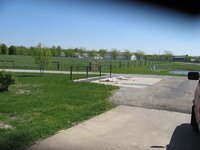
While I won't go onto a long discussion on the Amish faith let's just say some of the practices that stand out are the fact they don't use
any electricity- none- in their homes (to a limited degree they can use it in their businesses, but very limited) and they use horse and buggies as the principle means of transportation. When parked at the factory where my tops were made, you can see in the picture above, hitching posts and horse droppings from Amish customers who had parked there. Heart of Amish Country.
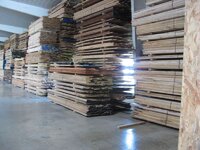
Once inside, the plant is clean, has ample lighting and is eerily quite. These are stacks of lumber waiting to be made into butcher block tops.
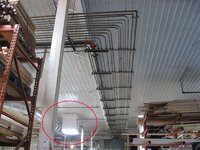
A glance at the ceiling shows where the majority of the interior lighting comes from. Circled is a light tube. I'll come back to all those lines that look like electrical conduit.

Light tubes were used everywhere in the plant. Natural sunlight is transmitted down from the roof through these tubes into the interior requiring no electricity to light up the plant. The few fluorescent fixtures seen are the minimal requirement of OSHA.
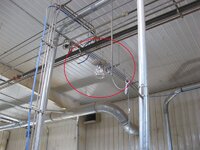
What the Amish use for interior lighting when they need it are these gas lamps, circled.
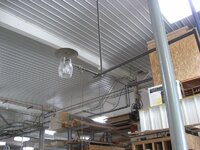
In essence these are the same as a gas lantern one would take to go camping in the wild. I forgot to ask what gas powers them. I know some smaller, one man shops that have used acetylene gas in the past, but for a plant this size I don't know.
When you take a closer look at some of what seems to be conventional, woodworking equipment; a Powermatic table saw in this case...

...upon closer inspection you can see where hydraulic lines run into the cabinet base to power a hydraulic motor that has replaced the electric motor.
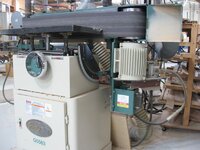
Here a conventional Grizzly belt sander has had the electric motor replaced.

In some instances they do used limited electrical power...
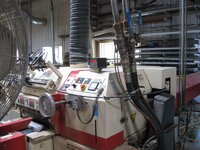
...note the digital display, even though the working end of the machine is hydraulically powered.

That machine cuts the lumber...
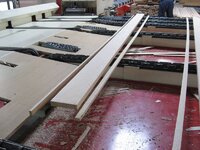
...to the correct width and then off loads it here where the scrap is seperated.
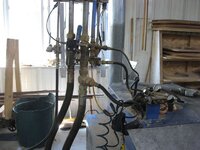
Here you can see 2 large hydraulic lines to...

...feed power to the motor of this grinder. This machine takes all the left over scrap wood and grinds it into almost mulch. That makes handling of the scrap material much easier.
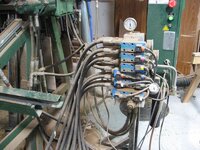
With all the different hoses, lines and fittings I really don't recall any that were leaking or weeping for that matter. Though there must have been some, all in all it was a very tidy, well run operation.

The hydraulics were combined with pneumatics in some instances as seen here.
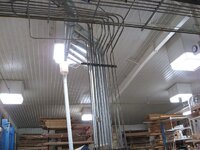
So what a first glance seems to be electrical conduit...

...in most cases are really hydraulic or pneumatic lines.
I hope this is of interest to see how different points of view are adapted to the world around us. It does touch on my next shop project somewhat which you'll see in time.
Again my apologies for any confusion my earlier post might have created. I try my best to put correct information out here and when I don't..........show me no mercy!
Next up,
Amish Factory - Part II.
Thomas


 Tell Norm I completely understand, as long as those umbrella girls down there can rotate his tires and bleed his brakes...............on the car I mean.


 That's something you just don't see around here everyday.