Here are some quick mark-ups.
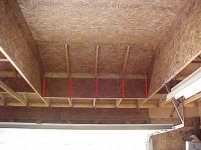
The first one shows where we added vericles behind the floor joist.
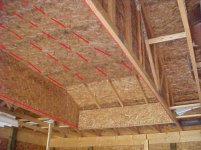
The second shows where we added chords to tie the top of the rafters together. They are hidden under the OSB.
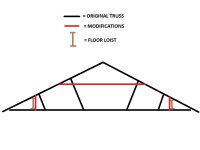
And the third is a quick sketch to show how everything relates.
Mark
I'm just trying to understand what you have done.
A couple of things.
The joists that were basically removed, were turned into rafters. The member added near the top acts similarly to a collar tie. It triangulates the top area of the rafters and resists spreading forces
The loads that these 3 trusses supported are now partially transferred into the new floor beam. There is still some lateral force into the outside wall and no bottom chord to resist it.
The loads transferred into the floor joist are also partly lateral.
The purpose of the floor joist is to transfer these loads into adjacent trusses.
The first truss on each side has been reinforced with OSB cladding. The cladding also adds a load. This reinforcing may allow some additional load to be accommodated. How much, exactly, is not determined.
All the additional OSB cladding adds stiffness and helps resist forces in multiple directions and helps transfer loads How much and where, is not determined.
Any additional load (Including the additional load of the floor truss itself), transferred by the floor truss, that is spread to adjacent trusses, has NOT been accommodated by reinforcing these trusses. So these trusses are supporting additional loads they weren't designed to support. This reduces the allowable roof loads for the area.
In a lot of the types of modifications, the modified structure doesn't fail or fall down, or even seem less strong. But unless the loads that were formerly supported, are provided with a complete path to earth, the structure is weakened in part. This includes any additional loads added by new structural members. Any existing structure that must take on additional loads, must be reinforced to support those loads.
The safety factors built in, and the fact that the most extreme wind, snow and other loads seldom combine to cause failure is what keeps these modifications OK.